The definitive book on customer lifetime value, Understanding the Predictable, is available in print and Kindle on Amazon. It explains how much each customer is worth to your business and how to use that to optimize marketing and user acquisition. More information
Lloyd Melnick
This is my personal blog. Views expressed here are mine alone and do not represent any organization I may be associated with.
I am Chief Growth and Strategy Officer at VGW. I previously led Chumba Casino as General Manager, and held senior roles at the Stars Group, Zynga and Disney. I have more than 30 years of experience in gaming.
I have been a consistent advocate of Blue Ocean strategy for years and a blog post by the Blue Ocean Team shows how you can grow your business by focusing on non-customers. Rather than fighting with your competitors to split up the existing pie, by thinking about non-customers you have greater growth potential. The blog post shows three types of non-customers and by understanding them you can tailor your product, new products or marketing to meet their needs. Below are the three groups of non-customers and my thoughts on their relevance to the social casino industry.
Non-customers who occasionally purchase or play
The first group of non-customers who represent a potential market are those who sit on the edge of the market, they purchase minimally your industry’s offerings but are always looking and quick to move to an alternative. The Blue Ocean Team uses the Pret A Manger chainas an example, as they appealed to people who reluctantly bought fast food but were looking for an alternative.
The social casino ecosystem includes many of these non-customers. These include gamers who are ready to skip to another genre (hypercasual, match-3, etc) if they see an appealing ad or the 90 plus percent of players who will play but not monetize. There are first-tier noncustomers waiting to be swayed in every industry.
Non-customers who refuse to become customers
The second group of non-customers is people who know an industry exists but have rejected it. As the Blue Ocean Team writes, “they have consciously thought about and considered your offering and then rejected it. It might be because another offering meets their needs better, or it could be that they simply can’t afford your offering. A second-tier noncustomer will compare your offering with another offering, weighing the pros and cons of each….The fact that second-tier noncustomers considered your industry means that you are far closer to possibly capturing them than you realize. So you need to find out why second-tier noncustomers refuse to use the products or services of your industry.”
In the social casino space, there are three types of these non-customers. The first is real money casino players (either land based or online) who have decided to not to play a free to play offering. They could have passed because they are only playing for economic reasons or the games offered are not what they prefer. The second is male casino players who may have rejected social casino because they consider them too “pink.” The third group is people who have tried social slot games but did not like the slot mechanic.
Non-customers who have not considered your industry
This category of non-customers has never considered your industry as an option. These non-customers have not been targeted ever by any company in your industry. This group is important to consider as it represents the largest potential market to penetrate (by definition it is everyone else). Existing companies in your industry assume these peoples needs are satisfied better by other industries.
In the social casino space, these are people who do not know or care that social slots games exist. It can be gamblers, gamers (other genres) or even people who have not played a mobile game.
What non-customers mean for social casino
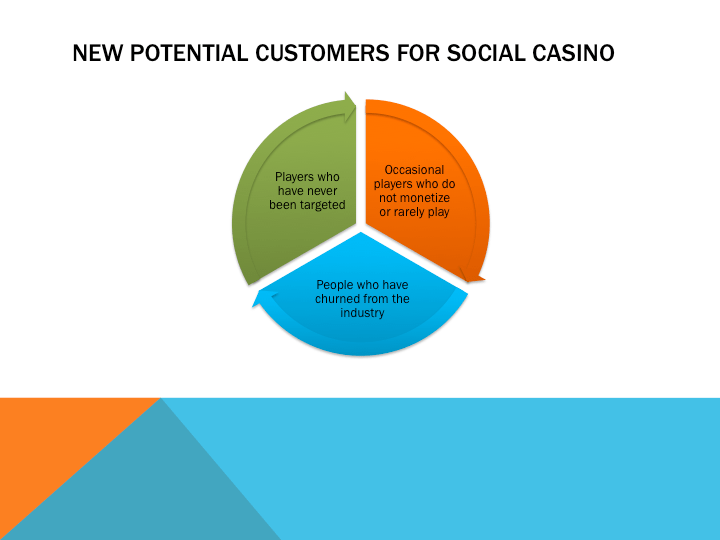
Non-customers are particularly important to social casino as the ecosystem has been growing consistently but through better monetization rather than an increase in customers. If the industry is going to continue growing or if you want to gain market share, appealing to non-customers is the best option. First, you can tailor a product appeal to people who play but do not monetize or play rarely. Second, you can build a product for people who have churned, tried social casino games but left. Finally, you can build a social casino product for people who the industry has never targeted.
While the successful companies will come up with concepts internally and not rely on this blog to provide the answers, the key will be creating social casino products that do not simply replicate the existing games. That means looking at mechanics other than slots. Is also means creating an environment that is not targeting 40+ women. To successfully turn non-customers into customers, the parameters of the products also must shift.
Key takeaways
While many companies look at their competitors and try to grow by building a better product for existing customers, the biggest opportunity exists in appealing to non-customers.
There are three types of non-customers: those who occasionally purchase or play, those who have rejected the current offerings and those who have not considered your industry.
If social casino is going to continue growing or if you want to gain market share, appealing to non-customers is the best option. First, you can tailor a product appeal to people who play but do not monetize or play rarely. Second, you can build a product for people who have churned, tried social casino games but left. Finally, you can build a social casino product for people who the industry has never targeted.
While apps and games have traditionally grown by having the acquisition team focus on the funnel, a recent blog post, Growth Loops are the New Funnels by growth guru Brian Balfour, shows a better strategy is to build growth loops. Rather than asking your marketing or user acquisition team to optimize user acquisition channels, growth loops has product and acquisition working holistically to build a product that will scale.
The traditional thinking
The strategy most game and app developers is create a great product, then optimize the acquisition funnel. After creating the product, they focus on optimizing the funnel below (testing different channels and strategies) to scale. This is a very KPI driven exercise, with each level of the funnel optimized through experiments and testing. The funnel consists of five categories, in this order:
Acquisition. Helping as many users as possible discover the game. This can be discovered by visitors in the app store, downloads, app install, etc.
Activation. Once acquiring a user, how many start playing the game (or using the app). This category can be measured by first spin (in a casino game), players who Facebook Connect, new accounts, completed tutorial, etc.
Retention. Retention is the next, and arguably most important, category in the funnel. In games, this is often measured by how many players come by the next day (D1), return in a week (D7) or are active a month after installing (D30). Other good retention metrics are CURR (current rate of returning users) or engagement metrics (how much time spent in app).
Referral. How many of your active players are helping bring new players. This category can be measured by actual referrals or K-score (number between 0-100 that indicates the strength of engagement between your product and your contacts, accounts, opportunities and leads).
Revenue. The final layer of the funnel is revenue, how well you monetize the players. This metric is measured by ARPDAU (average revenue per daily active user), conversion rate (how many players spend), frequency of purchases, total lifetime spend, etc.
Successful companies would optimize the above funnel, testing different channels, creative, etc., at each step of the funnel, then optimizing spend to improve these KPIs.
The new approach
Rather than focusing on the five categories in the growth funnel, Balfour suggests a holistic approach to growth. As Balfour points out, while the growth funnel has helped many companies scale, it is over eleven years old and the industry has since evolved. Funnels lead to silos, where the product team has its own domain, growth has its empire while monetization owns its business. This strategy can lead to failure as the product is not built to optimize the channels where it will be distributed (e.g. the AppStores).
The key is building a product or game where growth is part of the core product loop, not a separate task done by a growth or acquisition or marketing team. As Balfour writes, “The fastest growing products are better represented as a system of loops, not funnels. Loops are closed systems where the inputs through some process generates more of an output that can be reinvested in the input. There are growth loops that serve different value creation including new users, returning users, defensibility, or efficiency.”
The key to a successful growth loop is the customer or player reinvesting the value of the loop to drive the initial elements of the loop Pinterest does this by investing in creating content that shows up high in search engines, users then find the content and either return to Pinterest or sign up for it, Pinterest then serves related content with the user saves, thus creating more searchable content (the beginning of the loop). SurveyMonkey has a growth loop where a user signs up, creates a survey, sends the survey out, when the recipients finish the survey the are served an opportunity to sign up with SurveyMonkey, and those sign-ups restart the loop.
Just as with your financial investments, a critical element of the power of growth loops is that they compound growth. Rather than the linear approach of the growth funnel, a growth loop continuously adds to create more output and revenue. The more output that is reinvested by the user or player, the larger the output created from the next cycle. This compounding is critical as rather than creating a multitude of growth loops, you want to measure and focus on the ones that have the greatest impact.
As growth loops are holistic systems, they are also more defensible than growth funnel. In a funnel, any element of the funnel can be attacked. Growth loops, however, integrate product, channel and monetization model specific to your game and thus harder for other companies to copy.
Why loops are better
Balfour explains that growth loops change your entire business, largely for the better. The key benefits include:
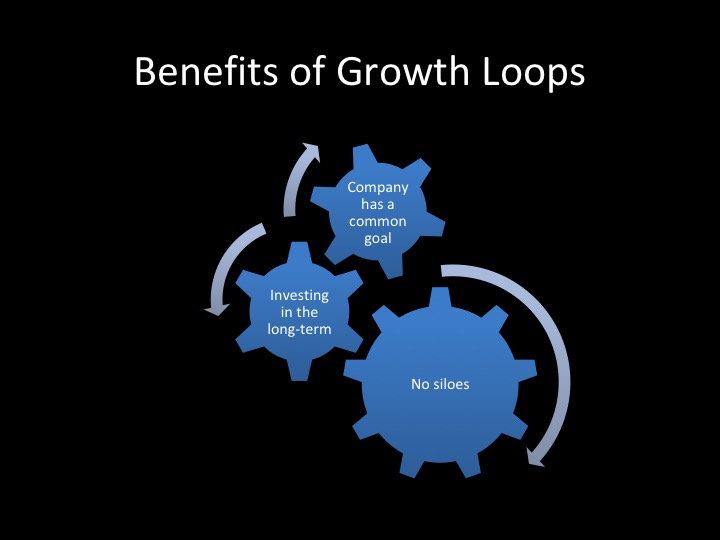
You get away from siloes (product, marketing, etc) and work together. Growth loops force companies to build a system.
You invest resources in systems that are more sustainable long-term, that continue to grow on their own.
You organize your personnel and teams towards a common goal, aligning and optimizing the growth loops.
Next steps
When building your company and designing your games or products, think holistically. Understand how you will create growth loops that will feed themselves and build a long-term dominant product. With games, ensure that there are loops in the game that drive the acquisition phase.
Key takeaways
Growth loops represent the evolution from a traditional acquisition funnel to a loop that continually creates value. Loops are closed systems where the inputs through some process generates more of an output that can be reinvested in the input.
Rather than creating siloes, growth loops help marketing, product, monetization, analytics work holistically.
A key value derived from growth loops is they have a compounding effect, they continually add value to the initial investment and thus perpetually grow the underlying product.
After spending three days at ICE, the largest B2B iGaming show in the world, I wanted to share some of the highlights. While there was nothing dramatically different this year, it reinforced several trends:
There are many red oceans
I have written many times about blue oceans and red oceans, the former being spaces in the market where your competitors are irrelevant, the latter where you are competing directly with others. In the iGaming space, there is very little creativity and almost all the companies are just trying to be a little better than their competitors. There are a few silos in the industry, and within each silo the companies are largely interchangeable. Virtually all the companies, large and small, are imitating each other and adding minor twists around the fringes. The concern with this situation is that in a red ocean it is very challenging to maintain your margins and generate long-term growth.
Content as a commodity
The iGaming industry is evolving to a position where content is becoming a commodity, in part driven by the red ocean mentality. Technology and globalization is also contributing to this situation, as the barriers to entry are exceedingly low for content development. A good artist and designer anywhere — Chicago, Bangalore, Vilnius or Jakarta — can create a beautiful slot. While math is critical, there are many great mathematicians who can make the beautiful slot into a decent game. Not only does good content flood the market, it allows operators to create their own content cost effectively and skim a large part of their revenue into machines that do not generate third party royalties.
While this problem runs counter to the concept that content is king, content is not king if it is virtually the same. Content that stands out still enjoys premium pricing and attracts more players and operators. Great content cannot be replaced with quickly made internal product. Very little content, though, falls into this bucket and most is competing for an increasingly small revenue pool.
While this situation is bad news for content creators, it is great for operators. The plethora of slot providers puts the basic supply and demand formula in favor of operators. They can negotiate more favorable royalty deals or build their own competitive machines with minimal cost.
Platforms offering zero value
Consistent with the glut of content is a glut of platforms and aggregators. In the video game space, there are many “publishers” who will license a game, take a share (sometimes very significant) and just submit the game to the AppStores, adding virtually zero value.
In the iGaming space, many people have created platforms where they aggregate slots content and distribute it to operators. The problem is that many of these platforms or aggregators have few relationships with operators, and even the operators who have integrated them put the content in the back of the virtual store. There were many stories at ICE of slots developers who have generated dollars or only cents from an integration with a platform. Just as in the video gaming space, content providers need to do their due diligence before selecting a platform.
Lots of people speaking American
For many years, G2E has been the gambling show that Americans went to while ICE was largely for Europeans, but I heard many American accents this year. Additionally, some traditionally US focused companies — Everi, AGS, Scientific Games, etc. — had large presences at ICE. It shows the US companies, particularly content providers, understand that the online real money market (which is dominated by Europeans) dwarfs the US land based market. Europe provides a great opportunity for many of these companies, though it also means more content on the market.
Not everyone got the memo about crypto
While the bloom is off the crypto rose almost everywhere, particularly tech, many iGaming companies are still operating on the momentum it had twelve months ago. Throw the word crypto on a mediocre offering and expect it to be worth an order of magnitude more. This approach is consistent with how the industry reacts and copies rather than seeks blue oceans, so I am confident that next year there will be very little crypto left and they will be chasing the next one year old trend.
The promise of virtual sports
Not all the news is bad. The quality and breadth of the virtual sports offerings is very impressive. Walking through the virtuals area was like being at a sports bar with multiple TVs showing live events. The rendered virtual sports are often better than games available for console, like Madden or FIFA. There are also some great offerings that put together video clips of live events and create a virtual event. I expect virtual sports to be a big growth area online (both real money and social) in the next few years.
Key takeaways
At ICE this year, there was little new and many companies copying each other, competing in a red ocean.
There is a glut of slots content, driving down revenue for slots providers but potentially providing a cost savings for operators.
Virtual sports represents the best opportunity for growth, as the quality of the content is improving exponentially.
I have written many times about customer lifetime value (LTV)and how it is the critical determinant of a company’s success (any company, from mobile games to retailers). A user’s lifetime value has to exceed the cost of acquiring the customer, otherwise companies cannot grow and will eventually die.
Last year, I discussed that out of the three key components of LTV – monetization, virality and retention – retention was the one most critical for success. While people sometimes focus on monetization, its impact on the long-term value of a customer is limited. Think of a retail store. Would they rather have a customer who comes in, makes a $100 purchase but never returns or somebody who comes in every week and makes a purchase ranging from $10 to $25? Obviously, they would prefer the latter. Successful businesses, games, apps, have great retention, thus creating high LTVs and allowing for more marketing spend.
While the mathematical case for focusing on retention is incontrovertible, many companies have not perfected how to measure retention effectively. Most social game companies, among the most sophisticated users of analytics, rely on measuring retention by D1/D7/D30 retention (how many players who installed on Day 0 are play after one day, seven days and thirty days, respectively). While this method is an acceptable (and sometimes powerful) way of tracking how new users are performing, even D30 retention only reflects behavior of customers acquired in the last month. It does not show how well the game or company is retaining its existing customer base.
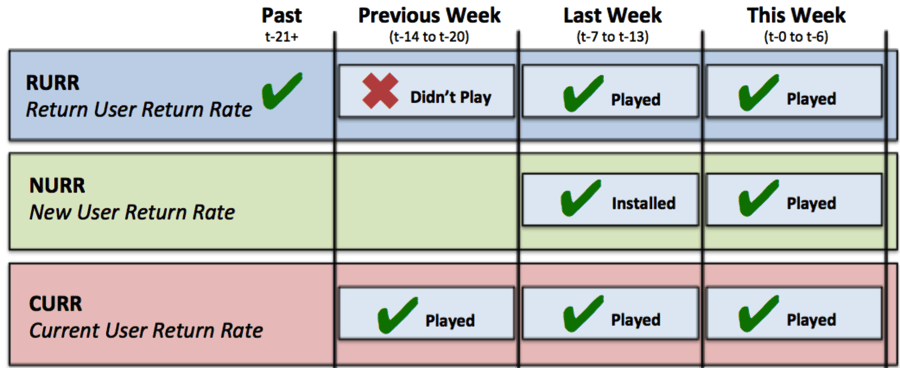
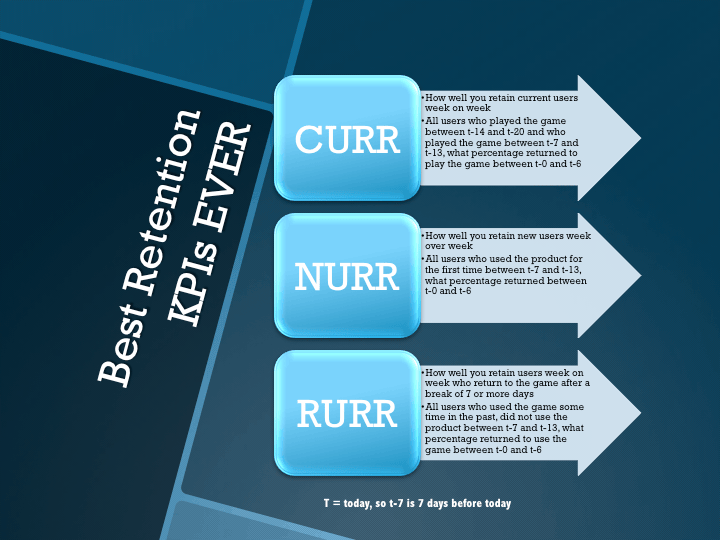
When I was at Zynga, I came across a metric that perfectly captures how well you are performing with your existing customers, CURR (current user return rate). CURR is complemented by NURR (new user return rate) and RURR (returning user return rate). Since leaving Zynga, not only have I taken these KPIs with me, I have used them as a key focus for optimizing products. A post by Nathan Williams, SaaS Retention Metrics: Lessons from Free-to-Play Games, reminded me how important these KPIs are and how to best use them.
CURR
CURR (current user return rate) is the most important KPI to track (or at least a tie with NPS). It shows how loyal your existing customers are; you should consider CURR the inverse of churn. If your CURR increases, it means you have improved your product’s appeal to existing players or customers, if CURR declines you have made your game worse. CURR is also an excellent way of looking at how your game is performing among different segments, VIPs versus payers versus never-spenders.
To calculate CURR, you start with all the users who played the game between t-14 (14 days before today, today minus 14) and t-20 and who used the product between t-7 and t-13, what percentage returned to play between t-0 and t-6. The benchmark for a good, but not great, game is 80 percent.
NURR
NURR (new user return rate) is a great metric for understanding how appealing your game is to players you have just acquired. A low NURR shows you have a bad initial experience (or a bad traffic source), turning off many users. It is virtually impossible to acquire players profitably with a low NURR.
To calculate NURR, take all the players who used the game for the first time between t-7 and t-13 and look at what percentage returned to the game between t-0 and t-6. You can benchmark NURR at about 30 percent, though it is dependent on the type of game and platform. There is much higher variance in NURR than CURR among successful games (a game on desktop could succeed with a much lower NURR than a game on Google Play).
RURR
RURR (return user return rate) shows how many people who had churned and returned to your game stay active. It is a great way of measuring how well your game can capitalize on CRM and paid reactivation campaigns. If the number is low, you are doing a great job of bringing players back but the product is still not compelling to these players.
You can calculate RURR by taking all the players who were active at some point but did not use the product between t-14 and t-20, and did use the product between t-7 and t-13, what percentage returned to play the game between t-0 and t-6. There is also significant variance in this benchmark but I usually target 40 percent for social casino games.
Use *URR to track product performance
Once you start monitoring CURR/RURR/NURR, you should use them to understand what is working and where there are issues. If you see a significant change in CURR, it is almost certainly caused by recent product changes. Low NURR indicates either you have broken your FTUE or you have added weak sources of traffic. A low RURR indicates your CRM or reactivation team is doing a good job but you need to add product features to keep the players you are bringing back.
Key takeaways
Retention is the key driver of customer lifetime value (LTV), and CURR/NURR/RURR are the most accurate metrics to track retention.
CURR (current user return rate) is your most valuable metric, the percent of your current players who are staying active. It shows whether changes in your product are appealing to or deterring your player base.
NURR (new user return rate) shows if your initial user experience is strong while RURR (return user return rate) shows if your game is appealing to players who have churned but decide to try it again.
When I listed my expectations for 2019, the one that generated the most conversation was that the convergence between Real Money Gaming and social casino would accelerate. The underlying driver of this convergence is that both ecosystems are strong and have many learnings to offer. Real Money casino is a $10.6 billion business. Meanwhile, social casino is a $5.4 billion industry that has grown every year since 2012 and is projected to continue growing 7-12 percent per year through 2022.
What social casino can learn from Real Money gaming
Content is king
Real Money casinos focus on adding more content (slots and table games) to increase revenue. While social casino operators also will profess content is king and acknowledge that new games are the strongest driver of KPIs, they do not have the singular focus on adding content that their Real Money counterparts have. Most social casino companies are happy releasing a new slot every second week and launching with 20-30 machines. Conversely, the top Real Money casinos often have over 500 slots and introduce new games much more rapidly.
Given the proven results from launching new content, social casinos should look at much more aggressive content schedules. To achieve this result, social casinos will need to move from their reliance on exclusive, homemade content.
Real Money operators can launch hundreds of games because they license the slots non-exclusively, thus providing access to thousands of slot machines and table games. While exclusivity does provide a unique selling point, many of the homemade social slots are not truly unique. They have common themes and standard math, they are effectively a commodity. Thus the exclusivity is only a perceived advantage, it has no value to the player. Rather than recreating the wheel for every machine, social casinos can still create a unique machine every two weeks (or four weeks or one week) but supplement it with non-exclusive content from the many third-party slot developers.
Cross-sell
While most social casino operators are focused on creating a strong slots app and then optimizing acquisition for that app, Real Money operators have a more robust model. While they still will acquire slots players for their casino products, they have entire verticals that exist largely to acquire players that can be cross-sold into casino. Virtually all the Real Money Bingo products derive the bulk of their revenue from slots. While sports betting is a profitable real money vertical on its own, all of the major sports betting companies rely on slots to drive LTV and allow for more aggressive user acquisition.
In the social space, the siloes are much stronger. Only Kama Games, which uses products like Blackjackist and Roulettist to drive traffic to its poker offering, regularly uses other casino mechanics to acquire players and then cross sell them to its core poker product. Even the social game companies with strong bingo products generally treat bingo as a standalone vertical with its own P&L, just acquiring players for bingo rather than to cross sell into their slots offerings.
Social game companies need to look more at their ecosystem rather than individual products. This will allow them to acquire more players at a higher ROI.
New mechanics
All successful social casino products are based on mechanics proven in the real money space (either land based or online) but not all real money gaming mechanics have made it to social casino. One of the challenges faced by social casino is that the number of players is no longer growing. While revenue continues to increase, it is driven by better monetization of the player base, rather than expanding the player base. One of the most obvious ways to appeal to more players is offering more gameplay options.
There are several real money mechanics that could benefit social casino companies:
Sports betting. Sports betting is the largest Real Money gaming vertical, worth well over $22 billion. Social casino companies have tried to replicate Real Money sports betting apps with no success; they have failed for several reasons. The products are normally very complicated, not lending itself to a new sports betting player. Sports betting is also very event driven (you are only interested when there is a match you want to bet on), while social games rely on strong daily retention. Despite these issues, given the overall interest in sports, strength of social fantasy applications and lack of Real Money sports betting in some core markets, a creative game designer can come up with the killer social app for this segment.
Virtual sports. Virtual sports is an important but small part of the online real money gaming ecosystem. Technology, however, has made it much more viable and a great option for social casino companies. Virtual sports are similar to slot machines in that winning is based on a random number generator with set odds, they just simulate a real sporting event. Technology, however, has made these simulated games look as good as real sports. The video below from virtual sports provider Inspired Gaming shows these matches look better than what you would see on a gaming console. Unlike actual sports betting, virtual sports are always available to the player so you can create an experience players can return to daily.
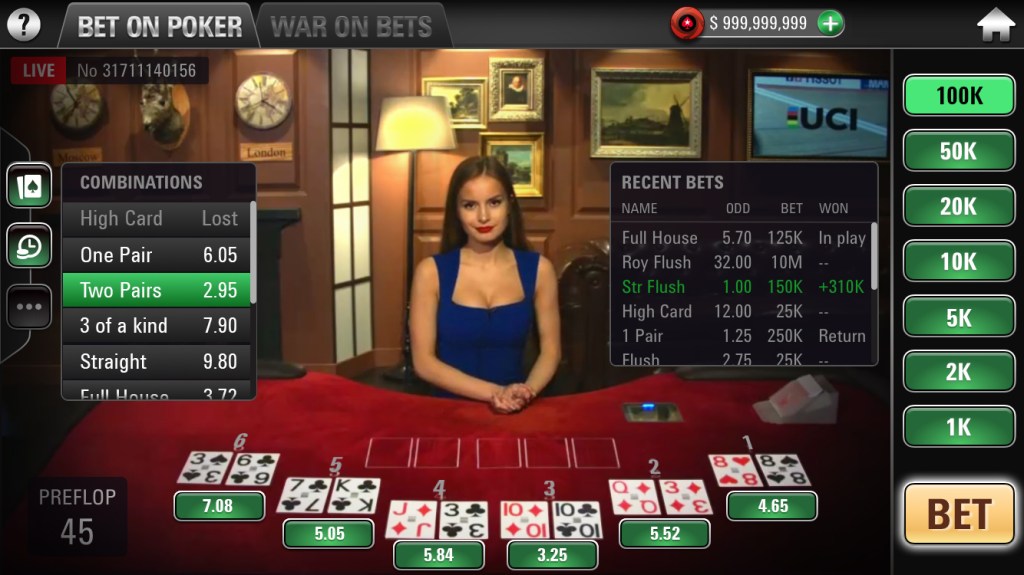
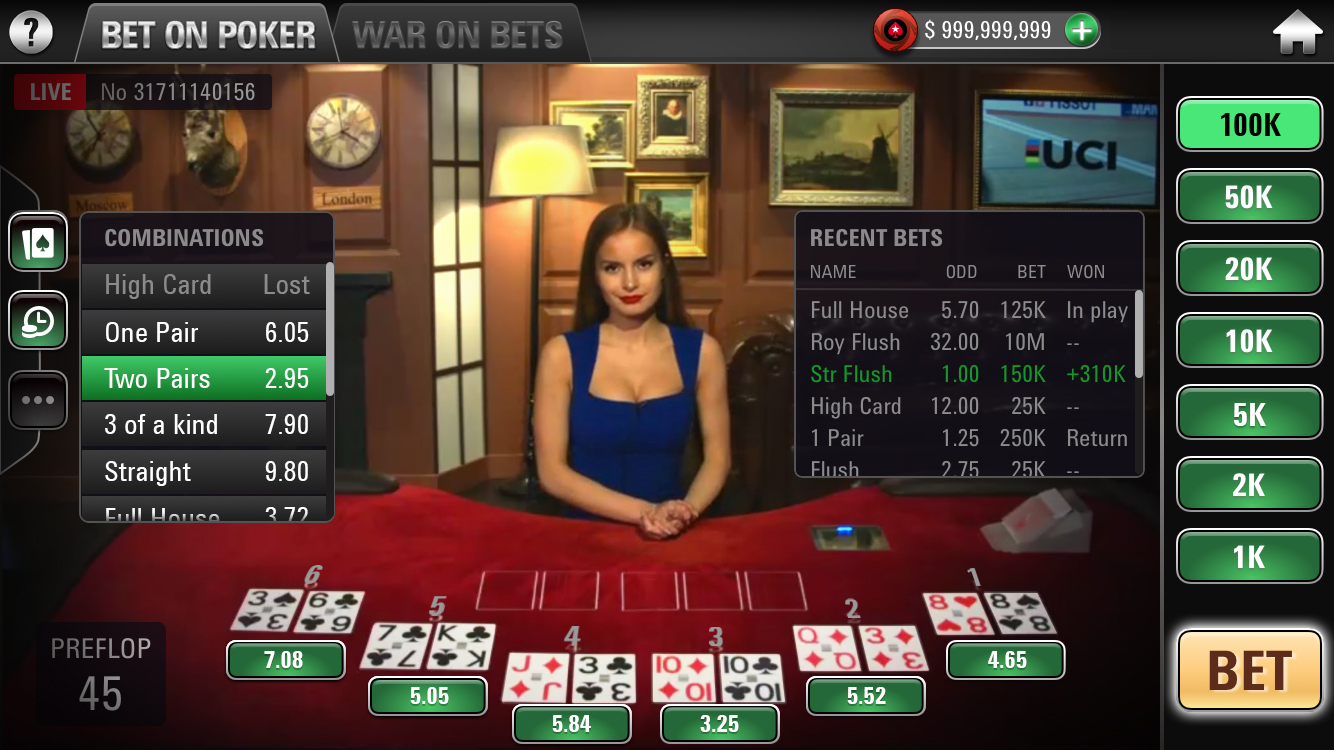
Live dealer. Live dealer games are the fastest growing mechanic in the real money gaming space. Companies led by Evolution Gaming, provide games where customers play against a live dealer or host through a video feed. Just as with virtual sports, technology has made this offering much better than only a few years ago, with smoother and higher quality streaming. It is the fastest growing segment of real money gaming and virtually when any B2C company reports its financial results, Live Dealer is the highlight or only bright spot. There are challenges integrating it into social games, bandwidth costs, one-to-one dealer requirements, etc., but as Stars Group showed these issues can be overcome.
New Audience
Real Money gaming shows that the addressable market is not limited to 40+ women. While 73 percent of social casino players are female, 65 percent of real money gamers (and 55 percent of real money casino players) are men. With user growth stagnant in social casino, appealing to a male demographic can expand the market for social casino.
Offer driven user acquisition
While social casino companies are more sophisticated with their overall digital marketing, Real Money operators are better at using promotional offers to bring in players. Promotions, such as a free money welcome bonus, spin to win, triple winnings their first day playing, etc., have a very strong pull. While the cost in Real Money of these promotions is sometimes challenging, in social casino they are less risky as providers are only gifting virtual currency. These offers are complicated by AppStore restrictions but this challenge is not insurmountable and more creative offers will improve social game companies user acquisition efforts.
VIP 3.0
While social casino is more reliant on VIPs than Real Money casinos, more than 60 percent of social casino revenue comes from 0.5 percent of players, Real Money operators are much more sophisticated in working with their VIPs. Only a few social casino operators, such as Zynga, have true VIP management programs, most social casinos have one person (who may also be responsible for social media or support) who runs their VIP “program.” Conversely, the most successful real money casinos have a more robust VIP support initiative:
Proactive. While much of VIP management in social casino is better customer support for spenders, VIP management in Real Money gaming consists of proactively reaching out to your top players and understanding them as a process. The VIP team can then anticipate problems or opportunities and provide a better experience to the player.
Rake back or loss return. Many real money gaming companies (both land based and online) refund part of player losses to their best players. This practice allows players to take more risks and helps overcome periods of bad luck. While it is a controversial practice, many in the real money space lament the cost is not worth the effort, it is a strong way to increase loyalty of your most active players.
First class promotions. Why are most fights in Las Vegas, answer is so the casinos can give their VIPs front row seats. Real Money operators will send their top players to great sporting events, sold out concerts, the top restaurants or even a luxury cruise to show their appreciation. While VIPs will often spend over $200,000 in a social game, these VIPs are often rewarded with a t-shirt (if they are lucky). Treating top VIPs similarly to the real money industry will keep them more engaged with social casino offerings.
Hospitality events. Not only do Real Money casinos send their VIPs to great events, they create great events. By creating your own event, you are building something unique that competitors cannot replicate and the player cannot get anywhere else. Thus, they are less likely to churn as they would not want to lose access to these events, while they can always buy fight or concert tickets. It is also a great opportunity for your VIP team to build personal relationships with your VIPs, and the personal bond is often stronger than financial benefits of being a VIP.
By replicating these practices, social casinos can reduce VIP churn and improve their lifetime value to the company.
What Real Money gaming can learn from social casino
Although Real Money casino is a larger business, in many ways it is less sophisticated than social gaming. For many years, Real Money casino operators could succeed by getting a stable product in front of customers. With LTVs upward of $400, they had significant margin of error in user acquisition and product features. Conversely, social casinos continuously had to optimize all facets of their business to continue growing. This optimization has led to the development of many features and tactics that can benefit Real Money gaming.
Progression
Providing progression serves many valuable purposes in games. First, it gives people a reason to play, they want to keep moving forward. Even in Real Money gaming, studies have shown over 65 percent do not play to win money, thus progression will appeal to the majority of these customers.
Progression also prevents churn. Loss aversion is a very strong driver of behaviour, people do not want to lose something they already have. The endowment effect also explains that they will also overvalue it.
In addition to reducing churn, progression increases engagement. Players want to complete as many levels as quickly as possible. If there are outstanding levels, they will want to reach them as they will want to finish everything open.
Progression also is a strong monetization driver. Candy Crush is a great example of a game genre that did not monetize but by adding progression King.com was able to create a billion-dollar franchise. Progression prompts players to want to keep playing even when they are out of chips, so thus depositing more, and to play at higher stakes, increasing their bet size.
In the Real Money casino world, where players will often jump between casino offerings to capitalize on the best promotions, progression creates loyal and valuable customers.
Social features
Social features are another strong behaviour driver that has largely been perfected by free to play games. Social interaction is a core value for customers, driving success across many industries. While many features satisfy base needs, social interaction appeals to a higher need and thus people are willing to pay more for it and less likely to give it up. The success of Big Fish Casino, and more recently Huuuge Games, shows how social features can create a unique and very profitable market position. Outside of the casino space, Clash of Clans is a great example of social features driving billions in revenue.
There are many different types of social features that Real Money casino operators can implement, with some of the most successful including:
Guilds or clans, where players join together to overcome challenges or compete with other groups.
Group challenges, so players have to team together to win rewards.
Chat, to enable players to interact with each other.
Customizable and useful player profiles, so players can know more about other players.
Social shares to unlock gifts.
Personalized videos, so players can share their gameplay with friends.
Team competitions, where players form teams to get higher scores (which could be chips won) than other teams.
Synchronous slot game play.
Social lobby, so players know they are not playing alone.
Visibility into where friends and other players are winning.
Player review of games and slots, similar to Amazon.
Referral program, so your players can also be your evangelists.
Some of these features will work better in certain products than others but a mix of these features will not only create bonds with your players but amongst your players.
UIUX
Social casino developers provide a much cleaner and smoother user interface (UI) and user experience (UX) than real money gaming companies. Players can quickly start playing and there is virtually no learning curve. It is easy to navigate in the product, take advantage of offers and understand every offering. Real Money, conversely, often overwhelms the customer with choice, increasing the cognitive load. This problem is not only in the lobby but in the products, betting options are often very complex and confusing. Overall, social gaming companies create an experience much more consistent with customers expectations in 2019.
In-product VIP
While Real Money gaming companies are great at hosting and managing their VIPs, social game companies are much better at giving them incentives and rewards in product. Virtually all social casinos have an in-game VIP system, where the more VIPs play, the more privileges they earn. This type of automated system provides continuous reinforcement and reminds VIPs why they want to remain in their favourite product.
Events
Within the past year, social casinos have become very adept at creating events that boost engagement. It could be the December Challenge or the Race to the Mountain Top, but in effect it is a collection of challenges and specialized content that is available for a limited time. Often the player has a chance to win an item(s) that is only available by completing the event and will not be available again, creating an incentive both to participate and to visit the game regularly (so they know about the events). These events also break the monotony of playing the same games repeatedly. Finally, they can provide an incentive to try new slots or mechanics.
The most successful social games are now running at least one event daily and this practice can be replicated in the Real Money world. A regular schedule of events increase loyalty, engagement and monetization.
Key takeaways
The strength of both the Real Money Gaming and social casino businesses suggest they both have many lessons to offer.
Social casino companies should focus on adding even more content than they do currently (in part by using third party content they do not have exclusively), create an ecosystem based on cross-sell, try game mechanics from Real Money gaming (sports, virtual sports, live dealer), try to engage male players, create more unique new player offers and replicate the high-touch VIP programs found in real money.
Real Money casinos can improve their profitability by adding progression mechanic, social features, more simple user interface and user experience, in-product VIP programmes and daily events.
If you are interested in hypercasual games and but were unable to watch my appearance last week on Indie Game Business, the show is now available on YouTube. It was also a fantastic opportunity to reminisce about the game business with my first hire, Jay Powell. To view the show:
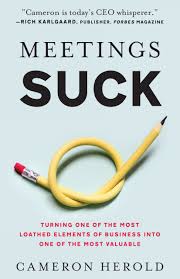
Most people hate meetings but they still waste hours upon hours of not only their time but colleagues time on them annually. I always like to work between Christmas and New Years because I get more done than I feel I typically do in a month. I realized this year that the reason for the much higher productivity is that I am not spending most of every day in meetings, often ones with questionable value. If you add the cost (wages) from my wasted time to that of all the other people who are not optimizing their time during meeting where they are not deriving or creating value, there is an opportunity to increase significantly your team or company’s operational efficiency.
Based on this realization and having read Meetings Suck by Cameron Herold, I developed some policies that I recommend you replicate:
Delete all meetings once a year (easiest in January) and then only reschedule the ones you need and only with the people you need to attend. This is a strategy I wrote about in 2015, that I stole from a top-five game company, that company now is one of the two or three largest in the US.
Talk, don’t meet. Sometimes a quick conversation can resolve items without needing a meeting.
Ensure everyone invited needs to be there. If someone is on there phone during the whole meeting, it is less that person’s fault than the meeting organizer who brought in someone who was not needed.
Let people opt-out. If somebody says they do not want to attend a meeting, respect their wishes.
Prepare before a meeting. If you are going to be reviewing financials or KPIs, have the analysis complete and know what you want to discuss. Nobody wants to sit around watching you work on a spreadsheet during a meeting
Have people arrive early. Everyone should be early for meetings so that they can stay on time. You and your colleagues should get to the meeting five minutes early so that people can settle and be ready at the start time. By starting late, you are wasting money having people just sit around.
Schedule meetings for 25 minutes. That will allow five minutes to get to the next meeting early. Abandon one hour (or longer) meetings, so that the meetings stay focused. It is better to schedule a follow up than have an extra 30 mins that people feel they have to fill. Only schedule 55 minutes when you are confident you will need all 55 minutes,
Share an agenda with all attendees. Share an agenda for meetings a few days in advance and allow people to opt out if there is no business relevant to them being discussed. If you use Outlook or a similar organizer, best to put the agenda in the invite.
Include a timetable. With the agenda, include a timetable so people can attend for the part of the meeting relevant
If you make these changes, you will be surprised at how liberated you feel. Meetings will take on improved importance, making them more interesting to you but also to your colleagues. Everyone will benefit from better meetings.
Key takeaways
Improving efficiency from meetings can save your company money, significant savings can come from reducing the wages lost by people attending meetings that they do not contribute to and do not derive value.
Start with a clean slate, delete all meetings and only add ones you need, and invite the people who need to be there.
Reduce meetings to 25 minutes so you can start on time (and arrive on time for the next meeting) and share an agenda and timetable before the meeting.
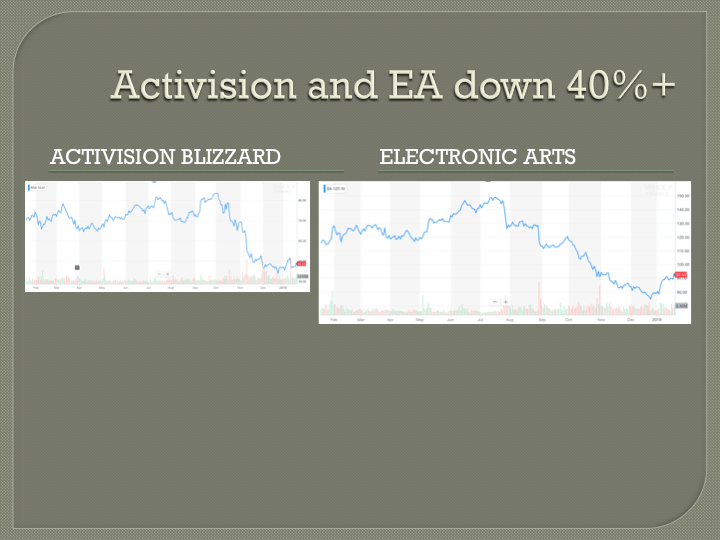
Both Electronic Arts and Activision have plummeted more than 40 percent from their 2018 heights and the underlying causes provide important lessons for other game companies. An article in Barrons, Electronic Arts and Activision Are Struggling to Survive a Fortnite World, highlights the key causes.
Look at the competition holistically
Many companies are focused on the competition but they fail to define the competition properly. While your direct competition can have the biggest short term impact by increasing marketing or adding a new feature, your entire business can be disrupted by a company that you did not realize is a competitor.
Netflix views Hulu and Amazon Prime as their primary competitors, and then the broadcast and cable networks. It was, however, Fortnite from Epic that had the biggest impact on Netflix last quarter as consumers shifted their entertainment focus from television to the massively popular game. The failure of Netflix to anticipate this competition from a non-traditional competitor has left them unable to respond promptly, adding more scripted content does not negate the appeal of a game like Fortnite.
As the article shows, it was not just Netflix who misread the competition, as it was a key driver for EA and Activision’s decline. These companies were focused on each other (as well as the other console games coming to market) and did not anticipate a free to play gaming changing the ecosystem so dramatically.
Outside of gaming, we have seen this phenomenon repeatedly, from the classic horse buggy companies that went bankrupt as they did not realize the impact of automobiles to the decline of retailers who were slow to respond to online shopping. Blockbuster focused on Hollywood Video and mom and pop video stores before realizing that Netflix was the real threat, realizing too late. In the 1990s, GM and Ford and Chrysler were so focused on competing with each other they all faced bankruptcy when Asian manufacturers gutted their market with a new breed of high mileage vehicles. Dell and Compaq were so fixated on providing better PCs at a more competitive price that they are now afterthoughts to Apple and Samsung.
The game and iGaming space is littered with similar examples. The THQs and Acclaims did not consider free to play a competitor until it was too late. Many land-based sportsbooks did not consider online a threat until they saw their businesses disintegrate. When Sega was looking at building the next Dreamcast, they focused on Nintendo and Sony, not Microsoft.
The lesson is the true threat to your business is not the competitors you recognize as competitors, but companies who provide an offering that your customers can use to replace yours, even if it is a very different product. By not realizing who your potential competitors are, you will not be positioned to retain your customers when they shift.
Franchises are not forever
The article points out how underperforming franchises have also negatively impacted Activision and EA. Destiny was one of Activision’s cornerstone franchises and as soon as Destiny 2 showed the franchise was in decline, the stock fell 12 percent.
Destiny is not the only example of a declining franchise pulling down its stock. When Zynga went public in 2011, Farmville and Zynga Poker helped drive a share price to over $12. As both “franchises” slipped, Zynga has struggled to remain relevant, with a share price about 65 percent lower than at its peak.
These examples show that franchises do not continue indefinitely on their own. You need to work at maintaining and growing them by keeping up with current customer needs, as well as anticipating shifts in the market place.
It also shows a growth strategy focused on acquiring franchises runs the risk of overpaying and failing. Almost by definition, you are buying at a peak because it is only a franchise when it is doing very well (then it is defined is a declining product). If the acquirer cannot grow the franchise, their large investment (and franchises do not come cheap) can crumble.
You need a pipeline of new products
The third lesson from the fall of EA and Activision is the need for a robust product pipeline. Given the risks of franchises declining, you need to have new products ready to replace them. As an analyst wrote in the Barron’s article, “the main issue [for Activision Blizzard] is an underperforming pipeline of games.” In EA’s case, the poor performance of its Battlefield franchise has left it with little to drive growth. Both EA and Activision have built their business by refreshing franchises, so when those fail, they have nothing to fall back on.
While the need for a pipeline of new products (for any industry) seems obvious, it requires a commitment, and not just money. This commitment often feels unnecessary when franchises are driving growth and revenue. Even if a company is willing to invest in new products, if they do not have a commitment from on top, it will still fail as their best people (marketing, tech, design, etc.) will be working on the existing franchise products. In a competitive industry (and every industry these days), your B team is not going to beat other companies who are focused on winning with new products.
What Activision and EA teach us
Rather than feeling sorry for Activision Blizzard and Electronic Arts (they are still valued at over $25+ billion each), you can learn from them to avoid the dramatic declines they have faced recently. Most importantly, when looking at the ecosystem and your customers, realize that customers are not simply deciding between you and your closest competitor, they are looking at the best use of their time. For a game company, that means not worrying about competing games (primarily), but Netflix, music, movies and other form of entertainment. You may create a better product than your competitor to find there is a much smaller market for both of you.
As you are anticipating your customers’ needs, you also need to anticipate they will be different, so you cannot rely on today’s franchises. You need a stream of new products that anticipate their new expectations.
Key takeaways
Activision and Electronic Arts shares have fallen more than 40 percent in the past twelve months, driven by a combination of misjudging the competition, relying on franchises and having a weak product pipeline.
When surveying and reacting to the competition, you must look beyond the direct competition and understand who else could take your customers.
While franchises are important revenue sources, you need to nurture them and have alternatives as they eventually will degrade.
Last quarter saw some interesting deals in the gaming space. Several of the deals, and non-deals, suggest trends that are likely to continue in 2019.
Playtika acquires Wooga rather than another social casino
The most interesting deal was Playtika acquiring Wooga for ~$100MM. The thought-provoking element to me was that Playtika decided to invest outside the social casino space. In the past, acquisitions such as House of Fun, Buffalo Studios, etc., were focused on expanding Playtika’s social casino portfolio. Wooga, however, has no presence in the social casino space, instead is a casual, primarily puzzle, game developer. Playtika’s move suggests one of the following:
Given the stagnant user numbers in social casino, there are better growth opportunities in other genres.
Valuations in casino are too high compared with growth potential in the space.
Most likely, social casino companies will continue to expand (and acquire) in casino but also are maturing to want a more robust and diversified portfolio (consistent with Aristocrat’s acquisition in 2017 of Plarium at the same time it purchased Big Fish).
Zynga spent $560+ million for one title, Empires & Puzzles
Zynga’s $560MM acquisition of 80 percent of Small Giant Games (thus valuing the company at $700MM) shows CEO Frank Gibeau’s strategy of focusing on controlling large, long-term franchises. Small Giant’s core product, Empires & Puzzles, is the 13th highest grossing title on mobile. Empires & Puzzles is Small Giant’s only game live, they are not known to have any other big projects in the pipeline (unlike Natural Motion, which had Dawn of Titans in the works when Zynga acquired it), so the acquisition is to add Empires & Puzzles to Zynga’s list of franchises.
This strategy is consistent with what Gibeau learned at EA, that franchises transform a game company from a hit driven business, with wide revenue fluctuations, to a company with sustainable and predictable growth (and thus higher valuation). He is collecting evergreen franchises to try to turn Zynga into the EA of mobile. These franchises include his purchase of Gram Games, which provided the hypercasual franchise Merge Dragons, and Harpin, which gave him Patience – Solitaire. In addition, acquiring rights to Star Wars, Harry Potter and Game of Thrones for gaming creates additional franchise opportunities. Coupled with existing Zynga franchises Zynga Poker, Words with Friends, CSR Racing and to a lesser extent Hit It Rich!, Wizard of Oz Casino Slots and Farmville, Zynga now has a stable revenue base to build on.
Epic raises $1.25BN at a valuation of $5BN-$6BN, showing the breadth and value of its business
Last October, Epic raised $1.25 billion from KKR, Kleiner Perkins, Vulcan Capital and other blue chip investors at a valuation probably well over $5 billion. What is most impressive about Epic is how it has consistently succeeded in different parts of the game industry. While companies frequently are unable to repeat successes in the gaming space or expand beyond their expertise, Epic seems to do it at ease. Fortnite is only the latest in a string of successes that I find incredibly surprising, given the challenges other companies in the game industry experience. I remember Epic when they were still a small North Carolina company, largely an indie developer. Their odds-defying achievements include (and I am probably forgetting some):
I first learned about Epic from a CNN story (I think 1998) about someone who created a first person shooter (FPS) in their basement that was soon to be released but getting much buzz. At the time, the FPS market was dominated by id Software (Doom) and all the other FPS were fringe products. They might have a loyal following, like Bungee’s Marathon, but nobody challenged id. I did not expect Epic to launch the top FPS but they did. Unreal turned into the biggest FPS for years, making id an afterthought.
With the success of Unreal, Epic decided to license its game engine (creatively branded the Unreal Engine). At the time, the game engine industry was awful. Companies like NDL (Emergent) scraped by to make payroll as no major developers were using third party engines. There was very much a not invented here mentality in the video game industry. Fast forward ten years later and Epic built a game engine company that powers many hit products and is worth hundreds of millions of dollars.
Most successful games are followed with…not another successful game. The video game industry is known as being hit driven and even the strongest companies have had difficulty replicating their big successes. While Epic surprised me by successfully creating a huge franchise with Unreal, it did not seem likely that they could ever replicate their success. Then they launched Gears of War in 2006 and ended up with a bigger franchise than Unreal.
This fundraising deal shows Epic is arguably the strongest company in the gaming sector and one that can expand its footprint into other gaming areas. Although I consider the Google/Apple duopoly over mobile gaming unshakeable, same for Steam on PC, it is hard to bet against Epic. Its ability to expand from Unreal to one of the largest core gaming companies also suggest that Fortnite will not be a one-hit wonder but we should anticipate more Epic titles dominating free to play gaming.
What Q4 means for 2019
The big deals in Q4 suggest several M&A trends I expect to see in 2019:
There will be a pick-up in consolidation among social casino companies, but these companies will also look at growing in other game genres.
The major game companies (all genres and all platforms) will focus acquisition efforts on acquiring franchises, not talent.
Epic will continue to defy the odds
Key takeaways
The three most important deals in the gaming space in Q4 2018 were Zynga’s acquisition of Small Giant Games, Playtika’s acquisition of Wooga and a $1.25BN investment in Epic at a valuation of $5BN-$6BN
Playtika’s deal shows that social casino companies are looking outside the space to grow
Zynga’s deal demonstrates the value of franchises is increasing in mobile gaming