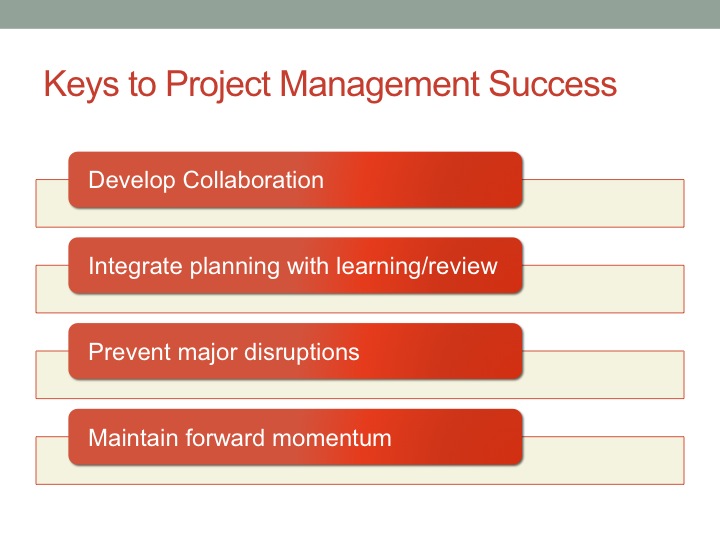
One of the biggest challenges in the game space, and the overall tech space, is project management. Many companies do not even expect to hit the dates they have set. This situation creates planning issues, cash flow problems and prompts investors to lose confidence. An article in the MIT Sloan Management Review, “What Successful Project Managers Do,” studied 150 successful projects and determined four key initiatives by project managers tied to success.
The article first shows three different types of events that can impact schedule. These events can be classified according to their level of predictability as follows:
- Events that were anticipated but whose impacts were much stronger than expected
- Events that could not have been predicted
- Events that could have been predicted but were not
All three types of events can become problems that need to be addressed by a project manager.
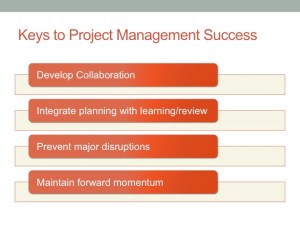
Develop collaboration
Since project progress depends on the contribution of individuals who represent different disciplines (e.g., art, design, programming) and are affiliated with diverse parties, collaboration is crucial for the early detection of problems as well as the quick development and smooth implementation of solutions.
As the authors point out, “most projects are characterized by an inherent incompatibility: The various parties to the project are loosely coupled, whereas the tasks themselves are tightly coupled. When unexpected events affect one task, many other interdependent tasks are quickly affected. Yet the direct responsibility for these tasks is distributed among various loosely coupled parties, who are unable to coordinate their actions and provide a timely response. Project success, therefore, requires both interdependence and trust among the various parties.”
If one or several of the people involved in the project believes that project planning and contractual documents provide sufficient protection from unexpected problems, developing collaboration among all the parties may require creative and bold practices. Thus, it is important to select the right people for the project and develop mutual interdependence and trust.
Integrate planning and review with learning
Project managers faced with unexpected events employ a “rolling wave” approach to planning. Recognizing that firm commitments cannot be made on the basis of volatile information, they create plans in waves as the project unfolds and information becomes more reliable. With their teams, they develop detailed short-term plans with firm commitments while also preparing tentative long-term plans with fewer details. To ensure that project milestones and objectives are met, these long-term plans include backup systems or surplus human resources.
One key difference between the traditional planning approach, in which both short- and long-term plans are prepared in great detail, and the rolling wave approach becomes evident when implementation deviates from the plan. In the traditional planning approach, the project team attempts to answer the question: Why didn’t our performance yesterday conform to the original plan? In the rolling wave approach, project managers also attempt to answer the question: What can we learn from the performance data to improve the next cycle of planning? In particular, they attempt to learn from their mistakes—to prevent an unexpected event from recurring. The successful project manager develops stable short-term plans and flexible long term plans while conducting learning-based project reviews.
Prevent Major Disruptions
Successful project managers never stop expecting surprises, even though they may effect major remedial changes only a few times during a project. They are constantly anticipating disruptions and maintaining the flexibility to respond proactively. The key is to anticipate and cope proactively with a few major problems.
Maintain Forward Momentum
When unexpected events affect one task, many other interdependent tasks may also be quickly impacted. Thus, solving problems as soon as they emerge is vital for maintaining work progress. Also in many situations, corrective action is possible only during a brief window.
In working to maintain a forward momentum, the manager seeks to avoid stalemates. A good project manager resolves problems by hands-on engagement, frequent face-to-face communication and moving about frequently.
What you should do as a leader
Although every project manager tries to minimize the frequency and negative impact of unexpected events, in today’s dynamic environment such events will still occur. Acknowledging the emergence of a problem is a necessary first step, allowing the project manager to respond quickly and effectively. Some organizations assume that almost all problems can be prevented if the project manager is competent enough—resulting in project managers who are hesitant to admit that they are facing an emerging problem.
By assuming the four roles discussed in this article, the successful project managers we studied are both intention- and event-driven and embrace all three orientations. Developing collaboration requires them to be people-oriented. Integrating planning and review with learning requires them to be information-oriented. Preventing major disruptions requires them to be action-oriented. Finally, maintaining forward momentum, which is pursued throughout a project, requires them to adopt all three orientations. Senior managers must ensure that all three orientations are considered when selecting project managers and developing project management methodologies.
Key takeaways
- Good project managers are critical for getting projects done on schedule.
- Effective project managers develop collaboration between different disciplines on their team, integrate planning with review and learning, focus on preventing major disruptions and maintain forward momentum.
- An effective leader will let their project managers respond quickly and effectively rather than create a culture of fear so problems are hidden.





 .