There was a great article in the Harvard Business Review, “The Truth About Customer Experience,” that shows more importantly than focusing on providing the customer with good discrete interactions you should focus on the entire journey. Interestingly, even if you have great metrics at each touch point (e.g., people are satisfied with onboarding, customer services call are resolved positively), overall customer satisfaction may be negative because of the holistic customer journey.
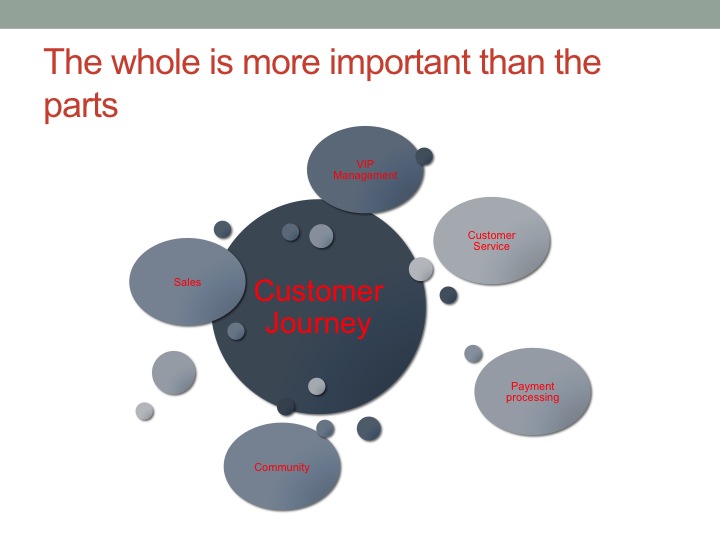
The article uses the example of new customer onboarding for a pay TV provider to show how the journey can be negative even when each touchpoint gets positive feedback. As the article describes, “Take new-customer onboarding, a journey that typically spans about three months and involves six or so phone calls, a home visit from a technician, and numerous web and mail exchanges. Each interaction with this provider had a high likelihood of going well. But in key customer segments, average satisfaction fell almost 40% over the course of the journey. It wasn’t the touchpoints that needed to be improved—it was the onboarding process as a whole. Most service encounters were positive in a narrow sense—employees resolved the issues at hand—but the underlying problems were avoidable, the fundamental causes went unaddressed, and the cumulative effect on the customer was decidedly negative.”
The root of the problem is that many customer focused functions (sales, CS, community management) are siloed in different organizations that have individual and insular cultures. These groups shape how the company interacts with consumers but although they may aim to optimize their contributions they lose focus of the customers desires.
The article describes four ways that companies can overcome this problem, effectively embedding the customer journey into your operational process. It is not about removing the functions but building an internal system that looks at customers holistically. Continue reading “It’s about the customer journey, not the touchpoints”
 The Business of Social Games and Casino