Skip to content

The Business of Social Games and Casino

How to succeed in the mobile game space by Lloyd Melnick

Day: June 8, 2016

How to become a growth company again

In February, I discussed the challenges companies have dealing with a changing business environment and a corollary to that challenge is how to reignite growth once your company has stagnated. Chris Zook and James Allen tackled this problem in an article, Reigniting Growth, in the Harvard Business Review. In the article, the authors point out that almost all companies eventually face stall-out, “a sudden large drop in revenue and profit growth or a collapse of once high shareholder returns to well below the cost of capital. Stall-out occurs when the growth engine that powered a company to success stops working. This rarely happens because the business model has suddenly become obsolete—a common misconception. Rather, [their] research shows that the business has almost always become too complex, most often owing to bureaucracy that slows the company’s metabolism, or internal dysfunction that distorts information and hampers managers’ ability to make rapid decisions and take swift action on them.”

There is a consistent theme when looking at big companies that have stalled-out. They talk about being swamped with bureaucracy, overwhelmed by Powerpoints and an inability to act decisively even on great opportunities. While competition impacts your growth, success hinges on remaining fast, perceptive, innovative and adaptable. 94 percent of leaders of companies with $5 billion plus revenue believe internal dysfuntion was the main barrier to growth, not competition or lack of opportunity.

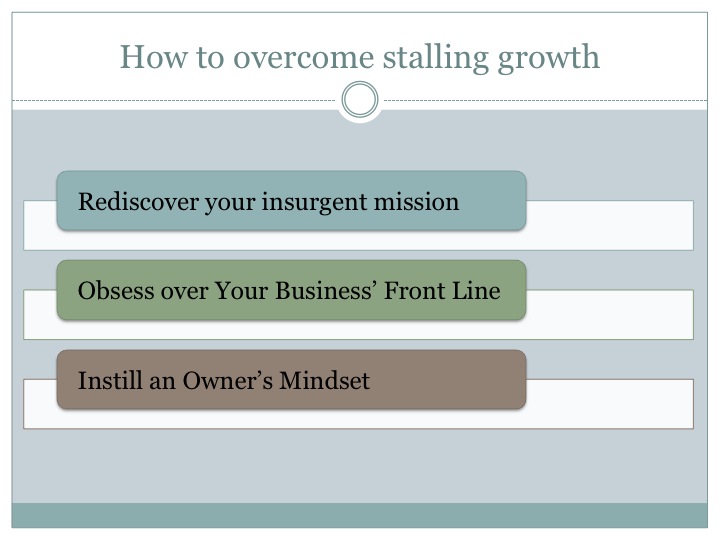
The authors identify three qualities that can help overcome stall-out. By rediscovering your insurgent mission, obsessing over the business front line and instilling an owner’s mindset, companies can reignite growth.

Rediscover your insurgent mission

The first key is to regain the focus and mission that drove your company’s growth. When stall-out occurs, it is almost always connected to creeping complexity. The authors suggest companies experiencing stall-out need to liberate resources, narrow focus and harness the vigor that drove early growth. The company should shed noncore assets and businesses. Then attack complexity in the core processes. Finally, your company should focus on reducing product complexity.

Part of the problem is the democratization – or socialism – of resources. As companies grow, internal budget processes spread resources evenly across businesses and opportunities. While this may feel fair to the management team, and all employees, it impacts growth and drives the company to mediocrity. Successful leaders instead make bold budget decisions to redifferentiate the company, usually establishing a major new capability that set off waves of growth.

Even after growth is reignited, companies need to renew their approach as being business insurgents. Companies should view their customers as underserved and their industries as setting insufficient standards, and should constantly emphasize what is special about themselves. Bold goals—not just the aim of living to fight another day—will sustain growth.

Conversely, you should not be scared to shrink your company to become more efficient and focused. By cutting back, it forces your company to focus on what is most important and reduce bureaucracy that does not increase value. It also allows you to dedicate more resources to growing your company.

Obsess over Your Businesses’ Front Line

The second key to reigniting growth is focusing on the front line of your business. As Zook and Allen write, “this obsession, which can often be traced back to a strong founder, shows up in three ways: an elevated status for frontline employees, a preoccupation with individual customers at all levels of the company, and an institutional curiosity about the details of the business.”

Usually, this obsession is what generated growth initially and the layering of bureaucracy chipped away at it. Other companies likely responded to the weakening relationships and provided better customer relationships and hired your best employees. By moving the focus back to what built the company, you can reignite growth.

Instill an Owner’s Mindset

The final component to overcoming stall-out is instilling an owner’s mindset throughout the organization. This is not just P&L responsibility, but giving employees personal responsibility for their actions and deployment of resources. Allow, and encourage, your employees to take risks. Eliminate the bureaucracy (think risk committees or really any committee) that takes decision making out of their hands. Allow them to partner with external companies. Encourage people to form internal teams to test new ideas. The key is give people the power to get things, important things, done.
Slide1

Preempt stall-out

While the article focused on how to overcome stall-out, more importantly it also implicitly shows how to avoid stall-out. Rather than reaching a situation where growth has stalled, if you leverage the three keys above while still in a growth stage you should continue to grow rather than have to deal with a turnaround.

Key Takeaways

  • Most successful companies eventually face a sudden, large drop in revenue or growth, stall-out, that is largely caused by an increase in bureaucracy.
  • To overcome stall-out, companies need to focus on what made them great initially, obsess over their customers and front-line employees and instill a true owner’s mindset where employees are empowered to make key decisions.
  • In addition to overcoming stall-out, these practices can help growing companies avoid the problem altogether.

Share this:

  • Click to share on Facebook (Opens in new window) Facebook
  • Click to share on LinkedIn (Opens in new window) LinkedIn
Like Loading...
Unknown's avatarAuthor Lloyd MelnickPosted on June 8, 2016May 2, 2016Categories General Social Games Business, General Tech Business, GrowthTags Growth, revenue, stall-out1 Comment on How to become a growth company again

Get my book on LTV

The definitive book on customer lifetime value, Understanding the Predictable, is now available in both print and Kindle formats on Amazon.

Understanding the Predictable delves into the world of Customer Lifetime Value (LTV), a metric that shows how much each customer is worth to your business. By understanding this metric, you can predict how changes to your product will impact the value of each customer. You will also learn how to apply this simple yet powerful method of predictive analytics to optimize your marketing and user acquisition.

For more information, click here

Follow The Business of Social Games and Casino on WordPress.com

Enter your email address to follow this blog and receive notifications of new posts by email.

Join 791 other subscribers

Most Recent Posts

  • Join me at PDMA Inspire for my talk on new product prioritization
  • Why keep studying?
  • The next three years of this blog
  • Interview with the CEO of Murka on the biggest growth opportunity in gaming, Barak David

Lloyd Melnick

This is Lloyd Melnick’s personal blog.  All views and opinions expressed on this website are mine alone and do not represent those of people, institutions or organizations that I may or may not be associated with in professional or personal capacity.

I am a serial builder of businesses (senior leadership on three exits worth over $700 million), successful in big (Disney, Stars Group/PokerStars, Zynga) and small companies (Merscom, Spooky Cool Labs) with over 20 years experience in the gaming and casino space.  Currently, I am the GM of VGW’s Chumba Casino and on the Board of Directors of Murka Games and Luckbox.

Topic Areas

  • Analytics (114)
  • Bayes' Theorem (8)
  • behavioral economics (8)
  • blue ocean strategy (14)
  • Crowdfunding (4)
  • DBA (2)
  • General Social Games Business (459)
  • General Tech Business (195)
  • Growth (88)
  • International Issues with Social Games (50)
  • Lloyd's favorite posts (101)
  • LTV (54)
  • Machine Learning (10)
  • Metaverse (1)
  • Mobile Platforms (37)
  • Prioritization (1)
  • Social Casino (52)
  • Social Games Marketing (105)
  • thinking fast and slow (5)
  • Uncategorized (33)

Social

  • View CasualGame’s profile on Facebook
  • View @lloydmelnick’s profile on Twitter
  • View lloydmelnick’s profile on LinkedIn

RSS

RSS Feed RSS - Posts

RSS Feed RSS - Comments

Categories

  • Analytics (114)
  • Bayes' Theorem (8)
  • behavioral economics (8)
  • blue ocean strategy (14)
  • Crowdfunding (4)
  • DBA (2)
  • General Social Games Business (459)
  • General Tech Business (195)
  • Growth (88)
  • International Issues with Social Games (50)
  • Lloyd's favorite posts (101)
  • LTV (54)
  • Machine Learning (10)
  • Metaverse (1)
  • Mobile Platforms (37)
  • Prioritization (1)
  • Social Casino (52)
  • Social Games Marketing (105)
  • thinking fast and slow (5)
  • Uncategorized (33)

Archives

  • September 2023
  • December 2021
  • July 2021
  • March 2021
  • February 2021
  • January 2021
  • December 2020
  • November 2020
  • October 2020
  • September 2020
  • August 2020
  • July 2020
  • June 2020
  • May 2020
  • April 2020
  • March 2020
  • February 2020
  • January 2020
  • November 2019
  • October 2019
  • September 2019
  • June 2019
  • May 2019
  • April 2019
  • March 2019
  • February 2019
  • January 2019
  • December 2018
  • June 2018
  • May 2018
  • April 2018
  • March 2018
  • February 2018
  • January 2018
  • December 2017
  • June 2017
  • May 2017
  • April 2017
  • March 2017
  • February 2017
  • January 2017
  • December 2016
  • November 2016
  • October 2016
  • September 2016
  • June 2016
  • May 2016
  • April 2016
  • March 2016
  • February 2016
  • January 2016
  • December 2015
  • November 2015
  • October 2015
  • September 2015
  • July 2015
  • June 2015
  • May 2015
  • April 2015
  • March 2015
  • February 2015
  • January 2015
  • December 2014
  • November 2014
  • October 2014
  • September 2014
  • August 2014
  • July 2014
  • June 2014
  • May 2014
  • April 2014
  • March 2014
  • February 2014
  • January 2014
  • December 2013
  • November 2013
  • October 2013
  • September 2013
  • August 2013
  • July 2013
  • June 2013
  • May 2013
  • April 2013
  • March 2013
  • February 2013
  • January 2013
  • December 2012
  • November 2012
  • October 2012
  • September 2012
  • August 2012
  • July 2012
  • June 2012
  • May 2012
  • April 2012
  • March 2012
  • February 2012
  • January 2012
  • December 2011
  • November 2011
  • October 2011
  • September 2011
  • August 2011
  • July 2011
  • June 2011
  • May 2011
  • December 2010
June 2016
S M T W T F S
 1234
567891011
12131415161718
19202122232425
2627282930  
« May   Sep »

by Lloyd Melnick

All posts by Lloyd Melnick unless specified otherwise
Google+

Enter your email address to subscribe to this blog and receive notifications of new posts by email.

Join 791 other subscribers
Follow Lloyd Melnick on Quora

RSS HBR Blog

  • How One Manufacturer Achieved Net Zero at Zero Cost
  • What Can U.S. Employers Do About Rising Healthcare Costs?
  • When You Have to Execute a Strategy You Disagree With
  • 4 Ways to Build Durable Relationships with Your Most Important Customers
  • What Jargon Says About Your Company Culture
  • Research: When Used Correctly, LLMs Can Unlock More Creative Ideas
  • Your New Role Requires Strategic Thinking…But You’re Stuck in the Weeds
  • For Circular Economy Innovation, Look to the Global South
  • Why Great Leaders Focus on the Details
  • Corporate Disclosure in the Age of AI

RSS Techcrunch

  • An error has occurred; the feed is probably down. Try again later.

RSS MIT Sloan Management Review Blog

  • AI Coding Tools: The Productivity Trap Most Companies Miss
  • How Procter & Gamble Uses AI to Unlock New Insights From Data
  • Rewire Organizational Knowledge With GenAI
  • Hungry for Learning: Wendy’s Will Croushorn
  • Beat Burnout: 10 Essential MIT SMR Reads
  • How Leaders Stay True to Themselves and Their Stakeholders
  • Our Guide to the Winter 2026 Issue
  • Broadening Future Perspectives at the Bank of England
  • A Faster Way to Build Future Scenarios
  • Assess What Is Certain in a Sea of Unknowns
The Business of Social Games and Casino Website Powered by WordPress.com.
  • Subscribe Subscribed
    • The Business of Social Games and Casino
    • Join 726 other subscribers
    • Already have a WordPress.com account? Log in now.
    • The Business of Social Games and Casino
    • Subscribe Subscribed
    • Sign up
    • Log in
    • Report this content
    • View site in Reader
    • Manage subscriptions
    • Collapse this bar
 

Loading Comments...
 

    %d