Skip to content

The Business of Social Games and Casino

How to succeed in the mobile game space by Lloyd Melnick

Day: January 11, 2017

How motivation can improve the performance of social games

One of the best books I read last year was Payoff: The Hidden Logic that Shapes our Motivation by Dan Ariely and I wrote about how to apply some of Ariely’s idea to improving your team’s motivation. In addition to showing how to improve employee’s motivation, Ariely’s book also has lessons that can be applied to increasing the motivation of players to engage more with your game.
slide1

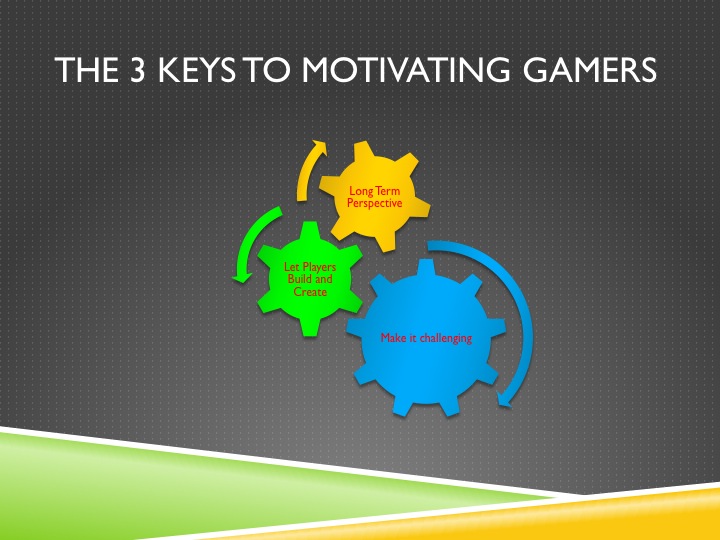
Make it challenging

The first insight is that people are often motivated to achieve things that are “difficult, challenging, and even painful.” Moreover, it they work harder and put in more effort, they enjoy a greater sense of ownership what they create and enjoy it more than if it is given to them.

Give people ownership

The second key to motivating players is to help them feel like owners of the content. In Ariely’s research, he had one group of people create origami creatures. He then offered to sell the origamis both to a group that was not involved in building them and to their creators. It turned out that the builders were willing to pay five times more for their handmade creations than the buyers were. As Ariely wrote, “our participants’ behavior clearly revealed that we are strongly motivated by identity, the need for recognition, a sense of accomplishment, and feeling of creation. “

The early invest express (invest your time and express yourself) games, such as Farmville and Hay Day, leveraged this motivation by allowing people to build their own farms. Since it was theirs, people would spend significant sums to keep and improve it. Even today, Clash of Clans and other games allow players to build their own forts or cities and this drives more engagement and monetization.

Create a long-term perspective

The final lesson from Ariely’s book is to create a long-term perspective. Rather than give people a one-time or short-term experience, players are most motivated if they have a long-term vision. Players would not bother putting a lot of energy into a short-term relationship, as Ariely writes, “whether with a romantic partner, employer, colleague, or apartment. But if you think of that relationship as a long-term investment, then you will be motivated to deposit more of your love, trust, energy, and time. This sense of investment is the basis of the marriage vow, and it is the basis of true dedication and loyalty….”

If you look at what turned social casino from a small niche part of the social game space to one of the largest is when they evolved from discrete slots experiences to a long-term meta-game where the goal was to continue unlocking content and progressing. This progression created a long-term perspective that motivates players to engage (and spend) more.

Another example would be the match-3 space. Bejeweled Blitz is a brilliant match-3 game. It is expertly designed for many exciting moments and perfect game balancing. Yet it never monetized as its creators had hoped (other than helping get the company sold to EA for about $1 billion). King entered the space with yet another match-3 game, Candy Crush Saga, but one that had a long-term goal, as you continuously wanted to progress. Candy Crush was able to transform an industry where customers were not motivated to spend to one of the most profitable in the mobile game space.

Motivation is critical

The better motivated your players, the more they will enjoy your game. The more they enjoy it, the more engaged they will be. And with engagement comes a successful product.

Key takeaways

  1. The first key to motivation is make it challenging.
  2. The second key to motivating players is to give them a sense of ownership.
  3. The final key to motivating players is give them a long-term perspective, not a one-off game play experience.

Share this:

  • Click to share on Facebook (Opens in new window) Facebook
  • Click to share on LinkedIn (Opens in new window) LinkedIn
Like Loading...
Unknown's avatarAuthor Lloyd MelnickPosted on January 11, 2017January 9, 2017Categories General Social Games Business, Social CasinoTags dan ariely, game design, motivationLeave a comment on How motivation can improve the performance of social games

Get my book on LTV

The definitive book on customer lifetime value, Understanding the Predictable, is now available in both print and Kindle formats on Amazon.

Understanding the Predictable delves into the world of Customer Lifetime Value (LTV), a metric that shows how much each customer is worth to your business. By understanding this metric, you can predict how changes to your product will impact the value of each customer. You will also learn how to apply this simple yet powerful method of predictive analytics to optimize your marketing and user acquisition.

For more information, click here

Follow The Business of Social Games and Casino on WordPress.com

Enter your email address to follow this blog and receive notifications of new posts by email.

Join 791 other subscribers

Most Recent Posts

  • Join me at PDMA Inspire for my talk on new product prioritization
  • Why keep studying?
  • The next three years of this blog
  • Interview with the CEO of Murka on the biggest growth opportunity in gaming, Barak David

Lloyd Melnick

This is Lloyd Melnick’s personal blog.  All views and opinions expressed on this website are mine alone and do not represent those of people, institutions or organizations that I may or may not be associated with in professional or personal capacity.

I am a serial builder of businesses (senior leadership on three exits worth over $700 million), successful in big (Disney, Stars Group/PokerStars, Zynga) and small companies (Merscom, Spooky Cool Labs) with over 20 years experience in the gaming and casino space.  Currently, I am the GM of VGW’s Chumba Casino and on the Board of Directors of Murka Games and Luckbox.

Topic Areas

  • Analytics (114)
  • Bayes' Theorem (8)
  • behavioral economics (8)
  • blue ocean strategy (14)
  • Crowdfunding (4)
  • DBA (2)
  • General Social Games Business (459)
  • General Tech Business (195)
  • Growth (88)
  • International Issues with Social Games (50)
  • Lloyd's favorite posts (101)
  • LTV (54)
  • Machine Learning (10)
  • Metaverse (1)
  • Mobile Platforms (37)
  • Prioritization (1)
  • Social Casino (52)
  • Social Games Marketing (105)
  • thinking fast and slow (5)
  • Uncategorized (33)

Social

  • View CasualGame’s profile on Facebook
  • View @lloydmelnick’s profile on Twitter
  • View lloydmelnick’s profile on LinkedIn

RSS

RSS Feed RSS - Posts

RSS Feed RSS - Comments

Categories

  • Analytics (114)
  • Bayes' Theorem (8)
  • behavioral economics (8)
  • blue ocean strategy (14)
  • Crowdfunding (4)
  • DBA (2)
  • General Social Games Business (459)
  • General Tech Business (195)
  • Growth (88)
  • International Issues with Social Games (50)
  • Lloyd's favorite posts (101)
  • LTV (54)
  • Machine Learning (10)
  • Metaverse (1)
  • Mobile Platforms (37)
  • Prioritization (1)
  • Social Casino (52)
  • Social Games Marketing (105)
  • thinking fast and slow (5)
  • Uncategorized (33)

Archives

  • September 2023
  • December 2021
  • July 2021
  • March 2021
  • February 2021
  • January 2021
  • December 2020
  • November 2020
  • October 2020
  • September 2020
  • August 2020
  • July 2020
  • June 2020
  • May 2020
  • April 2020
  • March 2020
  • February 2020
  • January 2020
  • November 2019
  • October 2019
  • September 2019
  • June 2019
  • May 2019
  • April 2019
  • March 2019
  • February 2019
  • January 2019
  • December 2018
  • June 2018
  • May 2018
  • April 2018
  • March 2018
  • February 2018
  • January 2018
  • December 2017
  • June 2017
  • May 2017
  • April 2017
  • March 2017
  • February 2017
  • January 2017
  • December 2016
  • November 2016
  • October 2016
  • September 2016
  • June 2016
  • May 2016
  • April 2016
  • March 2016
  • February 2016
  • January 2016
  • December 2015
  • November 2015
  • October 2015
  • September 2015
  • July 2015
  • June 2015
  • May 2015
  • April 2015
  • March 2015
  • February 2015
  • January 2015
  • December 2014
  • November 2014
  • October 2014
  • September 2014
  • August 2014
  • July 2014
  • June 2014
  • May 2014
  • April 2014
  • March 2014
  • February 2014
  • January 2014
  • December 2013
  • November 2013
  • October 2013
  • September 2013
  • August 2013
  • July 2013
  • June 2013
  • May 2013
  • April 2013
  • March 2013
  • February 2013
  • January 2013
  • December 2012
  • November 2012
  • October 2012
  • September 2012
  • August 2012
  • July 2012
  • June 2012
  • May 2012
  • April 2012
  • March 2012
  • February 2012
  • January 2012
  • December 2011
  • November 2011
  • October 2011
  • September 2011
  • August 2011
  • July 2011
  • June 2011
  • May 2011
  • December 2010
January 2017
S M T W T F S
1234567
891011121314
15161718192021
22232425262728
293031  
« Dec   Feb »

by Lloyd Melnick

All posts by Lloyd Melnick unless specified otherwise
Google+

Enter your email address to subscribe to this blog and receive notifications of new posts by email.

Join 791 other subscribers
Follow Lloyd Melnick on Quora

RSS HBR Blog

  • How One Manufacturer Achieved Net Zero at Zero Cost
  • What Can U.S. Employers Do About Rising Healthcare Costs?
  • When You Have to Execute a Strategy You Disagree With
  • 4 Ways to Build Durable Relationships with Your Most Important Customers
  • What Jargon Says About Your Company Culture
  • Research: When Used Correctly, LLMs Can Unlock More Creative Ideas
  • Your New Role Requires Strategic Thinking…But You’re Stuck in the Weeds
  • For Circular Economy Innovation, Look to the Global South
  • Why Great Leaders Focus on the Details
  • Corporate Disclosure in the Age of AI

RSS Techcrunch

  • An error has occurred; the feed is probably down. Try again later.

RSS MIT Sloan Management Review Blog

  • AI Coding Tools: The Productivity Trap Most Companies Miss
  • How Procter & Gamble Uses AI to Unlock New Insights From Data
  • Rewire Organizational Knowledge With GenAI
  • Hungry for Learning: Wendy’s Will Croushorn
  • Beat Burnout: 10 Essential MIT SMR Reads
  • How Leaders Stay True to Themselves and Their Stakeholders
  • Our Guide to the Winter 2026 Issue
  • Broadening Future Perspectives at the Bank of England
  • A Faster Way to Build Future Scenarios
  • Assess What Is Certain in a Sea of Unknowns
The Business of Social Games and Casino Website Powered by WordPress.com.
  • Subscribe Subscribed
    • The Business of Social Games and Casino
    • Join 726 other subscribers
    • Already have a WordPress.com account? Log in now.
    • The Business of Social Games and Casino
    • Subscribe Subscribed
    • Sign up
    • Log in
    • Report this content
    • View site in Reader
    • Manage subscriptions
    • Collapse this bar
 

Loading Comments...
 

    %d