Skip to content

The Business of Social Games and Casino

How to succeed in the mobile game space by Lloyd Melnick

Day: March 29, 2017

How to manage your own biases

I have always been interested in decision making and how people often are not logical in not only their preferences but even how they remember and look at facts. The most useful book I ever read was Thinking, Fast and Slow by Daniel Kahneman, (highly recommend it if you haven’t read it yet) and one of my favorite academics is behavioral economist Dan Ariely. Not only does Kahneman and Ariely’s research help you understand consumer behavior, it helps you understand your own decision making and, most importantly, mistakes most of us make.

A recent guest blog post on the Amplitude Blog, 5 Cognitive Biases Ruining Your Growth, does a great job of describing five biases that can greatly impact your business. While I will try to avoid just repeating the blog post, below are the five biases and some ways they may be impacting you:

  1. Confirmation bias. Confirmation bias is when you interpret or recall information in a way that confirms your preexisting beliefs or hypotheses, while giving disproportionately less consideration to alternative possibilities.This bias occurs regularly in the game space, especially with free to play games.

    A product manager may have driven a new feature, maybe a new price point on the pay wall. Rather than running an AB test (maybe insufficient traffic or other changes going on), they then review the feature pre and post launch. Game revenue per user increased 10 percent so they create a Powerpoint and email the CEO that there new feature had a 10 percent impact. Then the company adds this feature to all its games. The reality is that at the same time the feature was released the marketing team stopped a television campaign that was attracting poorly monetizing players. The latter is actually what caused the change in revenue. As someone who has known a lot of product managers, I can confirm this bias in the real world.

  2. The narrative fallacy. People try to comprehend information in stories, rather than looking at just the facts they create a story that links them together even if there is not really a link. If you watch business news, when the stock market goes up 5 points, the narrative may be the market has rebounded from its Brexit blues. If the market goes down 5 points, the same story would be the market is still suffering from Brexit. The reality is that 5 points is statistically insignificant (the market is an aggregate of multiple stocks) so neither narrative is more likely in either scenario. The key issue here is that we attribute causation where there is none.An example in the game world.

    Two branded games are in the top 5 of new releases. All of the analysis is that branded games are now what customers are looking for. The realities is that the two games, totally unrelated, had strong mechanics and were just that lucky 10% of games that succeed. Allowing the Narrative Fallacy to win, however, you then put your resources to branded games, which are no more popular than before the launch of the two successful titles.

  3. Dunning-Kruger Effect. Before the Amplitude post, I had not heard of this bias, at least with this name, but once you read about it I am sure you will know cases of it. The Dunning-Kruger Effect is when incompetent or somewhat unskilled people think they are more skilled than they are. As the article quotes, “incompetent people do not recognize—scratch that, cannot recognize—just how incompetent they are.”

    Again, for the example from the game industry. Let’s say you want to port your game to a new VR platform. You go to your development team and they say it won’t be a problem. You sign up for the project, give them the specs, six months later they still cannot get the game to run on the VR platform as they have no idea how to develop VR (this is a nicer example than some others I can remember).

  4. Backfire effect. The backfire effect is after analyzing something that you or your company are doing, if the results are negative and the action was bad, you or your colleagues refuse to accept the results. As they write in the blog post, “the exact definition of the Backfire Effect [is]: ‘When people react to disconfirming evidence by strengthening their beliefs.’”

    As an example, you decide to analyze how your company has been calculating LTV. You look back at the analysis done the last two years and see how actual LTV tracked with projections at that time. You discover that you underestimated actual spend by 50 percent. Should be great news, will allow you to ramp up dramatically your user acquisition. Instead, when you present this data to your analytics team, they refuse to accept it, saying your analysis is flawed because you are not looking at the right cohorts.

  5. Bandwagon effect. The bandwagon effect is what you would assume, the tendency to do things because many other people are doing it. People will rally around a cause, an idea, a candidate, a variation, or a strategy simply because it is popular.

    Given that I want to keep this blog post under 500 GB, I will not list all the examples of the bandwagon effect I have seen in the game industry. Product strategy, however, is the most obvious culprit. When the free to play game industry started to evolve to mobile, everyone started porting its Facebook games over to mobile. Since Zynga and the other big companies were doing it, all of the smaller companies as well as newly funded ones also tried to bring the same core mechanics from Facebook over to mobile. Mechanics that worked on Facebook, however, did not work on mobile but companies continued doing it because everyone else was. Rather than identify the market need and a potential blue ocean, companies just joined the bandwagon.
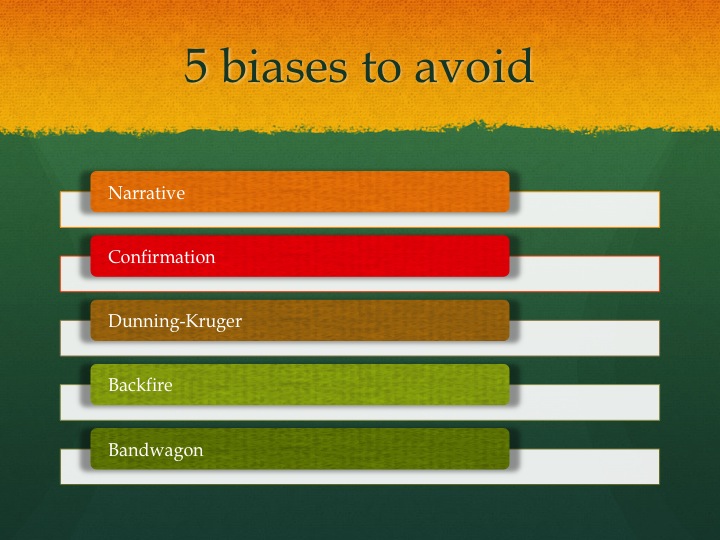
Slide1

Avoid these biases

The key to making the right decisions is not to assume you do not have biases, but always to be diligent in reviewing your decisions and making sure you are thinking rationally. All of these biases can lead to personal or company failure, so the inability to identify them can have extreme consequences.

Key takeaways

  1. Understanding our biases allows us to not only understand our customers but make better decisions.
  2. A core bias you see in the game industry is confirmation bias, where someone looks at data to prove their hypothesis (or brilliance), even if the data does not really support it.
  3. Another critical bias is the narrative fallacy, where we create a story to explain an event even if the story is not the cause of the event.

Share this:

  • Click to share on Facebook (Opens in new window) Facebook
  • Click to share on LinkedIn (Opens in new window) LinkedIn
Like Loading...
Unknown's avatarAuthor Lloyd MelnickPosted on March 29, 2017March 28, 2017Categories General Social Games Business, General Tech Business, UncategorizedTags bias, decision making1 Comment on How to manage your own biases

Get my book on LTV

The definitive book on customer lifetime value, Understanding the Predictable, is now available in both print and Kindle formats on Amazon.

Understanding the Predictable delves into the world of Customer Lifetime Value (LTV), a metric that shows how much each customer is worth to your business. By understanding this metric, you can predict how changes to your product will impact the value of each customer. You will also learn how to apply this simple yet powerful method of predictive analytics to optimize your marketing and user acquisition.

For more information, click here

Follow The Business of Social Games and Casino on WordPress.com

Enter your email address to follow this blog and receive notifications of new posts by email.

Join 791 other subscribers

Most Recent Posts

  • Join me at PDMA Inspire for my talk on new product prioritization
  • Why keep studying?
  • The next three years of this blog
  • Interview with the CEO of Murka on the biggest growth opportunity in gaming, Barak David

Lloyd Melnick

This is Lloyd Melnick’s personal blog.  All views and opinions expressed on this website are mine alone and do not represent those of people, institutions or organizations that I may or may not be associated with in professional or personal capacity.

I am a serial builder of businesses (senior leadership on three exits worth over $700 million), successful in big (Disney, Stars Group/PokerStars, Zynga) and small companies (Merscom, Spooky Cool Labs) with over 20 years experience in the gaming and casino space.  Currently, I am the GM of VGW’s Chumba Casino and on the Board of Directors of Murka Games and Luckbox.

Topic Areas

  • Analytics (114)
  • Bayes' Theorem (8)
  • behavioral economics (8)
  • blue ocean strategy (14)
  • Crowdfunding (4)
  • DBA (2)
  • General Social Games Business (459)
  • General Tech Business (195)
  • Growth (88)
  • International Issues with Social Games (50)
  • Lloyd's favorite posts (101)
  • LTV (54)
  • Machine Learning (10)
  • Metaverse (1)
  • Mobile Platforms (37)
  • Prioritization (1)
  • Social Casino (52)
  • Social Games Marketing (105)
  • thinking fast and slow (5)
  • Uncategorized (33)

Social

  • View CasualGame’s profile on Facebook
  • View @lloydmelnick’s profile on Twitter
  • View lloydmelnick’s profile on LinkedIn

RSS

RSS Feed RSS - Posts

RSS Feed RSS - Comments

Categories

  • Analytics (114)
  • Bayes' Theorem (8)
  • behavioral economics (8)
  • blue ocean strategy (14)
  • Crowdfunding (4)
  • DBA (2)
  • General Social Games Business (459)
  • General Tech Business (195)
  • Growth (88)
  • International Issues with Social Games (50)
  • Lloyd's favorite posts (101)
  • LTV (54)
  • Machine Learning (10)
  • Metaverse (1)
  • Mobile Platforms (37)
  • Prioritization (1)
  • Social Casino (52)
  • Social Games Marketing (105)
  • thinking fast and slow (5)
  • Uncategorized (33)

Archives

  • September 2023
  • December 2021
  • July 2021
  • March 2021
  • February 2021
  • January 2021
  • December 2020
  • November 2020
  • October 2020
  • September 2020
  • August 2020
  • July 2020
  • June 2020
  • May 2020
  • April 2020
  • March 2020
  • February 2020
  • January 2020
  • November 2019
  • October 2019
  • September 2019
  • June 2019
  • May 2019
  • April 2019
  • March 2019
  • February 2019
  • January 2019
  • December 2018
  • June 2018
  • May 2018
  • April 2018
  • March 2018
  • February 2018
  • January 2018
  • December 2017
  • June 2017
  • May 2017
  • April 2017
  • March 2017
  • February 2017
  • January 2017
  • December 2016
  • November 2016
  • October 2016
  • September 2016
  • June 2016
  • May 2016
  • April 2016
  • March 2016
  • February 2016
  • January 2016
  • December 2015
  • November 2015
  • October 2015
  • September 2015
  • July 2015
  • June 2015
  • May 2015
  • April 2015
  • March 2015
  • February 2015
  • January 2015
  • December 2014
  • November 2014
  • October 2014
  • September 2014
  • August 2014
  • July 2014
  • June 2014
  • May 2014
  • April 2014
  • March 2014
  • February 2014
  • January 2014
  • December 2013
  • November 2013
  • October 2013
  • September 2013
  • August 2013
  • July 2013
  • June 2013
  • May 2013
  • April 2013
  • March 2013
  • February 2013
  • January 2013
  • December 2012
  • November 2012
  • October 2012
  • September 2012
  • August 2012
  • July 2012
  • June 2012
  • May 2012
  • April 2012
  • March 2012
  • February 2012
  • January 2012
  • December 2011
  • November 2011
  • October 2011
  • September 2011
  • August 2011
  • July 2011
  • June 2011
  • May 2011
  • December 2010
March 2017
S M T W T F S
 1234
567891011
12131415161718
19202122232425
262728293031  
« Feb   Apr »

by Lloyd Melnick

All posts by Lloyd Melnick unless specified otherwise
Google+

Enter your email address to subscribe to this blog and receive notifications of new posts by email.

Join 791 other subscribers
Follow Lloyd Melnick on Quora

RSS HBR Blog

  • How One Manufacturer Achieved Net Zero at Zero Cost
  • What Can U.S. Employers Do About Rising Healthcare Costs?
  • When You Have to Execute a Strategy You Disagree With
  • 4 Ways to Build Durable Relationships with Your Most Important Customers
  • What Jargon Says About Your Company Culture
  • Research: When Used Correctly, LLMs Can Unlock More Creative Ideas
  • Your New Role Requires Strategic Thinking…But You’re Stuck in the Weeds
  • For Circular Economy Innovation, Look to the Global South
  • Why Great Leaders Focus on the Details
  • Corporate Disclosure in the Age of AI

RSS Techcrunch

  • An error has occurred; the feed is probably down. Try again later.

RSS MIT Sloan Management Review Blog

  • AI Coding Tools: The Productivity Trap Most Companies Miss
  • How Procter & Gamble Uses AI to Unlock New Insights From Data
  • Rewire Organizational Knowledge With GenAI
  • Hungry for Learning: Wendy’s Will Croushorn
  • Beat Burnout: 10 Essential MIT SMR Reads
  • How Leaders Stay True to Themselves and Their Stakeholders
  • Our Guide to the Winter 2026 Issue
  • Broadening Future Perspectives at the Bank of England
  • A Faster Way to Build Future Scenarios
  • Assess What Is Certain in a Sea of Unknowns
The Business of Social Games and Casino Website Powered by WordPress.com.
  • Subscribe Subscribed
    • The Business of Social Games and Casino
    • Join 726 other subscribers
    • Already have a WordPress.com account? Log in now.
    • The Business of Social Games and Casino
    • Subscribe Subscribed
    • Sign up
    • Log in
    • Report this content
    • View site in Reader
    • Manage subscriptions
    • Collapse this bar
 

Loading Comments...
 

    %d