Skip to content

The Business of Social Games and Casino

How to succeed in the mobile game space by Lloyd Melnick

Day: May 10, 2017

Making happy customers more profitable

While the key to business success is creating happy and loyal customers, you still need to get them to generate more revenue. A good NPS score and low churn rate shows your customers are satisfied but you only benefit when these customers act on their positive feelings. An article in Harvard Business Review, Make it Easier for Customers to Buy More by Bain Capital’s Rob Markey, shows how to convert this satisfaction into profits.
Slide1.png

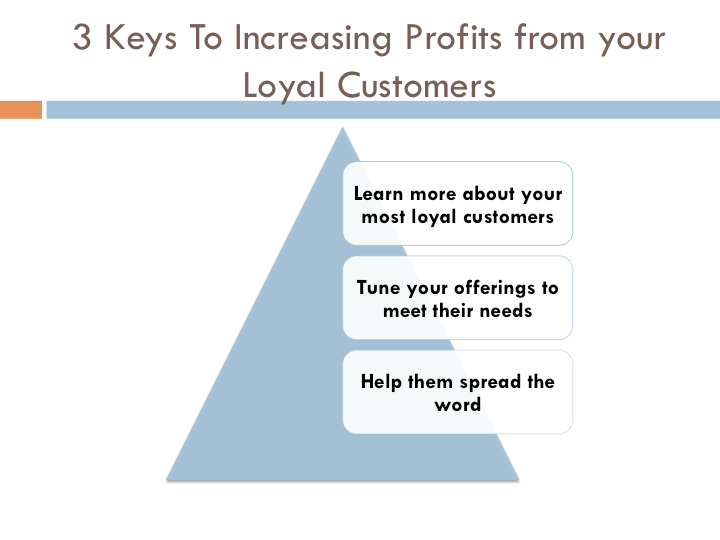
Learn more about your most loyal customers

The first key to generate more profits from your loyal customers is to understand them better. Markey makes the point that companies focus on learning why detractors, or unhappy customers, are dissatisfied but they do not put the same effort in understanding why the happy customers are happy. As Markey writes, “Converting feelings into action requires knowing exactly what you did to earn their loyalty, so you can replicate the action and extend it. To maintain that kind of intimate relationship with your most loyal customers, you have to create effective mechanisms for staying in close touch.”

Add to all of your communication channels feedback loops to ascertain why they love your company. Have your account or customer service reps ask customers why they first became enthusiastic. When sending out NPS surveys, make sure you ask those providing high scores the reason they gave such a score. Have customers post stories on social media on why they like your offering. Have events for your top customers and ensure part of the agenda is having customers discuss how they fell in love with your brand. Use all of your channels not only to help your customers but to learn from them.

Tune your offerings to meet their needs

When communicating with your best customers, you will learn both what they like and do not like about your offering. You will also understand if your competitors are offering something they want that you do not offer. Markey writes, “ideally, your offerings should be so attractive to your loyalists that they have no reason to look elsewhere for additional products or services.”

Once you understand your customers needs, then adjust your product to meet these needs. It may be by providing additional features or more support services. It could also entail offering your product through new distribution channels or in another format. The key is understanding what your best customers want from your product but are not getting, then adjusting your product to fill this need so they do not move to competitors.

Help them spread the word

Since your most loyal customers by definition love your offering, you want to harness this positive vibe by getting them to promote you to their friends. As people communicate best via stories, you need to provide them with stories that they can share. These stories can range from great interaction with your staff (maybe customer service, VIP management or on Facebook), a great experience with your game or product or even a little bonus you got via email. Once they have the stories, you need to facilitate them sharing the stories. This sharing often is by social media but it can be video testimonials on your website or even quotes in your game.

Loyal customers drive profits

While it is critical to create incredibly satisfied customers, that is not the end of the battle. You need to learn from them, use this knowledge to make your products even more suited to them and then turn them into advocates.

Key takeaways

  1. The first key to generate higher profits is learning from your most loyal customers why they love your product.
  2. The second key is taking this knowledge and further tweaking your product to meet your loyal customers’ needs.
  3. The final key is getting these loyal customers to advocate for you by sharing stories that show their friends why your product or company is great.

Share this:

  • Click to share on Facebook (Opens in new window) Facebook
  • Click to share on LinkedIn (Opens in new window) LinkedIn
Like Loading...
Unknown's avatarAuthor Lloyd MelnickPosted on May 10, 2017April 18, 2017Categories General Social Games Business, General Tech BusinessTags customer service, loyalty, NPSLeave a comment on Making happy customers more profitable

Get my book on LTV

The definitive book on customer lifetime value, Understanding the Predictable, is now available in both print and Kindle formats on Amazon.

Understanding the Predictable delves into the world of Customer Lifetime Value (LTV), a metric that shows how much each customer is worth to your business. By understanding this metric, you can predict how changes to your product will impact the value of each customer. You will also learn how to apply this simple yet powerful method of predictive analytics to optimize your marketing and user acquisition.

For more information, click here

Follow The Business of Social Games and Casino on WordPress.com

Enter your email address to follow this blog and receive notifications of new posts by email.

Join 791 other subscribers

Most Recent Posts

  • Join me at PDMA Inspire for my talk on new product prioritization
  • Why keep studying?
  • The next three years of this blog
  • Interview with the CEO of Murka on the biggest growth opportunity in gaming, Barak David

Lloyd Melnick

This is Lloyd Melnick’s personal blog.  All views and opinions expressed on this website are mine alone and do not represent those of people, institutions or organizations that I may or may not be associated with in professional or personal capacity.

I am a serial builder of businesses (senior leadership on three exits worth over $700 million), successful in big (Disney, Stars Group/PokerStars, Zynga) and small companies (Merscom, Spooky Cool Labs) with over 20 years experience in the gaming and casino space.  Currently, I am the GM of VGW’s Chumba Casino and on the Board of Directors of Murka Games and Luckbox.

Topic Areas

  • Analytics (114)
  • Bayes' Theorem (8)
  • behavioral economics (8)
  • blue ocean strategy (14)
  • Crowdfunding (4)
  • DBA (2)
  • General Social Games Business (459)
  • General Tech Business (195)
  • Growth (88)
  • International Issues with Social Games (50)
  • Lloyd's favorite posts (101)
  • LTV (54)
  • Machine Learning (10)
  • Metaverse (1)
  • Mobile Platforms (37)
  • Prioritization (1)
  • Social Casino (52)
  • Social Games Marketing (105)
  • thinking fast and slow (5)
  • Uncategorized (33)

Social

  • View CasualGame’s profile on Facebook
  • View @lloydmelnick’s profile on Twitter
  • View lloydmelnick’s profile on LinkedIn

RSS

RSS Feed RSS - Posts

RSS Feed RSS - Comments

Categories

  • Analytics (114)
  • Bayes' Theorem (8)
  • behavioral economics (8)
  • blue ocean strategy (14)
  • Crowdfunding (4)
  • DBA (2)
  • General Social Games Business (459)
  • General Tech Business (195)
  • Growth (88)
  • International Issues with Social Games (50)
  • Lloyd's favorite posts (101)
  • LTV (54)
  • Machine Learning (10)
  • Metaverse (1)
  • Mobile Platforms (37)
  • Prioritization (1)
  • Social Casino (52)
  • Social Games Marketing (105)
  • thinking fast and slow (5)
  • Uncategorized (33)

Archives

  • September 2023
  • December 2021
  • July 2021
  • March 2021
  • February 2021
  • January 2021
  • December 2020
  • November 2020
  • October 2020
  • September 2020
  • August 2020
  • July 2020
  • June 2020
  • May 2020
  • April 2020
  • March 2020
  • February 2020
  • January 2020
  • November 2019
  • October 2019
  • September 2019
  • June 2019
  • May 2019
  • April 2019
  • March 2019
  • February 2019
  • January 2019
  • December 2018
  • June 2018
  • May 2018
  • April 2018
  • March 2018
  • February 2018
  • January 2018
  • December 2017
  • June 2017
  • May 2017
  • April 2017
  • March 2017
  • February 2017
  • January 2017
  • December 2016
  • November 2016
  • October 2016
  • September 2016
  • June 2016
  • May 2016
  • April 2016
  • March 2016
  • February 2016
  • January 2016
  • December 2015
  • November 2015
  • October 2015
  • September 2015
  • July 2015
  • June 2015
  • May 2015
  • April 2015
  • March 2015
  • February 2015
  • January 2015
  • December 2014
  • November 2014
  • October 2014
  • September 2014
  • August 2014
  • July 2014
  • June 2014
  • May 2014
  • April 2014
  • March 2014
  • February 2014
  • January 2014
  • December 2013
  • November 2013
  • October 2013
  • September 2013
  • August 2013
  • July 2013
  • June 2013
  • May 2013
  • April 2013
  • March 2013
  • February 2013
  • January 2013
  • December 2012
  • November 2012
  • October 2012
  • September 2012
  • August 2012
  • July 2012
  • June 2012
  • May 2012
  • April 2012
  • March 2012
  • February 2012
  • January 2012
  • December 2011
  • November 2011
  • October 2011
  • September 2011
  • August 2011
  • July 2011
  • June 2011
  • May 2011
  • December 2010
May 2017
S M T W T F S
 123456
78910111213
14151617181920
21222324252627
28293031  
« Apr   Jun »

by Lloyd Melnick

All posts by Lloyd Melnick unless specified otherwise
Google+

Enter your email address to subscribe to this blog and receive notifications of new posts by email.

Join 791 other subscribers
Follow Lloyd Melnick on Quora

RSS HBR Blog

  • To Execute a Unified Strategy, Leaders Need to Shadow Each Other
  • What Companies that Excel at Strategic Foresight Do Differently
  • How Bristol Myers Squibb Transformed Working Capital to Fund Its Future - SPONSOR CONTENT FROM EY-PARTHENON
  • When Being a Family Business Becomes a Competitive Advantage
  • How to Handle a Difficult Board Member
  • How to Strengthen Your Focus When Demands Never Let Up
  • The Risks of Prioritizing Short-Term Revenue Over Customer Fit
  • When There’s Nowhere to Promote a Star Employee
  • Why AI Boosts Creativity for Some Employees but Not Others
  • Where McKinsey—and Consulting—Go From Here

RSS Techcrunch

  • An error has occurred; the feed is probably down. Try again later.

RSS MIT Sloan Management Review Blog

  • Build Better Pay-for-Performance (PFP) Compensation Plans
  • Your People Are Not All Right
  • Five Trends in AI and Data Science for 2026
  • Stop Making Hollow Apologies at Work
  • Calm: The Underrated Capability Every Leader Needs Now
  • The Top Five MIT SMR Videos of 2025
  • Three Steps Toward Fairer Talent Management
  • From Crisis to Coopetition: What Leaders Can Learn From Anesthesiologists
  • AI Coding Tools: The Productivity Trap Most Companies Miss
  • How Procter & Gamble Uses AI to Unlock New Insights From Data
The Business of Social Games and Casino Website Powered by WordPress.com.
  • Subscribe Subscribed
    • The Business of Social Games and Casino
    • Join 726 other subscribers
    • Already have a WordPress.com account? Log in now.
    • The Business of Social Games and Casino
    • Subscribe Subscribed
    • Sign up
    • Log in
    • Report this content
    • View site in Reader
    • Manage subscriptions
    • Collapse this bar
 

Loading Comments...
 

    %d