Last year, hypercasual games were the biggest story in mobile gaming. These games captured more than half of all downloads and saw several exits at high multiples. Five of the top 10 free games in the Google Play and Apple AppStores are hyper-casual while Ubisoft acquired Ketchapp for $100-$200 million, Zynga acquired Gram Games for $250 million and Goldman Sachs invested $200 million into Voodoo.
The space, however, is very reminiscent of the early days of social casino where any developer, small or large, could launch a slots product and then sit back and count the money. From Playtika (Slotomania was not great in the early days) to High 5 to Plumbee to GSN, anyone with a decent social casino app would enjoy high returns. As in any competitive industry, over the last few years the companies that could not create great products lost market share or failed whereas the good companies grew. While the social gaming market has grown every year for the past ten years, there have been winners and losers.
The hypercasual sector is likely develop similarly to social casino. Currently, virtually any developer (even one person) can build and launch (with the help of the many publishers) a profitable hypercasual game, with some earning hundreds of thousands of dollars monthly. You also see new companies flocking to the space daily: traditional developers who see it as easy money, established gaming companies looking for a new revenue stream and small independents.
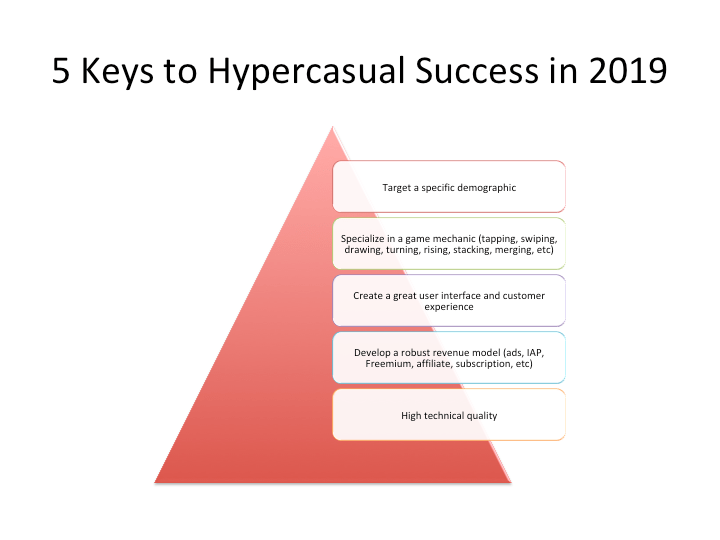
With the influx of so much supply, the next few years will become much more challenging for companies in the hypercasual space. There will still be huge successes, but there will be equally large failures, especially among players who are not committed or do not understand fully the space. Those that succeed will likely follow the five principles below:

Targeted demographic
”Know your customer” was probably the three words that a caveman etched in stone when writing the first business book. Developers of hypercasual games, however, claim their customers are “everybody” and there is no way to have an intimate customer knowledge if everyone is your customer. Most hypercasual games are thus developed for the lowest common denominator, so anyone can enjoy them.
This strategy works in the early days of a market, where there is so much demand a fun product will see a huge market. Think of Bejeweled in the early Match-3 days or Farmville when invest express games first hit Facebook. Those games were the biggest the category would ever see because there were so few options and thus everyone did play them. It’s the same with hypercasual, you still have a limited number of games.
As markets mature, the next phase is games that appeal to a specific demographic. Games for men 15-25, games for women 45+, games for students, games for artists, etc. Once you have a choice of a game optimized for your demographic, you are much less likely to be interested in mass entertainment. Thus, the next phase of the hypercasual market will see different developers focusing on different customer segments.
Focused on one game mechanic
Currently, as the hypercasual market is not very critical, developers are more interesting in create a suite of games quickly. They will replicate popular games and finish a game in a few months (or weeks), then move onto another entirely different game.
As the market matures, customers will be more discerning and will pick the best game in the category they like. The game industry is traditionally winner take all (or at least winner take most), so the likelihood the twentieth best stacking game will find a sizable audience are slim to none. Just as a slots developer is not going to create the best bingo game, a hypercasual developer is not going to create the best games for each hypercasual mechanic (tapping, swiping, drawing, turning, rising, stacking, merging, etc).
In the future, to succeed in hypercasual, you will need to master a game mechanic and create unique experiences. Rather than creating one game in each-sub-genre, create a great rising/falling game then iterate and keep making it better. To succeed, you will need to add unique features or elements to the genre and take it to the next level (pardon the pun).
Better UIUX
The current crop of hypercasual games often have poor user interfaces and mediocre customer experiences. While they are easy to learn, they are often difficult to understand and thoroughly enjoy. Most, even the successful ones, feel thrown together and the player has to figure it out as they go along. It is not a refined experience. They are the equivalent of cars that do not have handles on the doors or put the mirror control next to the back seat. As the industry evolves, customers will expect a smooth, intuitive interface and user experience.
Additionally, advertising now greatly diminishes the customer experience; with more product options players will be less accepting of so many intrusive ads. The only way to create a great UIUX is to devote the time to user testing and polishing and focus on the customer experience from installation through their lifetime, and this polish will be required to succeed in the future.
More robust revenue model
Now, most hypercasual games primarily generate revenue from ads. They do not have robust monetization models because they do not need it, revenue from ads is sufficient to cover user acquisition costs in successful hypercasual games.
Gram Games has expanded into IAP (in-app purchases) while several have a Freemium model that allows players to remove ads for a price. As the space gets more competitive, so will user acquisition. Simple supply and demand shows that UA costs will increase significantly while organic users will decrease as people will have more options. This phenomenon occurred in the social casino space and almost certainly will be replicated in hypercasual.
To mitigate higher acquisition costs, developers will have to increase LTV. Rather than simply relying on ads, successful developers will personalize monetization for each customer, with some happy to generate ad or affiliate revenue, others paying for IAP and some preferring a Freemium or subscription model.
High quality and tested
In the early days of any business, simply being first to market covers a lot of sins. Think of US automakers through the 1970s or the first Facebook games (which seemed to be in maintenance mode as much as they were live). As these and other industries matured, people placed a premium on reliable products. I have been amazed at how often the current generation of hypercasual games crash and how little time the developers have apparently devoted to QA. Success in 2019 (and beyond) will depend on making games that are reliable and bug-free.
How to win
To succeed in hypercasual in 2019 and beyond, you need to create a game that is best of breed for your target customer. Understand your customer and grow the segment, rather than trying to be everything to everyone. Most importantly, make sure the product is fun and polished.
Key takeaways
- In 2018, the hypercasual market was like the early days of the social casino market, put out a decent product and count the money. As companies flock to the hypercasual market, success will be much more challenging in 2019 and beyond.
- To succeed, rather than every developer putting out a plethora of different hypercasual games, the successful ones will target a demographic and specialize in a game mechanic that allows them to create a superior experience.
- Successful hypercasual developers will also polish products so that they have a professional UIUX and they work flawlessly.
 The Business of Social Games and Casino