Skip to content

The Business of Social Games and Casino

How to succeed in the mobile game space by Lloyd Melnick

Day: November 5, 2019

Confirmation of Confimation Bias

Confirmation of Confimation Bias

Although I have written many times about different kinds of biases, the one I find most common, even in my decision making, is his confirmation bias. An article I recently came across, Confirmation Bias: Why You Make Terrible Life Decision by Nir Eyal, confirmed to me what I suspected, confirmation bias is more pervasive than most people realize. Confirmation bias is where people pick out anecdotes or facts that support their belief, while neglecting conflicting evidence.

I see if often in the games industry, you want to add a new feature (say a chat system) and you point to three products with chat systems that are highly successful. You do not look at the ten products with chat systems that have failed. Maybe you are looking to build a new product and you want to license an expensive IP. You justify it by pointing to the revenue that Kim Kardashian’s game generating while not including in your calculation the 20 branded games that failed.

This problem is not limited to the game industry. You may believe that social democracy is the best path forward for a country and you use Sweden, Norway and the Netherlands to confirm your belief, while not noticing Cuba, Greece and Spain. Or you believe free markets are the answer and confirm this by looking at Singapore, Taiwan and the US while not noticing Sweden, Norway and the Netherlands. Sometimes people knowingly pick the cases that prove their point, however, confirmation bias is when they sub-consciously accept the evidence that supports their beliefs.

Data is not the panacea

Using data rather than emotions appears as a vaccine against confirmation bias but data can contribute to the problem. Analysts suffer from the same biases as other people and will often look at the data that confirms their hypothesis.

You may have launched a new product that has a strong LTV and is growing rapidly, surpassing your existing product. One analyst who belongs to the team that launched the new product might look at the retention and monetization metrics and compare them with the original product. These KPIs are higher in the new product so the analyst recommends marketing funds shift from the older product to the new product. An analyst on the team for the existing product might identify that shows that total revenue (new plus old product) is flat since the launch of the new product, despite additional marketing spend on the new product. They might argue that the new product is simply cannibalizing the existing product. The better KPIs of the new product are a result of the best users moving to the flashy new toy, not a fundamentally better product.

Depending on the analyst’s initial partiality, they will either investigate and then present the first or second data set. Neither data is incorrect but the conclusion and actions they lead to are very different. Even though both analysts are being honest and believe they are objective, confirmation bias is driving their analysis.

Confirmation bias can impact career decisions

Confirmation bias is not only prevalent in deciding what decisions to make in business but also how to manage your career. You might feel your company is not treating you fairly. Then when two colleagues get large bonuses and you do not, it confirms that you are being treated unfairly. The data you may not be considering is that you are on a higher compensation level already or had received a bonus six months ago.

You also may be considering moving to a competitor. You have met people at a trade show from the other company and they mentioned some of the great perks. You interview and are then offered a position. Before accepting, you see some negative reviews on Glassdoor. You have already decided that you want the new job so you convince yourself the reviews have to be from a different business unit or boss. When you get to the new job, you learn the problems are real.

How do you fight confirmation bias
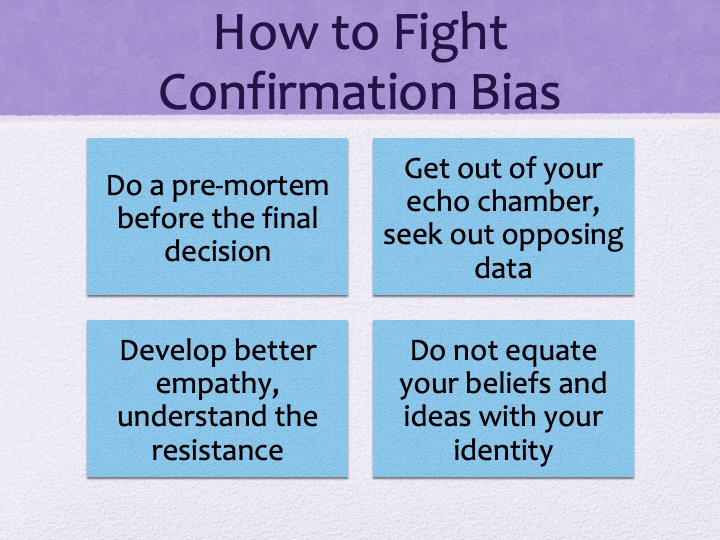
Slide1

Given the prevalence of confirmation bias, it is important to create a strategy to combat it. A recent article, Facts Don’t Change People’s Minds, Here is What Does by Ozan Varol, provides some great suggestions:

  • Do not feel your beliefs create your identity. Do not get defensive when someone questions you or your project. The data is not personal and you are not a better or worse person if your hypothesis is wrong.
  • Develop better empathy. If someone disagrees with you, it is because they think they are correct. Understand why they are disagreeing and be open to them being potentially correct.
  • Get out of your echo chamber. As Varol writes, “make a point to befriend people who disagree with you. Expose yourself to environments where your opinions can be challenged, as uncomfortable and awkward as that might be.” Seek out data that disproves your position.

Additionally, I have found pre-mortems a very useful tool to combat confirmation bias. A pre-mortem is a meeting held before a major decision where all those involved in making the decision imagine themselves six or twelve months after the decision was taken, assume it turned into a debacle, and then explore why it was a disaster. This type of meeting forces you to look at contradictory facts and raise potential problems.

It is important to be cognizant of confirmation bias and seek out all the information before making important decisions. Most importantly, look at contradictory information and do not discount it because it does not support your position.

Key takeaways

  • Confirmation bias is where people pick out examples or facts that support their belief, while neglecting conflicting evidence.
  • Being data driven does not avoid confirmation bias, as people gravitate to the data that supports their beliefs.
  • To combat confirmation bias, do not equate your beliefs with your identity, understand why others have different positions, seek out non-confirming data and do a pre-mortem for important decisions.

Share this:

  • Click to share on Facebook (Opens in new window) Facebook
  • Click to share on LinkedIn (Opens in new window) LinkedIn
Like Loading...
Unknown's avatarAuthor Lloyd MelnickPosted on November 5, 2019October 13, 2019Categories General Social Games BusinessTags confirmation bias, pre-mortem2 Comments on Confirmation of Confimation Bias

Get my book on LTV

The definitive book on customer lifetime value, Understanding the Predictable, is now available in both print and Kindle formats on Amazon.

Understanding the Predictable delves into the world of Customer Lifetime Value (LTV), a metric that shows how much each customer is worth to your business. By understanding this metric, you can predict how changes to your product will impact the value of each customer. You will also learn how to apply this simple yet powerful method of predictive analytics to optimize your marketing and user acquisition.

For more information, click here

Follow The Business of Social Games and Casino on WordPress.com

Enter your email address to follow this blog and receive notifications of new posts by email.

Join 791 other subscribers

Most Recent Posts

  • Join me at PDMA Inspire for my talk on new product prioritization
  • Why keep studying?
  • The next three years of this blog
  • Interview with the CEO of Murka on the biggest growth opportunity in gaming, Barak David

Lloyd Melnick

This is Lloyd Melnick’s personal blog.  All views and opinions expressed on this website are mine alone and do not represent those of people, institutions or organizations that I may or may not be associated with in professional or personal capacity.

I am a serial builder of businesses (senior leadership on three exits worth over $700 million), successful in big (Disney, Stars Group/PokerStars, Zynga) and small companies (Merscom, Spooky Cool Labs) with over 20 years experience in the gaming and casino space.  Currently, I am the GM of VGW’s Chumba Casino and on the Board of Directors of Murka Games and Luckbox.

Topic Areas

  • Analytics (114)
  • Bayes' Theorem (8)
  • behavioral economics (8)
  • blue ocean strategy (14)
  • Crowdfunding (4)
  • DBA (2)
  • General Social Games Business (459)
  • General Tech Business (195)
  • Growth (88)
  • International Issues with Social Games (50)
  • Lloyd's favorite posts (101)
  • LTV (54)
  • Machine Learning (10)
  • Metaverse (1)
  • Mobile Platforms (37)
  • Prioritization (1)
  • Social Casino (52)
  • Social Games Marketing (105)
  • thinking fast and slow (5)
  • Uncategorized (33)

Social

  • View CasualGame’s profile on Facebook
  • View @lloydmelnick’s profile on Twitter
  • View lloydmelnick’s profile on LinkedIn

RSS

RSS Feed RSS - Posts

RSS Feed RSS - Comments

Categories

  • Analytics (114)
  • Bayes' Theorem (8)
  • behavioral economics (8)
  • blue ocean strategy (14)
  • Crowdfunding (4)
  • DBA (2)
  • General Social Games Business (459)
  • General Tech Business (195)
  • Growth (88)
  • International Issues with Social Games (50)
  • Lloyd's favorite posts (101)
  • LTV (54)
  • Machine Learning (10)
  • Metaverse (1)
  • Mobile Platforms (37)
  • Prioritization (1)
  • Social Casino (52)
  • Social Games Marketing (105)
  • thinking fast and slow (5)
  • Uncategorized (33)

Archives

  • September 2023
  • December 2021
  • July 2021
  • March 2021
  • February 2021
  • January 2021
  • December 2020
  • November 2020
  • October 2020
  • September 2020
  • August 2020
  • July 2020
  • June 2020
  • May 2020
  • April 2020
  • March 2020
  • February 2020
  • January 2020
  • November 2019
  • October 2019
  • September 2019
  • June 2019
  • May 2019
  • April 2019
  • March 2019
  • February 2019
  • January 2019
  • December 2018
  • June 2018
  • May 2018
  • April 2018
  • March 2018
  • February 2018
  • January 2018
  • December 2017
  • June 2017
  • May 2017
  • April 2017
  • March 2017
  • February 2017
  • January 2017
  • December 2016
  • November 2016
  • October 2016
  • September 2016
  • June 2016
  • May 2016
  • April 2016
  • March 2016
  • February 2016
  • January 2016
  • December 2015
  • November 2015
  • October 2015
  • September 2015
  • July 2015
  • June 2015
  • May 2015
  • April 2015
  • March 2015
  • February 2015
  • January 2015
  • December 2014
  • November 2014
  • October 2014
  • September 2014
  • August 2014
  • July 2014
  • June 2014
  • May 2014
  • April 2014
  • March 2014
  • February 2014
  • January 2014
  • December 2013
  • November 2013
  • October 2013
  • September 2013
  • August 2013
  • July 2013
  • June 2013
  • May 2013
  • April 2013
  • March 2013
  • February 2013
  • January 2013
  • December 2012
  • November 2012
  • October 2012
  • September 2012
  • August 2012
  • July 2012
  • June 2012
  • May 2012
  • April 2012
  • March 2012
  • February 2012
  • January 2012
  • December 2011
  • November 2011
  • October 2011
  • September 2011
  • August 2011
  • July 2011
  • June 2011
  • May 2011
  • December 2010
November 2019
S M T W T F S
 12
3456789
10111213141516
17181920212223
24252627282930
« Oct   Jan »

by Lloyd Melnick

All posts by Lloyd Melnick unless specified otherwise
Google+

Enter your email address to subscribe to this blog and receive notifications of new posts by email.

Join 791 other subscribers
Follow Lloyd Melnick on Quora

RSS HBR Blog

  • To Execute a Unified Strategy, Leaders Need to Shadow Each Other
  • What Companies that Excel at Strategic Foresight Do Differently
  • How Bristol Myers Squibb Transformed Working Capital to Fund Its Future - SPONSOR CONTENT FROM EY-PARTHENON
  • When Being a Family Business Becomes a Competitive Advantage
  • How to Handle a Difficult Board Member
  • How to Strengthen Your Focus When Demands Never Let Up
  • The Risks of Prioritizing Short-Term Revenue Over Customer Fit
  • When There’s Nowhere to Promote a Star Employee
  • Why AI Boosts Creativity for Some Employees but Not Others
  • Where McKinsey—and Consulting—Go From Here

RSS Techcrunch

  • An error has occurred; the feed is probably down. Try again later.

RSS MIT Sloan Management Review Blog

  • Build Better Pay-for-Performance (PFP) Compensation Plans
  • Your People Are Not All Right
  • Five Trends in AI and Data Science for 2026
  • Stop Making Hollow Apologies at Work
  • Calm: The Underrated Capability Every Leader Needs Now
  • The Top Five MIT SMR Videos of 2025
  • Three Steps Toward Fairer Talent Management
  • From Crisis to Coopetition: What Leaders Can Learn From Anesthesiologists
  • AI Coding Tools: The Productivity Trap Most Companies Miss
  • How Procter & Gamble Uses AI to Unlock New Insights From Data
The Business of Social Games and Casino Website Powered by WordPress.com.
  • Subscribe Subscribed
    • The Business of Social Games and Casino
    • Join 726 other subscribers
    • Already have a WordPress.com account? Log in now.
    • The Business of Social Games and Casino
    • Subscribe Subscribed
    • Sign up
    • Log in
    • Report this content
    • View site in Reader
    • Manage subscriptions
    • Collapse this bar
 

Loading Comments...
 

    %d