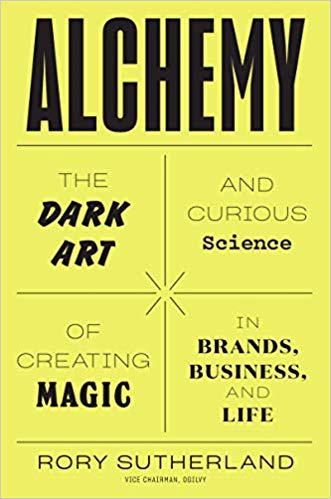
I am a huge fan of behavioral economics — Dan Ariely is my favorite author — and find it very useful in helping with business issues. Behavioral economics blends ideas from psychology and economics, and it can provide valuable insight that individuals are sometimes not behaving in their own best interests. Behavioral economics provides a framework to understand when and how people make errors. Systematic errors or biases recur predictably in particular circumstances. A colleague recently recommended a book, Alchemy by Ogilvy Vice Chairman and marketing guru Rory Sutherland, that provides many real life applications and insights leveraging behavioral economics.
To use Sutherland’s words, “ there is an ostensible, rational, self-declared reason why we do things, and there is also a cryptic or hidden purpose. Learning how to disentangle the literal from the lateral meaning is essential to solving cryptic crosswords, and it is also essential to understanding human behavior.”
Logic can prompt you to miss great opportunities
Sutherland’s first recommendation is that the first or obvious “logical” answer may not be right or optimal. He explains that the opposite of a good idea can also be a good idea. Even if one course of action makes sense, there may be a better approach.
Logic does not necessarily lead to great, in many ways it drives you to average. If you are being logical, you can assume your competitors are also following a logical course of thinking. By following a logical path, you will end up in a red ocean at a level comparable to your competitors.
Logic can prevent you from creating great. If Steve Jobs and Jony Ive had pursued logic when designing a PC or phone for Apple, at best they would have built a better Dell or Nokia, instead of the most valuable company in the world. As Sutherland writes, “the problem with logic is that it kills off magic.” To quote Jobs, “stay hungry, stay foolish.” If great ideas initially made sense, somebody else would have already discovered them.
Another problem with logic that Sutherlands points out is that it is often used to justify bad decisions. People will use logic to either justify a bad course of action or provide protection from bad decisions, rather than seeking the best decision. Good debaters are great at using logic to justify any position rather than finding the best course of action. Sutherland writes, “business people and politicians do not quite understand this and tend to evaluate decisions by the rigor of the process that produces them, rather than by the rigor with which you evaluate their consequences….To them, the use of reason ‘looks scientific’, even if it is being used in the wrong place.”
This misuse of logic often prompts people to proceed with apparently reasonable things quickly while treating counterintuitive ideas with suspicion. It is easy to defend the reasonable thing if it fails, but people run more risk if they try the counterintuitive idea and it fails. The latter, however, provides the opportunity to separate your business from the competition.
Sutherland offers several examples of counter-intuitive ideas that generated billion dollar businesses. One would be to imagine you are in the boardroom trying to come up with a strategy to compete with Coca-Cola. The conventional answer would be to create a drink that tastes better or is less expensive. What if someone, however, suggested, a worse tasting drink packaged in a smaller container at the same or higher price. The latter is what Red Bull did and created a brand that Forbes estimates is worth almost $10 billion.
Sutherland’s point is that conventional logic is hopeless in marketing, you end up in the same place as your competitors. Even if we cannot explain eloquently why something will work (like a bad tasting expensive soft drink), we should not be blind to the fact that it does.
People are not rational
Not only is the logical and rational path not necessarily optimal, it is also not the one our customers might be pursuing. Another example that Sutherland explains is a marketing test he ran. He showed two advertisements, one a contest where a player could win free energy for a year (worth about $1,500) and another where you could win a cute penguin nightlight (worth about $20). If people react rationally, you would expect an order of magnitude more entries into the contest giving away the energy. Almost the inverse happened, 67,000 people entered to win the energy and 360,000 entered to win the cute animal nightlight. The takeaway here is not only do people not always act logically but also that cute animals are a very effective marketing technique (and you cannot use logic to determine what will be a powerful marketing message).
There are many other examples of how people do not always behave in a way that would be considered rational. The best selling wine at restaurants is usually the second least expensive. That is not because restaurants put their best value there, they will often put a less expensive bottle cost wise in that position. P assume, however, the least expensive wine is lowest quality or are embarrassed to order it for fear of looking cheap, they are not making the wisest (or rational) decision. Restaurants have also found that by offering people still or sparkling bottled water, they increase sales because many people do not ask for tap water. These examples reinforce that consumer behavior is not simply based on people making rational decisions to optimize their happiness.
Data can be misleading
One area that Sutherland focuses on that is particularly dear to me is how data is often misused. Sutherland writes that “we constantly rewrite the past to form a narrative that cuts out the non-critical points–and which replaces luck and random experimentation with conscious intent…. It is important to remember that big data all comes from the same place–the past…. A single change in context can change human behavior significantly. For instance, all the behavioral data in 1993 would have predicted a great future for the fax machine.”
Not only can data be used to criticize a good decision or justify a bad one, it is possible to construct a plausible reason for any course of action, by cherry-picking the data you choose to include in your model and ignoring inconvenient facts. I have written before about confirmation bias, and more data makes it easier to find support for some spurious, self-serving narrative. Effectively, you can find more pieces to confirm whatever you are arguing. Sutherland argues, “the profusion of data in future will not settle arguments: it will make them worse.”
Related, Sutherland points out, “people who are not skilled at mathematics tend to view the output of second-rate mathematicians with an high level of credulity, and attach almost mystical significance to their findings. Bad maths is the palmistry of the twenty-first century. Yet bad maths can lead to collective insanity, and it is far easier to be massively wrong mathematically than most people realise–a single dud data point or false assumption can lead to results that are wrong by many orders of magnitude….To put it crudely, when you multiply bullshit with bullshit, you don’t get a bit more bullshit–you get bullshit squared.”
Market research is often as unreliable as other data. As well as not always acting rationally, people often do not know what they prefer. Sutherland writes, “the trouble with market research is that people don’t think what they feel, they don’t say what they think, and they don’t do what they say. People simply do not have introspective access to their motivations….It is perfectly possible that conventional market research has, over the past fifty years, killed more good ideas than it has spawned, by obsessing with a false idea of representativeness.”
Market research also can miss what is driving a person’s decision, such as avoiding disaster rather than getting the best outcome. Someone choosing Product A over Product B would say that they thought Product A is ‘better’, even if really they meant something quite different. They may unconsciously be deciding that they prefer Product A because the odds of its being disastrously bad are only 1 percent, whereas the risk with Product B might be 2.8 percent. This distinction matters a great deal, and it is borne out in many fields of decision science. People will pay a disproportionately high premium for the elimination of a small degree of uncertainty.
Once you understand the limitations of data, you can create great outcomes. Following conventional wisdom leads you do what your competitors are doings and metrics prompt you to design for average. Averages (and medians) encourage you to focus on the middle of a market, but innovation happens at the extremes. You are more likely to come up with a good idea focusing on one outlier than on ten average players.
Perception over reality
The other issue with relying on historic data is that it assumes people’s decisions are logical, given they are often not rational that reliance can be a mistake. Sutherland aptly says, “in maths it is a rule that 2 + 2 = 4. In psychology, 2 + 2 can equal more or less than 4. It’s up to you.” At its heart, people do not value things, they value the meaning attached to these things. While the objects properties are determined by physics, what they mean is determined by psychology.
There are multiple examples of how perception forms our reality. Wine tastes better when poured from a heavier bottle or has a French label. Painkillers are more effective when people believe they are expensive. Almost everything becomes more desirable when people believe it is in scarce supply, and possessions become more enjoyable when they have a famous brand name attached.
A great example of the power of psychology is Uber’s success. Uber’s map does not reduce the waiting time for a taxi but simply makes waiting much less frustrating. Travis Kalanick, Uber’s founder, realized people are bothered more by the uncertainty of waiting than by the duration of a wait.
Another example are claims on products, as people often think packaging that implies a product is healthy or good for them (or an app), is less tasty. It does not matter what something tastes like in blind tastings, if you put low in fat or any other health indicators on the packaging, Sutherland shows that you will make the contents taste worse.
Another area where perception is more important to a customer’s satisfaction is price. Why do people love sales, rather than spending the time to find the everyday low price. Sutherland explains “a low price, unlike a discount, does not allow people any scope to write a more cheerful narrative about a purchase after the event–‘I saved £33’, rather than ‘I spent £45’.” Marketing can have a strong impact here, not only justifying a high price but also detoxifying a low one.
The importance of optimizing for perception creates many opportunities to improve your business. I have written several times about customer experience and service, and focusing on perception allows you to create a superior experience. Some ways you can impact the experience, based on Sutherland’s ideas:
- Small acts of discretionary generosity, such as waiving a charge when a customer ordered a dish they did not like or a complimentary chocolate at the end of a meal are regarded by customers as reassuring indicators of trustworthiness; we correspondingly see the absence of such signals as being a cause for concern.
- Offering more customer service touch points or opportunities for live contacts. One of the reasons why customer service is such a strong indicator of how we judge a company is because we are aware that it costs money and time to provide.
- Provide collateral outside of email. Sutherland writes, “bits deliver information, but costliness carries meaning. We do not invite people to our weddings by sending out an email. We put the information (all of which would fit on an email–or even a text message) on a gilt embossed card, which costs a fortune….We notice and attach significance and meaning to those things that deviate from narrow, economic common sense, precisely because they deviate from it. The result of this is that the pursuit of narrow economic rationalism will produce a world rich in goods, but deficient in meaning.”
It is also important to stress that it is not immoral to build a product or service to appeal to customer’s perceptions rather than logic. The Greeks did it first. There is barely a straight line in the Parthenon, the floor curves upwards in the middle, the sides bow out and the columns swell in the middle. This shape is because it is not designed to be perfect, instead it is designed to look perfect to a human standing about a hundred yards away.
Effectively, we want to make people happier and feel better. This can be achieved by improving their perception of their situation. It’s similar to a doctor who can help cure a patient either by giving a placebo or actual medicine. If the placebo serves the same purpose, it is in the patient’s interest to get the placebo (as it potentially has less side effects). As Sutherland says, “we should be researching this rather than decrying it.”
Social context is critical
Another key insight in Alchemy is the importance of social context. Sutherland explains that the context in which someone experiences something is the key to how they perceive it. According to Sutherland, “our very perception of the world is affected by context, which is why the rational attempt to contrive universal, context-free laws for human behavior may be largely doomed.”
There are many examples of where context determines how something is perceived. A hospital might have brilliant doctors, but if the reception area has old magazines we are likely to complain. If you go to a restaurant, your perception will be driven less by the food, the real value lies in social connection, and status. If you see a movie star at the table across from you and a line of Bentleys outside, you will probably end up telling your friends about an incredible dining experience. Sutherland points out, “we make far more positive comments about a dish’s appeal and taste when it is garlanded with an evocative description: ‘A label directs a person’s attention towards a feature in a dish, and hence helps bring out certain flavors and textures.’ Never forget this: the nature of our attention affects the nature of our experience.”
Less is more
I have written before how making a product simpler and less functional is one of the key ways you can build a superior product – from Uber to Monzo
to hypercasual games– and Sutherland reinforces this hypothesis. With new products or games, you can always add, but while this makes the new offering more versatile, it also reduces the clarity of its affordance, making it less pleasurable to use and quite possibly more difficult to justify buying. Sutherland explains, “the jack-of-all-trades-heuristic, whereby we naturally assume that something that only does one thing is better than something that claims to do many things.”
Sutherland pointed to the success of the Sony Walkman. Sony, by removing the recording function from Walkmans, created a product that had less functionality, but a far greater potential to a change behavior. By reducing the possible applications of the device to a single use, it clarified how people could use the device. As Sutherland says, “it is surprisingly common for significant innovations to emerge from the removal of features rather than the addition.”
How to make it work
Given that logic or date or research cannot predict much behavior, you need to find an alternative to benefit from Sutherland’s findings. It comes down to testing different approaches and trying creative ideas. Sutherland suggests, “the only way you can discover what people really want (their ‘revealed preferences’, in economic parlance) is through seeing what they actually pay for under a variety of different conditions, in a variety of contexts. This requires trial and error–which requires competitive markets and marketing.”
In addition to testing, think creatively. Sutherland suggests we spend “20 per cent of conversational time … for the consideration of alternative explanations, acknowledging the possibility that the real ‘why’ differs from the official ‘why’, and that our evolved rationality is very different from the economic idea of rationality. If we could resist the urge to be logical just some of the time, and devote that time instead to the pursuit of alchemy, what might we discover? Quite a lot of lead, I suspect. But a surprising amount of gold.”
Key takeaways
- People often do not action logically so you should not base decisions on expecting your customers to act logically
- The key is someone’s perception, not the reality. While in math 2+2 = 4, in psychology it could equal 5 (or 6 or 3), so we need to anticipate how the context will drive the perception.
- The best way to create innovative solutions is by testing different options and thinking creatively.
 The Business of Social Games and Casino