Skip to content

The Business of Social Games and Casino

How to succeed in the mobile game space by Lloyd Melnick

Day: April 8, 2020

The Reese’s Peanut Butter Cup of game monetization models

The Reese’s Peanut Butter Cup of game monetization models

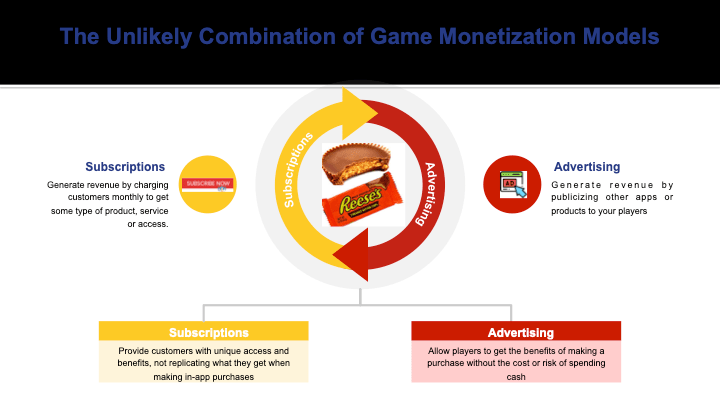
I am always on the lookout for monetization models that can augment or disrupt the gaming space and I have recently come across a hybrid one that has great potential. I think subscriptions are a great way to create recurring revenue and increased loyalty. I am also a big fan of in-game advertising, as it allows players who would not normally monetize to gain greater value from a product while delivering revenue to the creator. I also recently noted the success of hypercasual games, which has been driven by advertising.
Slide1

Recent research in the streaming space highlights an intriguing opportunity for game companies. A survey of consumers with connected televisions found that 76 percent are open to see ads in exchange for free streaming services. Additionally, 64 percent of consumers say they don’t plan to add a subscription video streaming service in the next year.

There are two very important implications of this research. The first is that while traditional subscriptions are still promising, many people are reluctant to add more subscriptions to their monthly burn. While it is still too early to understand the impact of Coronavirus, people may become even more conservative with their cash flow as they have to deal with a new economic environment. Second, rather than ask people to sign up for a regular charge, they are more likely to agree to a subscription if the cost is “free,” simply watching an advertisement(s).

Opportunities

For game companies, this peanut butter cup (the combination of subscriptions and advertising) presents multiple opportunities:

  • Create an additional subscription stream where players deliver revenue through ads. While the amount you can generate has a lower ceiling with ads, you can still build a subscription model using ads. By relying on ads rather than purchases, you also reduce customers’ barrier to signing up so you are more likely to get high pick up rate.
  • Use advertising to drive a game streaming service. While Stadia, and possibly Apple Arcade, have not gained much traction with a traditional subscription model, an ad-driven purchase model might allow them to get critical mass.
  • Leverage ad-driven subscriptions to sell flow of regular game or content release. If you are a hypercasual publisher, an ad driven subscription model can give players access to X/month games.

Ad driven subscriptions can also be integrated into different stages of your customer lifecycle or a broader subscription model. Rather than asking people to commit before they are hooked on your product, allowing players to subscribe by watching ads the first month or the first three months lowers their risk while getting them to become a subscriber. You then convert them later in the funnel to full paying subscribers.

You can also allow players who have lapsed or churned to renew their subscription by watching an ad. Thus, if they had to cancel because of cash flow issues or if they were not getting sufficient value to cover the cost, ad-driven subscriptions are an additional way to retain some revenue from these players and keep them in your ecosystem.

Challenges

While offering an ad-driven mechanic for customers to subscribe creates many options, it also presents challenges. First, one of the great benefits of subscriptions is that it gets your customers invested in the product. This makes them more committed and engaged. If they acquire the subscription by watching an ad(s), they may not be as committed to the long-term relationship. Second, to generate sufficient subscription revenue, a customer will need to watch or be exposed to multiple ads. If they are just watching ad after ad in one sitting, the value you can deliver to advertisers will be minimal. You will need to come up with creative solutions to generate enough ad revenue to justify providing a subscription. Finally, a subscription requires regular purchases, which is how subscriptions delivers reliable revenue. It is simple to bill a player regularly for their subscription and it becomes passive activity for your customer. With advertising, they will have to proactively watch ads every time the subscription renews. One potential alternative would be showing interstitial ads or ads in another frame, rather than relying on a watch-to-earn mechanic.

Figure it out

Just because nobody before Reese’s thought of a good way to combine chocolate with peanut butter did not mean it was a bad idea. It is the same with ads and subscriptions. The companies that crack the code first for merging these two monetization models are likely to see great returns.

Key takeaways

  1. Two of the most promising business models to grow the game industry are subscriptions and advertising, so combining the two can create a unique opportunity.
  2. There are three ways game companies can leverage this opportunity: create an in-game subscription option that incorporates ads, use subscriptions to grow a streaming service or publish a flow of games that customers subscribe to via subs.
  3. Challenges include generating enough subscription revenue through ads, getting customers to feel committed and figuring out a mechanic for players to renew.

Share this:

  • Click to share on Facebook (Opens in new window) Facebook
  • Click to share on LinkedIn (Opens in new window) LinkedIn
Like Loading...
Unknown's avatarAuthor Lloyd MelnickPosted on April 8, 2020March 28, 2020Categories General Social Games Business, GrowthTags advertising, monetization, SubscriptionLeave a comment on The Reese’s Peanut Butter Cup of game monetization models

Get my book on LTV

The definitive book on customer lifetime value, Understanding the Predictable, is now available in both print and Kindle formats on Amazon.

Understanding the Predictable delves into the world of Customer Lifetime Value (LTV), a metric that shows how much each customer is worth to your business. By understanding this metric, you can predict how changes to your product will impact the value of each customer. You will also learn how to apply this simple yet powerful method of predictive analytics to optimize your marketing and user acquisition.

For more information, click here

Follow The Business of Social Games and Casino on WordPress.com

Enter your email address to follow this blog and receive notifications of new posts by email.

Join 791 other subscribers

Most Recent Posts

  • Join me at PDMA Inspire for my talk on new product prioritization
  • Why keep studying?
  • The next three years of this blog
  • Interview with the CEO of Murka on the biggest growth opportunity in gaming, Barak David

Lloyd Melnick

This is Lloyd Melnick’s personal blog.  All views and opinions expressed on this website are mine alone and do not represent those of people, institutions or organizations that I may or may not be associated with in professional or personal capacity.

I am a serial builder of businesses (senior leadership on three exits worth over $700 million), successful in big (Disney, Stars Group/PokerStars, Zynga) and small companies (Merscom, Spooky Cool Labs) with over 20 years experience in the gaming and casino space.  Currently, I am the GM of VGW’s Chumba Casino and on the Board of Directors of Murka Games and Luckbox.

Topic Areas

  • Analytics (114)
  • Bayes' Theorem (8)
  • behavioral economics (8)
  • blue ocean strategy (14)
  • Crowdfunding (4)
  • DBA (2)
  • General Social Games Business (459)
  • General Tech Business (195)
  • Growth (88)
  • International Issues with Social Games (50)
  • Lloyd's favorite posts (101)
  • LTV (54)
  • Machine Learning (10)
  • Metaverse (1)
  • Mobile Platforms (37)
  • Prioritization (1)
  • Social Casino (52)
  • Social Games Marketing (105)
  • thinking fast and slow (5)
  • Uncategorized (33)

Social

  • View CasualGame’s profile on Facebook
  • View @lloydmelnick’s profile on Twitter
  • View lloydmelnick’s profile on LinkedIn

RSS

RSS Feed RSS - Posts

RSS Feed RSS - Comments

Categories

  • Analytics (114)
  • Bayes' Theorem (8)
  • behavioral economics (8)
  • blue ocean strategy (14)
  • Crowdfunding (4)
  • DBA (2)
  • General Social Games Business (459)
  • General Tech Business (195)
  • Growth (88)
  • International Issues with Social Games (50)
  • Lloyd's favorite posts (101)
  • LTV (54)
  • Machine Learning (10)
  • Metaverse (1)
  • Mobile Platforms (37)
  • Prioritization (1)
  • Social Casino (52)
  • Social Games Marketing (105)
  • thinking fast and slow (5)
  • Uncategorized (33)

Archives

  • September 2023
  • December 2021
  • July 2021
  • March 2021
  • February 2021
  • January 2021
  • December 2020
  • November 2020
  • October 2020
  • September 2020
  • August 2020
  • July 2020
  • June 2020
  • May 2020
  • April 2020
  • March 2020
  • February 2020
  • January 2020
  • November 2019
  • October 2019
  • September 2019
  • June 2019
  • May 2019
  • April 2019
  • March 2019
  • February 2019
  • January 2019
  • December 2018
  • June 2018
  • May 2018
  • April 2018
  • March 2018
  • February 2018
  • January 2018
  • December 2017
  • June 2017
  • May 2017
  • April 2017
  • March 2017
  • February 2017
  • January 2017
  • December 2016
  • November 2016
  • October 2016
  • September 2016
  • June 2016
  • May 2016
  • April 2016
  • March 2016
  • February 2016
  • January 2016
  • December 2015
  • November 2015
  • October 2015
  • September 2015
  • July 2015
  • June 2015
  • May 2015
  • April 2015
  • March 2015
  • February 2015
  • January 2015
  • December 2014
  • November 2014
  • October 2014
  • September 2014
  • August 2014
  • July 2014
  • June 2014
  • May 2014
  • April 2014
  • March 2014
  • February 2014
  • January 2014
  • December 2013
  • November 2013
  • October 2013
  • September 2013
  • August 2013
  • July 2013
  • June 2013
  • May 2013
  • April 2013
  • March 2013
  • February 2013
  • January 2013
  • December 2012
  • November 2012
  • October 2012
  • September 2012
  • August 2012
  • July 2012
  • June 2012
  • May 2012
  • April 2012
  • March 2012
  • February 2012
  • January 2012
  • December 2011
  • November 2011
  • October 2011
  • September 2011
  • August 2011
  • July 2011
  • June 2011
  • May 2011
  • December 2010
April 2020
S M T W T F S
 1234
567891011
12131415161718
19202122232425
2627282930  
« Mar   May »

by Lloyd Melnick

All posts by Lloyd Melnick unless specified otherwise
Google+

Enter your email address to subscribe to this blog and receive notifications of new posts by email.

Join 791 other subscribers
Follow Lloyd Melnick on Quora

RSS HBR Blog

  • How One Manufacturer Achieved Net Zero at Zero Cost
  • What Can U.S. Employers Do About Rising Healthcare Costs?
  • When You Have to Execute a Strategy You Disagree With
  • 4 Ways to Build Durable Relationships with Your Most Important Customers
  • What Jargon Says About Your Company Culture
  • Research: When Used Correctly, LLMs Can Unlock More Creative Ideas
  • Your New Role Requires Strategic Thinking…But You’re Stuck in the Weeds
  • For Circular Economy Innovation, Look to the Global South
  • Why Great Leaders Focus on the Details
  • Corporate Disclosure in the Age of AI

RSS Techcrunch

  • An error has occurred; the feed is probably down. Try again later.

RSS MIT Sloan Management Review Blog

  • AI Coding Tools: The Productivity Trap Most Companies Miss
  • How Procter & Gamble Uses AI to Unlock New Insights From Data
  • Rewire Organizational Knowledge With GenAI
  • Hungry for Learning: Wendy’s Will Croushorn
  • Beat Burnout: 10 Essential MIT SMR Reads
  • How Leaders Stay True to Themselves and Their Stakeholders
  • Our Guide to the Winter 2026 Issue
  • Broadening Future Perspectives at the Bank of England
  • A Faster Way to Build Future Scenarios
  • Assess What Is Certain in a Sea of Unknowns
The Business of Social Games and Casino Website Powered by WordPress.com.
  • Subscribe Subscribed
    • The Business of Social Games and Casino
    • Join 726 other subscribers
    • Already have a WordPress.com account? Log in now.
    • The Business of Social Games and Casino
    • Subscribe Subscribed
    • Sign up
    • Log in
    • Report this content
    • View site in Reader
    • Manage subscriptions
    • Collapse this bar
 

Loading Comments...
 

    %d