Skip to content

The Business of Social Games and Casino

How to succeed in the mobile game space by Lloyd Melnick

Day: June 17, 2020

How to avoid meetings about the trivial, aka bikeshedding

How to avoid meetings about the trivial, aka bikeshedding

I have written before on my general distaste of meetings and how they frequently destroy more value than they create, and one of the key reasons I detest meetings so much is they always seem to be about trivial things. A recent article, Why We Focus on Trivial Things: The Bikeshed Effect, explains why we gloss over important topics and focus on the trivial. Bikeshedding is a metaphor to illustrate the tendency we have to spend excessive time on trivial matters, often glossing over important ones.

What is bikeshedding and why it is a problem

Bikeshedding comes from an example by Cyril Northcote Parkinson, the father of Parkinson’s Law (tasks expand to fill the amount of time available), that explains the amount of time spent discussing an issue in an organization is inversely correlated to its actual importance. We discuss important complex issues minimally while simple, minor ones get the most attention.

In Parkinson’s example, an executive management team has three issues on its agenda

  • Build a $10 million nuclear power plant
  • Build a $350 bike shed
  • Allocate a $21/year coffee budget

Rather than focus the conversation on the big project, the power plant, the team runs through that proposal quickly. In Parkinson’s example, “[i]t’s too advanced for anyone to really dig into the details, and most of the members don’t know much about the topic in the first place. One member who does is unsure how to explain it to the others. Another member proposes a redesigned proposal, but it seems like such a huge task that the rest of the committee decline to consider it.”

When the conversation moves to the bike shed, it heats up. Everyone on the team is comfortable expressing thoughts on it. They all know what a bike shed looks like. They have different ideas on the material to use for the roof and potential small cost savings. The team spends more time discussing the bike shed than the $10 million nuclear power plant.

Finally, the team ends up spending the most time talking about the coffee budget. With coffee, everyone on the team is an authority. Each person knows about coffee and has a strong sense of cost and value. At the end of the meeting, they have spent more time discussing the coffee budget than the bike shed or the power plant combined. As they say in the post, “everyone walks away feeling satisfied, having contributed to the conversation.”

There are two critical issues caused by bikeshedding:

  1. Not enough time is spent discussing the power plant and the critical issues related to it. This decision potentially alters the trajectory of the company and a mistake could cost a lot of money or be fatal to the firm. By not looking at the details, even a small misstep can have a big impact.
  2. Even taking away the opportunity cost, wasting time talking about a cheap coffee plant or bike shed is likely to cost more in the value of time than any gain. Assuming each executive is well compensated, the value of their time spent talking about coffee is likely to run in the thousands of dollars.

Why do we have bikeshedding

Given the absurdity (and uncanny truth) of the above example, it begs the question how does this happen (and we have all seen it happen). According to the post, “the more people will have an opinion on it and thus more to say about it. When something is outside of our circle of competence, like a nuclear power plant, we don’t even try to articulate an opinion. But when something is just about comprehensible to us, even if we don’t have anything of genuine value to add, we feel compelled to say something, lest we look stupid. What idiot doesn’t have anything to say about a bike shed? Everyone wants to show that they know about the topic at hand and have something to contribute.”

During meetings, we reward people simply for expressing an opinion rather than for having put in the time and work to develop the judgment. Most importantly, people should focus on contributing when you have something valuable to add that would result in a better decision.

How to mitigate bikeshedding
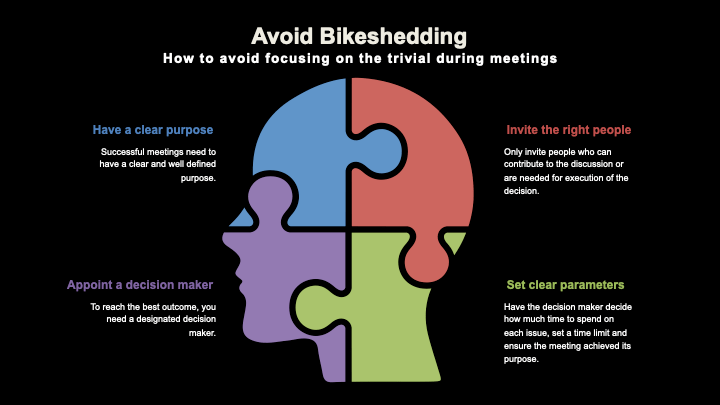
Slide1

Once you acknowledge the problem of bikeshedding, there are several steps you can take to avoid the issue and spend the appropriate time each issue demands:

  1. Have a clear purpose. Successful meetings need to have a clear and well defined purpose. Specificity is central to having a purpose and conveying it.
  2. Invite the right people. Only invite people who can contribute to the discussion or are needed for execution of the decision. If the purpose is to discuss the nuclear power plant, this purpose will make it clear who should and should not be in the meeting. As the post points out, “the most informed opinions are most relevant. This is one reason why big meetings with lots of people present, most of whom don’t need to be there, are such a waste of time in organizations. Everyone wants to participate, but not everyone has anything meaningful to contribute.”
  3. Appoint a decision maker. To reach the best outcome, you need a designated decision maker. First, it avoids forcing a consensus when there should be a black and white winner, a compromise is not always better than an extreme option. Also, it is often impossible to reach a consensus when nobody is in charge. The discussion just drags on and on.
  4. Have the decision maker set clear parameters. With one person in change, they can decide in advance how much importance to accord to the issue (for instance, by estimating how much its success or failure could help or harm the company’s bottom line). They can set a time limit for the discussion to create urgency. And they can end the meeting by verifying that it has indeed achieved its purpose.

By implementing these steps, you can help your company focus its efforts on finding solutions to the most intractable and important problems and let picking the right type of coffee to someone else.

Key takeaways

  • Bikeshedding is the tendency we have to spend excessive time on trivial matters in meetings, often glossing over important ones.
  • Bikeshedding is damaging because it wastes very valuable time and, more importantly, leads to insufficient discussion of important issues.
  • To avoid bikeshedding, set a clear purpose for all meetings (and eliminate conversations about other issues), only invite necessary people, appoint a decision maker and have the decision maker set clear parameters for the meeting.

Share this:

  • Click to share on Facebook (Opens in new window) Facebook
  • Click to share on LinkedIn (Opens in new window) LinkedIn
Like Loading...
Unknown's avatarAuthor Lloyd MelnickPosted on June 17, 2020May 23, 2020Categories behavioral economics, General Social Games Business, General Tech BusinessTags Bikeshedding, Meetings1 Comment on How to avoid meetings about the trivial, aka bikeshedding

Get my book on LTV

The definitive book on customer lifetime value, Understanding the Predictable, is now available in both print and Kindle formats on Amazon.

Understanding the Predictable delves into the world of Customer Lifetime Value (LTV), a metric that shows how much each customer is worth to your business. By understanding this metric, you can predict how changes to your product will impact the value of each customer. You will also learn how to apply this simple yet powerful method of predictive analytics to optimize your marketing and user acquisition.

For more information, click here

Follow The Business of Social Games and Casino on WordPress.com

Enter your email address to follow this blog and receive notifications of new posts by email.

Join 791 other subscribers

Most Recent Posts

  • Join me at PDMA Inspire for my talk on new product prioritization
  • Why keep studying?
  • The next three years of this blog
  • Interview with the CEO of Murka on the biggest growth opportunity in gaming, Barak David

Lloyd Melnick

This is Lloyd Melnick’s personal blog.  All views and opinions expressed on this website are mine alone and do not represent those of people, institutions or organizations that I may or may not be associated with in professional or personal capacity.

I am a serial builder of businesses (senior leadership on three exits worth over $700 million), successful in big (Disney, Stars Group/PokerStars, Zynga) and small companies (Merscom, Spooky Cool Labs) with over 20 years experience in the gaming and casino space.  Currently, I am the GM of VGW’s Chumba Casino and on the Board of Directors of Murka Games and Luckbox.

Topic Areas

  • Analytics (114)
  • Bayes' Theorem (8)
  • behavioral economics (8)
  • blue ocean strategy (14)
  • Crowdfunding (4)
  • DBA (2)
  • General Social Games Business (459)
  • General Tech Business (195)
  • Growth (88)
  • International Issues with Social Games (50)
  • Lloyd's favorite posts (101)
  • LTV (54)
  • Machine Learning (10)
  • Metaverse (1)
  • Mobile Platforms (37)
  • Prioritization (1)
  • Social Casino (52)
  • Social Games Marketing (105)
  • thinking fast and slow (5)
  • Uncategorized (33)

Social

  • View CasualGame’s profile on Facebook
  • View @lloydmelnick’s profile on Twitter
  • View lloydmelnick’s profile on LinkedIn

RSS

RSS Feed RSS - Posts

RSS Feed RSS - Comments

Categories

  • Analytics (114)
  • Bayes' Theorem (8)
  • behavioral economics (8)
  • blue ocean strategy (14)
  • Crowdfunding (4)
  • DBA (2)
  • General Social Games Business (459)
  • General Tech Business (195)
  • Growth (88)
  • International Issues with Social Games (50)
  • Lloyd's favorite posts (101)
  • LTV (54)
  • Machine Learning (10)
  • Metaverse (1)
  • Mobile Platforms (37)
  • Prioritization (1)
  • Social Casino (52)
  • Social Games Marketing (105)
  • thinking fast and slow (5)
  • Uncategorized (33)

Archives

  • September 2023
  • December 2021
  • July 2021
  • March 2021
  • February 2021
  • January 2021
  • December 2020
  • November 2020
  • October 2020
  • September 2020
  • August 2020
  • July 2020
  • June 2020
  • May 2020
  • April 2020
  • March 2020
  • February 2020
  • January 2020
  • November 2019
  • October 2019
  • September 2019
  • June 2019
  • May 2019
  • April 2019
  • March 2019
  • February 2019
  • January 2019
  • December 2018
  • June 2018
  • May 2018
  • April 2018
  • March 2018
  • February 2018
  • January 2018
  • December 2017
  • June 2017
  • May 2017
  • April 2017
  • March 2017
  • February 2017
  • January 2017
  • December 2016
  • November 2016
  • October 2016
  • September 2016
  • June 2016
  • May 2016
  • April 2016
  • March 2016
  • February 2016
  • January 2016
  • December 2015
  • November 2015
  • October 2015
  • September 2015
  • July 2015
  • June 2015
  • May 2015
  • April 2015
  • March 2015
  • February 2015
  • January 2015
  • December 2014
  • November 2014
  • October 2014
  • September 2014
  • August 2014
  • July 2014
  • June 2014
  • May 2014
  • April 2014
  • March 2014
  • February 2014
  • January 2014
  • December 2013
  • November 2013
  • October 2013
  • September 2013
  • August 2013
  • July 2013
  • June 2013
  • May 2013
  • April 2013
  • March 2013
  • February 2013
  • January 2013
  • December 2012
  • November 2012
  • October 2012
  • September 2012
  • August 2012
  • July 2012
  • June 2012
  • May 2012
  • April 2012
  • March 2012
  • February 2012
  • January 2012
  • December 2011
  • November 2011
  • October 2011
  • September 2011
  • August 2011
  • July 2011
  • June 2011
  • May 2011
  • December 2010
June 2020
S M T W T F S
 123456
78910111213
14151617181920
21222324252627
282930  
« May   Jul »

by Lloyd Melnick

All posts by Lloyd Melnick unless specified otherwise
Google+

Enter your email address to subscribe to this blog and receive notifications of new posts by email.

Join 791 other subscribers
Follow Lloyd Melnick on Quora

RSS HBR Blog

  • How One Manufacturer Achieved Net Zero at Zero Cost
  • What Can U.S. Employers Do About Rising Healthcare Costs?
  • When You Have to Execute a Strategy You Disagree With
  • 4 Ways to Build Durable Relationships with Your Most Important Customers
  • What Jargon Says About Your Company Culture
  • Research: When Used Correctly, LLMs Can Unlock More Creative Ideas
  • Your New Role Requires Strategic Thinking…But You’re Stuck in the Weeds
  • For Circular Economy Innovation, Look to the Global South
  • Why Great Leaders Focus on the Details
  • Corporate Disclosure in the Age of AI

RSS Techcrunch

  • An error has occurred; the feed is probably down. Try again later.

RSS MIT Sloan Management Review Blog

  • AI Coding Tools: The Productivity Trap Most Companies Miss
  • How Procter & Gamble Uses AI to Unlock New Insights From Data
  • Rewire Organizational Knowledge With GenAI
  • Hungry for Learning: Wendy’s Will Croushorn
  • Beat Burnout: 10 Essential MIT SMR Reads
  • How Leaders Stay True to Themselves and Their Stakeholders
  • Our Guide to the Winter 2026 Issue
  • Broadening Future Perspectives at the Bank of England
  • A Faster Way to Build Future Scenarios
  • Assess What Is Certain in a Sea of Unknowns
The Business of Social Games and Casino Website Powered by WordPress.com.
  • Subscribe Subscribed
    • The Business of Social Games and Casino
    • Join 726 other subscribers
    • Already have a WordPress.com account? Log in now.
    • The Business of Social Games and Casino
    • Subscribe Subscribed
    • Sign up
    • Log in
    • Report this content
    • View site in Reader
    • Manage subscriptions
    • Collapse this bar
 

Loading Comments...
 

    %d