Skip to content

The Business of Social Games and Casino

How to succeed in the mobile game space by Lloyd Melnick

Tag: Battle Pass

Finally, a new approach to monetization in free-to-play games

I am excited that the latest gaming phenomenon, Fortnite, is not only a hit game because of its content but also because it has brought a unique monetization mechanic to the mass market. For over ten years, people have been optimizing the free-to-play model, improving monetization primarily through in-app purchases. We have all talked about finding new or additional revenue mechanics but there have been no dramatic changes. Many companies have gotten better at getting players to pay more (or more players to pay) but nobody had changed the paradigm. Yet, as I have written many times, the real opportunity for growth is to find a blue ocean, do something your competitors are not.

Why Epic

Epic Games has overcome this challenge with Fortnite, creating a monetization mechanic previously seen only in niche titles. Initially, I have to admit I was particularly surprised this innovation came from Epic, as I frequently wrote that traditional game companies ( most recently Nintendo) could not succeed in the mobile space because they were too wedded to the old monetization model of discrete purchases. Epic is definitely a company that has benefitted mightily from the old model, from Unreal to Gears of War to their other hits, they have made billions of dollars from selling great games in pretty boxes. Now, though, they have disrupted the free-to-play space.

In retrospect, it is not that surprising that innovation did not come from a mobile game company. Just as traditional game companies could not embrace the free-to-play model fully, the “what are now” traditional free-to-play company cannot discard their in-app purchase (IAP) optimization strategy fully. Thus, Epic, which did not have the IAP optimization baggage, could look holistically at the opportunity and come up with a new approach.

What Epic did

Fortnite’s Battle Pass system is a unique approach to drive monetization that is showing great results. According to a recent article by Adam Telfer and Joseph Kim, Fortnite has generated $126 million in revenue, including $5.3 million mobile revenue in its first 10 days.

The Battle Pass is a mechanic that avoids pay to win (spending to get a competitive advantage over other players) but finds a way to get players to pay significantly for cosmetic benefits. Traditional thinking in free-to-play is that cosmetic accessories (avatars, skins, emotes, etc.) can only generate limited incremental revenue. With Fortnite, however, they have made the cosmetics the only way to show success and progression, so players are motivated to acquire (and show off) more and better items, and subsequently monetize to get the great cosmetics.

Battle Passes are largely a challenges mechanic, and even in traditional IAP games challenges are a proven monetization mechanic. They are a great way to drive player activity, guide them to specific activities and provide a sense of completion. It’s not surprising that the evolution from challenge systems to Battle Passes yields a new monetization mechanic.
Slide1

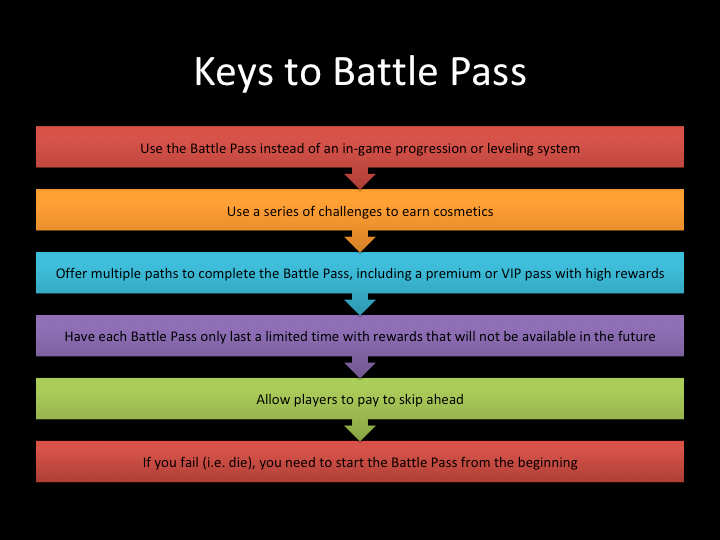
The first key element is that there is not a leveling or stats system. Thus, you cannot show others how skilled you are by pointing out you are level 5,274. Instead, status is conveyed by how great your cosmetics are. The more, and better, cosmetics, implicitly the better Fortnite player you are.

The second key element is the Battle Pass, a series of challenges to earn cosmetics. The Battle Pass is a series of challenges with each one providing cosmetic rewards.

The third key to the Battle Pass is offering multiple paths. In addition to the free path is a premium path that provides significantly more rewards. Epic is also very loose in providing rewards for the premium path, players feel they are getting an incredible value.

Fourth, each Battle Pass only lasts a season. Each of these seasons has its own cosmetics, so if you miss a season you never get them. This creates an incentive for the player to play each Battle Pass so they do not miss any content forever.

Fifth, and a key difference with traditional IAP models, players can pay to skip ahead in tiers. Since tiers are not levels, players are not actually paying to win anything, just to get to higher value cosmetics.

Sixth, if you fail at a challenge, you need to start the entire path again unless you monetize. Critically, if you die during a challenge (which happens to most players of Fortnite), you have to start at the beginning of the challenge. Thus, there is a strong incentive not to lose your progress (and plays to people’s loss aversion). People do not want to start from zero repeatedly.

How you can use Battle Passes

Battle passes effectively change monetization from the core game loop to the challenge mechanic. By eliminating levels and points, you can move monetization from interrupting gameplay to super-charging it. Challenges work in many genres but the Battle Pass takes it to the next level. Zynga credits much of its current success with Zynga Poker to challenges. Virtually any PvP game, and even some single player games, can integrate a challenge system. The key to success though will be recentering monetization on this system rather than the traditional IAP model, making it the source of showing progression and providing a VIP path.

Key takeaways

  • Fortnite is one of the biggest gaming successes ever, and it is being driven by a monetization system previously not seen in mass market free-to-play games, Battle Passes.
  • Battle Passes allow players to earn cosmetic rewards, which have a high value because they are the only way players can show progress in Fortnite.
  • By centering your monetization on a challenge system, you can develop a similar mechanic as Battle Passes.

Share this:

  • Click to share on Facebook (Opens in new window) Facebook
  • Click to share on LinkedIn (Opens in new window) LinkedIn
Like Loading...
Unknown's avatarAuthor Lloyd MelnickPosted on May 15, 2018May 13, 2018Categories General Social Games BusinessTags Battle Pass, epic games, Fortnite, free to play, monetization2 Comments on Finally, a new approach to monetization in free-to-play games

Get my book on LTV

The definitive book on customer lifetime value, Understanding the Predictable, is now available in both print and Kindle formats on Amazon.

Understanding the Predictable delves into the world of Customer Lifetime Value (LTV), a metric that shows how much each customer is worth to your business. By understanding this metric, you can predict how changes to your product will impact the value of each customer. You will also learn how to apply this simple yet powerful method of predictive analytics to optimize your marketing and user acquisition.

For more information, click here

Follow The Business of Social Games and Casino on WordPress.com

Enter your email address to follow this blog and receive notifications of new posts by email.

Join 791 other subscribers

Most Recent Posts

  • Join me at PDMA Inspire for my talk on new product prioritization
  • Why keep studying?
  • The next three years of this blog
  • Interview with the CEO of Murka on the biggest growth opportunity in gaming, Barak David

Lloyd Melnick

This is Lloyd Melnick’s personal blog.  All views and opinions expressed on this website are mine alone and do not represent those of people, institutions or organizations that I may or may not be associated with in professional or personal capacity.

I am a serial builder of businesses (senior leadership on three exits worth over $700 million), successful in big (Disney, Stars Group/PokerStars, Zynga) and small companies (Merscom, Spooky Cool Labs) with over 20 years experience in the gaming and casino space.  Currently, I am the GM of VGW’s Chumba Casino and on the Board of Directors of Murka Games and Luckbox.

Topic Areas

  • Analytics (114)
  • Bayes' Theorem (8)
  • behavioral economics (8)
  • blue ocean strategy (14)
  • Crowdfunding (4)
  • DBA (2)
  • General Social Games Business (459)
  • General Tech Business (195)
  • Growth (88)
  • International Issues with Social Games (50)
  • Lloyd's favorite posts (101)
  • LTV (54)
  • Machine Learning (10)
  • Metaverse (1)
  • Mobile Platforms (37)
  • Prioritization (1)
  • Social Casino (52)
  • Social Games Marketing (105)
  • thinking fast and slow (5)
  • Uncategorized (33)

Social

  • View CasualGame’s profile on Facebook
  • View @lloydmelnick’s profile on Twitter
  • View lloydmelnick’s profile on LinkedIn

RSS

RSS Feed RSS - Posts

RSS Feed RSS - Comments

Categories

  • Analytics (114)
  • Bayes' Theorem (8)
  • behavioral economics (8)
  • blue ocean strategy (14)
  • Crowdfunding (4)
  • DBA (2)
  • General Social Games Business (459)
  • General Tech Business (195)
  • Growth (88)
  • International Issues with Social Games (50)
  • Lloyd's favorite posts (101)
  • LTV (54)
  • Machine Learning (10)
  • Metaverse (1)
  • Mobile Platforms (37)
  • Prioritization (1)
  • Social Casino (52)
  • Social Games Marketing (105)
  • thinking fast and slow (5)
  • Uncategorized (33)

Archives

  • September 2023
  • December 2021
  • July 2021
  • March 2021
  • February 2021
  • January 2021
  • December 2020
  • November 2020
  • October 2020
  • September 2020
  • August 2020
  • July 2020
  • June 2020
  • May 2020
  • April 2020
  • March 2020
  • February 2020
  • January 2020
  • November 2019
  • October 2019
  • September 2019
  • June 2019
  • May 2019
  • April 2019
  • March 2019
  • February 2019
  • January 2019
  • December 2018
  • June 2018
  • May 2018
  • April 2018
  • March 2018
  • February 2018
  • January 2018
  • December 2017
  • June 2017
  • May 2017
  • April 2017
  • March 2017
  • February 2017
  • January 2017
  • December 2016
  • November 2016
  • October 2016
  • September 2016
  • June 2016
  • May 2016
  • April 2016
  • March 2016
  • February 2016
  • January 2016
  • December 2015
  • November 2015
  • October 2015
  • September 2015
  • July 2015
  • June 2015
  • May 2015
  • April 2015
  • March 2015
  • February 2015
  • January 2015
  • December 2014
  • November 2014
  • October 2014
  • September 2014
  • August 2014
  • July 2014
  • June 2014
  • May 2014
  • April 2014
  • March 2014
  • February 2014
  • January 2014
  • December 2013
  • November 2013
  • October 2013
  • September 2013
  • August 2013
  • July 2013
  • June 2013
  • May 2013
  • April 2013
  • March 2013
  • February 2013
  • January 2013
  • December 2012
  • November 2012
  • October 2012
  • September 2012
  • August 2012
  • July 2012
  • June 2012
  • May 2012
  • April 2012
  • March 2012
  • February 2012
  • January 2012
  • December 2011
  • November 2011
  • October 2011
  • September 2011
  • August 2011
  • July 2011
  • June 2011
  • May 2011
  • December 2010
December 2025
S M T W T F S
 123456
78910111213
14151617181920
21222324252627
28293031  
« Sep    

by Lloyd Melnick

All posts by Lloyd Melnick unless specified otherwise
Google+

Enter your email address to subscribe to this blog and receive notifications of new posts by email.

Join 791 other subscribers
Follow Lloyd Melnick on Quora

RSS HBR Blog

  • How One Manufacturer Achieved Net Zero at Zero Cost
  • What Can U.S. Employers Do About Rising Healthcare Costs?
  • When You Have to Execute a Strategy You Disagree With
  • 4 Ways to Build Durable Relationships with Your Most Important Customers
  • What Jargon Says About Your Company Culture
  • Research: When Used Correctly, LLMs Can Unlock More Creative Ideas
  • Your New Role Requires Strategic Thinking…But You’re Stuck in the Weeds
  • For Circular Economy Innovation, Look to the Global South
  • Why Great Leaders Focus on the Details
  • Corporate Disclosure in the Age of AI

RSS Techcrunch

  • An error has occurred; the feed is probably down. Try again later.

RSS MIT Sloan Management Review Blog

  • AI Coding Tools: The Productivity Trap Most Companies Miss
  • How Procter & Gamble Uses AI to Unlock New Insights From Data
  • Rewire Organizational Knowledge With GenAI
  • Hungry for Learning: Wendy’s Will Croushorn
  • Beat Burnout: 10 Essential MIT SMR Reads
  • How Leaders Stay True to Themselves and Their Stakeholders
  • Our Guide to the Winter 2026 Issue
  • Broadening Future Perspectives at the Bank of England
  • A Faster Way to Build Future Scenarios
  • Assess What Is Certain in a Sea of Unknowns
The Business of Social Games and Casino Website Powered by WordPress.com.
  • Subscribe Subscribed
    • The Business of Social Games and Casino
    • Join 726 other subscribers
    • Already have a WordPress.com account? Log in now.
    • The Business of Social Games and Casino
    • Subscribe Subscribed
    • Sign up
    • Log in
    • Report this content
    • View site in Reader
    • Manage subscriptions
    • Collapse this bar
 

Loading Comments...
 

    %d