Skip to content

The Business of Social Games and Casino

How to succeed in the mobile game space by Lloyd Melnick

Tag: challenges

Lifetime Value Part 28: Why you are probably under allocating resources to Live Services

Lifetime Value Part 28:  Why you are probably under allocating resources to Live Services

Last month, I wrote a post about how many game companies do not dedicate enough resources to retention. Another area that most game companies, other than the top mobile gaming companies, are also under allocate resources to is live services. The live services team, however, largely drives success in the gaming space. A strong live services team is a key part to having an LTV that justifies marketing (and thus growth).

During the MAU conference in April, there was an interesting session on why the top social casinos were successful. The speakers were from the leading social casino publishers, Playtika, Zynga and Play Studios. All of them credited live services as the key to their success, with one attributing 80 percent of their success to live services. Also, if you look at the recent surge in Zynga’s stock price, it is largely driven by the performance of recent acquisitions. Zynga’s ability to improve the live services at these studios is the key driver of this positive performance.

What are live services

The textbook description of live services are changes that are made to a game or app that do not require a new build (development work). Live services product managers are focused on optimizing retention or monetization KPIs, rather than the PMs or designers driving new content or features.

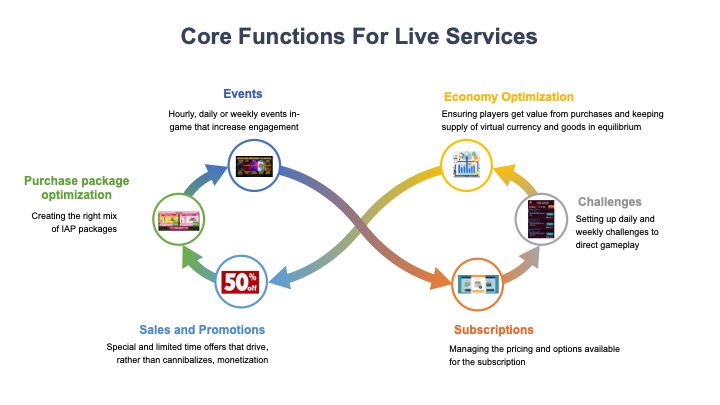
There are many types of live services initiatives, ranging from optimizations to full programs. Some that have strong impact include:
Slide2

  1. In-game events. In many mobile games, you will see daily or weekly (sometimes hourly) special events, such as a one-day race to the top. The event may include a special leaderboard for players who get the most combinations or kill the most of a certain type of enemy in a specified period. These events serve multiple purposes. They create a sense of excitement outside the core game loop. They provide a reason for players to replay a level or a machine. They drive more engagement as players compete to get higher on a leaderboard. They provide variation, a way of introducing new content without having to build more content. Events are one of the strongest drivers of both retention and monetization KPIs in the gaming space.
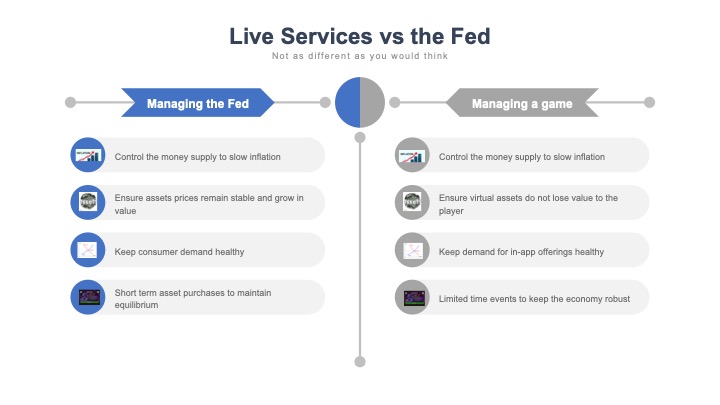
  2. Economy optimization. A key to keeping a free-to-play game successful long-term is managing the economy, an incredibly complex task. Managing the economy of a social game (or real money poker) is very similar to what Jay Powell, Chair of the Federal Reserve or Mark Carney, Governor of the Bank of England, must manage. Powell and Carney must regularly adjust interest rates, quantitative easing (asset purchases), reserve requirements, borrowing levels, etc. to manage inflation, demand, unemployment and the asset (stock) markets. If Powell or Carney gets it wrong, inflation could get out of control, unemployment could rise or asset prices (stocks and real estate) could plummet.Slide1

    It is the same in games. The Live Services team must ensure that the in-game economy stays in sync and is a good experience for all players while encouraging spend (keeping up the value of assets). They need to ensure prices for goods or bets in a casino are at a price level that gives players a fair return on their investment and keeps them engaged. They need to build a balance between the main and premium currencies. They need to ensure the spin speed of a slot creates a good experience without draining a player’s wallet. They need to guarantee that a new player has a good experience but elder players are still having fun. All of these initiatives are connected and a failure in one area could create the gaming equivalent of Venezuela.

  3. Purchase package optimization. Related to optimizing the economy, the live services tem must ensure continuously players are getting appropriate value for their purchases. If packages are priced incorrectly, a customer might not get sufficient value when they make a purchase (for example, five minutes of gameplay rather than one hour) and thus become less likely to make future purchases. Conversely, they may get so much value that they never have a need to make additional purchases.
  4. Challenges. One of the most engaging features in games are challenges. Challenges are usually offered on a daily or weekly basis, helping direct gameplay. They are useful for keeping players engaged, encouraging them to test new content or features or play more. The live services team should create effective challenges and structure them (rewards, timing, amount of effort required, etc.) to optimize the impact on KPIs.
  5. Sales and promotions. Just as in the retail space, sales and promotions are a valuable driver of monetization. If not structured properly by the live services team, the sales could end up cannibalizing purchases or negatively impacting the economy. When done well, they encourage higher sustained revenue.
  6. Subscriptions As I have written recently, subscriptions are a great opportunity for game companies. Managing the pricing and options available for the subscription model sits with the live services team.

This list is a subset of some of the projects that are driven by a good live services team. Strong live services product managers will proactively identify other areas of optimization that will improve retention and monetization.

While I previously said that the live services team drives improvements that do not require development work, that is often the case in theory only. Many games are not architectured in a way that these changes can be made without development, especially older products. The need for development work should not be a line in the sand on whether these initiatives are pursued by the live services team, the benefits of launching events or optimizing the economy persist regardless of any need for development. Additionally, most successful live services teams also impact the product development efforts, for example ensuring the pricing of a new feature enhances the existing product.

Where’s the love

Just like it’s cousin retention marketing, many companies do not allocate sufficient resources (financial and people) to live services. Most of the resources end up going to product development instead. This allocation occurs because the development side is on the face of it easier to measure and sexier. A new feature under development might have a projected impact of a 2% lift on revenue after six months of development. That 2 percent uplift would be incorporated in the financial projections and when the feature launches and the revenue accelerates, everyone is taken to dinner. The PM who designed the feature can then create a Powerpoint that they use to brag to their colleagues.

Live services is not as glamorous. Economy improvements might improve revenue 0.5% every month but over the course of the month, not overnight. The live services PM probably won’t be taken out to dinner for the 0.5% increase (especially as it does not happen overnight but gradually over the month) over a given month. Over the same six months that it took to develop the larger feature, however, the economy improvements generate over 3 percent uplift (assuming the improvement is compounded monthly), a 50 percent larger increase than the new feature. Additionally, it does not require the development resources (and costs) that the new feature absorbed.

The other factor inhibiting allocation of sufficient resources to live services is the cross over with marketing. Many of the live services activities described above fall under marketing at some game companies. As marketing is often focused on acquisition, it is not prioritized on the marketing team’s agenda. Even when it is, live services need to be integrated with the core game experience to succeed. The expertise to design and optimize live services is usually more consistent with Product Managers than Marketing Managers.

Live services is critical to managing your LTV

I have written many times about lifetime value (LTV), and as I have said before it is the lifeblood of any app or game. Products are successful when their LTV is greater than the cost of acquiring a new user (CPI), only when this happens can a company afford to market. Without marketing, products eventually wither and die. Most companies, particularly in the social gaming space, are fighting a perpetual battle to find acquisition channels where LTV is great than CPI. Live services drives continuous improvement of LTV, thus allowing products that would otherwise not justify acquisition thrive. It is often the big difference between the game companies that can maintain their franchises (see Words with Friends, Slotomania, Clash of Clans, etc) to the ones that rise and then burn out.

Key takeaways

  • Live services is the key to the success of the largest mobile game companies (Supercell, Zynga, etc.) but it is an area often over under resourced at other companies.
  • Live services projects include in-game events, economy and purchase package optimization, sales, challenges and subscriptions.
  • Live services often get fewer resources than product development because a new feature that takes six months to develop and generates a two percent revenue uplift is sexier and easier to visualize (and put in a P&L) than improvements that add 0.5 percent a month, though the latter leads to a 50 percent bigger impact.
Share this:

  • Click to share on Facebook (Opens in new window) Facebook
  • Click to share on LinkedIn (Opens in new window) LinkedIn
Like Loading...
Unknown's avatarAuthor Lloyd MelnickPosted on October 15, 2019October 16, 2019Categories General Social Games Business, Lloyd's favorite posts, LTV, Social CasinoTags challenges, IAP, Live services, Subscription1 Comment on Lifetime Value Part 28: Why you are probably under allocating resources to Live Services

Using consumer behavior to design your leveling or challenge system

I came across an interesting article on how you can learn from consumer behavior theory to build an effective leveling system, Using Psychology to Design Leveling Systems
by James Madigan
.  Although there are some holes in the analysis, it raises a very useful connection between loss aversion and leveling and challenge systems in games. Although intended for mobile and video games, the lessons are also applicable to any gamified application.

Madigan starts by reminding readers that customers react differently to gains than to losses. If a player is rewarded with one bonus of 750 chips and an additional reward of 250 chips, they would be less happier than if they got a single reward of 1,000 chips (even though rewards are the same). People like gains lumped together. However, if a player gets killed in a game and has to use 750 chips and then 250 chips to keep playing they would be happier than having to spend a lump sum of 1,000 chips to keep playing. Players prefer losses that are spread out. This concept was popularized by Richard Thaler and won him a Noble Prize in Economics.

These findings are tied to the principal of loss aversion, the fact that people dislike a loss of X more than they appreciate a gain of the same X. They will thus avoid situations where they can lose compared to ones where they can win. This situation becomes an interesting opportunity in game design, Madigan points out, because you can bundle wins and losses. Since we give losses more weight, a 100 chip loss coupled with a 300 chip gain does not feel like a 200 chip gain, it feels closer to zero since the loss is overvalued. Slot designers have known this for centuries, most slot math couples lots of small losses (each spin) with some big wins.

This concept also is very relevant in product design, you do not want to take something away from your players. If a player has worked to unlock a level or a slot machine, locking it later in the game would feel like a bigger loss than the gain from unlocking it or another level/machine.

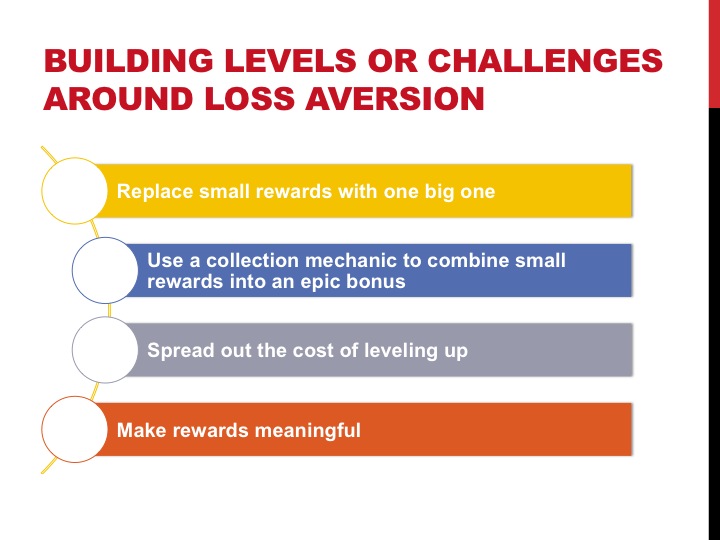
There are several key implications to optimizing your leveling system (or challenge system):

Slide1

  • Rather than give small rewards each time you level up (or complete a challenge), have them build up to one big reward. This could be by combining your leveling or challenge system with a collection mechanic, you get a piece each level and then every 10 levels can turn it in for a big reward.
  • Spread the costs of leveling up out. Rather than forcing players to win a big costly tournament or defeat an uber-boss, have the player go through multiple sinks to gain access to the big leveling reward.
  • Ensure your rewards for either leveling up or completing challenges are meaningful. Players need something big to overcome the perceived cost of the activity.

Key takeaways

  1. People, and gamers, place a higher negative value on a loss than they place a positive value on an equal gain.
  2. People prefer that their losses are spread out but their gains are large.
  3. You thus need to ensure big, meaningful rewards for leveling up or completing challenges to offset the costs (losses) of the activity. You can do this by creating a collection mechanic that leads to a large reward.

Share this:

  • Click to share on Facebook (Opens in new window) Facebook
  • Click to share on LinkedIn (Opens in new window) LinkedIn
Like Loading...
Unknown's avatarAuthor Lloyd MelnickPosted on March 27, 2018February 18, 2018Categories General Social Games BusinessTags challenges, game design, leveling, loss aversionLeave a comment on Using consumer behavior to design your leveling or challenge system

Get my book on LTV

The definitive book on customer lifetime value, Understanding the Predictable, is now available in both print and Kindle formats on Amazon.

Understanding the Predictable delves into the world of Customer Lifetime Value (LTV), a metric that shows how much each customer is worth to your business. By understanding this metric, you can predict how changes to your product will impact the value of each customer. You will also learn how to apply this simple yet powerful method of predictive analytics to optimize your marketing and user acquisition.

For more information, click here

Follow The Business of Social Games and Casino on WordPress.com

Enter your email address to follow this blog and receive notifications of new posts by email.

Join 791 other subscribers

Most Recent Posts

  • Join me at PDMA Inspire for my talk on new product prioritization
  • Why keep studying?
  • The next three years of this blog
  • Interview with the CEO of Murka on the biggest growth opportunity in gaming, Barak David

Lloyd Melnick

This is Lloyd Melnick’s personal blog.  All views and opinions expressed on this website are mine alone and do not represent those of people, institutions or organizations that I may or may not be associated with in professional or personal capacity.

I am a serial builder of businesses (senior leadership on three exits worth over $700 million), successful in big (Disney, Stars Group/PokerStars, Zynga) and small companies (Merscom, Spooky Cool Labs) with over 20 years experience in the gaming and casino space.  Currently, I am the GM of VGW’s Chumba Casino and on the Board of Directors of Murka Games and Luckbox.

Topic Areas

  • Analytics (114)
  • Bayes' Theorem (8)
  • behavioral economics (8)
  • blue ocean strategy (14)
  • Crowdfunding (4)
  • DBA (2)
  • General Social Games Business (459)
  • General Tech Business (195)
  • Growth (88)
  • International Issues with Social Games (50)
  • Lloyd's favorite posts (101)
  • LTV (54)
  • Machine Learning (10)
  • Metaverse (1)
  • Mobile Platforms (37)
  • Prioritization (1)
  • Social Casino (52)
  • Social Games Marketing (105)
  • thinking fast and slow (5)
  • Uncategorized (33)

Social

  • View CasualGame’s profile on Facebook
  • View @lloydmelnick’s profile on Twitter
  • View lloydmelnick’s profile on LinkedIn

RSS

RSS Feed RSS - Posts

RSS Feed RSS - Comments

Categories

  • Analytics (114)
  • Bayes' Theorem (8)
  • behavioral economics (8)
  • blue ocean strategy (14)
  • Crowdfunding (4)
  • DBA (2)
  • General Social Games Business (459)
  • General Tech Business (195)
  • Growth (88)
  • International Issues with Social Games (50)
  • Lloyd's favorite posts (101)
  • LTV (54)
  • Machine Learning (10)
  • Metaverse (1)
  • Mobile Platforms (37)
  • Prioritization (1)
  • Social Casino (52)
  • Social Games Marketing (105)
  • thinking fast and slow (5)
  • Uncategorized (33)

Archives

  • September 2023
  • December 2021
  • July 2021
  • March 2021
  • February 2021
  • January 2021
  • December 2020
  • November 2020
  • October 2020
  • September 2020
  • August 2020
  • July 2020
  • June 2020
  • May 2020
  • April 2020
  • March 2020
  • February 2020
  • January 2020
  • November 2019
  • October 2019
  • September 2019
  • June 2019
  • May 2019
  • April 2019
  • March 2019
  • February 2019
  • January 2019
  • December 2018
  • June 2018
  • May 2018
  • April 2018
  • March 2018
  • February 2018
  • January 2018
  • December 2017
  • June 2017
  • May 2017
  • April 2017
  • March 2017
  • February 2017
  • January 2017
  • December 2016
  • November 2016
  • October 2016
  • September 2016
  • June 2016
  • May 2016
  • April 2016
  • March 2016
  • February 2016
  • January 2016
  • December 2015
  • November 2015
  • October 2015
  • September 2015
  • July 2015
  • June 2015
  • May 2015
  • April 2015
  • March 2015
  • February 2015
  • January 2015
  • December 2014
  • November 2014
  • October 2014
  • September 2014
  • August 2014
  • July 2014
  • June 2014
  • May 2014
  • April 2014
  • March 2014
  • February 2014
  • January 2014
  • December 2013
  • November 2013
  • October 2013
  • September 2013
  • August 2013
  • July 2013
  • June 2013
  • May 2013
  • April 2013
  • March 2013
  • February 2013
  • January 2013
  • December 2012
  • November 2012
  • October 2012
  • September 2012
  • August 2012
  • July 2012
  • June 2012
  • May 2012
  • April 2012
  • March 2012
  • February 2012
  • January 2012
  • December 2011
  • November 2011
  • October 2011
  • September 2011
  • August 2011
  • July 2011
  • June 2011
  • May 2011
  • December 2010
December 2025
S M T W T F S
 123456
78910111213
14151617181920
21222324252627
28293031  
« Sep    

by Lloyd Melnick

All posts by Lloyd Melnick unless specified otherwise
Google+

Enter your email address to subscribe to this blog and receive notifications of new posts by email.

Join 791 other subscribers
Follow Lloyd Melnick on Quora

RSS HBR Blog

  • How One Manufacturer Achieved Net Zero at Zero Cost
  • What Can U.S. Employers Do About Rising Healthcare Costs?
  • When You Have to Execute a Strategy You Disagree With
  • 4 Ways to Build Durable Relationships with Your Most Important Customers
  • What Jargon Says About Your Company Culture
  • Research: When Used Correctly, LLMs Can Unlock More Creative Ideas
  • Your New Role Requires Strategic Thinking…But You’re Stuck in the Weeds
  • For Circular Economy Innovation, Look to the Global South
  • Why Great Leaders Focus on the Details
  • Corporate Disclosure in the Age of AI

RSS Techcrunch

  • An error has occurred; the feed is probably down. Try again later.

RSS MIT Sloan Management Review Blog

  • AI Coding Tools: The Productivity Trap Most Companies Miss
  • How Procter & Gamble Uses AI to Unlock New Insights From Data
  • Rewire Organizational Knowledge With GenAI
  • Hungry for Learning: Wendy’s Will Croushorn
  • Beat Burnout: 10 Essential MIT SMR Reads
  • How Leaders Stay True to Themselves and Their Stakeholders
  • Our Guide to the Winter 2026 Issue
  • Broadening Future Perspectives at the Bank of England
  • A Faster Way to Build Future Scenarios
  • Assess What Is Certain in a Sea of Unknowns
The Business of Social Games and Casino Website Powered by WordPress.com.
  • Subscribe Subscribed
    • The Business of Social Games and Casino
    • Join 726 other subscribers
    • Already have a WordPress.com account? Log in now.
    • The Business of Social Games and Casino
    • Subscribe Subscribed
    • Sign up
    • Log in
    • Report this content
    • View site in Reader
    • Manage subscriptions
    • Collapse this bar
 

Loading Comments...
 

    %d