Skip to content

The Business of Social Games and Casino

How to succeed in the mobile game space by Lloyd Melnick

Tag: Coin Master

Why Coin Master May Not Become a Franchise

Why Coin Master May  Not Become a Franchise

With the success of Coin Master, and the disruption it is causing in the social casino space, many are looking to understand and replicate its success. Although Coin Master is unquestionably doing great and has found a Blue Ocean, it would be the second largest social casino product if it was officially classified in that category, you need to proceed with caution if you plan to imitate it.

I will be writing in the near future about the Halo Effect and Survivor Bias, two heuristics that often lead to flawed decisions. With both of these heuristics, people look at a success and draw conclusions from that success in retrospect and are not repeatable (i.e. Monday morning quarterback). They miss, either consciously or subconsciously, many of the factors that led to the success and are necessary to replicate it, while potentially attributing the success to dynamics that actually did not contribute positively.

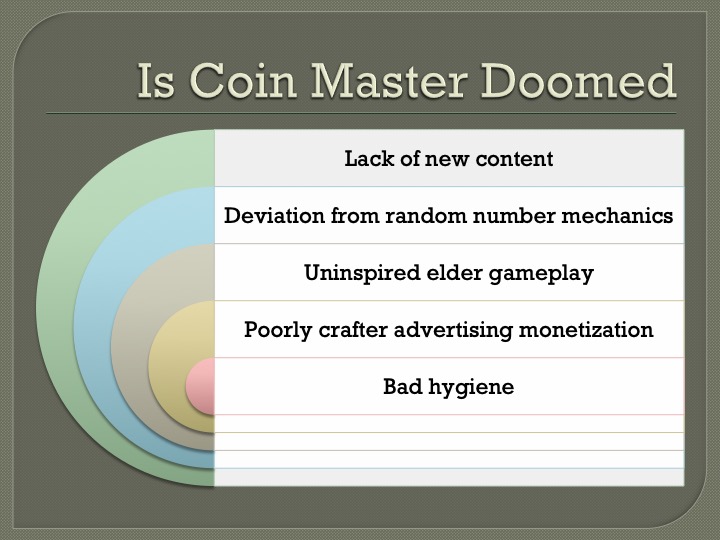
Given its current momentum, it is very easy to dissect Coin Master and say A, B and C can help you make $250k/day. Rather than jump on the bandwagon, I decided to take a step back and look at what Moon Active is not doing well. I may look stupid in twelve months if Coin Master consolidates its position and continues to grow but there are some fundamental issues with the product that suggest it may decline rapidly, despite most social game franchises lasting for years (Slotomania, DoubleDown, Clash of Clans, Candy Crush, CSR Racing, etc.). The issues below suggest Coin Master might experience a much shorter life at the apex.
Slide1

Lack of new content

Social casino products, and social games in general, drive most of their on-going revenue from new content. From the early days of Farmville and Mafia Wars to current top grossing games like Slotomania and Fishdom, new content most consistently contributes to revenue. New content drops are accompanied by much stronger player activity, including reactivating lapsed players and getting lapsed spenders to resume purchases, with little variance (unlike a new feature that may or may not resonate with the audience). This content can be a new slot machine, a new tournament format or theme, new virtual goods, etc., and for different games different content resonates (or falls flat) with its audience. Conversely, I cannot identify one top game where the content is largely unchanged from several years ago, let alone several months ago.

Coin Master, however, adds virtually no new content for the customer. They may add new villages for players who have completed every village, but that impacts very few players and those it does impact it touches very infrequently. Moon Active only has one slot machine that never changes. There are no new slots, new symbols or other new items to rejuvenate the gaming experience.

Deviation from random number mechanics

When I took my first social casino position, after being in traditional free to play games for several years, I quickly learned how strong casino mechanics are at driving monetization. Rather than finding artificial ways to “pinch players” or otherwise drive monetization, slots have generated revenue for over 100 years in a very straightforward manner tied to the core mechanic. Moreover, the random nature of casino games creates a fantastic roller coaster experience for players.

After playing Coin Master extensively, it is clear that rather than a random experience your outcomes are choreographed by Moon Active’s Product Managers. The patterns start to repeat and players see the same outcomes session after session. The hot and cold streaks that are part of gambling, driven by random numbers and the laws of probability, are absent. I have been involved with several social casinos where product managers believed they could create a better (or more profitable) experience than random number generation could and it never works. The gameplay gets stale or players realize they are being manipulated. In the long run (or even medium term as the experience is not as good), players enjoy a true random experience better than one created by product managers.

Uninspired elder gameplay

For a game to thrive for years, it needs to keep a base of loyal and valuable players and keep growing that base. Given user acquisition costs, you cannot grow a game to franchise proportions if you have to replace the entire player base less than six months from acquiring each player. It is this core of valuable players that provide a revenue floor each month that allows you to spend aggressively for new players without creating very adverse cash flow conditions. Most games appeal to their core of experienced players by adding new features or mechanics so the player is not doing the same thing day after day, month after month, year after year. Even in slot games, social casinos release slots with very different bonus games, graphic styles, math and mechanics.

Coin Master, however, is virtually the same game day one that it is if you have played it several hours a day for six or sixteen months. The mechanics do not change or evolve, depth is not introduced, and the experience is identical to past sessions. Even Microsoft Windows apparently evolves at a faster rate than Coin Master.

Poorly crafted advertising monetization

Advertising revenue is becoming an increasingly important part of the social gaming business model, an important additional revenue stream for games that rely on in-app purchases (IAPs) and increasingly it allows products to succeed even without IAPs. Hypercasual games, which now represent about 60 percent of app-store downloads, are almost entirely ad driven. Even more importantly, advertising works with the rest of the game to improve the overall experience and increase retention (watch to earn videos allow players to keep playing or earn premium currency).

Moon Active, however, still approaches driving advertising revenue in the conventional way. It identifies players not likely to monetize through IAPs, then forces players to watch ads. From the structure of how Moon Active uses ads, it is not concerned about users churning due to ads, instead it wants to get as much ad revenue as quickly as possible. This short-term approach is likely to reduce current user return rate (CURR), which is critical to maintain DAU. It is also important to deploy advertising smartly to optimize LTV, as it is better to have someone watch four ads per month for 12 month than force ten ads on them in a month and prompt the player to churn. Similar to the lack of new content and unsophisticated elder gameplay, Coin Master is not constructed to build its player and revenue base month over the long term.

Hygiene

In addition to these large issues, there are many smaller problems (often referred to as hygiene issues) that are likely to impact Coin Master negatively. As the genre gets more competitive, these issues can be enough to get players to switch to other games. Success in the social game space often reminds me of chaos theory, where a butterfly in Beijing can impact the weather in Chicago. Small issues can have big consequences. The hygiene issues in Coin Master include:

  • Stability and tech. People often underestimate the impact technical issues have on KPIs. A small change in loading time or app size, which the player might not consciously notice, often impacts KPIs 10 percent or more. Anecdotally, I have noticed that Coin Master’s slot will crash occasionally, sometimes freezing the player out until there is an app update. Even small crashes can contribute to user churn. Related, the absence of deep linking for push notification, usually a coding or tech debt issue, limits the ability to engage players through CRM.
  • Economy balancing. As players progress through Coin Master, the economy becomes a drag on the experience. While initially a reward (daily bonus, raid proceed, etc.) might be relevant, as the game progresses this relevance varies. As the player advances, less of the features are significant (for example, watching a video has so little value there is no incentive). This problem, coupled with the lack of new content and elder gameplay mechanics, make the game less (rather than the desired more) interesting for established players.
  • Portrait only mode. Coin Master is only available in portrait mode, creating a sub-optimal experience for players on a tablet or large smartphone who are looking for an immersive experience. While some casino games are limited to either portrait or landscape mode, the decision is often driven by an abundance of content (and the need to modify so much art). With Coin Master enjoying an uncontested market space, this limitation obviously is manageable (hence the $250k/day), but again it leaves them vulnerable to a competitor taking away some of Moon Active’s players who desire a landscape experience optimized to their device.

The future of Coin Master

It is impossible to predict the future and Moon Active has found an uncontested market space that protects it from many of its sins. That moat may protect it from the issues identified above and allow it to continue to grow Coin Master. More likely, Moon Active will either address these issues (it now has extensive resources available) or new entrants in the genre will surpass Coin Master.

Key takeaways

  1. Despite being a runaway success, Coin Master generates about $250k/day, some limitations in the product suggest it will not become a long-lived franchise.
  2. Unlike most successful franchises, Moon Active fails to regularly release new content into Coin Master or provide a deeper experience for long-time players.
  3. Coin Master’s deviation from a true random gaming experience, unlike other social casinos, also provides a discernable pattern that will take away from player enjoyment over time.


Share this:

  • Click to share on Facebook (Opens in new window) Facebook
  • Click to share on LinkedIn (Opens in new window) LinkedIn
Like Loading...
Unknown's avatarAuthor Lloyd MelnickPosted on April 23, 2019April 21, 2019Categories General Social Games Business, LTV, Social CasinoTags advertising, Coin Master, content, elder gameplay, in-game advertising, Moon Active2 Comments on Why Coin Master May Not Become a Franchise

Yes, Coin Master is Disruptive

Yes, Coin Master is Disruptive

There has been much debate lately, including on my Facebook page, whether Coin Master from Moon Active is truly disrupting the social casino genre or whether it should be classified in a different category. Much of the debate shows how challenging it is to disrupt a segment or an industry. Coin Master is classic disruption, and understanding the debate helps conceive of additional ways to disrupt.

For those not familiar with Coin Master, it is a mobile game currently generating over $250,000/day currently or an annualized run rate based on Q4 2018 of over $280 million (source: Eilers & Krejcik Gaming, LLC). This would make it the second largest social casino game, behind Slotomania but ahead of well known titles like Doubledown, Heart of Vegas, Big Fish Casino, Hit It Rich!, etc.

Given the success of Coin Master, there are many excellent articles about the gameplay mechanics, monetization, etc., and I will not repeat what others have written better than I could. For those who have not played Coin Master, there is a single, (simple) slot machine and not only do you win coins, you also can attack and raid other villages. You then use your coins to build your village.

Coin master

Coin Master uses a slot mechanic as part of the core game loop, hence why it may be categorized as a social casino product. As a social casino product, many think it has successfully disrupted a highly profitable but stagnant space. Conversely, as there are RPG and Invest-Express elements, it is also argued that it should not be considered social casino, thus it is not disruptive. The latter argument, however, misses the point of disruption.

Disruption, the Blue Ocean Way

One way to approach disrupting an industry is to take a Blue Ocean methodology. I have written frequently about Blue Ocean strategy and am a strong advocate of this technique. In Blue Ocean strategy, you create a new market space by serving the non-customers of an industry, making the competition irrelevant. You do this by adding-reducing-eliminating-increasing features.

This approach is exactly what Moon Active did with Coin Master. They built a game that served people who were not currently engaged in social casino. They also did not try to compete directly with Playtika or Aristocrat, with the eight figure marketing budgets those companies have, they disrupted the industry by finding untapped demand.

Moon Active’s strategy perfectly followed the Blue Ocean framework of adding-reducing-eliminating-increasing features

  • Add.  Key elements that Moon Active added include raiding and attacking friends and city-building (invest express).
  • Reduce.  Among the elements that Moon Active reduced were number of slot machines, quality (graphics and depth) of slots and purchase options.
  • Eliminate.  Moon Active also eliminated several features that are seen in virtually all other social casino products. These include locked machines, pay-tables, jackpots, tournaments and a reward system.
  • Increase.  Finally, Moon Active increased certain elements. Among the features increased were the value of progression, interaction with your friends and the importance of card collection.

There are many examples of companies in other industries that disrupted their industry with a Blue Ocean approach. Cirque de Soleil is one of the most popular examples, as the circus business was stagnant until Cirque de Soleil reinvented the industry by creating a new type of product that appealed to different customers. Ringling Brothers did not consider Cirque a competitor and most argued that it was a different, not disrupting the circus industry. Amazon did the same to retail when it started selling books online. Barnes & Noble and Borders did not consider it disruptive, and retailers in other industries certainly did not, as their customers were not looking to buy books (or shoes or electronics) online. When Wikipedia launched, Encyclopedia Britannica did not consider it a competitor. Now you probably would use Wikipedia to remember what Britannica was.

In all of these Blue Ocean cases, many argued the disruptive competitor was not a competitor or in the same category because it was so disruptive. That is the case with Coin Master and those who are arguing it is not disrupting the social casino space are largely proving that it is true disruption.

Coin Master is also an example of Classic Disruption theory

If you prefer red oceans and have not succumbed to Blue Ocean strategy, Coin Master is also a textbook example of classic disruption theory. Clay Christensen is considered the father of understanding innovation and disruption, with his book The Innovator’s Dilemma required reading at every tech (and most non-tech) company. In The Innovator’s Dilemma, incumbent businesses focus on improving their product to better meet customers’ needs but eventually lose their market to disruptors who appeal to less sophisticated customers initially but end up providing a more appealing, broader solution.

The incumbent understands its customers and is continually improving its product to suit better these customers. Christensen stresses, however, that it leaves the incumbent open to disruption. By focusing on existing customers, new entrants can create a product, often inexpensively, that appeals to a different set of customers (there are parallels with Blue Ocean). Institutionally, the incumbents are forced to resist appealing to these customers out of concern of alienating existing players.

An example would be the growth of the personal computer business. The PC initially did not compete with mainframes and mini-computers. Incumbents did not want to build these machines because they knew their customers needed a powerful machine and would not be interested in the “silly” PC. That arrogance allowed small companies (like Dell and Compaq) to build their business. Incumbents did not consider PC companies’ competitors because it did not fit the framework of what a computer does. Eventually their products became so good that the customer of the incumbents shifted and thus the PC disrupted the computer business.

In the Coin Master case, existing social casino companies know players well and are constantly building better slots and apps to meet these customers’ expectations. That is why you are seeing average revenue per user increase linearly, the companies are getting better at delivering value to existing social casino customers. Moon Active, however, created a slot machine with relatively low production value that does not compete for the player who wants an authentic casino slots experience. Coin Master appeals to a broad market while still leveraging a slot mechanic.

Just as with the Blue Ocean analysis, most of the industries Christensen studies that were disrupted in this manner did not consider the product or company creating the disruption a competitor, at least initially. Blackberry did not consider the iPhone a competitor, Blockbuster did not consider Netflix a competitor, GM did not consider Honda a competitor and server hardware companies never thought AWS would impact their business.

Why disruption matters

Rather than being an academic argument, it is important to realize that Moon Active is actually disrupting the social casino space. First, while disruptive products initially do not impact incumbents, in times they do shift the industry and create new winners and losers. While Digital Equipment, Data General, Olivetti, et. al., thrived for years they are now afterthoughts. Second, the disruptor is blazing a path for other companies. Coin Master will go from a Blue Ocean to a Red Ocean product, and there will be other successes in the new Red Ocean. Most importantly, Coin Master shows how to disrupt the social casino space. It is not about changing the type of jackpots or the orientation of the screen, it is about creating a social casino product that makes the competition irrelevant.

Key takeaways

  1. Coin Master has taken the social casino space by storm, generating more than $250,000/day, by disrupting the space and deviating from how other social casino products compete.
  2. Coin Master exemplifies how to disrupt an industry, appealing to non-customers of the industry by adding new features, increasing others while eliminating some elements and reducing the emphasis on other features.
  3. Coin Master is a textbook example of how to disrupt and succeed in the social casino space, by creating a product that makes the competition irrelevant.

Share this:

  • Click to share on Facebook (Opens in new window) Facebook
  • Click to share on LinkedIn (Opens in new window) LinkedIn
Like Loading...
Unknown's avatarAuthor Lloyd MelnickPosted on March 19, 2019March 2, 2021Categories blue ocean strategy, General Social Games Business, General Tech Business, Social CasinoTags blue ocean, blue ocean strategy, Clayton Christensen, Coin Master, disruption, Innovator's Dilemma, social casino3 Comments on Yes, Coin Master is Disruptive

Get my book on LTV

The definitive book on customer lifetime value, Understanding the Predictable, is now available in both print and Kindle formats on Amazon.

Understanding the Predictable delves into the world of Customer Lifetime Value (LTV), a metric that shows how much each customer is worth to your business. By understanding this metric, you can predict how changes to your product will impact the value of each customer. You will also learn how to apply this simple yet powerful method of predictive analytics to optimize your marketing and user acquisition.

For more information, click here

Follow The Business of Social Games and Casino on WordPress.com

Enter your email address to follow this blog and receive notifications of new posts by email.

Join 791 other subscribers

Most Recent Posts

  • Join me at PDMA Inspire for my talk on new product prioritization
  • Why keep studying?
  • The next three years of this blog
  • Interview with the CEO of Murka on the biggest growth opportunity in gaming, Barak David

Lloyd Melnick

This is Lloyd Melnick’s personal blog.  All views and opinions expressed on this website are mine alone and do not represent those of people, institutions or organizations that I may or may not be associated with in professional or personal capacity.

I am a serial builder of businesses (senior leadership on three exits worth over $700 million), successful in big (Disney, Stars Group/PokerStars, Zynga) and small companies (Merscom, Spooky Cool Labs) with over 20 years experience in the gaming and casino space.  Currently, I am the GM of VGW’s Chumba Casino and on the Board of Directors of Murka Games and Luckbox.

Topic Areas

  • Analytics (114)
  • Bayes' Theorem (8)
  • behavioral economics (8)
  • blue ocean strategy (14)
  • Crowdfunding (4)
  • DBA (2)
  • General Social Games Business (459)
  • General Tech Business (195)
  • Growth (88)
  • International Issues with Social Games (50)
  • Lloyd's favorite posts (101)
  • LTV (54)
  • Machine Learning (10)
  • Metaverse (1)
  • Mobile Platforms (37)
  • Prioritization (1)
  • Social Casino (52)
  • Social Games Marketing (105)
  • thinking fast and slow (5)
  • Uncategorized (33)

Social

  • View CasualGame’s profile on Facebook
  • View @lloydmelnick’s profile on Twitter
  • View lloydmelnick’s profile on LinkedIn

RSS

RSS Feed RSS - Posts

RSS Feed RSS - Comments

Categories

  • Analytics (114)
  • Bayes' Theorem (8)
  • behavioral economics (8)
  • blue ocean strategy (14)
  • Crowdfunding (4)
  • DBA (2)
  • General Social Games Business (459)
  • General Tech Business (195)
  • Growth (88)
  • International Issues with Social Games (50)
  • Lloyd's favorite posts (101)
  • LTV (54)
  • Machine Learning (10)
  • Metaverse (1)
  • Mobile Platforms (37)
  • Prioritization (1)
  • Social Casino (52)
  • Social Games Marketing (105)
  • thinking fast and slow (5)
  • Uncategorized (33)

Archives

  • September 2023
  • December 2021
  • July 2021
  • March 2021
  • February 2021
  • January 2021
  • December 2020
  • November 2020
  • October 2020
  • September 2020
  • August 2020
  • July 2020
  • June 2020
  • May 2020
  • April 2020
  • March 2020
  • February 2020
  • January 2020
  • November 2019
  • October 2019
  • September 2019
  • June 2019
  • May 2019
  • April 2019
  • March 2019
  • February 2019
  • January 2019
  • December 2018
  • June 2018
  • May 2018
  • April 2018
  • March 2018
  • February 2018
  • January 2018
  • December 2017
  • June 2017
  • May 2017
  • April 2017
  • March 2017
  • February 2017
  • January 2017
  • December 2016
  • November 2016
  • October 2016
  • September 2016
  • June 2016
  • May 2016
  • April 2016
  • March 2016
  • February 2016
  • January 2016
  • December 2015
  • November 2015
  • October 2015
  • September 2015
  • July 2015
  • June 2015
  • May 2015
  • April 2015
  • March 2015
  • February 2015
  • January 2015
  • December 2014
  • November 2014
  • October 2014
  • September 2014
  • August 2014
  • July 2014
  • June 2014
  • May 2014
  • April 2014
  • March 2014
  • February 2014
  • January 2014
  • December 2013
  • November 2013
  • October 2013
  • September 2013
  • August 2013
  • July 2013
  • June 2013
  • May 2013
  • April 2013
  • March 2013
  • February 2013
  • January 2013
  • December 2012
  • November 2012
  • October 2012
  • September 2012
  • August 2012
  • July 2012
  • June 2012
  • May 2012
  • April 2012
  • March 2012
  • February 2012
  • January 2012
  • December 2011
  • November 2011
  • October 2011
  • September 2011
  • August 2011
  • July 2011
  • June 2011
  • May 2011
  • December 2010
December 2025
S M T W T F S
 123456
78910111213
14151617181920
21222324252627
28293031  
« Sep    

by Lloyd Melnick

All posts by Lloyd Melnick unless specified otherwise
Google+

Enter your email address to subscribe to this blog and receive notifications of new posts by email.

Join 791 other subscribers
Follow Lloyd Melnick on Quora

RSS HBR Blog

  • How to Manage—and Motivate—Gen Z
  • The Most-Watched HBR Videos of 2025
  • The HBR Charts that Help Explain 2025
  • The Most Popular HBR Podcast Episodes of 2025
  • How the Best Leaders Develop and Spend “Innovation Capital”
  • The 10 Most Popular HBR Articles of 2025
  • How Work Changed in 2025, According to HBR Readers
  • What Leaders Can Learn from a Formula 1 Turnaround
  • Climate Rising: Extending Apparel Lifespan with ThredUp
  • Bring Your Extended Leadership Team into Strategy Decisions

RSS Techcrunch

  • An error has occurred; the feed is probably down. Try again later.

RSS MIT Sloan Management Review Blog

  • Calm: The Underrated Capability Every Leader Needs Now
  • The Top Five MIT SMR Videos of 2025
  • Three Steps Toward Fairer Talent Management
  • From Crisis to Coopetition: What Leaders Can Learn From Anesthesiologists
  • AI Coding Tools: The Productivity Trap Most Companies Miss
  • How Procter & Gamble Uses AI to Unlock New Insights From Data
  • Rewire Organizational Knowledge With GenAI
  • Hungry for Learning: Wendy’s Will Croushorn
  • Beat Burnout: 10 Essential MIT SMR Reads
  • How Leaders Stay True to Themselves and Their Stakeholders
The Business of Social Games and Casino Website Powered by WordPress.com.
  • Subscribe Subscribed
    • The Business of Social Games and Casino
    • Join 726 other subscribers
    • Already have a WordPress.com account? Log in now.
    • The Business of Social Games and Casino
    • Subscribe Subscribed
    • Sign up
    • Log in
    • Report this content
    • View site in Reader
    • Manage subscriptions
    • Collapse this bar
 

Loading Comments...
 

    %d