Skip to content

The Business of Social Games and Casino

How to succeed in the mobile game space by Lloyd Melnick

Tag: customers

Think of Non-Customers First If You Want to Grow

Think of Non-Customers First If You Want to Grow

I have been a consistent advocate of Blue Ocean strategy for years and a blog post by the Blue Ocean Team shows how you can grow your business by focusing on non-customers. Rather than fighting with your competitors to split up the existing pie, by thinking about non-customers you have greater growth potential. The blog post shows three types of non-customers and by understanding them you can tailor your product, new products or marketing to meet their needs. Below are the three groups of non-customers and my thoughts on their relevance to the social casino industry.

Non-customers who occasionally purchase or play

The first group of non-customers who represent a potential market are those who sit on the edge of the market, they purchase minimally your industry’s offerings but are always looking and quick to move to an alternative. The Blue Ocean Team uses the Pret A Manger chainas an example, as they appealed to people who reluctantly bought fast food but were looking for an alternative.

The social casino ecosystem includes many of these non-customers. These include gamers who are ready to skip to another genre (hypercasual, match-3, etc) if they see an appealing ad or the 90 plus percent of players who will play but not monetize. There are first-tier noncustomers waiting to be swayed in every industry.

Non-customers who refuse to become customers

The second group of non-customers is people who know an industry exists but have rejected it. As the Blue Ocean Team writes, “they have consciously thought about and considered your offering and then rejected it. It might be because another offering meets their needs better, or it could be that they simply can’t afford your offering. A second-tier noncustomer will compare your offering with another offering, weighing the pros and cons of each….The fact that second-tier noncustomers considered your industry means that you are far closer to possibly capturing them than you realize. So you need to find out why second-tier noncustomers refuse to use the products or services of your industry.”

In the social casino space, there are three types of these non-customers. The first is real money casino players (either land based or online) who have decided to not to play a free to play offering. They could have passed because they are only playing for economic reasons or the games offered are not what they prefer. The second is male casino players who may have rejected social casino because they consider them too “pink.” The third group is people who have tried social slot games but did not like the slot mechanic.

Non-customers who have not considered your industry

This category of non-customers has never considered your industry as an option. These non-customers have not been targeted ever by any company in your industry. This group is important to consider as it represents the largest potential market to penetrate (by definition it is everyone else). Existing companies in your industry assume these peoples needs are satisfied better by other industries.

In the social casino space, these are people who do not know or care that social slots games exist. It can be gamblers, gamers (other genres) or even people who have not played a mobile game.

What non-customers mean for social casino

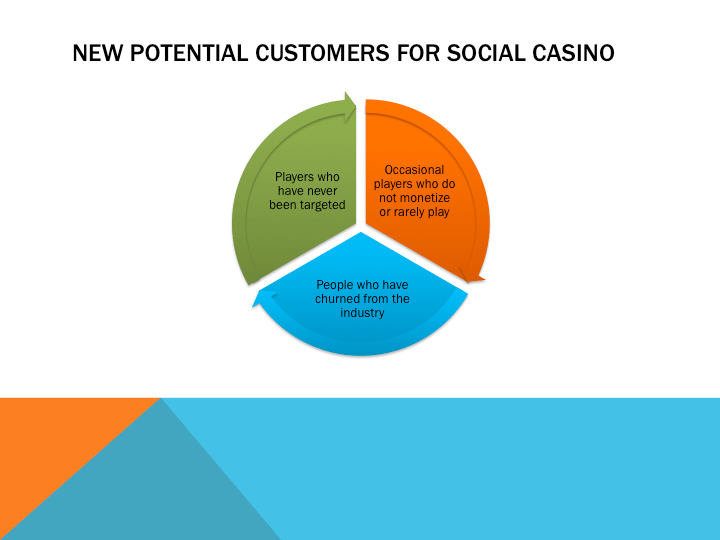
Non-customers are particularly important to social casino as the ecosystem has been growing consistently but through better monetization rather than an increase in customers. If the industry is going to continue growing or if you want to gain market share, appealing to non-customers is the best option. First, you can tailor a product appeal to people who play but do not monetize or play rarely. Second, you can build a product for people who have churned, tried social casino games but left. Finally, you can build a social casino product for people who the industry has never targeted.

While the successful companies will come up with concepts internally and not rely on this blog to provide the answers, the key will be creating social casino products that do not simply replicate the existing games. That means looking at mechanics other than slots. Is also means creating an environment that is not targeting 40+ women. To successfully turn non-customers into customers, the parameters of the products also must shift.

Key takeaways

  1. While many companies look at their competitors and try to grow by building a better product for existing customers, the biggest opportunity exists in appealing to non-customers.
  2. There are three types of non-customers: those who occasionally purchase or play, those who have rejected the current offerings and those who have not considered your industry.
  3. If social casino is going to continue growing or if you want to gain market share, appealing to non-customers is the best option. First, you can tailor a product appeal to people who play but do not monetize or play rarely. Second, you can build a product for people who have churned, tried social casino games but left. Finally, you can build a social casino product for people who the industry has never targeted.

Share this:

  • Click to share on Facebook (Opens in new window) Facebook
  • Click to share on LinkedIn (Opens in new window) LinkedIn
Like Loading...
Unknown's avatarAuthor Lloyd MelnickPosted on February 19, 2019April 11, 2020Categories blue ocean strategy, General Social Games Business, General Tech Business, GrowthTags blue ocean strategy, customers, Growth, Strategy1 Comment on Think of Non-Customers First If You Want to Grow

Becoming truly customer-centric and personalized

Focusing and organizing your company around the customer, not functions or products, is the only way to become truly customer-centric. While loyalty and rewards programs are a great tool to increase engagement, they are only one part of becoming customer-centric. Not only does David Norton’s The High Roller Experienceprovide a roadmap for building a strong loyalty program, it also shows how Harrah’s/Caesar’s casino group created a truly customer-centric company.

Put the customer at the center

Slide1

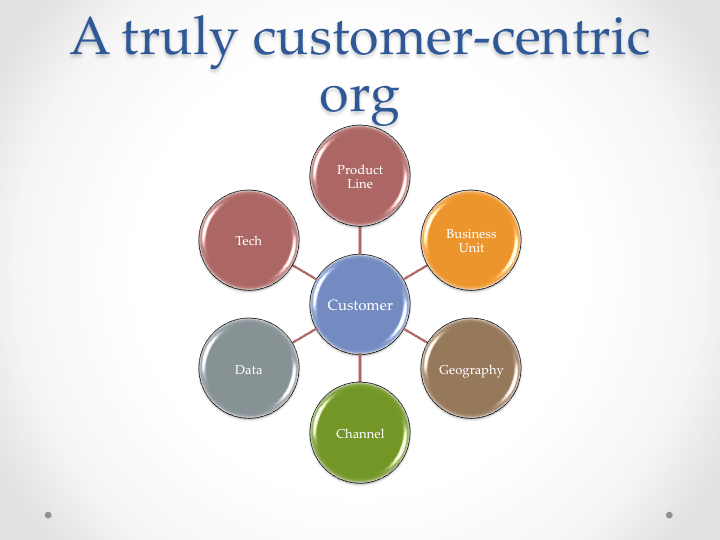
By definition, to be customer-centric, you need to put the customer at the center of your company. The leadership of most businesses build their organization around product line, business unit, or geography, which makes it quite difficult to take a customer-centric approach to running the company. The customer becomes a by-product of the organization’s design rather than the core around which the company revolves. As Norton writes, “customer centricity means that the customer is the company’s and not an individual business unit’s. It is an ability to interact with the customer cohesively and consistently regardless of which business unit the customer is dealing with.”

You also need to put the customer at the center of your data. Norton writes, “being able to truly understand the customer and present relevant content at the right moment through the right channel is the holy grail for which companies should strive in order to engender deep loyalty from customers. Data and technology can enhance the customer experience while simultaneously driving incremental profits for the company. “

To achieve this convergence of data and technology, you should build cross-functional task forces that include analytics, technology and the various functions that interact with the customer. These teams can then derive how to understand the individual customer behavior and integrate the results at each touch point so the customer gets the optimal experience for them.

It is more than loyalty

Being customer-centric is much more than loyalty. While Norton created Total Rewards, Harrah’s incredibly successful loyalty program, he writes, “loyalty is about understanding your customers in detail and interacting with them in a highly personalized way at every point of contact with your brand.” Loyalty is about more than a rewards program where customers are fixated on point accumulation and the company is primarily concerned about the cost of contingent liability. It is about interacting with the customer across their entire journey, at every interaction with your company.

It cannot be product specific

As mentioned earlier, you cannot be customer centric if you are focused on product lines or types. You need to look at the customer across all of your products. This focus also then allows you to help the customer find the products and experiences that are most likely to resonate with them.

Looking at the customer across products also enhances the lifetime value of the customer to the company. If you set up your data and organization around the customer and not product, you can predict who of the low-value masses has the potential to shop across products, largely by looking at demographic and behavioral factors. You can then target these customers so as not to confuse the individual product positioning in mass advertising.

Put the customer at the center

With customer now expecting a personalized and great experience, and getting it from the top companies (Netflix, Amazon, etc), you need to move from a 20th century company to a customer centric company. Blow up your organization and structure it around the user. Build your analytics and business intelligence so it tracks the customer journey and allows you to touch every player individually the right way at the right time. When you build your company around the customer, you build it to succeed.

Key takeaways

  • Being a customer centric organization is much more than having a great loyalty program.
  • You need to structure your organization around the customer, not along product lines or geography or channels.
  • Your data also needs to be customer centric, understanding the customer at all points of their journey and ensuring that it then feeds this data back to given the customer the best personal experience for them.

Share this:

  • Click to share on Facebook (Opens in new window) Facebook
  • Click to share on LinkedIn (Opens in new window) LinkedIn
Like Loading...
Unknown's avatarAuthor Lloyd MelnickPosted on February 13, 2018January 14, 2018Categories General Social Games Business, General Tech Business, Lloyd's favorite postsTags Customer centric, customers, data, organizational structureLeave a comment on Becoming truly customer-centric and personalized

Why you should not focus just on existing players or customers

Many companies, especially game companies, build out their products based on how early customers like the product but this approach can inhibit growth. An article in the Harvard Business Review, “Focus On the Customers You Want, Not the Ones You Have” by JP Eggers, shows that the hard part in creating a successful product or game is not appealing to users early but sustaining.

The problem with early users

CustomersEarly players are by definition early adapters. They probably have a higher preference for innovation and are more likely to take risks. They may have different ways of making decisions, including whether they monetize in a game, if they invite friends or if they come back. An early player may be very enthusiastic and tell friends but then go on to the next shiny object, so basing decision on their play would suggest you should focus on getting them to bring in as many users as possible before they leave.

Companies run into problems if they base product decisions on these early adopters, which is often the case. Eggers also points to research that shows early adopters are different. According to Eggers, “early adopters are typically younger, more willing to take risks, more eager to try new things, more affluent, and substantially less numerous … First, what worked with early adopters isn’t likely to work with later adopters. In launching new products or services, start-ups tend to accumulate deep knowledge about customers at the leading edge of a technology. But that knowledge doesn’t necessarily apply to other consumer groups; that’s one reason so many new firms struggle to create second rounds of offerings. To be successful, companies need to innovate for the consumers they want, not the ones they have.”

Another issue comes up because early adopters do not want to see the product expand to the mass market. A chess app may appeal strongly to grandmasters but if it becomes something the mass-market plays, the grandmasters may no longer want to use the product. Similarly, Facebook lost some of their young users when their parents started using it, but there were hundreds of millions more adults than teens. Although it worked for Facebook, the influx of users so alienated the early users of MySpace, you may no longer even remember MySpace.

A solution

There are several strategies to combat the problem of having a product that either is not attractive to new users or alienates existing users:

  • Innovate for future users. Build features and new content so it appeals to new users, what people not currently using your product would want.
  • Engage early adopters. By engaging your customers, you ensure they feel connected to the product. Letting them have a voice, even if you cannot always listen to it, keeps them engaged and likely to cope with changes they do not consider ideal.

The key is understanding that what appealed to your first users, and their behavior, is not necessarily what will drive your growth.

Key Takeaways

  1. Early users will not have the same preferences and consumption patterns as customers you attract later in the product’s life cycle.
  2. If you slavishly build features and new content for existing users, it may not appeal to new users.
  3. The key is to innovate for new users while keeping your early adopters engaged so will tolerate the changes to the product.
Like Loading...
Unknown's avatarAuthor Lloyd MelnickPosted on July 8, 2015May 1, 2021Categories Analytics, General Social Games Business, General Tech Business, Growth, Social Games MarketingTags customers, early adopters, Growth, targetingLeave a comment on Why you should not focus just on existing players or customers

Get my book on LTV

The definitive book on customer lifetime value, Understanding the Predictable, is now available in both print and Kindle formats on Amazon.

Understanding the Predictable delves into the world of Customer Lifetime Value (LTV), a metric that shows how much each customer is worth to your business. By understanding this metric, you can predict how changes to your product will impact the value of each customer. You will also learn how to apply this simple yet powerful method of predictive analytics to optimize your marketing and user acquisition.

For more information, click here

Follow The Business of Social Games and Casino on WordPress.com

Enter your email address to follow this blog and receive notifications of new posts by email.

Join 791 other subscribers

Most Recent Posts

  • Join me at PDMA Inspire for my talk on new product prioritization
  • Why keep studying?
  • The next three years of this blog
  • Interview with the CEO of Murka on the biggest growth opportunity in gaming, Barak David

Lloyd Melnick

This is Lloyd Melnick’s personal blog.  All views and opinions expressed on this website are mine alone and do not represent those of people, institutions or organizations that I may or may not be associated with in professional or personal capacity.

I am a serial builder of businesses (senior leadership on three exits worth over $700 million), successful in big (Disney, Stars Group/PokerStars, Zynga) and small companies (Merscom, Spooky Cool Labs) with over 20 years experience in the gaming and casino space.  Currently, I am the GM of VGW’s Chumba Casino and on the Board of Directors of Murka Games and Luckbox.

Topic Areas

  • Analytics (114)
  • Bayes' Theorem (8)
  • behavioral economics (8)
  • blue ocean strategy (14)
  • Crowdfunding (4)
  • DBA (2)
  • General Social Games Business (459)
  • General Tech Business (195)
  • Growth (88)
  • International Issues with Social Games (50)
  • Lloyd's favorite posts (101)
  • LTV (54)
  • Machine Learning (10)
  • Metaverse (1)
  • Mobile Platforms (37)
  • Prioritization (1)
  • Social Casino (52)
  • Social Games Marketing (105)
  • thinking fast and slow (5)
  • Uncategorized (33)

Social

  • View CasualGame’s profile on Facebook
  • View @lloydmelnick’s profile on Twitter
  • View lloydmelnick’s profile on LinkedIn

RSS

RSS Feed RSS - Posts

RSS Feed RSS - Comments

Categories

  • Analytics (114)
  • Bayes' Theorem (8)
  • behavioral economics (8)
  • blue ocean strategy (14)
  • Crowdfunding (4)
  • DBA (2)
  • General Social Games Business (459)
  • General Tech Business (195)
  • Growth (88)
  • International Issues with Social Games (50)
  • Lloyd's favorite posts (101)
  • LTV (54)
  • Machine Learning (10)
  • Metaverse (1)
  • Mobile Platforms (37)
  • Prioritization (1)
  • Social Casino (52)
  • Social Games Marketing (105)
  • thinking fast and slow (5)
  • Uncategorized (33)

Archives

  • September 2023
  • December 2021
  • July 2021
  • March 2021
  • February 2021
  • January 2021
  • December 2020
  • November 2020
  • October 2020
  • September 2020
  • August 2020
  • July 2020
  • June 2020
  • May 2020
  • April 2020
  • March 2020
  • February 2020
  • January 2020
  • November 2019
  • October 2019
  • September 2019
  • June 2019
  • May 2019
  • April 2019
  • March 2019
  • February 2019
  • January 2019
  • December 2018
  • June 2018
  • May 2018
  • April 2018
  • March 2018
  • February 2018
  • January 2018
  • December 2017
  • June 2017
  • May 2017
  • April 2017
  • March 2017
  • February 2017
  • January 2017
  • December 2016
  • November 2016
  • October 2016
  • September 2016
  • June 2016
  • May 2016
  • April 2016
  • March 2016
  • February 2016
  • January 2016
  • December 2015
  • November 2015
  • October 2015
  • September 2015
  • July 2015
  • June 2015
  • May 2015
  • April 2015
  • March 2015
  • February 2015
  • January 2015
  • December 2014
  • November 2014
  • October 2014
  • September 2014
  • August 2014
  • July 2014
  • June 2014
  • May 2014
  • April 2014
  • March 2014
  • February 2014
  • January 2014
  • December 2013
  • November 2013
  • October 2013
  • September 2013
  • August 2013
  • July 2013
  • June 2013
  • May 2013
  • April 2013
  • March 2013
  • February 2013
  • January 2013
  • December 2012
  • November 2012
  • October 2012
  • September 2012
  • August 2012
  • July 2012
  • June 2012
  • May 2012
  • April 2012
  • March 2012
  • February 2012
  • January 2012
  • December 2011
  • November 2011
  • October 2011
  • September 2011
  • August 2011
  • July 2011
  • June 2011
  • May 2011
  • December 2010
December 2025
S M T W T F S
 123456
78910111213
14151617181920
21222324252627
28293031  
« Sep    

by Lloyd Melnick

All posts by Lloyd Melnick unless specified otherwise
Google+

Enter your email address to subscribe to this blog and receive notifications of new posts by email.

Join 791 other subscribers
Follow Lloyd Melnick on Quora

RSS HBR Blog

  • How One Manufacturer Achieved Net Zero at Zero Cost
  • What Can U.S. Employers Do About Rising Healthcare Costs?
  • When You Have to Execute a Strategy You Disagree With
  • 4 Ways to Build Durable Relationships with Your Most Important Customers
  • What Jargon Says About Your Company Culture
  • Research: When Used Correctly, LLMs Can Unlock More Creative Ideas
  • Your New Role Requires Strategic Thinking…But You’re Stuck in the Weeds
  • For Circular Economy Innovation, Look to the Global South
  • Why Great Leaders Focus on the Details
  • Corporate Disclosure in the Age of AI

RSS Techcrunch

  • An error has occurred; the feed is probably down. Try again later.

RSS MIT Sloan Management Review Blog

  • AI Coding Tools: The Productivity Trap Most Companies Miss
  • How Procter & Gamble Uses AI to Unlock New Insights From Data
  • Rewire Organizational Knowledge With GenAI
  • Hungry for Learning: Wendy’s Will Croushorn
  • Beat Burnout: 10 Essential MIT SMR Reads
  • How Leaders Stay True to Themselves and Their Stakeholders
  • Our Guide to the Winter 2026 Issue
  • Broadening Future Perspectives at the Bank of England
  • A Faster Way to Build Future Scenarios
  • Assess What Is Certain in a Sea of Unknowns
The Business of Social Games and Casino Website Powered by WordPress.com.
  • Subscribe Subscribed
    • The Business of Social Games and Casino
    • Join 726 other subscribers
    • Already have a WordPress.com account? Log in now.
    • The Business of Social Games and Casino
    • Subscribe Subscribed
    • Sign up
    • Log in
    • Report this content
    • View site in Reader
    • Manage subscriptions
    • Collapse this bar
 

Loading Comments...
 

    %d