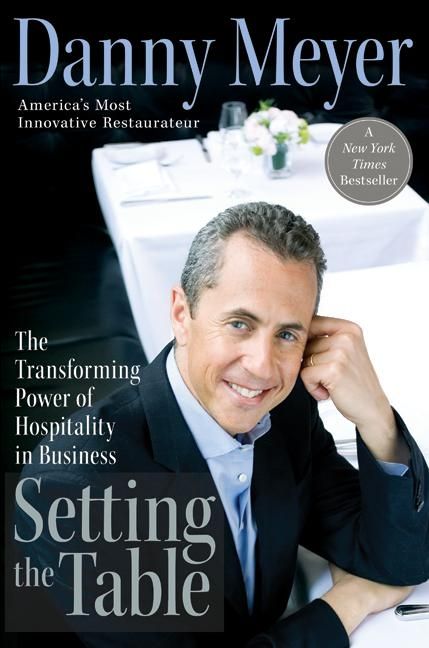
One of the most useful book I read last year had nothing to do with tech or the gaming space but was Danny Meyer’s Setting The Table, about how he created an incredibly successful restaurant empire. Meyer, who is not a chef, has built arguably the most successful restaurant business in the hyper-competitive New York market and is one of the founders of Shake Shack. Meyer built his empire not on creative dishes but creating a fantastic customer experience, which resulted in very high customer retention.
Given the importance of retention to game companies, creating a great customer experience is critical to retaining your players. While the product contributes to the experience, there are many other factors. When you go to a restaurant, the food is important but a key reason whether you return (are retained) is the overall experience. You might have great food, but if the waiter is surly, you have an issue paying the bill or even the cloakroom attendant is rude, you might not come back and will probably leave a bad Yelp or TripAdvisor review. Thus, the restaurant industry provides great lessons on how to create a superior customer experience, and Danny Meyer is probably the best restaurateur at delivering a fantastic experience. By extrapolating Meyer’s philosophy into a more general strategy, you can build a roadmap for improving almost any business.
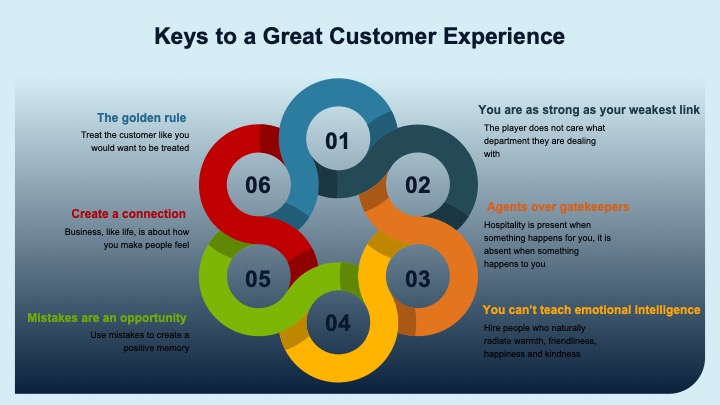
The Golden Rule
Creating a fantastic customer experience begins with the Golden Rule, “do as you would be done by.” In effect, you should treat your customers the way you would want to be treated (and spoken to). If you do not want to get a call at 5 AM, do not try to call your customers at 5 AM because they are more likely to answer. If you would not want to have to answer ten stupid questions to cash out from a casino, do not ask your customer ten stupid questions. In all situations, put yourself in your customer’s perspective and ask how you would want to be approached or treated.
You are as strong as your weakest link
While your core product offering may be fantastic, customers are going to remember the worst part of their experience. If you are in a hotel, you may have a beautiful room with a very comfortable bed but if when you check out you are charged for a bag of cashews from the minibar that you did not take, that is what you are likely to remember. If you go to the hotel restaurant and the food is bad, that is what you will write about on TripAdvisor. It also does not matter to the customer if the restaurant is owned by the hotel or licensed to a third party; the customer will probably be more irate if you try to blame someone else. The key lesson is if you are spending time and money creating a great game or product, do not neglect all the other ways you interact with your customer or player.
Create a connection
One of the strongest motivators for people is seeking connections. As I wrote last week, after satisfying physiological needs and safety, people focus on needs of belonging and esteem, so if the organization is focused on building connections with customers that focus creates tremendous value. Meyer writes, “business, like life, is about how you make people feel….Service without soul is quickly forgotten.” Creating this connection and sense of affiliation builds trust and leads to repeat business.
To create a connection, the first step is to make your players feel important. They should not feel like a number or one of many players (you are number 800 in the queue, please hold on). Every customer should feel like a VIP, they should feel important and loved by the company. According to Meyer, “everyone goes through life with an invisible sign hanging around his or her neck reading, ‘make me feel important.’” If everyone dealing with customers treats them (and considers them) VIPs, you will build a long-lasting connection that keeps the customer from churning and probably improves engagement.
Customer’s time is money
Many companies fail to realize that a customer’s time is more valuable to them than money. All game and gaming companies at their core are entertainment companies, people are choosing between playing your game online or watching the latest episode of the Witcher, land based casinos have learned the Bellagio is competing not only with the Wynn but also with a trip to Hawaii. Your customer facing team must realize it is as important to save customers’ time as how much money they are spending.

Optimizing your customers’ time is also critical in ensuring their experience is better than their next best option. If you are using your customers’ time, you need to provide value (to them, not you) in exchange. Meyer writes, “what mattered most to me was trying to provide maximum value in exchange not just for the guests ’ money but also for their time. Anything that unnecessarily disrupts a guest’s time with his or her companions or disrupts the enjoyment of the meal undermines hospitality.”
If you have a great game, say an online casino, that they enjoy but have to spend half their time dealing with technical issues or trying to cash out, it effectively reduces their enjoyment 50 percent. Even if they get 10 percent more pleasure in your online casino then they would watching the Witcher, by forcing them to waste 50 percent of their time you make the Witcher, your competitor, a superior option.
Agents over gatekeepers
Creating a great customer experiences requires agents to act as advocates of the customers, not as gate-keepers. In every business, there are employees who are the first point of contact with the customers (attendants at airport gates, receptionists at doctors’ offices, bank tellers, executive assistants). Those people can come across either as agents or as gatekeepers. An agent makes things happen for others. A gatekeeper sets up barriers to keep people out. They need to represent the customer’s interest, fight for the customer and thus understand the customer’s concerns. As Meyer writes, “hospitality is present when something happens for you, it is absent when something happens to you.”
Mistakes are an opportunity
To me, mistakes are one of the best things that can happen in the customer experience world. Players remember the way mistakes are handled much more than the mistake and often more than the actual gaming experience. Mistakes provide an opportunity to create a great memory and a connection with your customer. Meyer writes, “The road to success is paved with mistakes well handled. Business is problem solving. As human beings, we are all fallible. You’ve got to welcome the inevitability of mistakes if you want to succeed in the restaurant business — or in any business. It’s critical for us to accept and embrace our ongoing mistakes as opportunities to learn, grow, and profit.”
Meyer identifies five elements for effectively addressing mistakes, fortunately all start with the letter A:
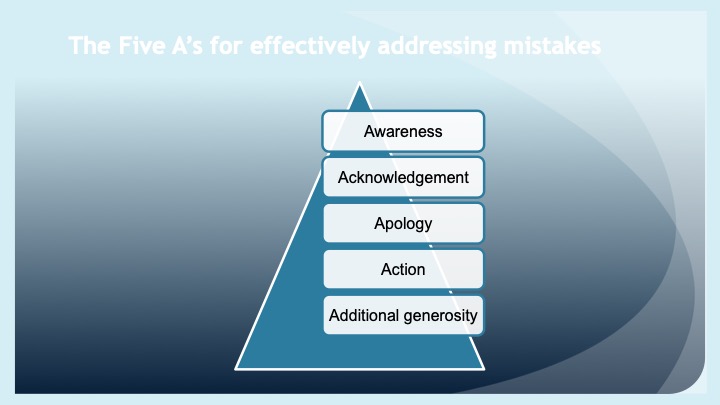
- Awareness. Knowing that a mistake has been made.
- Acknowledgment. Admitting that a mistake was made. It is incredibly frustrating having to argue with a company that they made a mistake. I remember a recent business trip to Sydney where the Internet in my room was not working. I had to argue with the front desk, then with a maintenance worker, both assumed that I did not know how to connect my phone to the Internet. Long story short is the wireless access point in the room was broken but their refusal to acknowledge the problem quickly ended up in my cancelling a stay the following month and not staying during visits every quarter. That is the cost of not acknowledging a mistake.
- Apology. Saying you are sorry is an important step in turning a mistake into a good experience for your customer.
- Action. Fix the mistake. Say what you are going to do to make amends then follow through. Make sure that the issue is resolved to the customer’s satisfaction and that you take care of it, do not put the resolution of the problem on the customer (remember to value their time).
- Additional generosity. Do not simply make good for the mistake, provide more than you have to. Turn the bad experience into a great one. If a diner has a bad experience at one of Meyer’s restaurant, not only would they probably not be charged for the meal, but they might get a bottle of wine or champagne.
Another area to leverage mistakes is to turn a customer’s mistake into your mistake. Rather than fighting with a customer, accept responsibility even if it was not your fault. If you stress the customer made a mistake, either they will be mad at you or mad at themselves (if they do not believe you). Either way, they are not having a good experience. Instead, turn the mistake into your mistake and make them happy. That will drive additional engagement.
You need to align hiring with creating a great experience
To create a fantastic experience for your customer or player, the people responsible for dealing with them must have the right mentality. To have the right people, you need to hire the right people. As Meyer stresses, “you can’t teach emotional intelligence.”
You can have scripts and processes for dealing with customers but unless your team members can radiate warmth, friendliness, happiness and kindness, you will not be able to create great experience. Thus, you need to hire warm, empathetic people who have an excellence reflex. The excellence reflex is a natural reaction to fix something that is not right or to improve something that can be better. Not all hiring is perfect, so if you end up with some people who are not empathetic or have an excellence reflex, then you need to find them a new home. Otherwise, you will not be able to create great customer experiences.
You also need to ensure your people can control their moods. We all have bad days, but the customer does not care. You need people with personal mastery, team members aware of their moods and able to keep them in check.
Hiring is the key. As Meyer explained, “Over the years, the most consistent compliment we’ve received and the one I am always proudest to hear, is ‘I love your restaurants and the food is fantastic. But what I really love is how great your people are. ‘ The only way a company can grow, stay true to its soul, and remain consistently successful is to attract, hire, and keep great people.”
Customer experience is the key to success
While it is very challenging to build an organization with great customer experience, it is critical to engaging your players and preventing churn. Meyer’s success using customer experience as the key differentiator in building a restaurant empire in New York City, one of the most competitive and saturated markets, shows how this feature can help companies in other industries (like gaming) stand out and succeed.
Key takeaways
- The key to strong retention is creating a great customer experience outside of the actual product, ensuring that customer contact is extraordinary.
- To create a great experience for customers, everyone dealing with them needs to treat customers as they would want to be treated.
- It is also critical to ensure you have no weak links in your interaction with customers, you create a connection with your player, your people act as agents for the customers and not gatekeepers, you treat mistakes as opportunities and you hire for emotional intelligence.
 The Business of Social Games and Casino