A colleague of mine recently used in a presentation a chart from a Harvard Business Review article and it was so helpful in defining a new product I wanted to share the concepts with everyone. In The Elements of Value by Eric Almquist, John Senior and Nicolas Block of Bain’s Strategy Practice, the authors discuss that while consumers evaluate a product by its perceived value versus cost, most marketers and executives focus on the price side of the equation. They attribute this focus largely to it being easier to manage price, as there are limited variables involved and it is easy to test.
It is more challenging to measure and optimize what customers truly value, whether functional (giving someone more capabilities) or emotional, because it is often a combination of multiple components. While value is always intrinsic to the customer (different people have a different value for the same attributes), the authors have identified universal building blocks of value to improve performance in current markets or enter new markets. Their analysis shows that the right combinations of these attributes leads to higher customer loyalty, greater willingness to try a brand and sustained revenue growth.
In the article, they have identified 30 elements of value (see below), fundamental attributes in their most essential and discrete forms. You can categorize these components in four buckets:
- Functional
- Emotional
- Life-changing
- Social impact
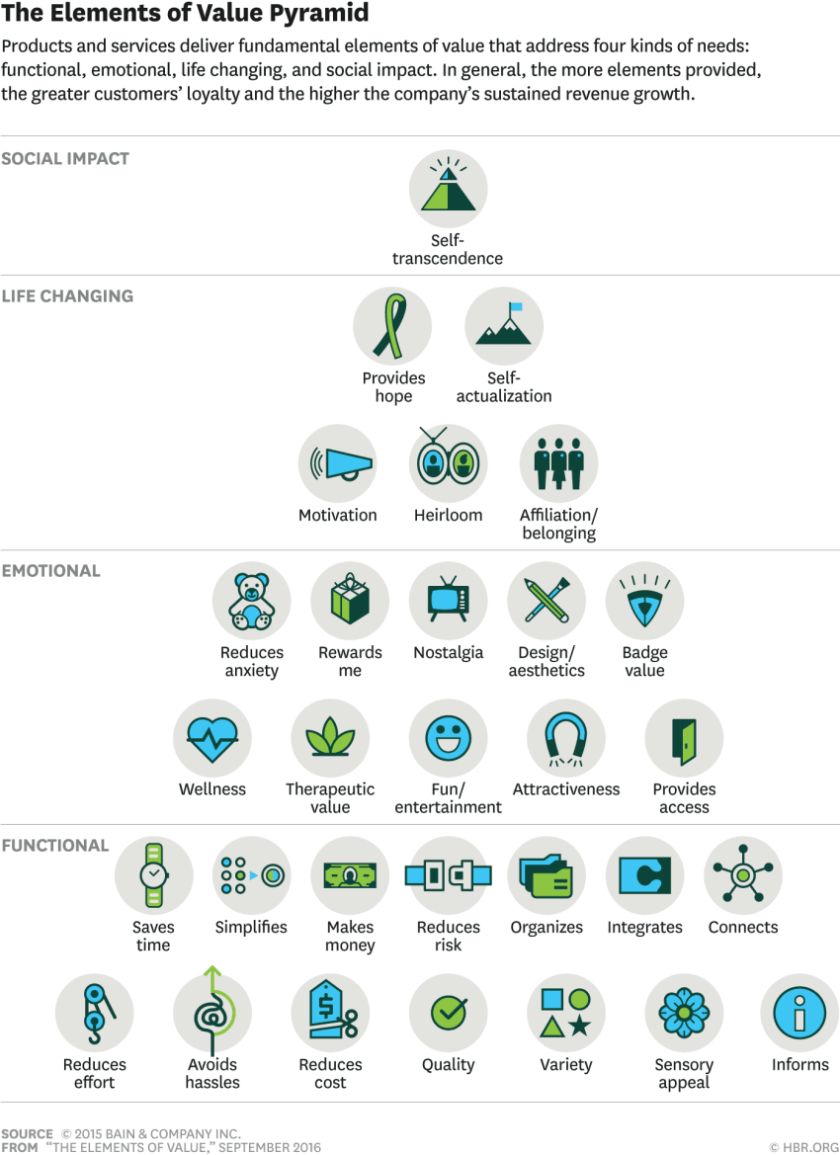
Some are inwardly focused, like motivation, while others help people deal with other or operate in the world, Not surprisingly, the Value Pyramid is related to Maslow’s Hierarchy of Needs. For those not familiar with Maslow’s work, Maslow’s hierarchy of needs is often portrayed in the shape of a pyramid with the largest, most fundamental levels of needs at the bottom and the need for self-actualization and self-transcendence at the top. The most fundamental and basic four layers of the pyramid contain what Maslow called “deficiency needs” or “d-needs”: esteem, friendship and love, security, and physical needs. If these “deficiency needs” are not met – with the exception of the most fundamental (physiological) need – there may not be a physical indication, but the individual will feel anxious and tense. Maslow’s theory suggests that the most basic level of needs must be met before the individual will strongly desire (or focus motivation upon) the secondary or higher level needs.
According the Almquist, Senior and Bloch, “the elements of value approach extends his insights by focusing on people as consumers—describing their behavior as it relates to products and services….The elements of value pyramid is a heuristic model—practical rather than theoretically perfect—in which the most powerful forms of value live at the top. To be able to deliver on those higher-order elements, a company must provide at least some of the functional elements required by a particular product category.”
Depending on your industry and product, the elements of value will vary. Some industries or geographies will focus more on basic elements, those near the bottom of the pyramid, while others will be focused higher.
Product lifecycle is critical
One area the authors did not explore that I think is critical is product lifecycle. Also, although not a feature of the article, an industry’s stage of development strongly impacts which elements will drive value for a consumer. In an emerging industry, consumers will be much more driven by the functional features. As an industry matures, you no longer will be able to compete on the functional elements but instead will need to move higher up the pyramid. Everyone in the industry will be providing the functional features, so you will have to deliver emotional value. Even there, your competitors will catch up and you will then have to deliver life changing or social impact attributes.
The social slots business is a great example of how the value pyramid has driven success. Five + years ago, companies experienced great success just by providing an online version of slot machines that people formerly only played in casinos. As long as you had a game that worked, priced it correctly (free to play) and made it simple to use, you had a ticket to print money. As the market became more mature, emotional attributes became the factor that generated success. Companies late to the market leap-frogged the Functional leaders by making the products nostalgic (classic slots by DGN or Rocket Games) or better design and more attractive (Hit It Rich by Zynga). As the market gets even more mature and competitive the companies that are experiencing success are those that are introducing life changing elements, primarily affiliation and belonging (such as Huuuge Games).
Using the elements to grow
An area where the elements can help you succeed is by improving on the elements that form your core value, so you can differentiate from the competition and better meet your customers’ needs. The elements can also help you grow your product’s value without overhauling your game or product.
Some companies use the elements to identify where customers see strengths and weaknesses. First, they look at which elements are important in their industry and how they compare with competitors. Then if there are any significant gaps, the priority is eliminating those gaps. Once the gaps are closed, you can then see what elements could create a new gap above your competitors.
Implementation
To leverage the elements model effectively, you should integrate it into several key areas of your business:
- New product development. The elements framework should provide ideas for new products and enhancements to existing products.
- Pricing. If you are looking to increase your prices, you can soften the blow of the increase by concurrently increasing the value your customer receives from your product. Amazon Prime is a great example, as the service started at $79.99 (I think) with frequent discounts and is now significantly higher but the free shipping is only a side thought, as you get everything from streaming services to special credit cards.
- Customer segmentation. Rather than only segmenting customers by demographic or behavioral group, you can use the elements to segment them by where they are deriving value. You can then focus on delivering more of the elements that these segments want or highlighting the elements that may exist but they are not aware of.
While adding value to increase competitive is not the most unique or newest idea, Almquist et. al., have created a framework to focus on creating the most value for your customers and knowing where to focus to increase that value. If you continue to deliver more value than your competitors, you will succeed.
Key takeaways
- There are 30 core elements that drive the value a consumer derives from a product and the more they are willing to spend on the product
- The values are hierarchical, similar to Maslow’s hierarchy of needs, and once a consumer gets the base value they will be more engaged by life changing or social impact elements.
- The value you need to deliver is based on the life stage of the industry. Young industries are focused on functional value while you need to deliver higher level value to compete in a mature industry.
 The Business of Social Games and Casino