
Skip to content

The Business of Social Games and Casino

How to succeed in the mobile game space by Lloyd Melnick

Tag: FTUE

The Making of a Product Management Case Study

The Making of a Product Management Case Study

Monzo, a fintech start up approaching Unicorn status, is a Product Management case study in the making. While it is easy to pick successful businesses and look backwards, self-selecting the examples you want to make the case of what you should do, Monzo is the opposite. They are still in the start-up phase and by monitoring their progress you can see how these practices work in the real world. By looking and monitoring Monzo, you can also learn how to differentiate successfully your offering, regardless of the industry.

Truly customer centric

What differentiates Monzo from other tech start-ups is that although they are clearly data driven they are even more customer driven. I became a fan of Monzo’s strategy by starting as a customer and seeing that they were truly customer-centric. Living on the Isle of Man, it is often a challenge working with financial institutions, as we are not part of the UK or EU. While setting up a debit card with one of Monzo’s competitors, Revolut, was an exercise in frustration, Monzo clearly had its team focused on creating a good user experience. Rather than a multi-day response to chats from a CS rep based in a low-cost location (the Revolut model), Monvo offered near real time support as I was trying to navigate setting up from the Isle of Man. This customer focus secured me as a loyal customer – and advocate – at a time when I was looking for a long-term fin partner. Monzo is now my card of choice even though there offering is feature-wise like Revolut. Given the importance of engagement and retention on LTV, this was a wise investment on Monzo’s part.

Product strategy based on making customers life easier

From a product development and management point of view, Monzo is somewhat unique in that it focuses on eliminating friction from customers’ daily life rather than adding a list of features. Monzo sent to its customers a blog post from its CEO about its plans for 2019 and what struck me was that most of the new features they will test were aimed at reducing or eliminating (in Blue Ocean parlance) rather than adding:

  • Automatically compare utility options, such as energy providers, so the customer does not have to go to price comparison sites
  • A way to get a mortgage or refinance with less paperwork
  • Centralizing a customer’s loyalty schemes and reward programs
  • Offering different types of insurance without complex terms and conditions
  • Help building and tracking a customer’s credit score, as most customers do not know how their credit scores are calculated (and the credit agencies are not transparent)

What is particularly thought-provoking with these features that they are considering is not that they are innovative but that they make the customers’ life easier. They are not trying to be the coolest start-up; I did not see the words AI, crypto or VR anywhere in their roadmap. Instead, Monzo is focused on eliminating hurdles their customers face in their daily lives.

Great FTUE and simple UIUX

Another area where Monzo excels is its first-time user experience (FTUE) and user interface and experience (UIUX). When I first signed up for Monzo, I found its FTUE unique in that they turned a potentially negative experience into a positive and viral moment. When I first applied for Monzo’s debit card, they apparently were experiencing rapid growth and there was a delay in completing the KYC (know your customer) process and delivering physical debit cards. Rather than ask you to endure the delays, thus immediately decreasing your satisfaction, Monzo placed me in a queue with specific information on how many customers were ahead of me and when I would receive my card. They then allowed me to jump ahead by recommending Monzo to friends (which I did), and immediately updating how many people were still ahead of me in the queue. Even before becoming a customer, they turned me into an advocate. They then created a positive feeling by giving me control and visibility into the process.

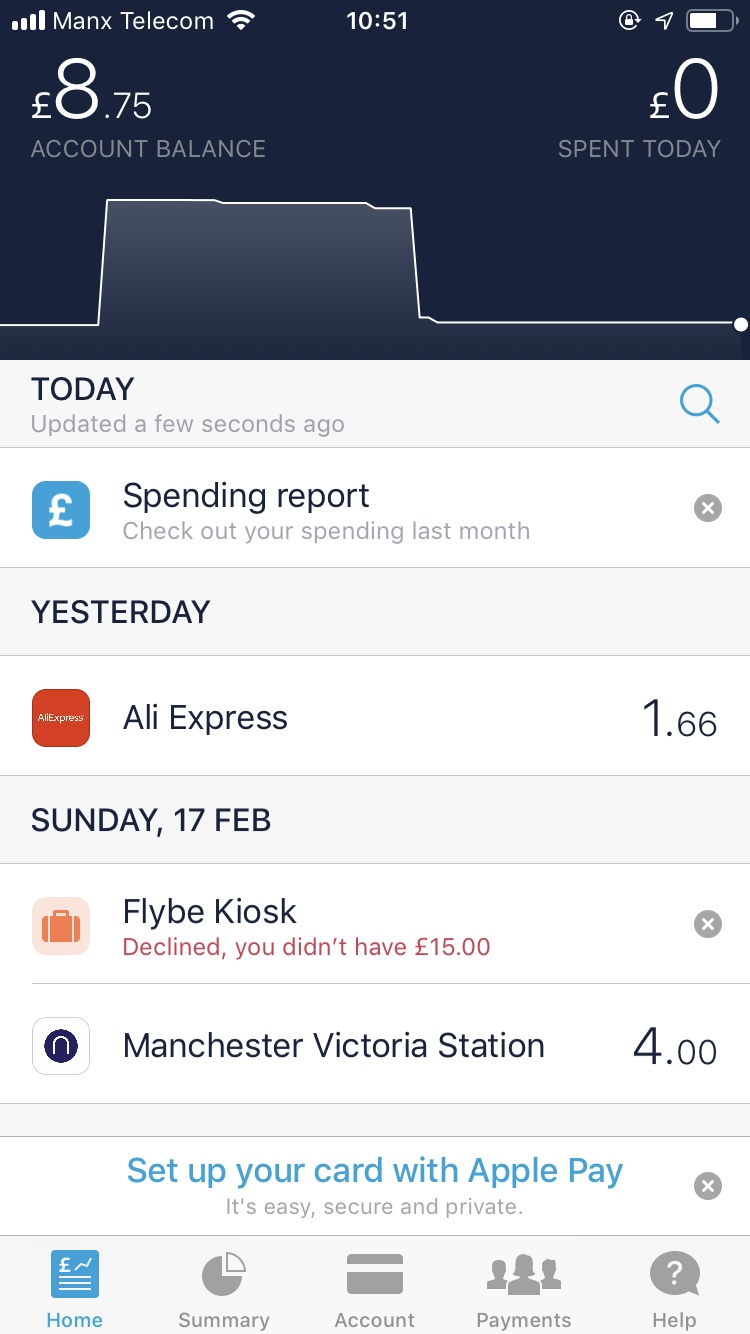
Beyond the initial experience, Monzo has a very straightforward user interface, it is very easy to navigate and learn how to use the features. You never need a tutorial or help, the product is designed to allow you to determine quickly how to conduct transactions.
Monzo Image-1.jpg

Monzo reminds me of Uber, where upon opening the app anyone can figure out how to request a ride. Creating a simple UI, however, is more difficult than creating a complex AI. Any designer can build a UI with 100 options, nested in menu after menu. Reducing those options requires a deep understanding of the customer journey and where the customer is getting value as well as hard decisions on what to include and what to delete.

The UI is also consistent with the product approach described above on making the customers’ life easier rather than just providing them with more options. If the product team simply added feature upon feature, then even the best UI designer would be unable to keep the app’s user interface clean. With alignment between the product and design team, Monzo can focus entirely on removing complications from its customers’ lives.

Lessons

The strategy that Monzo is pursuing provides many useful practices for companies in other parts of the tech space, gaming, gambling, etc. Rather than trying to differentiate yourself from competitors by adding fancy bells and whistles, look at ways you can make your product easier and simpler than competitors (again, more difficult than just adding a new game to your offering). Also, ensure that everything is aligned to your strategy with your customer. If you are trying to provide a fast, clean experience, then not only should the product team develop consistent features, but your support team should focus on creating a complimentary experience and your design team should ensure the app reflects this focus.

Key takeaways

  1. Monzo, a UK based FinTech start-up, is a future case study in product management best practices. By looking and following Monzo, businesses in other industries can learn how to differentiate their offering.
  2. Key to Monzo is a product strategy focused on making its customers lives easier rather than adding glitzy features.
  3. Monzo is successful by aligning its entire business on making a customer’s experience simple, from product features to the first time user experience to the overall user interface through customer support.

Share this:

  • Click to share on Facebook (Opens in new window) Facebook
  • Click to share on LinkedIn (Opens in new window) LinkedIn
Like Loading...
Unknown's avatarAuthor Lloyd MelnickPosted on May 7, 2019May 7, 2019Categories General Social Games Business, General Tech BusinessTags FTUE, Monzo, product management, simplicity, uiux1 Comment on The Making of a Product Management Case Study

Get my book on LTV

The definitive book on customer lifetime value, Understanding the Predictable, is now available in both print and Kindle formats on Amazon.

Understanding the Predictable delves into the world of Customer Lifetime Value (LTV), a metric that shows how much each customer is worth to your business. By understanding this metric, you can predict how changes to your product will impact the value of each customer. You will also learn how to apply this simple yet powerful method of predictive analytics to optimize your marketing and user acquisition.

For more information, click here

Follow The Business of Social Games and Casino on WordPress.com

Enter your email address to follow this blog and receive notifications of new posts by email.

Join 791 other subscribers

Most Recent Posts

  • Join me at PDMA Inspire for my talk on new product prioritization
  • Why keep studying?
  • The next three years of this blog
  • Interview with the CEO of Murka on the biggest growth opportunity in gaming, Barak David

Lloyd Melnick

This is Lloyd Melnick’s personal blog.  All views and opinions expressed on this website are mine alone and do not represent those of people, institutions or organizations that I may or may not be associated with in professional or personal capacity.

I am a serial builder of businesses (senior leadership on three exits worth over $700 million), successful in big (Disney, Stars Group/PokerStars, Zynga) and small companies (Merscom, Spooky Cool Labs) with over 20 years experience in the gaming and casino space.  Currently, I am the GM of VGW’s Chumba Casino and on the Board of Directors of Murka Games and Luckbox.

Topic Areas

  • Analytics (114)
  • Bayes' Theorem (8)
  • behavioral economics (8)
  • blue ocean strategy (14)
  • Crowdfunding (4)
  • DBA (2)
  • General Social Games Business (459)
  • General Tech Business (195)
  • Growth (88)
  • International Issues with Social Games (50)
  • Lloyd's favorite posts (101)
  • LTV (54)
  • Machine Learning (10)
  • Metaverse (1)
  • Mobile Platforms (37)
  • Prioritization (1)
  • Social Casino (52)
  • Social Games Marketing (105)
  • thinking fast and slow (5)
  • Uncategorized (33)

Social

  • View CasualGame’s profile on Facebook
  • View @lloydmelnick’s profile on Twitter
  • View lloydmelnick’s profile on LinkedIn

RSS

RSS Feed RSS - Posts

RSS Feed RSS - Comments

Categories

  • Analytics (114)
  • Bayes' Theorem (8)
  • behavioral economics (8)
  • blue ocean strategy (14)
  • Crowdfunding (4)
  • DBA (2)
  • General Social Games Business (459)
  • General Tech Business (195)
  • Growth (88)
  • International Issues with Social Games (50)
  • Lloyd's favorite posts (101)
  • LTV (54)
  • Machine Learning (10)
  • Metaverse (1)
  • Mobile Platforms (37)
  • Prioritization (1)
  • Social Casino (52)
  • Social Games Marketing (105)
  • thinking fast and slow (5)
  • Uncategorized (33)

Archives

  • September 2023
  • December 2021
  • July 2021
  • March 2021
  • February 2021
  • January 2021
  • December 2020
  • November 2020
  • October 2020
  • September 2020
  • August 2020
  • July 2020
  • June 2020
  • May 2020
  • April 2020
  • March 2020
  • February 2020
  • January 2020
  • November 2019
  • October 2019
  • September 2019
  • June 2019
  • May 2019
  • April 2019
  • March 2019
  • February 2019
  • January 2019
  • December 2018
  • June 2018
  • May 2018
  • April 2018
  • March 2018
  • February 2018
  • January 2018
  • December 2017
  • June 2017
  • May 2017
  • April 2017
  • March 2017
  • February 2017
  • January 2017
  • December 2016
  • November 2016
  • October 2016
  • September 2016
  • June 2016
  • May 2016
  • April 2016
  • March 2016
  • February 2016
  • January 2016
  • December 2015
  • November 2015
  • October 2015
  • September 2015
  • July 2015
  • June 2015
  • May 2015
  • April 2015
  • March 2015
  • February 2015
  • January 2015
  • December 2014
  • November 2014
  • October 2014
  • September 2014
  • August 2014
  • July 2014
  • June 2014
  • May 2014
  • April 2014
  • March 2014
  • February 2014
  • January 2014
  • December 2013
  • November 2013
  • October 2013
  • September 2013
  • August 2013
  • July 2013
  • June 2013
  • May 2013
  • April 2013
  • March 2013
  • February 2013
  • January 2013
  • December 2012
  • November 2012
  • October 2012
  • September 2012
  • August 2012
  • July 2012
  • June 2012
  • May 2012
  • April 2012
  • March 2012
  • February 2012
  • January 2012
  • December 2011
  • November 2011
  • October 2011
  • September 2011
  • August 2011
  • July 2011
  • June 2011
  • May 2011
  • December 2010
December 2025
S M T W T F S
 123456
78910111213
14151617181920
21222324252627
28293031  
« Sep    

by Lloyd Melnick

All posts by Lloyd Melnick unless specified otherwise
Google+

Enter your email address to subscribe to this blog and receive notifications of new posts by email.

Join 791 other subscribers
Follow Lloyd Melnick on Quora

RSS HBR Blog

  • How One Manufacturer Achieved Net Zero at Zero Cost
  • What Can U.S. Employers Do About Rising Healthcare Costs?
  • When You Have to Execute a Strategy You Disagree With
  • 4 Ways to Build Durable Relationships with Your Most Important Customers
  • What Jargon Says About Your Company Culture
  • Research: When Used Correctly, LLMs Can Unlock More Creative Ideas
  • Your New Role Requires Strategic Thinking…But You’re Stuck in the Weeds
  • For Circular Economy Innovation, Look to the Global South
  • Why Great Leaders Focus on the Details
  • Corporate Disclosure in the Age of AI

RSS Techcrunch

  • An error has occurred; the feed is probably down. Try again later.

RSS MIT Sloan Management Review Blog

  • AI Coding Tools: The Productivity Trap Most Companies Miss
  • How Procter & Gamble Uses AI to Unlock New Insights From Data
  • Rewire Organizational Knowledge With GenAI
  • Hungry for Learning: Wendy’s Will Croushorn
  • Beat Burnout: 10 Essential MIT SMR Reads
  • How Leaders Stay True to Themselves and Their Stakeholders
  • Our Guide to the Winter 2026 Issue
  • Broadening Future Perspectives at the Bank of England
  • A Faster Way to Build Future Scenarios
  • Assess What Is Certain in a Sea of Unknowns
The Business of Social Games and Casino Website Powered by WordPress.com.
  • Subscribe Subscribed
    • The Business of Social Games and Casino
    • Join 726 other subscribers
    • Already have a WordPress.com account? Log in now.
    • The Business of Social Games and Casino
    • Subscribe Subscribed
    • Sign up
    • Log in
    • Report this content
    • View site in Reader
    • Manage subscriptions
    • Collapse this bar
 

Loading Comments...
 

    %d