Skip to content

The Business of Social Games and Casino

How to succeed in the mobile game space by Lloyd Melnick

Tag: IAP

Lifetime Value Part 28: Why you are probably under allocating resources to Live Services

Lifetime Value Part 28:  Why you are probably under allocating resources to Live Services

Last month, I wrote a post about how many game companies do not dedicate enough resources to retention. Another area that most game companies, other than the top mobile gaming companies, are also under allocate resources to is live services. The live services team, however, largely drives success in the gaming space. A strong live services team is a key part to having an LTV that justifies marketing (and thus growth).

During the MAU conference in April, there was an interesting session on why the top social casinos were successful. The speakers were from the leading social casino publishers, Playtika, Zynga and Play Studios. All of them credited live services as the key to their success, with one attributing 80 percent of their success to live services. Also, if you look at the recent surge in Zynga’s stock price, it is largely driven by the performance of recent acquisitions. Zynga’s ability to improve the live services at these studios is the key driver of this positive performance.

What are live services

The textbook description of live services are changes that are made to a game or app that do not require a new build (development work). Live services product managers are focused on optimizing retention or monetization KPIs, rather than the PMs or designers driving new content or features.

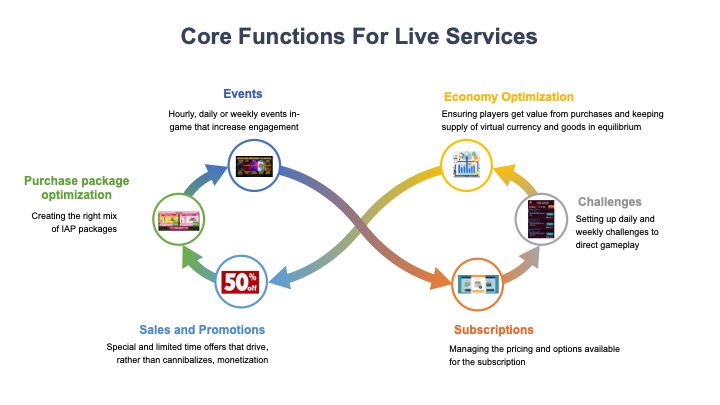
There are many types of live services initiatives, ranging from optimizations to full programs. Some that have strong impact include:
Slide2

  1. In-game events. In many mobile games, you will see daily or weekly (sometimes hourly) special events, such as a one-day race to the top. The event may include a special leaderboard for players who get the most combinations or kill the most of a certain type of enemy in a specified period. These events serve multiple purposes. They create a sense of excitement outside the core game loop. They provide a reason for players to replay a level or a machine. They drive more engagement as players compete to get higher on a leaderboard. They provide variation, a way of introducing new content without having to build more content. Events are one of the strongest drivers of both retention and monetization KPIs in the gaming space.
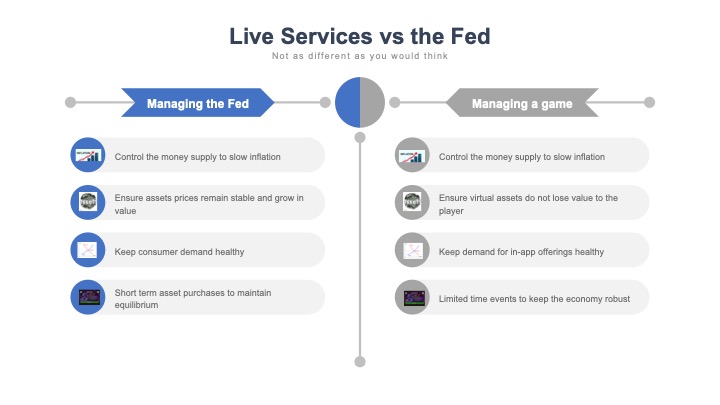
  2. Economy optimization. A key to keeping a free-to-play game successful long-term is managing the economy, an incredibly complex task. Managing the economy of a social game (or real money poker) is very similar to what Jay Powell, Chair of the Federal Reserve or Mark Carney, Governor of the Bank of England, must manage. Powell and Carney must regularly adjust interest rates, quantitative easing (asset purchases), reserve requirements, borrowing levels, etc. to manage inflation, demand, unemployment and the asset (stock) markets. If Powell or Carney gets it wrong, inflation could get out of control, unemployment could rise or asset prices (stocks and real estate) could plummet.Slide1

    It is the same in games. The Live Services team must ensure that the in-game economy stays in sync and is a good experience for all players while encouraging spend (keeping up the value of assets). They need to ensure prices for goods or bets in a casino are at a price level that gives players a fair return on their investment and keeps them engaged. They need to build a balance between the main and premium currencies. They need to ensure the spin speed of a slot creates a good experience without draining a player’s wallet. They need to guarantee that a new player has a good experience but elder players are still having fun. All of these initiatives are connected and a failure in one area could create the gaming equivalent of Venezuela.

  3. Purchase package optimization. Related to optimizing the economy, the live services tem must ensure continuously players are getting appropriate value for their purchases. If packages are priced incorrectly, a customer might not get sufficient value when they make a purchase (for example, five minutes of gameplay rather than one hour) and thus become less likely to make future purchases. Conversely, they may get so much value that they never have a need to make additional purchases.
  4. Challenges. One of the most engaging features in games are challenges. Challenges are usually offered on a daily or weekly basis, helping direct gameplay. They are useful for keeping players engaged, encouraging them to test new content or features or play more. The live services team should create effective challenges and structure them (rewards, timing, amount of effort required, etc.) to optimize the impact on KPIs.
  5. Sales and promotions. Just as in the retail space, sales and promotions are a valuable driver of monetization. If not structured properly by the live services team, the sales could end up cannibalizing purchases or negatively impacting the economy. When done well, they encourage higher sustained revenue.
  6. Subscriptions As I have written recently, subscriptions are a great opportunity for game companies. Managing the pricing and options available for the subscription model sits with the live services team.

This list is a subset of some of the projects that are driven by a good live services team. Strong live services product managers will proactively identify other areas of optimization that will improve retention and monetization.

While I previously said that the live services team drives improvements that do not require development work, that is often the case in theory only. Many games are not architectured in a way that these changes can be made without development, especially older products. The need for development work should not be a line in the sand on whether these initiatives are pursued by the live services team, the benefits of launching events or optimizing the economy persist regardless of any need for development. Additionally, most successful live services teams also impact the product development efforts, for example ensuring the pricing of a new feature enhances the existing product.

Where’s the love

Just like it’s cousin retention marketing, many companies do not allocate sufficient resources (financial and people) to live services. Most of the resources end up going to product development instead. This allocation occurs because the development side is on the face of it easier to measure and sexier. A new feature under development might have a projected impact of a 2% lift on revenue after six months of development. That 2 percent uplift would be incorporated in the financial projections and when the feature launches and the revenue accelerates, everyone is taken to dinner. The PM who designed the feature can then create a Powerpoint that they use to brag to their colleagues.

Live services is not as glamorous. Economy improvements might improve revenue 0.5% every month but over the course of the month, not overnight. The live services PM probably won’t be taken out to dinner for the 0.5% increase (especially as it does not happen overnight but gradually over the month) over a given month. Over the same six months that it took to develop the larger feature, however, the economy improvements generate over 3 percent uplift (assuming the improvement is compounded monthly), a 50 percent larger increase than the new feature. Additionally, it does not require the development resources (and costs) that the new feature absorbed.

The other factor inhibiting allocation of sufficient resources to live services is the cross over with marketing. Many of the live services activities described above fall under marketing at some game companies. As marketing is often focused on acquisition, it is not prioritized on the marketing team’s agenda. Even when it is, live services need to be integrated with the core game experience to succeed. The expertise to design and optimize live services is usually more consistent with Product Managers than Marketing Managers.

Live services is critical to managing your LTV

I have written many times about lifetime value (LTV), and as I have said before it is the lifeblood of any app or game. Products are successful when their LTV is greater than the cost of acquiring a new user (CPI), only when this happens can a company afford to market. Without marketing, products eventually wither and die. Most companies, particularly in the social gaming space, are fighting a perpetual battle to find acquisition channels where LTV is great than CPI. Live services drives continuous improvement of LTV, thus allowing products that would otherwise not justify acquisition thrive. It is often the big difference between the game companies that can maintain their franchises (see Words with Friends, Slotomania, Clash of Clans, etc) to the ones that rise and then burn out.

Key takeaways

  • Live services is the key to the success of the largest mobile game companies (Supercell, Zynga, etc.) but it is an area often over under resourced at other companies.
  • Live services projects include in-game events, economy and purchase package optimization, sales, challenges and subscriptions.
  • Live services often get fewer resources than product development because a new feature that takes six months to develop and generates a two percent revenue uplift is sexier and easier to visualize (and put in a P&L) than improvements that add 0.5 percent a month, though the latter leads to a 50 percent bigger impact.

Share this:

  • Click to share on Facebook (Opens in new window) Facebook
  • Click to share on LinkedIn (Opens in new window) LinkedIn
Like Loading...
Unknown's avatarAuthor Lloyd MelnickPosted on October 15, 2019October 16, 2019Categories General Social Games Business, Lloyd's favorite posts, LTV, Social CasinoTags challenges, IAP, Live services, Subscription1 Comment on Lifetime Value Part 28: Why you are probably under allocating resources to Live Services

Subscriptions: The new weapon in the game monetization arsenal

Subscriptions:  The new weapon in the game monetization arsenal

People in the game industry are continually asking about “a new business model” but they usually want new monetization techniques (ie. gatcha mechanic, piggy bank, etc.). Now, however, there is a real opportunity to disrupt the industry with a new model, subscriptions. I have been in the games industry since 1993 and in that time there have only been two new models, try-before-you-buy and free-to-play. Subscriptions may usher in the next era of gaming.

Try-before-you-buy was introduced in the early 2000s and perfected by Big Fish Games, who released via download a game every day that was free for the first hour and then the player would have the option of purchasing the full game. While the model did not have a huge impact on the traditional game companies (who were selling their product for a fixed cost in retail), it was blue ocean as it brought an entirely new demographic into gaming. For the first time, gaming was not dominated by teen age boys playing in their parents’ basements (or 30 year old boys playing in their parents’ basements) but saw an influx of female players, particularly older women.

Early in the 2010s the gaming industry experienced its greatest disruption. Free-to-play gaming gained traction in the US (and Europe) after dominating Asian markets. In this model, games were truly free and over 90 percent of the players would never spend a penny. The games, however, were built to get the most engaged players to spend to improve or speed up their gaming experience, and many of these players would spend tens or even hundreds of thousands of dollars in their favorite games. Social gaming companies, led by Zynga, gained millions of daily players, pulling them from other gaming or entertainment companies.

Free-to-play was truly disruptive. Household names like Atari, Acclaim and THQ (which had earlier reached over $1 billion in sales) went bankrupt. Zynga saw its valuation reach over $10 billion. Disney and Electronic Arts both spent hundreds of thousands of dollars to acquire companies in the space. The concepts behind free-to-play have grown to shape the video game space, even those old-school companies that still monetize with an upfront purchase use in-game monetization to drive their revenue growth.

Given the impact of free-to-play and the millionaires it, everyone has been looking for the next disruptive business model. Based on how other industries are evolving, subscriptions are likely to be the next disruptive model in the game industry,

How subscriptions are changing the world

While Asia provided a clue that free-to-play would disrupt Western video game markets, developments in other industries show the likelihood that subscriptions will emerge as a disruptive force. The largest retailer in the world (by market cap), Amazon, uses its Prime subscription service to lock in customers. Salesforce.com, the most important company in the enterprise software space, eschewed the high fixed fee model for a subscription model that left its established competitors in the dust. Adobe, the largest provider of graphics software, abandoned its old business model to move to a subscription model and is now valued at $135 billion. Netflix, the second most important entertainment company in the world (nobody is beating Disney for a while), gained its position with a subscription model. Even Disney is betting its future on subscriptions with Disney Plus.

Enabling this shift is a change in people’s attitude. Ten years ago, people would not pay for digital content and overall wanted to own things. People did not pay for music (remember Napster). People would buy a DVD or CD, even if they would only experience it once. The examples above (and the hundreds I left out) show that attitudes have shifted. Millions of people are willing to pay Spotify money every month without owning a song. According to the Reuters Institute, in the United States, the proportion of people ages eighteen to twenty-four paying for online news leaped from 4 percent in 2016 to 18 percent in 2017. Attitudes have clearly shifted.

Why subscriptions work

Subscriptions have succeeded because they better align customers with providers than other business models. Rather than the linear model of selling a product to a customer, the subscription model creates a dynamic where the company to please constantly its customers. As Tien Tzuo says in Subscribed, “companies that know what their customers want, and how they want it, will succeed over companies that spend a lot of time and effort creating a product they think is a good idea, then spend equal amounts of time and effort trying to persuade people to buy it.”

Further driving the success of the subscription model are the benefits it has for the provider. Subscriptions allow companies to start the month (or year) with a guaranteed base of business. Rather than having to estimate how many units you will sell, you look at your subscriber base and can accurately forecast your revenue. This stability allows companies to market aggressively, invest in new content, etc., as they can predict cash flow.

The subscription model also aligns companies with their customers. As Tzuo writes, “instead of thinking about reseller margins and unit sales, [companies are] thinking about subscriber bases and engagement rates.” Companies driven by a subscription model have direct ongoing relationships with their customers. They no longer have to segment customers, they now have individual subscribers. With the industry leaders (Amazon, Netflix, etc), every subscriber has their own home page, their own activity history, their own red flags, their own algorithmically derived suggestions, their own unique experiences. And thanks to subscriber IDs, all the boring transactional point-of-sale processes disappeared. As companies can never be too close to their customers, subscriptions create the loop that makes customer intimacy a reality.

Will subscriptions work in the game industry

Now that we agree that subscriptions are a great opportunity overall, will they work in the game industry. First, many game companies already are using this model. According to a great blog post by Google, they have seen global growth in game subscriptions of 70 percent year over year. Second, it is working. According to the post, game companies that have integrated subscriptions experience 20 percent higher retention. They also have seen higher overall monetization. Finally, subscriptions offset risk in developing and launching new content. According to Tzuo, “regardless of whether a show is successful or not, investing in sharp new content helps Netflix to both (a) attract new subscribers and (b) extend the lifetime of its current subscribers. Those shows don’t go away! Together, they’re increasing the overall value of the portfolio. They are instrumental in driving down customer acquisition costs (as more subscribers sign up) and increasing subscriber lifetime value (as more subscribers stick around for longer).”

How you should implement subscriptions in games

While subscriptions are an exciting opportunity, success with the model will come down to execution. Just as hundreds (or thousands) of game companies failed to implement successfully free-to-play, succeeding with subscriptions is more difficult than adding another package to your purchase page. There are several core concepts in building a product that leverages subscriptions.

Slide1

Subscriptions need to be about access

The biggest challenge, and most common mistake, game companies face is what to provide for the subscription fee. The easy answer is virtual currency, after all it is what customers are willing to pay for with in-app purchases. The easy answer is wrong. As stated in the Google post, “it’s important to move away from the mindset that subscriptions are just an auto-renewal mechanism for discounted IAP. Instead, subscriptions need to be thought of as offering highly-retentive long-term access to content, rather than the one-time situational purchase of content offered by IAP.”

Successful subscriptions are about giving players access to content and special benefits, access that can be gained or lost. In a social casino, it could be access to new slots or unique table games. In a game like Archero, it could be access to special levels or powers. The benefits could also be exclusive tournaments, special avatars or unique in-game events. The key, though, is not limiting (or even relying) on giving players virtual or premium currency but access to a premium experience.

Keep it simple

One of the core principles in creating successful products is to focus on simplicity, which is often very complex to do, and subscriptions are one area where it is easy to fall into the complexity trap. Companies with very successful subscription offerings have very few options.

If you offer customers too many options, it is likely to overwhelm them and preclude them from choosing any of the options. This concept of cognitive load is critical to the success of many products, from games like slots to apps like Uber. Given that the human brain consumers 20 percent of the body’s energy but only is 2 percent of the body’s mass, it is important to understand that people will subconsciously work to reduce the amount of energy the brain is using.

Cognitive load is how much info people are processing at any one time. Cognitive load is tied to working memory, the more information in that short-term memory the higher the cognitive load. As cognitive load increases, consumers are less likely to make a purchasing decision.

With subscriptions, this is directly tied to the offerings. If a player has different options ranging from the term of the subscription, monthly costs, benefits levels, they are likely to choose none. For example, you might offer people a month-to-month, 3-month-, 6-month or 1-year plan, with pricing at $4.99, $9.99, $19.99 and $49.99, each with different benefits. Rather than the player finding the one that optimizes their utility (to use an economist term, or makes them happiest, to use a human term), they are more likely to shut off and just pass on the offerings.

Instead, offer them one or two (at most) options. It can be a regular subscription or a premium one (additional benefits) or a short-term plan and an annual plan. You do not see Netflix offering ten different types of subscriptions. The key is make it very easy for the player to understand the value and choose between the two plans and whether or not to subscribe.

Keep it honest

One of the reasons subscriptions took so long to be commonly accepted is that until recently they were part of a sleazy industry. Companies would trick customers into signing up for a subscription, then make it very difficult to cancel the subscription. They might let you sign up easily, then require you to call them to cancel at a call center open one hour a week every second week. Even then, the agent you spoke to would do everything humanly possible to keep you from cancelling, creating an awful experience. These practices soured people overall on signing up for subscriptions. With social media and sites like TrustPilot, word quickly gets out of deceptive subscription tactics.

Preventing customers from leaving or tricking them into subscribing is not only unethical, it is bad business. One of the fundamental values that subscriptions create for a business is the connection with the customer. It forces the company to ensure every month it is creating value for the customer and that is why the customer renews or maintains the subscription. Everyone on the product team looks at new content and features and judges whether it will help retain customers and bring in new subscribers. While scamming customers may bring short term gain, it is the customer connection that subscriptions create that leads to great companies like Amazon, Netflix, Spotify, etc.

The best companies use subscriptions to improve their underlying business. Tien Tzuo writes in Subscribed that “the smart [companies] realize that if they really want to retain their subscribers, they need to focus on building a great service, without relying on lame tricks like hiding the cancel button.…Make it easy for customers to leave if they want to. You can certainly ask them why they’re leaving, or try to win them back, but don’t get in their way—the digital equivalent of blocking the exit with a hulking security guard. When you build subscriptions into your game, let customer value drive the offering rather than tricks on keeping customers from cancelling.

Build a loop

A successful subscription plan should be tied to engagement in the underlying game. The more a customer plays the game, the higher the value of the subscription. According to the Google post, “in mobile games’ subscriptions design, some offer a booster or bonus points, to reinforce the action of ‘play.’ Some create a durable good, such as a permanent building or character, that levels up as a player remains a subscriber for a longer period of time. In these cases, the desired action is “continue to subscribe.” In other cases, subscribers get bonus premium items, currency or points to reinforce the action of in-app purchases.

Looking outside the game industry, airlines have done a good job of creating a loop around their frequent flier programs. With frequent flier programs, members improve their status by flying more or buying expensive tickets, such as business class. According to the Google post, “the ‘earn’ criteria here — flying or spending — is precisely the desired customer actions that the airlines want to reinforce.”

Evolve benefits

Another important element of a successful subscription program is that benefits evolve. According to Google, “as the players invest more in the game, whether it’s with their time, skills, or other IAP, the subscription benefit also compounds.” Thus, the player can unlock more sophisticated content or new challenges that would not have been relevant for them earlier in their experience.

Celebrate VIPs

VIPs are the core of virtually any social game’s success. Most free-to-play games generate 60-90 percent of their revenue from the top 1 or 2 percent of players. Many product managers have avoided subscription programs because of concern on how it would impact VIPs. If a player can subscribe to a VIP program for a fixed sum, the concern is that would put a cap on how much the VIP would spend in the game.

This concern leads back to the first point on subscription design, that is should be about access, not a replacement for existing purchases. Thus, the subscription plan might give the VIP access to slots they would love to play but not chips to play those slots.

When thinking about your VIPs, do not forget they are already VIPs. If someone is spending significantly in your game, do not try to take another $5 or $10 from them every month. Instead, turn the subscription into a celebration of their VIP status. Give them a free subscription, the goodwill will be worth much more than the short term revenue you would generate from forcing your VIP to purchase a subscription.

Use subscriptions to drive acquisition and convert players

In addition to driving monetization and engagement, subscriptions are a great way of increasing retention they are also a strong acquisition tool and powerful CRM element early in the product life cycle. First, an offer of a one or three month complimentary subscription can entice a potential customer not only to try your game but invest time to learn about your product.

Second, subscriptions can help convert players into customers of in-app purchases. They provide a way to let players see and test the spectrum of in-app offerings. According to Google, “Scopely’s game Wheel of Fortune frames its subscriptions offer as an all-access pass. These subscriptions feature exclusive rewards that a potential buyer would want in addition to a sales discount. Surfaced right after the first-time user experience (FTUE), with benefits such as ‘more energy, this subscription aims to increase these new buyers’ in-game engagement, and cultivate a habit of playing regularly and investing in their future gameplay.”

Third, subscriptions can increase virality, helping your existing users bring in new customers. Campaigns that let your subscribers give free months to their friends, and get free months themselves, are very effective at driving new user acquisition. For example, a promotion where a player can gift a new player three free months, and get a free month for every new player who signs up, helps you acquire players with the only cost being the lost subscription revenue of your advocate.

Making subscriptions a reality

Rather than being a follower, future successful game companies will push forward with subscriptions and help disrupt the industry, not react to the disruption. By focusing on execution and building a strong subscription offering, it is likely we will see the next Netflix or Spotify.

Key takeaways

  • Many industries are evolving from a discrete purchase model to a subscription model. From retail (Amazon) to music (Spotify) to entertainment (Netflix) to enterprise software (Salesforce.com), the subscription model is redefining winners and losers. The game industry will eventually succumb to the same forces.
  • To create a successful subscription program, the offering needs to center around providing customers with unique access and benefits, not replicating what they get when making in-app purchases.
  • Successful subscriptions also need to build an honest relationship with players, provide simple options, create a loop where subscribers enjoy more benefits by playing more, appeals to new potential customers and rewards your VIPs.

Share this:

  • Click to share on Facebook (Opens in new window) Facebook
  • Click to share on LinkedIn (Opens in new window) LinkedIn
Like Loading...
Unknown's avatarAuthor Lloyd MelnickPosted on September 17, 2019September 15, 2019Categories General Social Games Business, General Tech Business, Lloyd's favorite posts, Social Casino, Social Games MarketingTags IAP, monetization, Subscription, vip4 Comments on Subscriptions: The new weapon in the game monetization arsenal

Dawn of a new era of in-game advertising

Last week I wrote about the rising cost of paid user acquisition. this week I want to dive deeper into how advertising can help mitigate this issue. Ironically, my former employer, Zynga, made a creative move recently in this direction. Zynga announced SponsoredPLAY, an in-game advertising product where sponsors offer special content or levels that enhance rather than detract from gameplay. I do not know enough about the offering to comment on it directly but it shows how game companies need to think to thrive in the coming age of higher cost per installs.

Why advertising is the natural hedge

Last week I discussed the fundamentals of the paid user acquisition space and why it pointed to dramatically higher CPIs (cost per installs) in the near future. There are several options to cope with this situation but one of the strongest is to increase advertising revenue in your game. Once advertising becomes a significant component of your revenue mix, any increase your CPIs due to higher advertising rates should also generate additional ad revenue on the other side of the equation. The more CPIs increase, the more your ad revenue increases.

Advertising 2.0

Unfortunately, increasing advertising is not as easy as putting banner ads in your games. Last January I wrote how consumers are much savvier now and expect their communications with companies to be as smart and sophisticated as they are. The same holds true for advertising.

For advertising to work in 2015 and beyond, it must achieve certain functions that most ads do notSlide1

  • Targeted: The advertising should be relevant to the customer. A 50-year-old man should not see an ad for a Miley Cyrus concert.
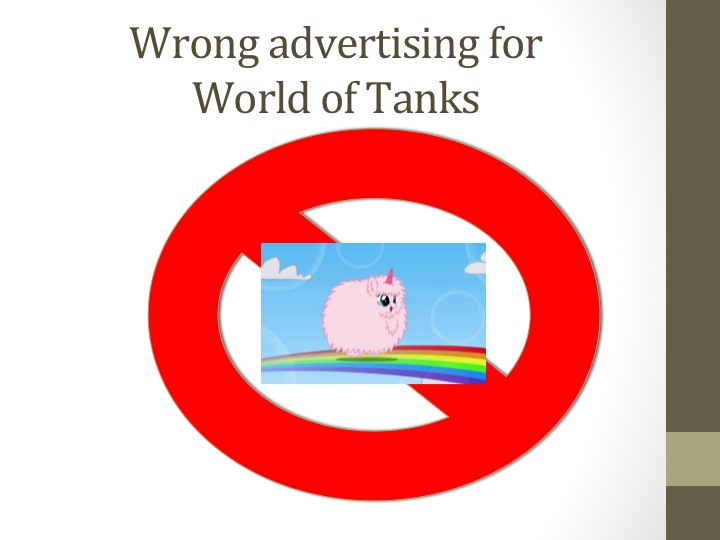
  • Contextual: The advertising should fit naturally with the overall game experience. You should not be playing Game of War and all of a sudden see an advertisement with pink fluffy unicorns dancing on rainbows.
  • Beneficial: Rather than having the advertising annoy the player, enhance their experience. Use it to deliver benefits that they would not normally receive.
  • Segment: You do not have to show ads to everyone. You may only want to show ads to non-spenders. If the ads are truly beneficial, you may actually want to show them more frequently to spenders. The important thing is to create as small clusters as possible and then create an advertising strategy that optimizes the value for that cluster (IAP [in-app purchases], subscription, advertisements).
  • Multiple formats: You should not limit your advertising strategy to one type of advertising, just as you would not limit your in-app purchases to only allowing players to buy chickens. Different types of ads will work in different parts of your game and some types will be more relevant to certain users. Use the full arsenal of advertising to optimize your player’s experience and the revenue they generate.
  • Flexibility: The digital marketing world is still in its infancy. Rather than have a laser focus on one ad unit or strategy, keep abreast of developments in the industry and continually evolve your strategy as best practices evolve.

Continue reading “Dawn of a new era of in-game advertising”

Share this:

  • Click to share on Facebook (Opens in new window) Facebook
  • Click to share on LinkedIn (Opens in new window) LinkedIn
Like Loading...
Unknown's avatarAuthor Lloyd MelnickPosted on October 21, 2015January 4, 2016Categories General Social Games Business, Social Games MarketingTags advertising, CPI, IAP, in-app purchases, in-game advertising, monetization, sponsored play, zynga1 Comment on Dawn of a new era of in-game advertising

Get my book on LTV

The definitive book on customer lifetime value, Understanding the Predictable, is now available in both print and Kindle formats on Amazon.

Understanding the Predictable delves into the world of Customer Lifetime Value (LTV), a metric that shows how much each customer is worth to your business. By understanding this metric, you can predict how changes to your product will impact the value of each customer. You will also learn how to apply this simple yet powerful method of predictive analytics to optimize your marketing and user acquisition.

For more information, click here

Follow The Business of Social Games and Casino on WordPress.com

Enter your email address to follow this blog and receive notifications of new posts by email.

Join 791 other subscribers

Most Recent Posts

  • Join me at PDMA Inspire for my talk on new product prioritization
  • Why keep studying?
  • The next three years of this blog
  • Interview with the CEO of Murka on the biggest growth opportunity in gaming, Barak David

Lloyd Melnick

This is Lloyd Melnick’s personal blog.  All views and opinions expressed on this website are mine alone and do not represent those of people, institutions or organizations that I may or may not be associated with in professional or personal capacity.

I am a serial builder of businesses (senior leadership on three exits worth over $700 million), successful in big (Disney, Stars Group/PokerStars, Zynga) and small companies (Merscom, Spooky Cool Labs) with over 20 years experience in the gaming and casino space.  Currently, I am the GM of VGW’s Chumba Casino and on the Board of Directors of Murka Games and Luckbox.

Topic Areas

  • Analytics (114)
  • Bayes' Theorem (8)
  • behavioral economics (8)
  • blue ocean strategy (14)
  • Crowdfunding (4)
  • DBA (2)
  • General Social Games Business (459)
  • General Tech Business (195)
  • Growth (88)
  • International Issues with Social Games (50)
  • Lloyd's favorite posts (101)
  • LTV (54)
  • Machine Learning (10)
  • Metaverse (1)
  • Mobile Platforms (37)
  • Prioritization (1)
  • Social Casino (52)
  • Social Games Marketing (105)
  • thinking fast and slow (5)
  • Uncategorized (33)

Social

  • View CasualGame’s profile on Facebook
  • View @lloydmelnick’s profile on Twitter
  • View lloydmelnick’s profile on LinkedIn

RSS

RSS Feed RSS - Posts

RSS Feed RSS - Comments

Categories

  • Analytics (114)
  • Bayes' Theorem (8)
  • behavioral economics (8)
  • blue ocean strategy (14)
  • Crowdfunding (4)
  • DBA (2)
  • General Social Games Business (459)
  • General Tech Business (195)
  • Growth (88)
  • International Issues with Social Games (50)
  • Lloyd's favorite posts (101)
  • LTV (54)
  • Machine Learning (10)
  • Metaverse (1)
  • Mobile Platforms (37)
  • Prioritization (1)
  • Social Casino (52)
  • Social Games Marketing (105)
  • thinking fast and slow (5)
  • Uncategorized (33)

Archives

  • September 2023
  • December 2021
  • July 2021
  • March 2021
  • February 2021
  • January 2021
  • December 2020
  • November 2020
  • October 2020
  • September 2020
  • August 2020
  • July 2020
  • June 2020
  • May 2020
  • April 2020
  • March 2020
  • February 2020
  • January 2020
  • November 2019
  • October 2019
  • September 2019
  • June 2019
  • May 2019
  • April 2019
  • March 2019
  • February 2019
  • January 2019
  • December 2018
  • June 2018
  • May 2018
  • April 2018
  • March 2018
  • February 2018
  • January 2018
  • December 2017
  • June 2017
  • May 2017
  • April 2017
  • March 2017
  • February 2017
  • January 2017
  • December 2016
  • November 2016
  • October 2016
  • September 2016
  • June 2016
  • May 2016
  • April 2016
  • March 2016
  • February 2016
  • January 2016
  • December 2015
  • November 2015
  • October 2015
  • September 2015
  • July 2015
  • June 2015
  • May 2015
  • April 2015
  • March 2015
  • February 2015
  • January 2015
  • December 2014
  • November 2014
  • October 2014
  • September 2014
  • August 2014
  • July 2014
  • June 2014
  • May 2014
  • April 2014
  • March 2014
  • February 2014
  • January 2014
  • December 2013
  • November 2013
  • October 2013
  • September 2013
  • August 2013
  • July 2013
  • June 2013
  • May 2013
  • April 2013
  • March 2013
  • February 2013
  • January 2013
  • December 2012
  • November 2012
  • October 2012
  • September 2012
  • August 2012
  • July 2012
  • June 2012
  • May 2012
  • April 2012
  • March 2012
  • February 2012
  • January 2012
  • December 2011
  • November 2011
  • October 2011
  • September 2011
  • August 2011
  • July 2011
  • June 2011
  • May 2011
  • December 2010
December 2025
S M T W T F S
 123456
78910111213
14151617181920
21222324252627
28293031  
« Sep    

by Lloyd Melnick

All posts by Lloyd Melnick unless specified otherwise
Google+

Enter your email address to subscribe to this blog and receive notifications of new posts by email.

Join 791 other subscribers
Follow Lloyd Melnick on Quora

RSS HBR Blog

  • How One Manufacturer Achieved Net Zero at Zero Cost
  • What Can U.S. Employers Do About Rising Healthcare Costs?
  • When You Have to Execute a Strategy You Disagree With
  • 4 Ways to Build Durable Relationships with Your Most Important Customers
  • What Jargon Says About Your Company Culture
  • Research: When Used Correctly, LLMs Can Unlock More Creative Ideas
  • Your New Role Requires Strategic Thinking…But You’re Stuck in the Weeds
  • For Circular Economy Innovation, Look to the Global South
  • Why Great Leaders Focus on the Details
  • Corporate Disclosure in the Age of AI

RSS Techcrunch

  • An error has occurred; the feed is probably down. Try again later.

RSS MIT Sloan Management Review Blog

  • AI Coding Tools: The Productivity Trap Most Companies Miss
  • How Procter & Gamble Uses AI to Unlock New Insights From Data
  • Rewire Organizational Knowledge With GenAI
  • Hungry for Learning: Wendy’s Will Croushorn
  • Beat Burnout: 10 Essential MIT SMR Reads
  • How Leaders Stay True to Themselves and Their Stakeholders
  • Our Guide to the Winter 2026 Issue
  • Broadening Future Perspectives at the Bank of England
  • A Faster Way to Build Future Scenarios
  • Assess What Is Certain in a Sea of Unknowns
The Business of Social Games and Casino Website Powered by WordPress.com.
  • Subscribe Subscribed
    • The Business of Social Games and Casino
    • Join 726 other subscribers
    • Already have a WordPress.com account? Log in now.
    • The Business of Social Games and Casino
    • Subscribe Subscribed
    • Sign up
    • Log in
    • Report this content
    • View site in Reader
    • Manage subscriptions
    • Collapse this bar
 

Loading Comments...
 

    %d