Skip to content

The Business of Social Games and Casino

How to succeed in the mobile game space by Lloyd Melnick

Tag: Kim Kardashian

The most important company in the game industry

The most important company in the game industry

Key takeaways

  1. The most significant company in the video and computer game space is one that people do not frequently think of Tencent, which has a market value of $229 billion (more than the market value of Apple, Google, Microsoft, Sony and EA combined).
  2. Tencent’s game properties include the biggest PC game (League of Legends), the strongest mobile franchise (Clash, as in Clash of Clans and Clash Royale) and the most important console game company (Epic, maker of Unreal and Gears of War).
  3. Tencent is also a very progressive company, allowing is investments the autonomy to make decisions and grow.

The most important company in the game industry

I was doing some research last week, when I was surprised at a company with a $200+ billion market value (market capitalization). The company was Tencent, with a market cap $229 billion. For comparison Microsoft has a market value is $479 billion. Apple is at $614 billion. It is definitely more than Sony, who only has a $37 billion market. Want to try EA, forget it, only $24 billion.

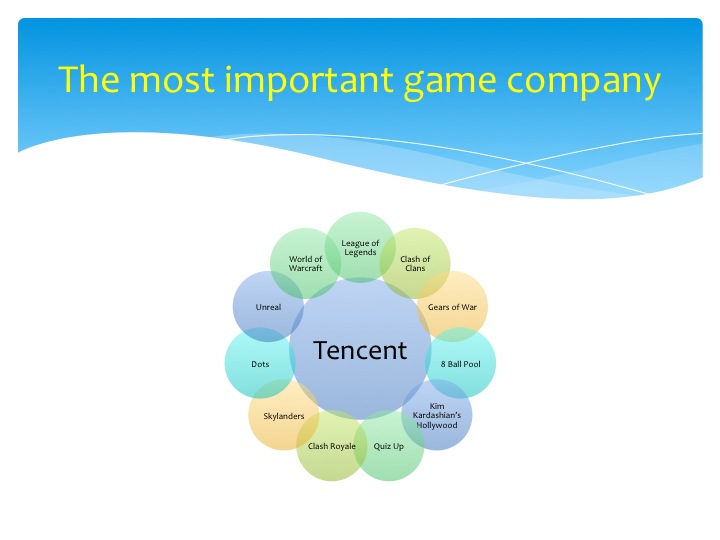
While you can argue that Tencent is not a game company (and the bulk of its income does come from other operations), looking closely it becomes apparent that they also dominate in the (western) game space. Among their assets in the game space:

  • Clash of Clans and Clash Royale from Supercell. Tencent acquired Supercell this Spring.
  • Unreal and Gears of War developer Epic Games. Tencent is the largest shareholder in Epic, probably the most important developer in the console game space. Unreal is the engine (a suite of game development tools) used to create many of the most popular games in the world, from Dragon Quest and Final Fantasy to Moto Racer to Street Fighter to Assassins Creed to Brothers in Arms to…. Not only is it the most successful game development engine, Epic’s first party titles include Unreal (big surprise), Gears of War and Infinity Blade.
  • League of Legends creator Riot Games. Tencent controls the largest PC game in the world, League of Legends.
  • 8 Ball Pool and Agar.io developer Miniclip is another Tencent company. Miniclip always sems to have multiple games in the top-10 mobile charts and has tens of millions of daily players.
  • Kim Kardashian Hollywood developer Glu Mobile. Tencent is a minority investor in the most prolific mobile developer that uses big name IP, such as Kim Kardashian, Nicki Minaj and Gordon Ramsey.
  • QuizUp from Plain Vanilla is another part of the Tencent empire, as Tencent is one of Plain Vanilla’s largest investors.
  • Skylanders, World of Warcraft, Destiny and Call of Duty owner Activision/Blizzard is also part of the Tencent empire. Tencent owns 25 percent of Activision/Blizzard.
  • And there is more. Tencent is also one of the largest shareholders in PocketGems, Dots, Robot Entertainment and I am sure some I have missed.
slide1

When you look at the properties that Tencent controls (Clash of Clans, League of Legends, etc), it is clearly the most important company in our space.

The other interesting element of Tencent

In my conversations with people at some of the companies above (and this data is totally anecdotal), Tencent is a very interesting parent. People often group it with Japanese and Korean companies, which are often very challenging to work at. My friends who have worked for Japanese companies complain about how western employees and executives had virtually no autonomy to make decisions (they were all made at the Japan level) and even then decision making was excruciatingly slow.

From what I have heard, Tencent, and Chinese companies in general, are pretty much the opposite and often more progressive than western companies. Tencent has left the companies above very autonomous and business has barely changed on the day-to-day level. Tencent, however, has helped these companies grow by expanding into the Asia. Most surprisingly, in the incredibly cynical game space, I have not heard anyone say anything bad about working for Tencent.

Chinese multinationals are often much more progressive than other Asian and often western competitors. In 2013, I wrote about how Haier (a Chinese white goods manufacturer) eliminated all of its middle management, a concept here that companies (other than Zappos) are just starting to look at. I have never worked at a Chinese company and have actually interacted very little with them, but between Tencent, Haier and Alibaba (the world’s most successful retailer), Chinese companies show many progressives traits that lead to success in the game industry.

The game industry’s most important player

When you combine Tencent’s market valuation with its network of the most important game properties, it is clear that they are the most important game company in the world. Over time, Tencent’s performance will be more parallel to that of the game. When Tencent does well, the game industry does well. When the game industry does well, Tencent will do well.
Share this:

  • Click to share on Facebook (Opens in new window) Facebook
  • Click to share on LinkedIn (Opens in new window) LinkedIn
Like Loading...
Unknown's avatarAuthor Lloyd MelnickPosted on December 14, 2016December 14, 2016Categories General Social Games BusinessTags Activision, clash of clans, clash royale, epic games, Glu Mobile, Kim Kardashian, league of legends, miniclip, Pocket Gems, quiz-up, riot games, supercell, Tencent1 Comment on The most important company in the game industry

Bayes Theorem Part 7: Kim Kardashian

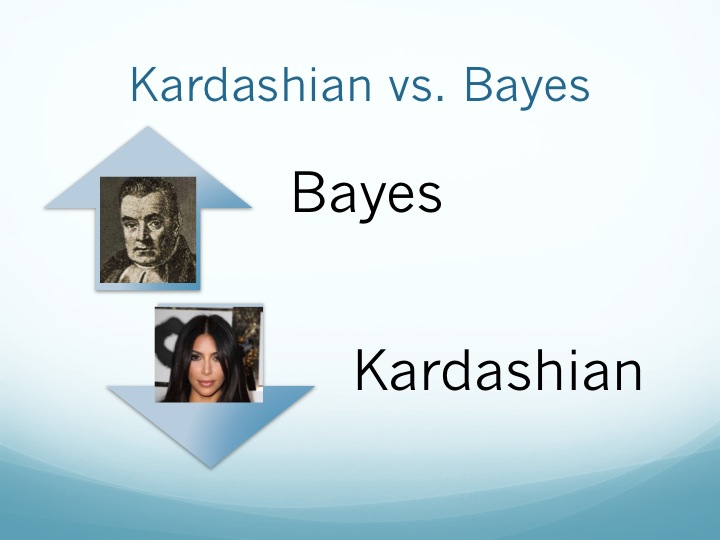
I have written several times about Bayes Theorem and its application to social and mobile gaming but the reaction to the Kim Kardashian game from Glu reminded me how often it is neglected. Bayes Theorem calculates the probability of something happening based on conditions related to the event, prior probability. The importance of Bayes Theorem is that it takes into account the underlying probability of an event happening so that you are not weighing too heavily a local data point or discrete test (you can see the actual formula in my original post).

Slide1

To illustrate, assume you are trying to determine the chance of a Libertarian candidate winning the US Presidency. You may look at the candidate and see how he checks all the right boxes and could be appealing to the mass market. Based on this information you may think he has a 20% chance of winning. But then if you look at the data of third party candidates overall in the US winning less than 1 percent of elections, you understand that even the strongest candidate at best would have slightly better than 1 percent chance of winning an election.

Reverend Thomas Bayes and Kim Kardashian

Bayes Theorem provides a useful point in not only looking at the success of Kim Kardashian: Hollywood but also applying it to your business. For those not aware, Glu Mobile launched a social/mobile game in 2014 centered around Kardashian. The game was a tremendous success for Glu, with over 35 million downloads, and helped them raise over $125 million in capital.

What is interesting is that this success has created an entirely new category, with multiple companies trying to replicate it, and this is where Bayes’ Theorem becomes important. Glu has signed other celebrities, including Britney Spears, Katy Perry and Nicki Minaj. Demi Lovato is doing a game with Pocket Gems. Rovio develoed a Shakira game. Moreover, virtually every game company and definitely every talent agent is trying to get into the celebrity mobile game business, driving up the cost of using such talent dramatically.

The problem with this approach, however, is that the game companies are neglecting Bayes’ Theorem. Most people inside the game industry agree that 80-90 percent of all games fail (by fail, do not get to ROI positive ad spend and fail to make a profit). This metric is not simply for start-ups but if you look at the major game publishers (Zynga, Kabam, King.com, etc), they deal with the same reality.

Just as having a great candidate for the Libertarian Party does not significantly change the odds of winning the election, Bayes Theorem shows that having a celebrity front a game does not significantly improve the odds of the game being successful.

Back to the Kardashian case, even with an 80 percent chance of failing, there is a 20 percent chance of success. Just because one product, Kim Kardashian: Hollywood, fell into that 20 percent you should not infer that the probability changed.

What it means for your game company

First and foremost, a celebrity does not guarantee success. Rovio’s Shakira game has already failed. Even the Kardashian game is no longer among the top grossing. Thus, a strategy based on celebrity games that does not rely on all of the games reaching Kardashian levels.

Second, everyone knows about the celebrity thing. If it was that easy to make a top-10 game by working with one, the top 10 games would feature celebrities. With so many companies using celebrities, a celebrity will no longer differentiate your product or company. You need to build a product and company strategy that creates a defendable position and compelling value proposition to your player.

Third, you need a good game. A celebrity can lower your user acquisition costs and potentially increase the number of organics, but if the game is not compelling all these new players will not monetize and leave. That does not create any value for your company.

Most importantly, structure the deal to reflect the reality the game probably has at least a 75 percent chance of failing. I know my licensing friends won’t be happy with me, but you need to limit your risk in the deal. With the success of Kim Kardashian: Hollywood, many stars are expecting seven figure royalty guarantees. While you probably do not mind paying millions if you have a top-10 hit, writing a big check for a game that has failed is very painful (and potentially bankruptcy inducing). Structure deals where you and the celebrity share in the upside but you do not bear all the risk. The good news is that and their agent probably are not familiar with Bayes’ Theorem so only expect a success, so they may be open to a revenue share.

Conclusion

Most games fail, so while a celebrity may help it is not a golden ticket to a top-10 game. You still need to deal with the underlying reality that it is a hit-driven business. Thus, it is important to manage your risk if you use a celebrity and build out a robust plan for success.

Key takeaways

  1. Bayes’ Theorem shows that the underlying probability of an event happening drives the likelihood of the event happening, despite changes in the immediate situation. For gaming, as 80-90 percent of new games fail, basing a game on a celebrity will only marginally improve those odds. Thus a game with a celebrity is probably 75-80 percent likely to fail (not formal numbers, just estimates).
  2. Do not build a strategy around the assumption that a celebrity face for a game will make the game a success, you need to still create a product strategy that builds a competitive game.
  3. Structure your deals so that the celebrity receives the bulk of their royalties if the game is successful, so you are not forced to pay millions for a failed project.

Share this:

  • Click to share on Facebook (Opens in new window) Facebook
  • Click to share on LinkedIn (Opens in new window) LinkedIn
Like Loading...
Unknown's avatarAuthor Lloyd MelnickPosted on January 20, 2016January 22, 2016Categories Bayes' Theorem, General Social Games BusinessTags Bayes' Theorem, brand, branded social games, Glu Mobile, IP, Kim Kardashian2 Comments on Bayes Theorem Part 7: Kim Kardashian

Get my book on LTV

The definitive book on customer lifetime value, Understanding the Predictable, is now available in both print and Kindle formats on Amazon.

Understanding the Predictable delves into the world of Customer Lifetime Value (LTV), a metric that shows how much each customer is worth to your business. By understanding this metric, you can predict how changes to your product will impact the value of each customer. You will also learn how to apply this simple yet powerful method of predictive analytics to optimize your marketing and user acquisition.

For more information, click here

Follow The Business of Social Games and Casino on WordPress.com

Enter your email address to follow this blog and receive notifications of new posts by email.

Join 791 other subscribers

Most Recent Posts

  • Join me at PDMA Inspire for my talk on new product prioritization
  • Why keep studying?
  • The next three years of this blog
  • Interview with the CEO of Murka on the biggest growth opportunity in gaming, Barak David

Lloyd Melnick

This is Lloyd Melnick’s personal blog.  All views and opinions expressed on this website are mine alone and do not represent those of people, institutions or organizations that I may or may not be associated with in professional or personal capacity.

I am a serial builder of businesses (senior leadership on three exits worth over $700 million), successful in big (Disney, Stars Group/PokerStars, Zynga) and small companies (Merscom, Spooky Cool Labs) with over 20 years experience in the gaming and casino space.  Currently, I am the GM of VGW’s Chumba Casino and on the Board of Directors of Murka Games and Luckbox.

Topic Areas

  • Analytics (114)
  • Bayes' Theorem (8)
  • behavioral economics (8)
  • blue ocean strategy (14)
  • Crowdfunding (4)
  • DBA (2)
  • General Social Games Business (459)
  • General Tech Business (195)
  • Growth (88)
  • International Issues with Social Games (50)
  • Lloyd's favorite posts (101)
  • LTV (54)
  • Machine Learning (10)
  • Metaverse (1)
  • Mobile Platforms (37)
  • Prioritization (1)
  • Social Casino (52)
  • Social Games Marketing (105)
  • thinking fast and slow (5)
  • Uncategorized (33)

Social

  • View CasualGame’s profile on Facebook
  • View @lloydmelnick’s profile on Twitter
  • View lloydmelnick’s profile on LinkedIn

RSS

RSS Feed RSS - Posts

RSS Feed RSS - Comments

Categories

  • Analytics (114)
  • Bayes' Theorem (8)
  • behavioral economics (8)
  • blue ocean strategy (14)
  • Crowdfunding (4)
  • DBA (2)
  • General Social Games Business (459)
  • General Tech Business (195)
  • Growth (88)
  • International Issues with Social Games (50)
  • Lloyd's favorite posts (101)
  • LTV (54)
  • Machine Learning (10)
  • Metaverse (1)
  • Mobile Platforms (37)
  • Prioritization (1)
  • Social Casino (52)
  • Social Games Marketing (105)
  • thinking fast and slow (5)
  • Uncategorized (33)

Archives

  • September 2023
  • December 2021
  • July 2021
  • March 2021
  • February 2021
  • January 2021
  • December 2020
  • November 2020
  • October 2020
  • September 2020
  • August 2020
  • July 2020
  • June 2020
  • May 2020
  • April 2020
  • March 2020
  • February 2020
  • January 2020
  • November 2019
  • October 2019
  • September 2019
  • June 2019
  • May 2019
  • April 2019
  • March 2019
  • February 2019
  • January 2019
  • December 2018
  • June 2018
  • May 2018
  • April 2018
  • March 2018
  • February 2018
  • January 2018
  • December 2017
  • June 2017
  • May 2017
  • April 2017
  • March 2017
  • February 2017
  • January 2017
  • December 2016
  • November 2016
  • October 2016
  • September 2016
  • June 2016
  • May 2016
  • April 2016
  • March 2016
  • February 2016
  • January 2016
  • December 2015
  • November 2015
  • October 2015
  • September 2015
  • July 2015
  • June 2015
  • May 2015
  • April 2015
  • March 2015
  • February 2015
  • January 2015
  • December 2014
  • November 2014
  • October 2014
  • September 2014
  • August 2014
  • July 2014
  • June 2014
  • May 2014
  • April 2014
  • March 2014
  • February 2014
  • January 2014
  • December 2013
  • November 2013
  • October 2013
  • September 2013
  • August 2013
  • July 2013
  • June 2013
  • May 2013
  • April 2013
  • March 2013
  • February 2013
  • January 2013
  • December 2012
  • November 2012
  • October 2012
  • September 2012
  • August 2012
  • July 2012
  • June 2012
  • May 2012
  • April 2012
  • March 2012
  • February 2012
  • January 2012
  • December 2011
  • November 2011
  • October 2011
  • September 2011
  • August 2011
  • July 2011
  • June 2011
  • May 2011
  • December 2010
December 2025
S M T W T F S
 123456
78910111213
14151617181920
21222324252627
28293031  
« Sep    

by Lloyd Melnick

All posts by Lloyd Melnick unless specified otherwise
Google+

Enter your email address to subscribe to this blog and receive notifications of new posts by email.

Join 791 other subscribers
Follow Lloyd Melnick on Quora

RSS HBR Blog

  • How One Manufacturer Achieved Net Zero at Zero Cost
  • What Can U.S. Employers Do About Rising Healthcare Costs?
  • When You Have to Execute a Strategy You Disagree With
  • 4 Ways to Build Durable Relationships with Your Most Important Customers
  • What Jargon Says About Your Company Culture
  • Research: When Used Correctly, LLMs Can Unlock More Creative Ideas
  • Your New Role Requires Strategic Thinking…But You’re Stuck in the Weeds
  • For Circular Economy Innovation, Look to the Global South
  • Why Great Leaders Focus on the Details
  • Corporate Disclosure in the Age of AI

RSS Techcrunch

  • An error has occurred; the feed is probably down. Try again later.

RSS MIT Sloan Management Review Blog

  • AI Coding Tools: The Productivity Trap Most Companies Miss
  • How Procter & Gamble Uses AI to Unlock New Insights From Data
  • Rewire Organizational Knowledge With GenAI
  • Hungry for Learning: Wendy’s Will Croushorn
  • Beat Burnout: 10 Essential MIT SMR Reads
  • How Leaders Stay True to Themselves and Their Stakeholders
  • Our Guide to the Winter 2026 Issue
  • Broadening Future Perspectives at the Bank of England
  • A Faster Way to Build Future Scenarios
  • Assess What Is Certain in a Sea of Unknowns
The Business of Social Games and Casino Website Powered by WordPress.com.
  • Subscribe Subscribed
    • The Business of Social Games and Casino
    • Join 726 other subscribers
    • Already have a WordPress.com account? Log in now.
    • The Business of Social Games and Casino
    • Subscribe Subscribed
    • Sign up
    • Log in
    • Report this content
    • View site in Reader
    • Manage subscriptions
    • Collapse this bar
 

Loading Comments...
 

    %d