
Skip to content

The Business of Social Games and Casino

How to succeed in the mobile game space by Lloyd Melnick

Tag: pre-mortem

2021 Pre-Mortem: What went wrong in 2021

2021 Pre-Mortem:  What went wrong in 2021

While it is impossible to predict the future — Chaos Theory shows that even very small events can have a huge impact — you can still prepare for likely scenarios. The uncertainty principle, a key tenet of quantum mechanics (as popularized by Stephen Hawking), postulates that perfect predictions are impossible if the universe itself is random. Thus, I do not believe in predictions (outside of State Fairs), but I am a strong advocate of pre-mortems and thought a pre-mortem on 2021 for the game industry would be useful. A pre-mortem is a meeting held before a major decision where all those involved in making the decision imagine themselves six or twelve months after the decision was taken, assume it turned into a debacle, and then explore why it was a disaster. The value is not predicting exactly how 2021 will turn out but preparing for events that could have a major impact.

For 2021, I want to take a similar approach and put my readers in December 2021 looking back at the year and understanding what went wrong. I have put together several ideas to consider for your pre-mortem but as every company has a different risk profile, you should focus on those that could most impact your business.

We underestimated the headwinds created by Covid-19

At the end of 2021, we may look back and regret not seeing the disruption Covid would cause to our industry. With many people unemployed or seeing lower earnings, spending in iGaming and social gaming could deteriorate sharply. If you made investments or acquisitions based on continued growth, you may find yourself in a difficult position.

covid

We overestimated how quickly revenue would revert to pre-Covid levels

There is also a possibility that when 2021 is over, you may regret anticipating that the impact of Covid would be short lived. Instead, the phenomenal growth many social and iGaming companies experienced could continue or even accelerate, as more people see the value of online gaming. Thus, you may have underinvested in growth expecting a weaker market.

We missed the impact of the new consoles on social gaming

Generally, it has been mobile and free-to-play games that have impacted the console gaming space (see THQ and Acclaim) but in a year we may look back and realize that the launch of the PS5 and Xbox Series X/M significantly impacted the mobile and gaming businesses. With the strength of the new console launches, particularly Sony’s, there is a possibility that these consoles pull users from other forms of gaming. I have always said you should not look at your direct competitors but consider the entire entertainment space (gaming, streaming media, television, etc.) as potential competitors, so discounting console gaming is something you may regret.

PS5

Real Money Gaming happens faster than expected in the US

The last year has seen the move to online accelerate (just ask most brick and mortar retailers) and this acceleration may spread to the US real money gaming industry. While the valuation of several iGaming companies have exploded because of the US opportunity (Draftkings anybody), most companies still assume the majority of the US will not legalize real money gaming in the short term. While the process has been slow, often disruption manifests itself initially slower than expected only to hit an inflection point that surprises people with the speed of the transformation (ask a movie theater owner). Changes in the US market would not only impact real money gaming operators but could change the playing field for social casino companies (for better or for worse).
Piratees

The European Real Money market shrinks significantly

While the US real money market is the opportunity everyone is looking at, the industry could experience very material changes in the markets that generate virtually all of the current profits. Evolving legislation in many European markets is impacting companies’ ability to compete and to maintain profitability. Changes always create challenges and opportunities and that is likely to be the situation in Europe’s real money market.

IDFA has a major impact on acquisition ROI

While there has been much hand-wringing and chatter about Apple’s planned IDFA change, most companies are operating under the assumption that Apple will not make a change that causes apocalyptic destruction. While that is likely the case, there is the possibility that the change will be as damaging as some warn, making it unprofitable for many game companies to acquire players. You may regret not building up a strategy that reduces your dependency on performance marketing and instead increase your competence in cross-sell and monetization (if players cost more, you need to make more from them). You also may regret what genres you pursued, as some will be more resilient to an IDFA change than others.

M&A market drives non-profitable behavior

In the last year, the M&A market in both social gaming and iGaming has heated up, with 9 and 10 figure deals commonplace. You often see in a strong M&A market that companies focus more on positioning for a sale than profitability, which cascades across the entire industry. If valuations are driven by new user growth (say the US sportsbook market), companies will bid up prices for new players and give incentives to attract customers from competitors (sometimes with a negative ROI). For businesses focused on profitability, you may find that your previously sound approach did not work in 2021.

Your “supply” lines are disrupted

Over the past five or ten years, most game companies have shifted to a model where various functions are outsourced. You may have moved your game design to India or your art to Nebraska or your sound/music to Kuala Lumpur, which has allowed you to harness the best talent in the world and potentially reduce costs. While these changes have increased elements of your resiliency, they also provide new risks. In 2020, Covid made it harder (and in some cases impossible) to travel, Brexit creates questions in how the UK will collaborate with other European countries and new trade wars potentially impact the ability to work across borders. You may find that critical functions turn into bottlenecks that slow or halt your content stream or new products.

Work from home changes the nature of the workforce

Many people have forecast how the workforce will change in a post-Covid world but, as I said earlier, predictions are not my business. Instead, you should be aware of potential shifts that could have a dramatic impact on your business in 2021:

  • Major tech companies move to a permanent part online model, thus increasing their recruiting reach worldwide. While in the past you may have considered your employees safe if you were in Belarus or Sri Lanka, you may now be competing with the world’s best companies to keep these employees.
  • People might want to return to an office. If you have moved to a pure or primarily WFH situation, you may lose employees who want to be back in an office.
  • Work from home has a negative impact on your team’s mental health.

There are many ways that work from home can evolve and you should anticipate changes in the macro-environment impacting your business.

Something happens that you never saw coming

You also need to realize that risks come in many forms. While you can anticipate some, there will be risks that come out of the blue from complex combinations of typical events or from unprecedented massive events (i.e. Covid). You need to detect these quickly and respond based on the event, rather than trying to fit it into your anticipated risk bucket. This response should be improvisational, rapid, iterative, and humble, since not every action taken will work as intended.

What to do

While I can’t (and, really, neither can you) predict the future, you need to look at possible outcomes and build up a risk adjusted strategy to optimize your growth. Do not rely on the ones listed above, but look at your business and understand what external factors could have a significant impact next year. Keep in mind, a pre-mortem is meant to look at and avoid potential disasters so while many of the above scenarios are negative, hopefully most (if not all) will never materialize. If they do not, great, it’s better to have an insurance policy you never use than needing one you do not have. You also need to be ready to react quickly to unanticipated challenges.

Key takeaways

  1. Rather than trying to guess (predict) the future, conduct a pre-mortem, where you put yourself in December 2021 and look back at what went terribly wrong for your business. The exercise will help you identify the biggest risks you face.
  2. Some of the areas you should look at include the impact of Covid, spread of Real Money gaming in the US, challenges to RMG in Europe, the new gaming consoles and how work from home is changing the workplace.
  3. You also need to realize that risks come in many forms and some are impossible to anticipate. You need to detect these quickly and respond with improvisation, speed and an iterative approach, since not every action taken will work as intended.
Share this:

  • Click to share on Facebook (Opens in new window) Facebook
  • Click to share on LinkedIn (Opens in new window) LinkedIn
Like Loading...
Unknown's avatarAuthor Lloyd MelnickPosted on December 22, 2020April 5, 2021Categories General Social Games Business, General Tech Business, International Issues with Social Games, Social CasinoTags Covid19, IDFA, Mergers and Acquisition, pre-mortem, real money online gambling, Work from home1 Comment on 2021 Pre-Mortem: What went wrong in 2021

Confirmation of Confimation Bias

Confirmation of Confimation Bias

Although I have written many times about different kinds of biases, the one I find most common, even in my decision making, is his confirmation bias. An article I recently came across, Confirmation Bias: Why You Make Terrible Life Decision by Nir Eyal, confirmed to me what I suspected, confirmation bias is more pervasive than most people realize. Confirmation bias is where people pick out anecdotes or facts that support their belief, while neglecting conflicting evidence.

I see if often in the games industry, you want to add a new feature (say a chat system) and you point to three products with chat systems that are highly successful. You do not look at the ten products with chat systems that have failed. Maybe you are looking to build a new product and you want to license an expensive IP. You justify it by pointing to the revenue that Kim Kardashian’s game generating while not including in your calculation the 20 branded games that failed.

This problem is not limited to the game industry. You may believe that social democracy is the best path forward for a country and you use Sweden, Norway and the Netherlands to confirm your belief, while not noticing Cuba, Greece and Spain. Or you believe free markets are the answer and confirm this by looking at Singapore, Taiwan and the US while not noticing Sweden, Norway and the Netherlands. Sometimes people knowingly pick the cases that prove their point, however, confirmation bias is when they sub-consciously accept the evidence that supports their beliefs.

Data is not the panacea

Using data rather than emotions appears as a vaccine against confirmation bias but data can contribute to the problem. Analysts suffer from the same biases as other people and will often look at the data that confirms their hypothesis.

You may have launched a new product that has a strong LTV and is growing rapidly, surpassing your existing product. One analyst who belongs to the team that launched the new product might look at the retention and monetization metrics and compare them with the original product. These KPIs are higher in the new product so the analyst recommends marketing funds shift from the older product to the new product. An analyst on the team for the existing product might identify that shows that total revenue (new plus old product) is flat since the launch of the new product, despite additional marketing spend on the new product. They might argue that the new product is simply cannibalizing the existing product. The better KPIs of the new product are a result of the best users moving to the flashy new toy, not a fundamentally better product.

Depending on the analyst’s initial partiality, they will either investigate and then present the first or second data set. Neither data is incorrect but the conclusion and actions they lead to are very different. Even though both analysts are being honest and believe they are objective, confirmation bias is driving their analysis.

Confirmation bias can impact career decisions

Confirmation bias is not only prevalent in deciding what decisions to make in business but also how to manage your career. You might feel your company is not treating you fairly. Then when two colleagues get large bonuses and you do not, it confirms that you are being treated unfairly. The data you may not be considering is that you are on a higher compensation level already or had received a bonus six months ago.

You also may be considering moving to a competitor. You have met people at a trade show from the other company and they mentioned some of the great perks. You interview and are then offered a position. Before accepting, you see some negative reviews on Glassdoor. You have already decided that you want the new job so you convince yourself the reviews have to be from a different business unit or boss. When you get to the new job, you learn the problems are real.

How do you fight confirmation bias

Slide1

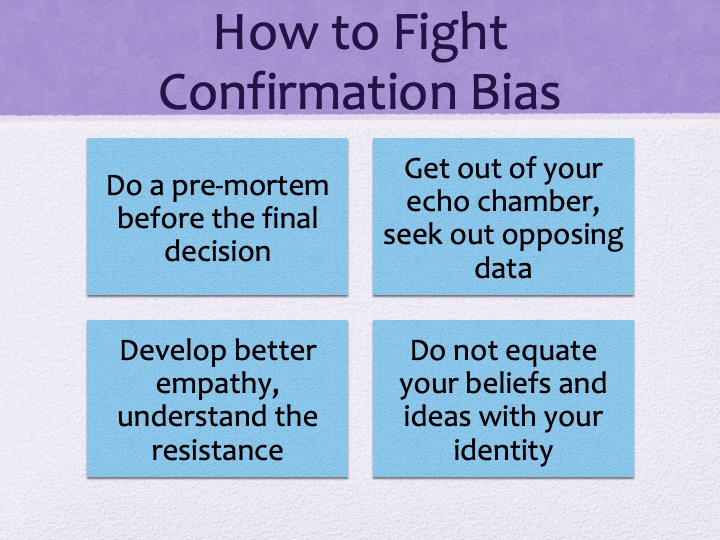
Given the prevalence of confirmation bias, it is important to create a strategy to combat it. A recent article, Facts Don’t Change People’s Minds, Here is What Does by Ozan Varol, provides some great suggestions:

  • Do not feel your beliefs create your identity. Do not get defensive when someone questions you or your project. The data is not personal and you are not a better or worse person if your hypothesis is wrong.
  • Develop better empathy. If someone disagrees with you, it is because they think they are correct. Understand why they are disagreeing and be open to them being potentially correct.
  • Get out of your echo chamber. As Varol writes, “make a point to befriend people who disagree with you. Expose yourself to environments where your opinions can be challenged, as uncomfortable and awkward as that might be.” Seek out data that disproves your position.

Additionally, I have found pre-mortems a very useful tool to combat confirmation bias. A pre-mortem is a meeting held before a major decision where all those involved in making the decision imagine themselves six or twelve months after the decision was taken, assume it turned into a debacle, and then explore why it was a disaster. This type of meeting forces you to look at contradictory facts and raise potential problems.

It is important to be cognizant of confirmation bias and seek out all the information before making important decisions. Most importantly, look at contradictory information and do not discount it because it does not support your position.

Key takeaways

  • Confirmation bias is where people pick out examples or facts that support their belief, while neglecting conflicting evidence.
  • Being data driven does not avoid confirmation bias, as people gravitate to the data that supports their beliefs.
  • To combat confirmation bias, do not equate your beliefs with your identity, understand why others have different positions, seek out non-confirming data and do a pre-mortem for important decisions.

Share this:

  • Click to share on Facebook (Opens in new window) Facebook
  • Click to share on LinkedIn (Opens in new window) LinkedIn
Like Loading...
Unknown's avatarAuthor Lloyd MelnickPosted on November 5, 2019October 13, 2019Categories General Social Games BusinessTags confirmation bias, pre-mortem2 Comments on Confirmation of Confimation Bias

The Pre-Mortem

I recently began using a decision making technique I read about and have found it so immensely useful I wanted to share it with everyone in the social game space. I am reading Daniel Kahneman’s Thinking, Fast and Slow and although I have not finished it yet have already learned many useful decision making practices. The most significant of these is the pre-mortem.

Continue reading “The Pre-Mortem”

Share this:

  • Click to share on Facebook (Opens in new window) Facebook
  • Click to share on LinkedIn (Opens in new window) LinkedIn
Like Loading...
Unknown's avatarAuthor Lloyd MelnickPosted on August 7, 2012June 4, 2014Categories General Social Games BusinessTags Daniel Kahneman, pre-mortem, thinking fast and slow7 Comments on The Pre-Mortem

Get my book on LTV

The definitive book on customer lifetime value, Understanding the Predictable, is now available in both print and Kindle formats on Amazon.

Understanding the Predictable delves into the world of Customer Lifetime Value (LTV), a metric that shows how much each customer is worth to your business. By understanding this metric, you can predict how changes to your product will impact the value of each customer. You will also learn how to apply this simple yet powerful method of predictive analytics to optimize your marketing and user acquisition.

For more information, click here

Follow The Business of Social Games and Casino on WordPress.com

Enter your email address to follow this blog and receive notifications of new posts by email.

Join 791 other subscribers

Most Recent Posts

  • Join me at PDMA Inspire for my talk on new product prioritization
  • Why keep studying?
  • The next three years of this blog
  • Interview with the CEO of Murka on the biggest growth opportunity in gaming, Barak David

Lloyd Melnick

This is Lloyd Melnick’s personal blog.  All views and opinions expressed on this website are mine alone and do not represent those of people, institutions or organizations that I may or may not be associated with in professional or personal capacity.

I am a serial builder of businesses (senior leadership on three exits worth over $700 million), successful in big (Disney, Stars Group/PokerStars, Zynga) and small companies (Merscom, Spooky Cool Labs) with over 20 years experience in the gaming and casino space.  Currently, I am the GM of VGW’s Chumba Casino and on the Board of Directors of Murka Games and Luckbox.

Topic Areas

  • Analytics (114)
  • Bayes' Theorem (8)
  • behavioral economics (8)
  • blue ocean strategy (14)
  • Crowdfunding (4)
  • DBA (2)
  • General Social Games Business (459)
  • General Tech Business (195)
  • Growth (88)
  • International Issues with Social Games (50)
  • Lloyd's favorite posts (101)
  • LTV (54)
  • Machine Learning (10)
  • Metaverse (1)
  • Mobile Platforms (37)
  • Prioritization (1)
  • Social Casino (52)
  • Social Games Marketing (105)
  • thinking fast and slow (5)
  • Uncategorized (33)

Social

  • View CasualGame’s profile on Facebook
  • View @lloydmelnick’s profile on Twitter
  • View lloydmelnick’s profile on LinkedIn

RSS

RSS Feed RSS - Posts

RSS Feed RSS - Comments

Categories

  • Analytics (114)
  • Bayes' Theorem (8)
  • behavioral economics (8)
  • blue ocean strategy (14)
  • Crowdfunding (4)
  • DBA (2)
  • General Social Games Business (459)
  • General Tech Business (195)
  • Growth (88)
  • International Issues with Social Games (50)
  • Lloyd's favorite posts (101)
  • LTV (54)
  • Machine Learning (10)
  • Metaverse (1)
  • Mobile Platforms (37)
  • Prioritization (1)
  • Social Casino (52)
  • Social Games Marketing (105)
  • thinking fast and slow (5)
  • Uncategorized (33)

Archives

  • September 2023
  • December 2021
  • July 2021
  • March 2021
  • February 2021
  • January 2021
  • December 2020
  • November 2020
  • October 2020
  • September 2020
  • August 2020
  • July 2020
  • June 2020
  • May 2020
  • April 2020
  • March 2020
  • February 2020
  • January 2020
  • November 2019
  • October 2019
  • September 2019
  • June 2019
  • May 2019
  • April 2019
  • March 2019
  • February 2019
  • January 2019
  • December 2018
  • June 2018
  • May 2018
  • April 2018
  • March 2018
  • February 2018
  • January 2018
  • December 2017
  • June 2017
  • May 2017
  • April 2017
  • March 2017
  • February 2017
  • January 2017
  • December 2016
  • November 2016
  • October 2016
  • September 2016
  • June 2016
  • May 2016
  • April 2016
  • March 2016
  • February 2016
  • January 2016
  • December 2015
  • November 2015
  • October 2015
  • September 2015
  • July 2015
  • June 2015
  • May 2015
  • April 2015
  • March 2015
  • February 2015
  • January 2015
  • December 2014
  • November 2014
  • October 2014
  • September 2014
  • August 2014
  • July 2014
  • June 2014
  • May 2014
  • April 2014
  • March 2014
  • February 2014
  • January 2014
  • December 2013
  • November 2013
  • October 2013
  • September 2013
  • August 2013
  • July 2013
  • June 2013
  • May 2013
  • April 2013
  • March 2013
  • February 2013
  • January 2013
  • December 2012
  • November 2012
  • October 2012
  • September 2012
  • August 2012
  • July 2012
  • June 2012
  • May 2012
  • April 2012
  • March 2012
  • February 2012
  • January 2012
  • December 2011
  • November 2011
  • October 2011
  • September 2011
  • August 2011
  • July 2011
  • June 2011
  • May 2011
  • December 2010
December 2025
S M T W T F S
 123456
78910111213
14151617181920
21222324252627
28293031  
« Sep    

by Lloyd Melnick

All posts by Lloyd Melnick unless specified otherwise
Google+

Enter your email address to subscribe to this blog and receive notifications of new posts by email.

Join 791 other subscribers
Follow Lloyd Melnick on Quora

RSS HBR Blog

  • How One Manufacturer Achieved Net Zero at Zero Cost
  • What Can U.S. Employers Do About Rising Healthcare Costs?
  • When You Have to Execute a Strategy You Disagree With
  • 4 Ways to Build Durable Relationships with Your Most Important Customers
  • What Jargon Says About Your Company Culture
  • Research: When Used Correctly, LLMs Can Unlock More Creative Ideas
  • Your New Role Requires Strategic Thinking…But You’re Stuck in the Weeds
  • For Circular Economy Innovation, Look to the Global South
  • Why Great Leaders Focus on the Details
  • Corporate Disclosure in the Age of AI

RSS Techcrunch

  • An error has occurred; the feed is probably down. Try again later.

RSS MIT Sloan Management Review Blog

  • AI Coding Tools: The Productivity Trap Most Companies Miss
  • How Procter & Gamble Uses AI to Unlock New Insights From Data
  • Rewire Organizational Knowledge With GenAI
  • Hungry for Learning: Wendy’s Will Croushorn
  • Beat Burnout: 10 Essential MIT SMR Reads
  • How Leaders Stay True to Themselves and Their Stakeholders
  • Our Guide to the Winter 2026 Issue
  • Broadening Future Perspectives at the Bank of England
  • A Faster Way to Build Future Scenarios
  • Assess What Is Certain in a Sea of Unknowns
The Business of Social Games and Casino Website Powered by WordPress.com.
  • Subscribe Subscribed
    • The Business of Social Games and Casino
    • Join 726 other subscribers
    • Already have a WordPress.com account? Log in now.
    • The Business of Social Games and Casino
    • Subscribe Subscribed
    • Sign up
    • Log in
    • Report this content
    • View site in Reader
    • Manage subscriptions
    • Collapse this bar
 

Loading Comments...
 

    %d