Skip to content

The Business of Social Games and Casino

How to succeed in the mobile game space by Lloyd Melnick

Tag: Scarcity

Using scarcity to increase revenue

I recently came across a great post, 9 Essential Ways to Use Scarcity to Increase Sales, on how to use scarcity to increase sales, something we all strive for. Scarcity is a technique used by traditional retailers for ages but something that applies to digital and virtual goods as well. By creating a perceived scarcity, customers are more likely to make a purchase quickly. It boils down to the phrase, “you always want what you can’t get.”

Scarcity promotions

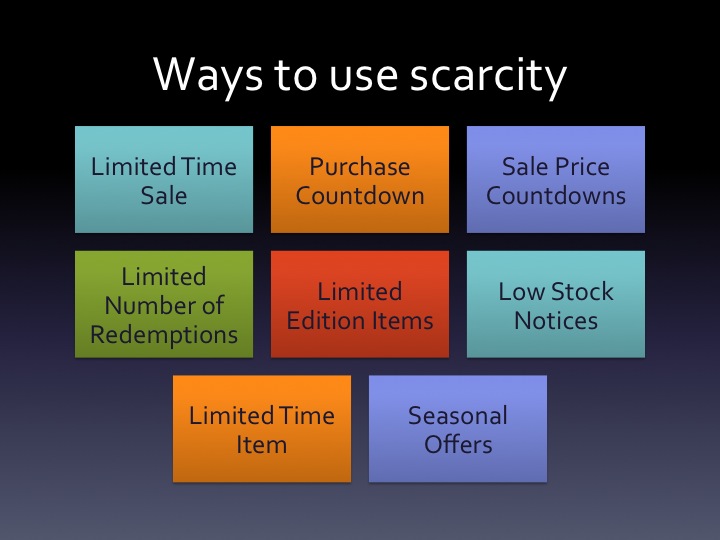
There are several ways to use scarcity, including for virtual items:

  • Limited time sale. Make an offer that lasts for only a limited time. For example, players can get twice the normal amount of virtual currency with a purchase if the purchase is made in the next 24 hours.
  • Purchase countdown. Building on a limited time sale, Putting a timer or countdown within a sales context means defining some scarcity parameters. When the customer has a firm grasp on how much time he or she has left to make a decision, it adds a sense of urgency to the process.
  • Sale price countdowns. Countdowns can also be used in the context of a limited time sale price to remind viewers how much time is left to act before the discounted offer goes away.
  • Limited number of redemptions. Offer a sale that is only available for the first X customers.
  • Limited edition item. Sell a product where there are only a limited number made. This can be modified for virtual goods, there will only be a certain number of the good sold.
  • Low stock notices. While largely for retail, this can also be used with virtual goods, particularly limited edition virtual goods.
  • Limited time item. A virtual item or package that is only available for a certain number of days or hours.
  • Seasonal offers. A sale or item only available for a certain season. It can be anything from a Halloween Pumpkin latte to a Independence Day Virtual Chip bundle.
Slide1

Scarcity basics

For scarcity to work, there are several criteria that you need to meet. The first key is that it is useful. Making something that has no value scarce does not magically impart value on the item or offering. There needs to be an underlying value that can be accentuated by scarcity.

The offering should be transferable. By allowing people to share the offer, the offer filters to those who value it. Finally, you need to be able to own it, even a virtual good. One of the values of scarcity is that you can show it off and there is no way to show off something you cannot possess.

There are several reasons why scarcity works, and understand these reasons can help you create a stronger offering:

  • Scarce items feel exclusive.
  • Scarce items appear more valuable.
  • Scarce items make people feel powerful.

In the article, the authors also point to four limits on using scarcity:

  1. Test to know what works. As with anything, testing is always recommended. AB test different techniques, time limits, product limits, etc.
  2. Too much pressure is a bad thing. Give the user or customer time to make their decision.
  3. Everything in moderation. Limited edition or limited time sales work if they feel special, if there is one every day people soon realize they are only a sales tactic.
  4. Scarcity tactics are not a fix for lagging sales. If your product is not appealing, offering less of it will not turn things around. These tactics make a good product more successful, they are not a way to trick people into using a bad product.

Scarcity is a tool

Scarcity can be a very useful tool when building your promotion strategy. It is not a silver bullet but used effectively can help improve sales and conversions.

Key takeaways

  • Scarcity, or perceived scarcity, is a very useful tool for increasing sales.
  • Scarcity works because it makes items feel exclusive, appear more valuable and make the buyers feel powerful.
  • Scarcity is best used in limited time sales or limited edition items.

Share this:

  • Click to share on Facebook (Opens in new window) Facebook
  • Click to share on LinkedIn (Opens in new window) LinkedIn
Like Loading...
Unknown's avatarAuthor Lloyd MelnickPosted on May 4, 2016April 18, 2016Categories General Social Games Business, Growth, Social Games MarketingTags promotions, Sales, ScarcityLeave a comment on Using scarcity to increase revenue

Turning your customers into your venture capital

John Mullins
John Mullins

Raising capital to finance growth for game and tech companies is one of the important responsibilities a leader will havem=, and to do it successfully you must realize it is not just about getting money in the bank. My post last week about Hasbro’s acquisition of Backflip Studios highlighted how smart cash management enabled the Backflip management team to capitalize on the opportunity with Hasbro (and make out quite well for themselves) largely because they did not receive significant investment. Had they taken a large investment at a high valuation, they most likely would not of been able to work with Hasbro. A recent Harvard Business Review article, Use Customer Cash to Finance Your Start-Up by John Mullins highlights the success many tech companies are having building a business through their customers’—not investors’—cash.

The Airbnb story

Airbnb is a great example of a company relying on customer cash to finance growth, allowing it to reach a point at which it was valued at over $1 billion when it did raise venture capital. Continue reading “Turning your customers into your venture capital”

Share this:

  • Click to share on Facebook (Opens in new window) Facebook
  • Click to share on LinkedIn (Opens in new window) LinkedIn
Like Loading...
Unknown's avatarAuthor Lloyd MelnickPosted on July 18, 2013August 19, 2013Categories General Social Games BusinessTags Airbnb, Deposit, Financing, John Mullins, Matchmaker, Scarcity, Standardize and Resell, Subscription3 Comments on Turning your customers into your venture capital

Get my book on LTV

The definitive book on customer lifetime value, Understanding the Predictable, is now available in both print and Kindle formats on Amazon.

Understanding the Predictable delves into the world of Customer Lifetime Value (LTV), a metric that shows how much each customer is worth to your business. By understanding this metric, you can predict how changes to your product will impact the value of each customer. You will also learn how to apply this simple yet powerful method of predictive analytics to optimize your marketing and user acquisition.

For more information, click here

Follow The Business of Social Games and Casino on WordPress.com

Enter your email address to follow this blog and receive notifications of new posts by email.

Join 791 other subscribers

Most Recent Posts

  • Join me at PDMA Inspire for my talk on new product prioritization
  • Why keep studying?
  • The next three years of this blog
  • Interview with the CEO of Murka on the biggest growth opportunity in gaming, Barak David

Lloyd Melnick

This is Lloyd Melnick’s personal blog.  All views and opinions expressed on this website are mine alone and do not represent those of people, institutions or organizations that I may or may not be associated with in professional or personal capacity.

I am a serial builder of businesses (senior leadership on three exits worth over $700 million), successful in big (Disney, Stars Group/PokerStars, Zynga) and small companies (Merscom, Spooky Cool Labs) with over 20 years experience in the gaming and casino space.  Currently, I am the GM of VGW’s Chumba Casino and on the Board of Directors of Murka Games and Luckbox.

Topic Areas

  • Analytics (114)
  • Bayes' Theorem (8)
  • behavioral economics (8)
  • blue ocean strategy (14)
  • Crowdfunding (4)
  • DBA (2)
  • General Social Games Business (459)
  • General Tech Business (195)
  • Growth (88)
  • International Issues with Social Games (50)
  • Lloyd's favorite posts (101)
  • LTV (54)
  • Machine Learning (10)
  • Metaverse (1)
  • Mobile Platforms (37)
  • Prioritization (1)
  • Social Casino (52)
  • Social Games Marketing (105)
  • thinking fast and slow (5)
  • Uncategorized (33)

Social

  • View CasualGame’s profile on Facebook
  • View @lloydmelnick’s profile on Twitter
  • View lloydmelnick’s profile on LinkedIn

RSS

RSS Feed RSS - Posts

RSS Feed RSS - Comments

Categories

  • Analytics (114)
  • Bayes' Theorem (8)
  • behavioral economics (8)
  • blue ocean strategy (14)
  • Crowdfunding (4)
  • DBA (2)
  • General Social Games Business (459)
  • General Tech Business (195)
  • Growth (88)
  • International Issues with Social Games (50)
  • Lloyd's favorite posts (101)
  • LTV (54)
  • Machine Learning (10)
  • Metaverse (1)
  • Mobile Platforms (37)
  • Prioritization (1)
  • Social Casino (52)
  • Social Games Marketing (105)
  • thinking fast and slow (5)
  • Uncategorized (33)

Archives

  • September 2023
  • December 2021
  • July 2021
  • March 2021
  • February 2021
  • January 2021
  • December 2020
  • November 2020
  • October 2020
  • September 2020
  • August 2020
  • July 2020
  • June 2020
  • May 2020
  • April 2020
  • March 2020
  • February 2020
  • January 2020
  • November 2019
  • October 2019
  • September 2019
  • June 2019
  • May 2019
  • April 2019
  • March 2019
  • February 2019
  • January 2019
  • December 2018
  • June 2018
  • May 2018
  • April 2018
  • March 2018
  • February 2018
  • January 2018
  • December 2017
  • June 2017
  • May 2017
  • April 2017
  • March 2017
  • February 2017
  • January 2017
  • December 2016
  • November 2016
  • October 2016
  • September 2016
  • June 2016
  • May 2016
  • April 2016
  • March 2016
  • February 2016
  • January 2016
  • December 2015
  • November 2015
  • October 2015
  • September 2015
  • July 2015
  • June 2015
  • May 2015
  • April 2015
  • March 2015
  • February 2015
  • January 2015
  • December 2014
  • November 2014
  • October 2014
  • September 2014
  • August 2014
  • July 2014
  • June 2014
  • May 2014
  • April 2014
  • March 2014
  • February 2014
  • January 2014
  • December 2013
  • November 2013
  • October 2013
  • September 2013
  • August 2013
  • July 2013
  • June 2013
  • May 2013
  • April 2013
  • March 2013
  • February 2013
  • January 2013
  • December 2012
  • November 2012
  • October 2012
  • September 2012
  • August 2012
  • July 2012
  • June 2012
  • May 2012
  • April 2012
  • March 2012
  • February 2012
  • January 2012
  • December 2011
  • November 2011
  • October 2011
  • September 2011
  • August 2011
  • July 2011
  • June 2011
  • May 2011
  • December 2010
December 2025
S M T W T F S
 123456
78910111213
14151617181920
21222324252627
28293031  
« Sep    

by Lloyd Melnick

All posts by Lloyd Melnick unless specified otherwise
Google+

Enter your email address to subscribe to this blog and receive notifications of new posts by email.

Join 791 other subscribers
Follow Lloyd Melnick on Quora

RSS HBR Blog

  • How One Manufacturer Achieved Net Zero at Zero Cost
  • What Can U.S. Employers Do About Rising Healthcare Costs?
  • When You Have to Execute a Strategy You Disagree With
  • 4 Ways to Build Durable Relationships with Your Most Important Customers
  • What Jargon Says About Your Company Culture
  • Research: When Used Correctly, LLMs Can Unlock More Creative Ideas
  • Your New Role Requires Strategic Thinking…But You’re Stuck in the Weeds
  • For Circular Economy Innovation, Look to the Global South
  • Why Great Leaders Focus on the Details
  • Corporate Disclosure in the Age of AI

RSS Techcrunch

  • An error has occurred; the feed is probably down. Try again later.

RSS MIT Sloan Management Review Blog

  • AI Coding Tools: The Productivity Trap Most Companies Miss
  • How Procter & Gamble Uses AI to Unlock New Insights From Data
  • Rewire Organizational Knowledge With GenAI
  • Hungry for Learning: Wendy’s Will Croushorn
  • Beat Burnout: 10 Essential MIT SMR Reads
  • How Leaders Stay True to Themselves and Their Stakeholders
  • Our Guide to the Winter 2026 Issue
  • Broadening Future Perspectives at the Bank of England
  • A Faster Way to Build Future Scenarios
  • Assess What Is Certain in a Sea of Unknowns
The Business of Social Games and Casino Website Powered by WordPress.com.
  • Subscribe Subscribed
    • The Business of Social Games and Casino
    • Join 726 other subscribers
    • Already have a WordPress.com account? Log in now.
    • The Business of Social Games and Casino
    • Subscribe Subscribed
    • Sign up
    • Log in
    • Report this content
    • View site in Reader
    • Manage subscriptions
    • Collapse this bar
 

Loading Comments...
 

    %d