Nobody can argue that the business environment is constantly changing, probably at a faster rate than ever before. New technologies are introduced almost daily, customer tastes change frequently as our global society exposes people to new products and the business cycle is compressed with automated trading. An article in the Harvard Business Review — The Biology of Corporate Survival by Martin Reeves, Simon Levin and Daichi Ueda – explains how companies are like biological species and need to adapt to survive.
As the authors write, “companies operate in an increasingly complex world. Business environments are more diverse, dynamic, and interconnected than ever – and far less predictable. Yet many firms pursue classic approaches to strategy that were designed for more stable times, emphasizing analysis and planning focused on maximizing short-term performance rather than long-term robustness.”
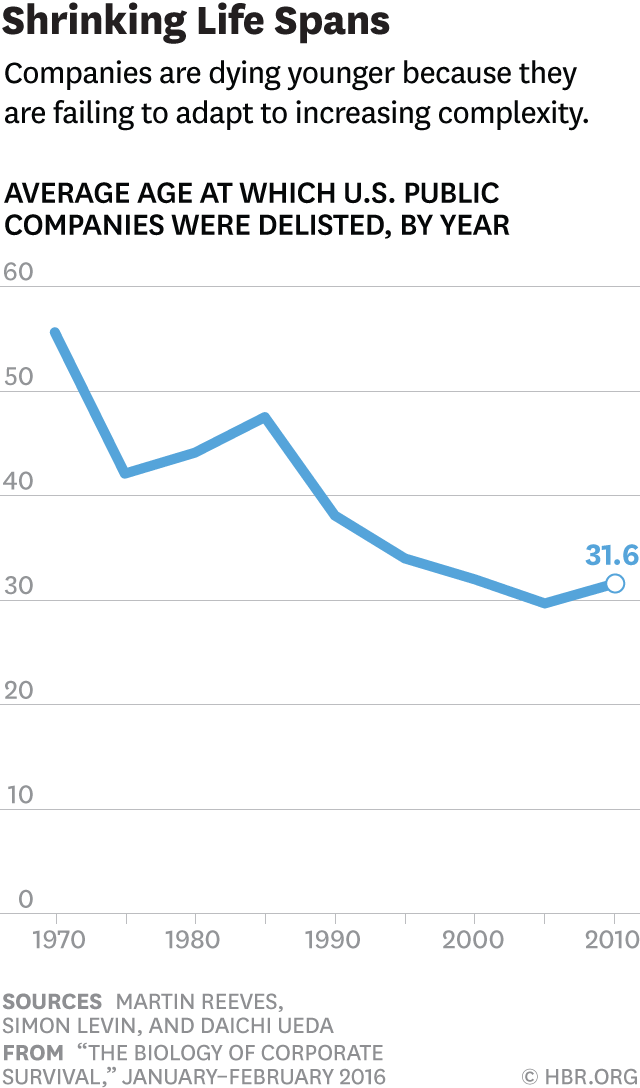
When looking at the results of this practice, the authors say that companies are disappearing faster than ever. Over 30 percent of publicly traded companies will be delisted in the next five years, due to bankruptcy, liquidation, M&A or other causes. Compared to 40 years ago (the 1970s for those who did not major in mathematics), this represents a 6 times greater likelihood that a public company disappears.
The authors believe this higher mortality rate is due to companies failing to adapt to the increasing complexity of the business environment. Many misread the environment, selected the wrong approach to strategy, or failed to support a viable approach with the right behaviors and capabilities.
Business is complex
As the article states, “in a complex adaptive system, local events and interactions among the “agents,” whether ants, trees, or people, can cascade and reshape the entire system—a property called emergence. The system’s new structure then influences the individual agents, resulting in further changes to the overall system. Thus the system continually evolves in hard-to-predict ways through a cycle of local interactions, emergence, and feedback. In nature we see this play out when ants of some species, for example, although individually following simple behavioral rules, collectively create ‘supercolonies’ of several hundred million ants covering more than a square kilometer of territory. In business we see workers and management, through their local actions and interactions, shape the overall structure, behavior, and performance of a firm. In both spheres these emergent outcomes influence individuals and create new contexts for their interactions. Whether we look at team dynamics, the evolution of strategies, or the behavior of markets, the pattern of local interactions, emergence, and feedback is apparent.
Complex adaptive systems are often nested in broader systems. A population is a CAS nested in a natural ecosystem, which itself is nested in the broader biological environment. A company is a CAS nested in a business ecosystem, which is nested in the broad societal environment. Complexity therefore exists at multiple levels, not just within organizational boundaries; and at each level there is tension between what is good for an individual agent and what is good for the larger system.”
This complexity has several implications for business leaders:
- Do not overestimate what you can predict and control as much is beyond the reach of managerial influence. You need to expect unpredictable and extreme emergent outcomes will cascade from actions at the lower levels.
- You must look beyond what your company owns or controls, monitoring and addressing complexity outside of your company.
- You must embrace the inconvenient truth that attempts to control directly agents at lower levels of the system often create counter-intuitive outcomes at higher levels. Rather than trying to control the behavior seek to shape the context for that behavior.
Six principles to build complex adaptive systems
Based on the complexity of the business environment, the authors of the article propose six principals to make complex adaptive systems in business robust. Some of the principles help create a more robust structure while the others provide managerial guidance.
Avoid Homogeneity
Variety in a complex adaptive system allows the system to adapt to a changing environment. As a leader, you must ensure the company is diverse in terms of people, ideas and endeavors. This practice often starts with who you hire but you must also encourage your diverse team to express diverse ideas.
Sustain Modularity
You should build your system to consist of different nodes of loosely connected components. Highly modular systems impede the spread of shocks from one component to the next. Within a company, tight connections across regions or businesses can enhance information flows, innovation and agility. These tight connections, however, tend to make your company vulnerable to severe adverse events.
Preserve Redundancy
In systems with redundancy, multiple components play overlapping functions. When one fails, another takes over the same role. Redundancy is particularly important in highly dynamic environments, where adverse shocks occur frequently.
Expect surprises while reducing uncertainty
A key feature of complex adaptive systems is that we cannot precisely predict their future states. However, we can collect signals, detect patterns of change, and imagine plausible outcomes—and take action to minimize undesirable ones.
As the article states, “In business systems few things are harder to predict than the progress and impact of new technologies. But it can be worthwhile to actively monitor and react to the activities of maverick competitors in an effort to avoid being blindsided. Companies that do this follow a few best practices. First, if they are incumbents, they accept that their business models will be superseded at some point, and they consider how that may happen and what to do about it. Second, they understand that change often comes from an industry’s periphery—from start-ups or challengers who have no choice but to bet against incumbents’ models. Third, they collect weak signals from the smart money flows and early-stage entrepreneurial activity that constitute those bets against their models. Fourth, they practice contingent thinking: Rather than posing the unanswerable question of whether this or that company or technology will succeed, they ask, If the maverick’s idea worked, what would be the consequences for us? Finally, they take preemptive action against such threats by replicating the idea, acquiring it, or building defenses against it.”
Create feedback loops and adaptive mechanisms
Feedback loops ensure that selection occurs and improves the fitness of the system. Your company can identify quickly changes in the environment by having good feedback loops in place. As the authors write, “In nature, mutation and natural selection—the variation, selection, and propagation of genes that contribute to reproductive success—is an autonomous process. In business the analog is a predominantly “managed” activity. The variation, selection, and propagation of innovations happen only when leaders explicitly create and encourage mechanisms that promote those things. In fact, mainstream management thinking, as taught in many business schools, may actively suppress the intrinsic “variance” and “inefficiency” associated with iterative experimentation. Yet the cultivation of this adaptive capability is now essential for companies that may have managed themselves for decades using only analysis and planning.”
There are two steps you can take to adapt this principle to iterative innovation:
- It must detect the correct signals from across your company. The key here is to interact with employees at all levels.
- You must translate those signals into actions.
If the feedback cycle becomes too short or the response to change is too strong, the system may overshoot its targets and become unstable. As with the other principles, calibration is essential.
Foster trust and reciprocity
Complex adaptive systems require vigorous cooperation, while direct control of system participants is seldom possible. Individual interests often conflict, and when individuals pursue their own interests, the system becomes weaker and everyone suffers. Individuals lack incentives to act in ways that benefit the overall system unless they benefit in immediate ways themselves. Trust and the enforcement of reciprocity combine to provide a mechanism for organizations to overcome this predicament.
Leaders should consider how their firms contribute to other stakeholders in their ecosystem. They must ensure that they are adding value to the system even as they seek to maximize profits.
What it all means
You must build your organization and company for the reality of a constantly changing business ecosystem. To do this, you need a structure that minimizes these risks. This includes heterogeneity (so you get different ideas), modularity (so that you can isolate negative disturbances) and redundancy (so you can deal with large shocks). You also need to put in place managerial principles to deal proactively with this changing environment. These principals include expecting surprises while reducing uncertainty, creating feedback loops and implementing them and creating an atmosphere of trust and reciprocity. Only by proactively adapting to this fast changing system will you survive and thrive.
Key takeaways
- Businesses face ever more diverse environments, which are harsher, less predictable and more malleable than historical environments.
- To adapt to the changing system, you need to implement an adaptive structure. This includes heterogeneity (so you get different ideas), modularity (so that you can isolate negative disturbances) and redundancy (so you can deal with large shocks).
- You also need to put in place three key managerial principles. These principals include expecting surprises while reducing uncertainty, creating feedback loops and implementing them and creating an atmosphere of trust and reciprocity.
 The Business of Social Games and Casino