Skip to content

The Business of Social Games and Casino

How to succeed in the mobile game space by Lloyd Melnick

Tag: You Tube

How to use nano-marketing to grow your game or app

One of the constant challenges developers face is user acquisition, as costs seem to increase much faster than revenue per user. This issue is not limited to game developers as more companies see digital and performance marketing as their premium-marketing channel, the competition for eyeballs drives up costs. It is a constant challenge for everyone in growth or marketing to understand the newest techniques for finding the best and most effective channels. No longer can any executive run television ads and then hide behind ambiguous results. The issue is magnified when trying to reach millennials, who spend most of their time (free time or not) in the digital world.

A recent article in the MIT Sloan Management Review, The Right Way to Market to Millennials by Jay Sinha and Thomas Fung, does a great job of presenting the idea of nano-marketing, one of the most promising new growth mechanics. Nano-marketing is using micro-influencers to market your product or build your brand. This approach is evolving into one of the most effective forms of advertising.

Who and what are micro-influencers

While we are all familiar with the personalities who have huge social media followings, the Kim Kardashians or Gwyneth Paltrows, the people with smaller followings are proving most effective. Micro-influencers have between 1,000 and 100,000 followers. Although their following is relatively small (Kim Kardashian has over 100 million followers), they have a category specific following and much more engaged audience. Micro-influencers also build more personal relationships with their fans, as they can engage with them one-on-one. They are also frequently considered experts in their fields (something you may not say about a Kardashian).

People also often consider micro-influencers more credible. When LeBron James tweets his support of a shoe, most people assume he is getting paid for that tweet. Conversely, a micro-influencer who promotes your game will believe he is a fan and give him the benefit of the doubt. Even if people assume the micro-influencer was paid, they also assume that the personality has a true affinity for the product.

Not only can micro-influencers drive sales, but they can contribute to your brand building. Sinha and Fung discuss how Coca-Cola leverages micro-influencers to develop compelling brand narratives. They also discuss how start-ups, such as sock retailer Stance Inc., have used micro-influencers to grow into major brands.

How to leverage micro-influencers

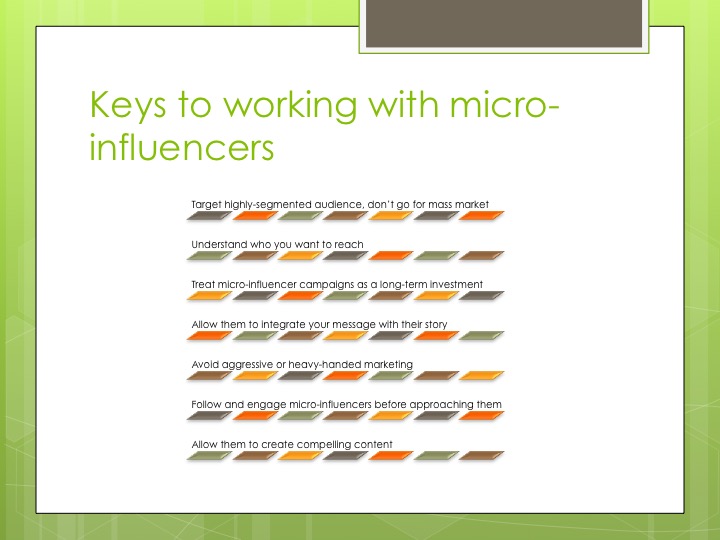
Working with micro-influencers is different than working with celebrities or other marketing channels, it also requires a personal approach. There are several keys to building a successful micro-influencer program, with may of them highlighted by Sinha and Fung as well as a VentureBeat post on how micro-influencers are essential. The elements of a successful program include:
Slide1

  1. Use micro-influencers to target highly segmented audiences. This channel is not the right option to reach millions at once. Instead, micro-influencers are a great way to amplify a feature that largely appeals to a niche or helps you recruit a specialized segment.
  2. Understand who you want to reach. There are millions of micro-influencers, you need to understand exactly who you want to target and the goal(s) of your campaign. Once you have a clear understanding of your target, you can then find the micro-influencers who reach that audience.
  3. Look at micro-influencer work as a long-term investment. Build a long-term relationship with the most appropriate micro-influencers, so they can continuously weave your brand into their stories.
  4. Effective micro-influencers integrate their personal narratives with the brands they endorse. Rather than trying to foist a message on the micro-influencers, use their story-telling ability to create a compelling message.
  5. Avoid heavy-handed or aggressive push-marketing and instead have the micro-influencer give their audience a gentle nudge.
  6. Before approaching micro-influencers, follow and engage with them. As VentureBeat writes, “this helps you better understand their personality and interests so you can determine their fit with your brand. It also helps you approach them with a more personal request, which is more likely to get a positive response.”
  7. Allow the micro-influencer to create compelling content rather than directing them. As Sinha and Fung write, “young, creative micro-influencers are good at producing innovative content that features the brands in an interesting way. They know their audience would want to be educated about new offerings, while being entertained at the same time.”

By following these steps, you can build an effective micro-influencer program that will support your marketing initiatives.

Key takeaways

  • Marketing continues to evolve quickly, with it increasingly difficult and important to find effective advertising channels. Nano marketing is one of the most promising of these channels.
  • Nano marketing entails working with micro-influencers, people with between 1,000 and 100,000 followers, to promote your brand or products.
  • Micro-influencers are particularly effective because consumers consider them more genuine and they have much greater focus than celebrities who have huge followings.

Share this:

  • Click to share on Facebook (Opens in new window) Facebook
  • Click to share on LinkedIn (Opens in new window) LinkedIn
Like Loading...
Unknown's avatarAuthor Lloyd MelnickPosted on May 22, 2018May 14, 2018Categories General Social Games Business, General Tech Business, Growth, Social Games MarketingTags influencers, Millenials, Nano Marketing, You TubeLeave a comment on How to use nano-marketing to grow your game or app

Get my book on LTV

The definitive book on customer lifetime value, Understanding the Predictable, is now available in both print and Kindle formats on Amazon.

Understanding the Predictable delves into the world of Customer Lifetime Value (LTV), a metric that shows how much each customer is worth to your business. By understanding this metric, you can predict how changes to your product will impact the value of each customer. You will also learn how to apply this simple yet powerful method of predictive analytics to optimize your marketing and user acquisition.

For more information, click here

Follow The Business of Social Games and Casino on WordPress.com

Enter your email address to follow this blog and receive notifications of new posts by email.

Join 791 other subscribers

Most Recent Posts

  • Join me at PDMA Inspire for my talk on new product prioritization
  • Why keep studying?
  • The next three years of this blog
  • Interview with the CEO of Murka on the biggest growth opportunity in gaming, Barak David

Lloyd Melnick

This is Lloyd Melnick’s personal blog.  All views and opinions expressed on this website are mine alone and do not represent those of people, institutions or organizations that I may or may not be associated with in professional or personal capacity.

I am a serial builder of businesses (senior leadership on three exits worth over $700 million), successful in big (Disney, Stars Group/PokerStars, Zynga) and small companies (Merscom, Spooky Cool Labs) with over 20 years experience in the gaming and casino space.  Currently, I am the GM of VGW’s Chumba Casino and on the Board of Directors of Murka Games and Luckbox.

Topic Areas

  • Analytics (114)
  • Bayes' Theorem (8)
  • behavioral economics (8)
  • blue ocean strategy (14)
  • Crowdfunding (4)
  • DBA (2)
  • General Social Games Business (459)
  • General Tech Business (195)
  • Growth (88)
  • International Issues with Social Games (50)
  • Lloyd's favorite posts (101)
  • LTV (54)
  • Machine Learning (10)
  • Metaverse (1)
  • Mobile Platforms (37)
  • Prioritization (1)
  • Social Casino (52)
  • Social Games Marketing (105)
  • thinking fast and slow (5)
  • Uncategorized (33)

Social

  • View CasualGame’s profile on Facebook
  • View @lloydmelnick’s profile on Twitter
  • View lloydmelnick’s profile on LinkedIn

RSS

RSS Feed RSS - Posts

RSS Feed RSS - Comments

Categories

  • Analytics (114)
  • Bayes' Theorem (8)
  • behavioral economics (8)
  • blue ocean strategy (14)
  • Crowdfunding (4)
  • DBA (2)
  • General Social Games Business (459)
  • General Tech Business (195)
  • Growth (88)
  • International Issues with Social Games (50)
  • Lloyd's favorite posts (101)
  • LTV (54)
  • Machine Learning (10)
  • Metaverse (1)
  • Mobile Platforms (37)
  • Prioritization (1)
  • Social Casino (52)
  • Social Games Marketing (105)
  • thinking fast and slow (5)
  • Uncategorized (33)

Archives

  • September 2023
  • December 2021
  • July 2021
  • March 2021
  • February 2021
  • January 2021
  • December 2020
  • November 2020
  • October 2020
  • September 2020
  • August 2020
  • July 2020
  • June 2020
  • May 2020
  • April 2020
  • March 2020
  • February 2020
  • January 2020
  • November 2019
  • October 2019
  • September 2019
  • June 2019
  • May 2019
  • April 2019
  • March 2019
  • February 2019
  • January 2019
  • December 2018
  • June 2018
  • May 2018
  • April 2018
  • March 2018
  • February 2018
  • January 2018
  • December 2017
  • June 2017
  • May 2017
  • April 2017
  • March 2017
  • February 2017
  • January 2017
  • December 2016
  • November 2016
  • October 2016
  • September 2016
  • June 2016
  • May 2016
  • April 2016
  • March 2016
  • February 2016
  • January 2016
  • December 2015
  • November 2015
  • October 2015
  • September 2015
  • July 2015
  • June 2015
  • May 2015
  • April 2015
  • March 2015
  • February 2015
  • January 2015
  • December 2014
  • November 2014
  • October 2014
  • September 2014
  • August 2014
  • July 2014
  • June 2014
  • May 2014
  • April 2014
  • March 2014
  • February 2014
  • January 2014
  • December 2013
  • November 2013
  • October 2013
  • September 2013
  • August 2013
  • July 2013
  • June 2013
  • May 2013
  • April 2013
  • March 2013
  • February 2013
  • January 2013
  • December 2012
  • November 2012
  • October 2012
  • September 2012
  • August 2012
  • July 2012
  • June 2012
  • May 2012
  • April 2012
  • March 2012
  • February 2012
  • January 2012
  • December 2011
  • November 2011
  • October 2011
  • September 2011
  • August 2011
  • July 2011
  • June 2011
  • May 2011
  • December 2010
December 2025
S M T W T F S
 123456
78910111213
14151617181920
21222324252627
28293031  
« Sep    

by Lloyd Melnick

All posts by Lloyd Melnick unless specified otherwise
Google+

Enter your email address to subscribe to this blog and receive notifications of new posts by email.

Join 791 other subscribers
Follow Lloyd Melnick on Quora

RSS HBR Blog

  • How One Manufacturer Achieved Net Zero at Zero Cost
  • What Can U.S. Employers Do About Rising Healthcare Costs?
  • When You Have to Execute a Strategy You Disagree With
  • 4 Ways to Build Durable Relationships with Your Most Important Customers
  • What Jargon Says About Your Company Culture
  • Research: When Used Correctly, LLMs Can Unlock More Creative Ideas
  • Your New Role Requires Strategic Thinking…But You’re Stuck in the Weeds
  • For Circular Economy Innovation, Look to the Global South
  • Why Great Leaders Focus on the Details
  • Corporate Disclosure in the Age of AI

RSS Techcrunch

  • An error has occurred; the feed is probably down. Try again later.

RSS MIT Sloan Management Review Blog

  • AI Coding Tools: The Productivity Trap Most Companies Miss
  • How Procter & Gamble Uses AI to Unlock New Insights From Data
  • Rewire Organizational Knowledge With GenAI
  • Hungry for Learning: Wendy’s Will Croushorn
  • Beat Burnout: 10 Essential MIT SMR Reads
  • How Leaders Stay True to Themselves and Their Stakeholders
  • Our Guide to the Winter 2026 Issue
  • Broadening Future Perspectives at the Bank of England
  • A Faster Way to Build Future Scenarios
  • Assess What Is Certain in a Sea of Unknowns
The Business of Social Games and Casino Website Powered by WordPress.com.
  • Subscribe Subscribed
    • The Business of Social Games and Casino
    • Join 726 other subscribers
    • Already have a WordPress.com account? Log in now.
    • The Business of Social Games and Casino
    • Subscribe Subscribed
    • Sign up
    • Log in
    • Report this content
    • View site in Reader
    • Manage subscriptions
    • Collapse this bar
 

Loading Comments...
 

    %d