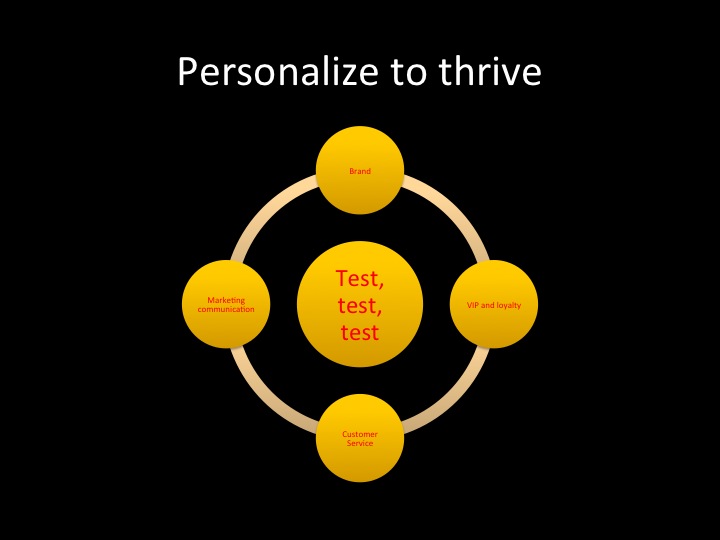
In 2018, if you are not delivering a personalized customer journey in your game or product you will fail. Personalization, for marketing, for customer experience, for CRM, for almost everything, is the current buzzword but it is still rare that companies have a comprehensive plan to create a personal experience. David Norton, former CMO at Harrah’s Casino group and architect of its Total Rewards program, discusses several ways companies can personalize effectively in his book The High Roller Experience.
Personalization is critical not only to a great customer experience but also to optimizing efficiency. As Norton writes, “personalizing the marketing communication approach will dramatically improve the efficiency of marketing spend both by eliminating activities that will not be fruitful and by improving response through more appropriate offers.” As your competitors are already optimizing, if you are not you will not be able to spend as many marketing dollars as they can, putting you at a fatal disadvantage.
How to create a personalized experience
Realistically, you are not going to have one-to-one personalization on day one, so you need practical planning to create a personal experience. A great way to start is replicate what Harrah’s did as a way to improve its marketing effectiveness, using a basic life cycle approach: new business, non-loyal, loyal, and defector. If you initially communicate differently with these segments, you will see an increase in overall ROI.
You also need to leverage the data you have on customers beyond the typical events. At Harrah’s, they looked at implied preferences based on all the information they had about their customers normal behavior, such as what customers did on their visits to our properties, including games played, offers redeemed, and nongaming activities, and then stored the preferences at a customer level for easy use in campaigns. They noted whether the customers preferred slot or table games, if they participated in gaming tournaments, if they most often came midweek or on the weekend, how often they redeemed offers when they came, what type of entertainment they preferred, which channel of communication they preferred, and a host of other factors. They used these implied preferences as inclusion and exclusion rules in campaigns. By excluding customers from programs that they had no chance to respond to based on their past behavior, they significantly improved response rates and cost savings. Most importantly, as Norton wrote, “we made our customers happier.”
Find the segments with high ROI
As alluded to above, you do not need to create hundreds of micro-segments initially but you do need to determine which segments you should invest in. Non-loyal customers represent a particularly attractive segment to target, as this is where you have the biggest opportunity to win market share. At Harrah’s, they targeted this segment by giving them increased value for more frequent visits, generating a significant increase in revenue from this group than they had predicted. In gaming, this creates opportunities, especially in the social and real money casino spaces, where players normally play three to five competitive apps.
Another segment rich with opportunity is defectors. Harrah’s found a way to identify those customers who had broken their typical visitation pattern as opposed to the standard inactive program practice of waiting 6 or 12 months to reach out to them, at which time they would have been long gone. This practice created lower churn and more value from this segment.
Treat VIPs extra special
I have written multiple times about VIP, and you need to ensure your personalization extends to giving VIPs a very special experience. This includes making sure you not only identify VIPs who make a large purchase in one product (or in Caesars case one property) but the ones who have the highest lifetime value. For an online company, the key is looking at number of transactions and adding across products to get the best picture of who your true VIPs are. You then need to treat VIPs in one product as VIPs in all your products. One of the biggest failures of personalization is when a VIP in one product or one retail location then goes to another and is treated as a standard customer.
Personalize all touch points
It is not just personalizing communications that is critical but you also need to personalize all the core functions. According to Norton, personalization needs to extend to brand, loyalty and customer service. As Norton writes, “if a company can execute against all three of these well, it is going to outperform its competitors….Customers increasingly want a seamless experience across touchpoints with a brand, and contact channels are often one of the greatest frustration points.”
Do not forget customer service (CS)
Given that you need to personalize all touch points, the one that companies most often miss is customer service. The service profit chain is not a theory but a powerful motivator and value creator.
It is absolutely essential, however, to think about the holistic customer service experience and understand the interplay among various channels. The call center and other contact channels are a valuable commodity. When personalized, CS can drive revenue and brand advocacy and provide valuable customer data. Norton writes, “I have always viewed customer care as a critical marketing channel that can build customer relationships, be a source of relevant information about the customer, and of course turn demand into revenue.“ Many of the product improvements that have led to the most revenue growth in my past two positions originated from feedback from our customer facing team members and VIP hosts.
CS is also an area for innovation, as you can improve your offering through technology. Customers may embrace technology before your company might, so CS can be a great vehicle to try new tools and channels.
To truly leverage customer service as a tool to improve personalization and the customer journey, you need to measure it at a granular level. This helps drive service improvement efficiently.
Testing is the key
You need to constantly test to ensure you are personalizing optimally. As Norton writes, “constantly testing and learning and holding out control groups is the best way to optimize marketing spend. This allows companies to find the most appropriate message and to spend .”
The first step is to automate the test process. If it takes months to evaluate what happened, the results become useless as the competitive landscape has changed.
It is also critical to have a control group for each campaign and program. While this policy seems automatic, there is often pressure to release what you believe is the optimal campaign or communications to everyone, as you do not want to leave money on the table. Holding out customers, however, from a specific marketing program is much more informative in determining which marketing activities drive the most incremental profitability, changing the customer’s behavior to spend more with you than with a competitor. This is also a better strategy than a universal control group, which does not show you the relative performance of different marketing programs.
As mentioned above, customer service is critical to personalization and measuring customer service with a significant level of granularity provides tremendous insight about the customer experience and helps identify areas for improvement. As Norton writes, “being able to correlate improved service to increased revenue, and developing a well-constructed incentive plan, leads to great outcomes for both a company and its customers— especially when there is innovation around challenged service touchpoints that drive overall customer satisfaction with the brand.”
Personalize, personalize, personalize
The key to success in the current business environment is personalization, your customers expect it, and if you do not deliver they will go to a competitor. And you need to deliver not only in communication but also in customer service and VIP. Then you need to optimize to ensure you are delivering a truly effective personal experience. This is not a secret to gaining competitive advantage, it is the cost of doing business.
Key takeaways
- Personalization improves the efficiency of marketing spend by eliminating activities that will not be fruitful and by improving response through more appropriate offers
- Think holistically about the customer journey. Ensure all parts of it are personalized, from the initial communication through the product to customer service and support.
- Testing and control groups are the best ways to optimize your marketing and ensure your personalization efforts are creating value.
 The Business of Social Games and Casino