Skip to content

The Business of Social Games and Casino

How to succeed in the mobile game space by Lloyd Melnick

Day: January 19, 2019

Why Activision and EA have dropped over 40 percent

Why Activision and EA have dropped over 40 percent

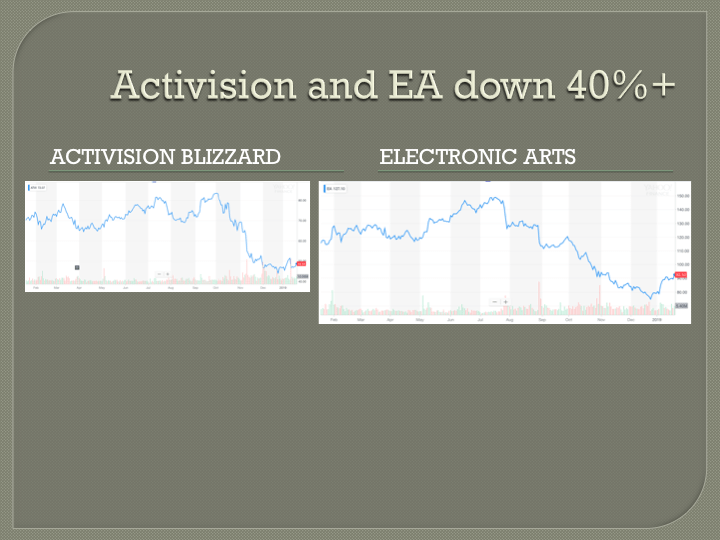
Both Electronic Arts and Activision have plummeted more than 40 percent from their 2018 heights and the underlying causes provide important lessons for other game companies. An article in Barrons, Electronic Arts and Activision Are Struggling to Survive a Fortnite World, highlights the key causes.
slide1

Look at the competition holistically

Many companies are focused on the competition but they fail to define the competition properly. While your direct competition can have the biggest short term impact by increasing marketing or adding a new feature, your entire business can be disrupted by a company that you did not realize is a competitor.

Netflix views Hulu and Amazon Prime as their primary competitors, and then the broadcast and cable networks. It was, however, Fortnite from Epic that had the biggest impact on Netflix last quarter as consumers shifted their entertainment focus from television to the massively popular game. The failure of Netflix to anticipate this competition from a non-traditional competitor has left them unable to respond promptly, adding more scripted content does not negate the appeal of a game like Fortnite.

As the article shows, it was not just Netflix who misread the competition, as it was a key driver for EA and Activision’s decline. These companies were focused on each other (as well as the other console games coming to market) and did not anticipate a free to play gaming changing the ecosystem so dramatically.

Outside of gaming, we have seen this phenomenon repeatedly, from the classic horse buggy companies that went bankrupt as they did not realize the impact of automobiles to the decline of retailers who were slow to respond to online shopping. Blockbuster focused on Hollywood Video and mom and pop video stores before realizing that Netflix was the real threat, realizing too late. In the 1990s, GM and Ford and Chrysler were so focused on competing with each other they all faced bankruptcy when Asian manufacturers gutted their market with a new breed of high mileage vehicles. Dell and Compaq were so fixated on providing better PCs at a more competitive price that they are now afterthoughts to Apple and Samsung.

The game and iGaming space is littered with similar examples. The THQs and Acclaims did not consider free to play a competitor until it was too late. Many land-based sportsbooks did not consider online a threat until they saw their businesses disintegrate. When Sega was looking at building the next Dreamcast, they focused on Nintendo and Sony, not Microsoft.

The lesson is the true threat to your business is not the competitors you recognize as competitors, but companies who provide an offering that your customers can use to replace yours, even if it is a very different product. By not realizing who your potential competitors are, you will not be positioned to retain your customers when they shift.

Franchises are not forever

The article points out how underperforming franchises have also negatively impacted Activision and EA. Destiny was one of Activision’s cornerstone franchises and as soon as Destiny 2 showed the franchise was in decline, the stock fell 12 percent.

Destiny is not the only example of a declining franchise pulling down its stock. When Zynga went public in 2011, Farmville and Zynga Poker helped drive a share price to over $12. As both “franchises” slipped, Zynga has struggled to remain relevant, with a share price about 65 percent lower than at its peak.

These examples show that franchises do not continue indefinitely on their own. You need to work at maintaining and growing them by keeping up with current customer needs, as well as anticipating shifts in the market place.

It also shows a growth strategy focused on acquiring franchises runs the risk of overpaying and failing. Almost by definition, you are buying at a peak because it is only a franchise when it is doing very well (then it is defined is a declining product). If the acquirer cannot grow the franchise, their large investment (and franchises do not come cheap) can crumble.

You need a pipeline of new products

The third lesson from the fall of EA and Activision is the need for a robust product pipeline. Given the risks of franchises declining, you need to have new products ready to replace them. As an analyst wrote in the Barron’s article, “the main issue [for Activision Blizzard] is an underperforming pipeline of games.” In EA’s case, the poor performance of its Battlefield franchise has left it with little to drive growth. Both EA and Activision have built their business by refreshing franchises, so when those fail, they have nothing to fall back on.

While the need for a pipeline of new products (for any industry) seems obvious, it requires a commitment, and not just money. This commitment often feels unnecessary when franchises are driving growth and revenue. Even if a company is willing to invest in new products, if they do not have a commitment from on top, it will still fail as their best people (marketing, tech, design, etc.) will be working on the existing franchise products. In a competitive industry (and every industry these days), your B team is not going to beat other companies who are focused on winning with new products.

What Activision and EA teach us

Rather than feeling sorry for Activision Blizzard and Electronic Arts (they are still valued at over $25+ billion each), you can learn from them to avoid the dramatic declines they have faced recently. Most importantly, when looking at the ecosystem and your customers, realize that customers are not simply deciding between you and your closest competitor, they are looking at the best use of their time. For a game company, that means not worrying about competing games (primarily), but Netflix, music, movies and other form of entertainment. You may create a better product than your competitor to find there is a much smaller market for both of you.

As you are anticipating your customers’ needs, you also need to anticipate they will be different, so you cannot rely on today’s franchises. You need a stream of new products that anticipate their new expectations.

Key takeaways

  • Activision and Electronic Arts shares have fallen more than 40 percent in the past twelve months, driven by a combination of misjudging the competition, relying on franchises and having a weak product pipeline.
  • When surveying and reacting to the competition, you must look beyond the direct competition and understand who else could take your customers.
  • While franchises are important revenue sources, you need to nurture them and have alternatives as they eventually will degrade.

Share this:

  • Click to share on Facebook (Opens in new window) Facebook
  • Click to share on LinkedIn (Opens in new window) LinkedIn
Like Loading...
Unknown's avatarAuthor Lloyd MelnickPosted on January 19, 2019January 19, 2019Categories General Social Games BusinessTags Activision, competition, Electronic Arts, franchises, Green Light, new product development1 Comment on Why Activision and EA have dropped over 40 percent

Get my book on LTV

The definitive book on customer lifetime value, Understanding the Predictable, is now available in both print and Kindle formats on Amazon.

Understanding the Predictable delves into the world of Customer Lifetime Value (LTV), a metric that shows how much each customer is worth to your business. By understanding this metric, you can predict how changes to your product will impact the value of each customer. You will also learn how to apply this simple yet powerful method of predictive analytics to optimize your marketing and user acquisition.

For more information, click here

Follow The Business of Social Games and Casino on WordPress.com

Enter your email address to follow this blog and receive notifications of new posts by email.

Join 791 other subscribers

Most Recent Posts

  • Join me at PDMA Inspire for my talk on new product prioritization
  • Why keep studying?
  • The next three years of this blog
  • Interview with the CEO of Murka on the biggest growth opportunity in gaming, Barak David

Lloyd Melnick

This is Lloyd Melnick’s personal blog.  All views and opinions expressed on this website are mine alone and do not represent those of people, institutions or organizations that I may or may not be associated with in professional or personal capacity.

I am a serial builder of businesses (senior leadership on three exits worth over $700 million), successful in big (Disney, Stars Group/PokerStars, Zynga) and small companies (Merscom, Spooky Cool Labs) with over 20 years experience in the gaming and casino space.  Currently, I am the GM of VGW’s Chumba Casino and on the Board of Directors of Murka Games and Luckbox.

Topic Areas

  • Analytics (114)
  • Bayes' Theorem (8)
  • behavioral economics (8)
  • blue ocean strategy (14)
  • Crowdfunding (4)
  • DBA (2)
  • General Social Games Business (459)
  • General Tech Business (195)
  • Growth (88)
  • International Issues with Social Games (50)
  • Lloyd's favorite posts (101)
  • LTV (54)
  • Machine Learning (10)
  • Metaverse (1)
  • Mobile Platforms (37)
  • Prioritization (1)
  • Social Casino (52)
  • Social Games Marketing (105)
  • thinking fast and slow (5)
  • Uncategorized (33)

Social

  • View CasualGame’s profile on Facebook
  • View @lloydmelnick’s profile on Twitter
  • View lloydmelnick’s profile on LinkedIn

RSS

RSS Feed RSS - Posts

RSS Feed RSS - Comments

Categories

  • Analytics (114)
  • Bayes' Theorem (8)
  • behavioral economics (8)
  • blue ocean strategy (14)
  • Crowdfunding (4)
  • DBA (2)
  • General Social Games Business (459)
  • General Tech Business (195)
  • Growth (88)
  • International Issues with Social Games (50)
  • Lloyd's favorite posts (101)
  • LTV (54)
  • Machine Learning (10)
  • Metaverse (1)
  • Mobile Platforms (37)
  • Prioritization (1)
  • Social Casino (52)
  • Social Games Marketing (105)
  • thinking fast and slow (5)
  • Uncategorized (33)

Archives

  • September 2023
  • December 2021
  • July 2021
  • March 2021
  • February 2021
  • January 2021
  • December 2020
  • November 2020
  • October 2020
  • September 2020
  • August 2020
  • July 2020
  • June 2020
  • May 2020
  • April 2020
  • March 2020
  • February 2020
  • January 2020
  • November 2019
  • October 2019
  • September 2019
  • June 2019
  • May 2019
  • April 2019
  • March 2019
  • February 2019
  • January 2019
  • December 2018
  • June 2018
  • May 2018
  • April 2018
  • March 2018
  • February 2018
  • January 2018
  • December 2017
  • June 2017
  • May 2017
  • April 2017
  • March 2017
  • February 2017
  • January 2017
  • December 2016
  • November 2016
  • October 2016
  • September 2016
  • June 2016
  • May 2016
  • April 2016
  • March 2016
  • February 2016
  • January 2016
  • December 2015
  • November 2015
  • October 2015
  • September 2015
  • July 2015
  • June 2015
  • May 2015
  • April 2015
  • March 2015
  • February 2015
  • January 2015
  • December 2014
  • November 2014
  • October 2014
  • September 2014
  • August 2014
  • July 2014
  • June 2014
  • May 2014
  • April 2014
  • March 2014
  • February 2014
  • January 2014
  • December 2013
  • November 2013
  • October 2013
  • September 2013
  • August 2013
  • July 2013
  • June 2013
  • May 2013
  • April 2013
  • March 2013
  • February 2013
  • January 2013
  • December 2012
  • November 2012
  • October 2012
  • September 2012
  • August 2012
  • July 2012
  • June 2012
  • May 2012
  • April 2012
  • March 2012
  • February 2012
  • January 2012
  • December 2011
  • November 2011
  • October 2011
  • September 2011
  • August 2011
  • July 2011
  • June 2011
  • May 2011
  • December 2010
January 2019
S M T W T F S
 12345
6789101112
13141516171819
20212223242526
2728293031  
« Dec   Feb »

by Lloyd Melnick

All posts by Lloyd Melnick unless specified otherwise
Google+

Enter your email address to subscribe to this blog and receive notifications of new posts by email.

Join 791 other subscribers
Follow Lloyd Melnick on Quora

RSS HBR Blog

  • How One Manufacturer Achieved Net Zero at Zero Cost
  • What Can U.S. Employers Do About Rising Healthcare Costs?
  • When You Have to Execute a Strategy You Disagree With
  • 4 Ways to Build Durable Relationships with Your Most Important Customers
  • What Jargon Says About Your Company Culture
  • Research: When Used Correctly, LLMs Can Unlock More Creative Ideas
  • Your New Role Requires Strategic Thinking…But You’re Stuck in the Weeds
  • For Circular Economy Innovation, Look to the Global South
  • Why Great Leaders Focus on the Details
  • Corporate Disclosure in the Age of AI

RSS Techcrunch

  • An error has occurred; the feed is probably down. Try again later.

RSS MIT Sloan Management Review Blog

  • AI Coding Tools: The Productivity Trap Most Companies Miss
  • How Procter & Gamble Uses AI to Unlock New Insights From Data
  • Rewire Organizational Knowledge With GenAI
  • Hungry for Learning: Wendy’s Will Croushorn
  • Beat Burnout: 10 Essential MIT SMR Reads
  • How Leaders Stay True to Themselves and Their Stakeholders
  • Our Guide to the Winter 2026 Issue
  • Broadening Future Perspectives at the Bank of England
  • A Faster Way to Build Future Scenarios
  • Assess What Is Certain in a Sea of Unknowns
The Business of Social Games and Casino Website Powered by WordPress.com.
  • Subscribe Subscribed
    • The Business of Social Games and Casino
    • Join 726 other subscribers
    • Already have a WordPress.com account? Log in now.
    • The Business of Social Games and Casino
    • Subscribe Subscribed
    • Sign up
    • Log in
    • Report this content
    • View site in Reader
    • Manage subscriptions
    • Collapse this bar
 

Loading Comments...
 

    %d