Skip to content

The Business of Social Games and Casino

How to succeed in the mobile game space by Lloyd Melnick

Day: February 12, 2019

Creating growth loops to scale your game

Creating growth loops to scale your game

While apps and games have traditionally grown by having the acquisition team focus on the funnel, a recent blog post, Growth Loops are the New Funnels by growth guru Brian Balfour, shows a better strategy is to build growth loops. Rather than asking your marketing or user acquisition team to optimize user acquisition channels, growth loops has product and acquisition working holistically to build a product that will scale.

The traditional thinking

The strategy most game and app developers is create a great product, then optimize the acquisition funnel. After creating the product, they focus on optimizing the funnel below (testing different channels and strategies) to scale. This is a very KPI driven exercise, with each level of the funnel optimized through experiments and testing. The funnel consists of five categories, in this order:

  1. Acquisition. Helping as many users as possible discover the game. This can be discovered by visitors in the app store, downloads, app install, etc.
  2. Activation. Once acquiring a user, how many start playing the game (or using the app). This category can be measured by first spin (in a casino game), players who Facebook Connect, new accounts, completed tutorial, etc.
  3. Retention. Retention is the next, and arguably most important, category in the funnel. In games, this is often measured by how many players come by the next day (D1), return in a week (D7) or are active a month after installing (D30). Other good retention metrics are CURR (current rate of returning users) or engagement metrics (how much time spent in app).
  4. Referral. How many of your active players are helping bring new players. This category can be measured by actual referrals or K-score (number between 0-100 that indicates the strength of engagement between your product and your contacts, accounts, opportunities and leads).
  5. Revenue. The final layer of the funnel is revenue, how well you monetize the players. This metric is measured by ARPDAU (average revenue per daily active user), conversion rate (how many players spend), frequency of purchases, total lifetime spend, etc.

Successful companies would optimize the above funnel, testing different channels, creative, etc., at each step of the funnel, then optimizing spend to improve these KPIs.

The new approach

Rather than focusing on the five categories in the growth funnel, Balfour suggests a holistic approach to growth. As Balfour points out, while the growth funnel has helped many companies scale, it is over eleven years old and the industry has since evolved. Funnels lead to silos, where the product team has its own domain, growth has its empire while monetization owns its business. This strategy can lead to failure as the product is not built to optimize the channels where it will be distributed (e.g. the AppStores).

The key is building a product or game where growth is part of the core product loop, not a separate task done by a growth or acquisition or marketing team. As Balfour writes, “The fastest growing products are better represented as a system of loops, not funnels. Loops are closed systems where the inputs through some process generates more of an output that can be reinvested in the input. There are growth loops that serve different value creation including new users, returning users, defensibility, or efficiency.”

The key to a successful growth loop is the customer or player reinvesting the value of the loop to drive the initial elements of the loop Pinterest does this by investing in creating content that shows up high in search engines, users then find the content and either return to Pinterest or sign up for it, Pinterest then serves related content with the user saves, thus creating more searchable content (the beginning of the loop). SurveyMonkey has a growth loop where a user signs up, creates a survey, sends the survey out, when the recipients finish the survey the are served an opportunity to sign up with SurveyMonkey, and those sign-ups restart the loop.

Just as with your financial investments, a critical element of the power of growth loops is that they compound growth. Rather than the linear approach of the growth funnel, a growth loop continuously adds to create more output and revenue. The more output that is reinvested by the user or player, the larger the output created from the next cycle. This compounding is critical as rather than creating a multitude of growth loops, you want to measure and focus on the ones that have the greatest impact.

As growth loops are holistic systems, they are also more defensible than growth funnel. In a funnel, any element of the funnel can be attacked. Growth loops, however, integrate product, channel and monetization model specific to your game and thus harder for other companies to copy.

Why loops are better

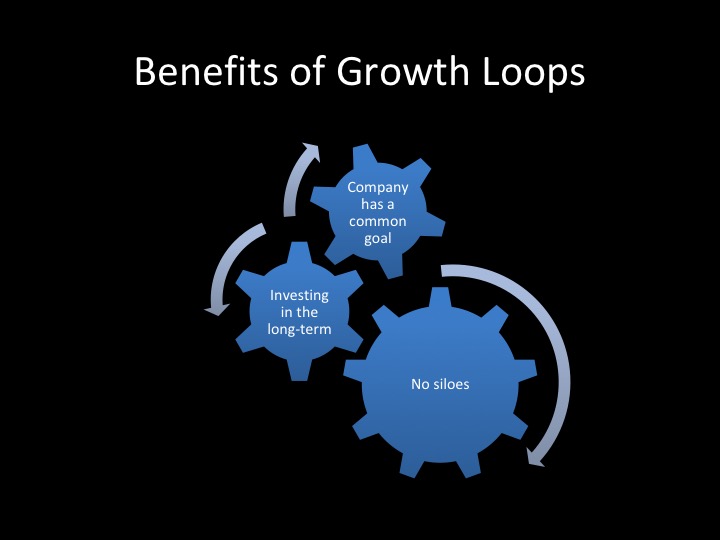
Balfour explains that growth loops change your entire business, largely for the better. The key benefits include:

  • You get away from siloes (product, marketing, etc) and work together. Growth loops force companies to build a system.
  • You invest resources in systems that are more sustainable long-term, that continue to grow on their own.
  • You organize your personnel and teams towards a common goal, aligning and optimizing the growth loops.

Next steps

When building your company and designing your games or products, think holistically. Understand how you will create growth loops that will feed themselves and build a long-term dominant product. With games, ensure that there are loops in the game that drive the acquisition phase.

Key takeaways

  • Growth loops represent the evolution from a traditional acquisition funnel to a loop that continually creates value. Loops are closed systems where the inputs through some process generates more of an output that can be reinvested in the input.
  • Rather than creating siloes, growth loops help marketing, product, monetization, analytics work holistically.
  • A key value derived from growth loops is they have a compounding effect, they continually add value to the initial investment and thus perpetually grow the underlying product.
  • Share this:

    • Click to share on Facebook (Opens in new window) Facebook
    • Click to share on LinkedIn (Opens in new window) LinkedIn
    Like Loading...
Unknown's avatarAuthor Lloyd MelnickPosted on February 12, 2019January 4, 2019Categories General Social Games Business, General Tech Business, Growth, Social Games MarketingTags funnel, Growth3 Comments on Creating growth loops to scale your game

Get my book on LTV

The definitive book on customer lifetime value, Understanding the Predictable, is now available in both print and Kindle formats on Amazon.

Understanding the Predictable delves into the world of Customer Lifetime Value (LTV), a metric that shows how much each customer is worth to your business. By understanding this metric, you can predict how changes to your product will impact the value of each customer. You will also learn how to apply this simple yet powerful method of predictive analytics to optimize your marketing and user acquisition.

For more information, click here

Follow The Business of Social Games and Casino on WordPress.com

Enter your email address to follow this blog and receive notifications of new posts by email.

Join 791 other subscribers

Most Recent Posts

  • Join me at PDMA Inspire for my talk on new product prioritization
  • Why keep studying?
  • The next three years of this blog
  • Interview with the CEO of Murka on the biggest growth opportunity in gaming, Barak David

Lloyd Melnick

This is Lloyd Melnick’s personal blog.  All views and opinions expressed on this website are mine alone and do not represent those of people, institutions or organizations that I may or may not be associated with in professional or personal capacity.

I am a serial builder of businesses (senior leadership on three exits worth over $700 million), successful in big (Disney, Stars Group/PokerStars, Zynga) and small companies (Merscom, Spooky Cool Labs) with over 20 years experience in the gaming and casino space.  Currently, I am the GM of VGW’s Chumba Casino and on the Board of Directors of Murka Games and Luckbox.

Topic Areas

  • Analytics (114)
  • Bayes' Theorem (8)
  • behavioral economics (8)
  • blue ocean strategy (14)
  • Crowdfunding (4)
  • DBA (2)
  • General Social Games Business (459)
  • General Tech Business (195)
  • Growth (88)
  • International Issues with Social Games (50)
  • Lloyd's favorite posts (101)
  • LTV (54)
  • Machine Learning (10)
  • Metaverse (1)
  • Mobile Platforms (37)
  • Prioritization (1)
  • Social Casino (52)
  • Social Games Marketing (105)
  • thinking fast and slow (5)
  • Uncategorized (33)

Social

  • View CasualGame’s profile on Facebook
  • View @lloydmelnick’s profile on Twitter
  • View lloydmelnick’s profile on LinkedIn

RSS

RSS Feed RSS - Posts

RSS Feed RSS - Comments

Categories

  • Analytics (114)
  • Bayes' Theorem (8)
  • behavioral economics (8)
  • blue ocean strategy (14)
  • Crowdfunding (4)
  • DBA (2)
  • General Social Games Business (459)
  • General Tech Business (195)
  • Growth (88)
  • International Issues with Social Games (50)
  • Lloyd's favorite posts (101)
  • LTV (54)
  • Machine Learning (10)
  • Metaverse (1)
  • Mobile Platforms (37)
  • Prioritization (1)
  • Social Casino (52)
  • Social Games Marketing (105)
  • thinking fast and slow (5)
  • Uncategorized (33)

Archives

  • September 2023
  • December 2021
  • July 2021
  • March 2021
  • February 2021
  • January 2021
  • December 2020
  • November 2020
  • October 2020
  • September 2020
  • August 2020
  • July 2020
  • June 2020
  • May 2020
  • April 2020
  • March 2020
  • February 2020
  • January 2020
  • November 2019
  • October 2019
  • September 2019
  • June 2019
  • May 2019
  • April 2019
  • March 2019
  • February 2019
  • January 2019
  • December 2018
  • June 2018
  • May 2018
  • April 2018
  • March 2018
  • February 2018
  • January 2018
  • December 2017
  • June 2017
  • May 2017
  • April 2017
  • March 2017
  • February 2017
  • January 2017
  • December 2016
  • November 2016
  • October 2016
  • September 2016
  • June 2016
  • May 2016
  • April 2016
  • March 2016
  • February 2016
  • January 2016
  • December 2015
  • November 2015
  • October 2015
  • September 2015
  • July 2015
  • June 2015
  • May 2015
  • April 2015
  • March 2015
  • February 2015
  • January 2015
  • December 2014
  • November 2014
  • October 2014
  • September 2014
  • August 2014
  • July 2014
  • June 2014
  • May 2014
  • April 2014
  • March 2014
  • February 2014
  • January 2014
  • December 2013
  • November 2013
  • October 2013
  • September 2013
  • August 2013
  • July 2013
  • June 2013
  • May 2013
  • April 2013
  • March 2013
  • February 2013
  • January 2013
  • December 2012
  • November 2012
  • October 2012
  • September 2012
  • August 2012
  • July 2012
  • June 2012
  • May 2012
  • April 2012
  • March 2012
  • February 2012
  • January 2012
  • December 2011
  • November 2011
  • October 2011
  • September 2011
  • August 2011
  • July 2011
  • June 2011
  • May 2011
  • December 2010
February 2019
S M T W T F S
 12
3456789
10111213141516
17181920212223
2425262728  
« Jan   Mar »

by Lloyd Melnick

All posts by Lloyd Melnick unless specified otherwise
Google+

Enter your email address to subscribe to this blog and receive notifications of new posts by email.

Join 791 other subscribers
Follow Lloyd Melnick on Quora

RSS HBR Blog

  • How One Manufacturer Achieved Net Zero at Zero Cost
  • What Can U.S. Employers Do About Rising Healthcare Costs?
  • When You Have to Execute a Strategy You Disagree With
  • 4 Ways to Build Durable Relationships with Your Most Important Customers
  • What Jargon Says About Your Company Culture
  • Research: When Used Correctly, LLMs Can Unlock More Creative Ideas
  • Your New Role Requires Strategic Thinking…But You’re Stuck in the Weeds
  • For Circular Economy Innovation, Look to the Global South
  • Why Great Leaders Focus on the Details
  • Corporate Disclosure in the Age of AI

RSS Techcrunch

  • An error has occurred; the feed is probably down. Try again later.

RSS MIT Sloan Management Review Blog

  • AI Coding Tools: The Productivity Trap Most Companies Miss
  • How Procter & Gamble Uses AI to Unlock New Insights From Data
  • Rewire Organizational Knowledge With GenAI
  • Hungry for Learning: Wendy’s Will Croushorn
  • Beat Burnout: 10 Essential MIT SMR Reads
  • How Leaders Stay True to Themselves and Their Stakeholders
  • Our Guide to the Winter 2026 Issue
  • Broadening Future Perspectives at the Bank of England
  • A Faster Way to Build Future Scenarios
  • Assess What Is Certain in a Sea of Unknowns
The Business of Social Games and Casino Website Powered by WordPress.com.
  • Subscribe Subscribed
    • The Business of Social Games and Casino
    • Join 726 other subscribers
    • Already have a WordPress.com account? Log in now.
    • The Business of Social Games and Casino
    • Subscribe Subscribed
    • Sign up
    • Log in
    • Report this content
    • View site in Reader
    • Manage subscriptions
    • Collapse this bar
%d