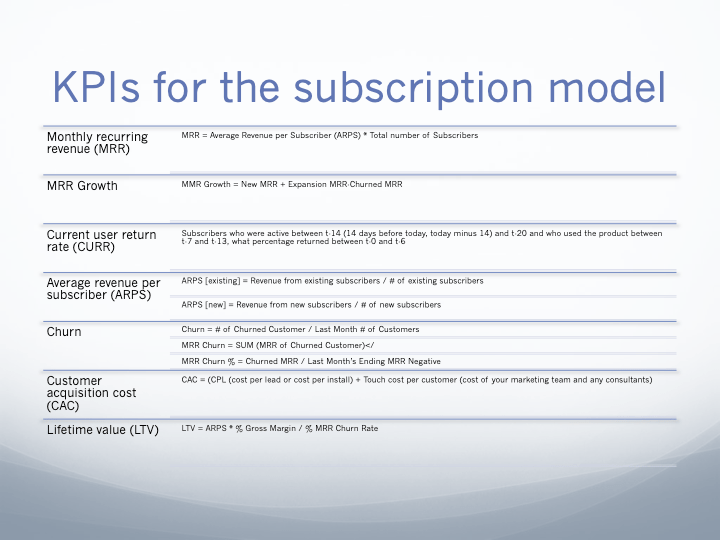

I have written several times recently about building and running a successful subscription modelin gaming but I did not address how to measure whether it is successful. To grow any business you need to understand what to measure so you can then optimize against these KPIs. While subscriptions do share some common characteristics with the free-to-play business, driven by the in-app purchase model, there are certain KPIs unique to subscriptions that you should focus on when building your program. As Leandro Faria says in The Essential SaaS Metrics Guide, “data doesn’t do you any good unless you act on it.”
MRR
Monthly recurring revenue (MRR) is generally the first KPI that companies focus on when looking at the health of their subscription program. You calculate MRR by looking at the average revenue per subscriber by the number of subscribers. If you only have one subscription level, then it is simply the monthly subscription cost times the number of subscribers. If you have subscriptions for various terms (monthly, quarterly and annual, for example), you calculate the average monthly revenue from the different subscription (an annual subscription of $144 generates $12 per subscriber in MRR). The formula is
- MRR = Average monthly revenue per subscriber (ARPS) * Total number of subscribers
The reason MRR is the first KPI that subscription businesses monitor is because it shows the value of the model. MRR effectively is how much revenue the business can count on every month. The company can then allocate this cash flow to marketing, operations, acquisitions, etc. By having a guaranteed amount of revenue (which you do not have with discrete sales or in-app purchases), you have a clear source of funds to operate your business. Most companies will extend MRR to create an Annual Run Rate (ARR), which is important both for business planning purposes and understanding the value of the subscription component of your business.
MRR Growth
In addition to looking at MRR, you should monitor MRR Growth. To analyze MRR growth, you need to break it into three components. The first is new MRR, revenue brought by newly acquired customers.
The second component of MRR growth is Expansion MRR. Expansion MRR is increases in subscription revenue from existing subscribers. This revenue is driven by up-selling and cross-selling your customers.
The third element of MRR Growth is churn. Churned MRR is the revenue that has been lost from customers cancelling or downgrading their plans.
Taking these three components into account, the overall formula for MRR Growth is:
- MMR Growth = New MRR + Expansion MRR-Churned MRR
CURR
I have written before about CURR (current user return rate), and it is as valuable in subscription businesses as it is for other online models. CURR shows how loyal your existing customers are; you should consider CURR the inverse of churn. If your CURR increases, it means you have improved your product’s appeal to existing players or customers, if CURR declines you have made your game worse. CURR is also an excellent way of looking at how your game is performing among different segments, VIPs versus payers versus never-spenders.
To calculate CURR:
- Subscribers who were active between t-14 (14 days before today, today minus 14) and t-20 and who used the product between t-7 and t-13, what percentage returned between t-0 and t-6.
Measuring CURR is critical to see how engaged your subscribers are. If CURR trends downward, you are likely to experience increasing customer churn.
.
ARPS
As mentioned above, Average Revenue Per Subscriber (ARPS) is central for calculating MRR, but it is also an important KPI itself. Increasing ARPS shows that customers are upgrading and most likely seeing high value in your offering, thus they are willing to pay more. Conversely, declining ARPS shows that customers are not experiencing sufficient value and are either down-grading or moving to free plans
You should also monitor ARPS separately for existing players versus new players. As Faria writes, “there is a good practice of measuring the Average Revenue per [subscriber] separately for new customers. So instead of having an [ARPS] metric for all your customers, you’d have two different metrics: Average Revenue per Existing [Subscriber] and Average Revenue per New [Subscriber].” To calculate:
- ARPS [existing] = Revenue from existing subscribers / # of existing subscribers
- ARPS [new] = Revenue from new subscribers / # of new subscribers
Churn
Churn is the enemy of any business, but is even more troubling for subscription businesses. You never want to lose customers, but with subscription businesses churn means you are losing not simply a sale but an entire revenue stream.
You need to monitor both Customer Churn and Revenue Churn.
Customer Churn is how many players have canceled their subscription while Revenue Churn is how much those lost customers represents in revenue. There are thus three churn KPIs you should closely monitor:
- Churn = # of Churned Customer / Last Month # of Customers
- MRR Churn = SUM (MRR of Churned Customer)
- MRR Churn % = Churned MRR / Last Month’s Ending MRR Negative
CAC
Customer Acquisition Cost (CAC) is the cost to acquire an additional customer, your marketing cost per customer. One way to calculate CAC is to consider the three variables that compose it. This method allows you to go into detail and might give you good insights about your sales process cost and conversions:
- CAC = (CPL (cost per lead or cost per install) + Touch cost per customer (cost of your marketing team and any consultants)
I prefer to focus on cost per install (CPI) or cost per subscriber (CPS). As long as your lifetime value is higher than your CPS, you can continue to acquire subscribers and manage your overhead, including your marketing infrastructure.
LTV
Speaking of customer Lifetime Value (LTV), I have written repeatedly how it is the lifeblood of a successful business. LTV is a function that shows the present value of a new customer, how much that customer is worth to your company. While the equation is effectively the same for any business (the total expected value of your customer over their lifetime), it is somewhat simpler to calculate for subscription businesses. To calculate LTV for a subscription business, the following formula captures the core elements:
-
LTV = ARPS * % Gross Margin / % MRR Churn Rate
The hybrid model
While these KPIs show the health of a subscription business, you need to modify how you use them in most social games as well as iGaming. As subscriptions will only be one element of your revenue stream, in-app purchases will remain a major part of social gaming while gambling revenue will drive the casino industry. The above KPIs will help understand the health of the subscription element of your business, and whether you should invest in growing it, but they need to be incorporated into your other KPIs to understand both the impact on your business and your overall financial health. Subscription revenue will only be one part of your overall LTV calculation while you may want to look separately at CURR of players customers versus those making in-app purchases. There are many different combinations of models but the core subscription KPIs need to be incorporating into your daily review of the health of your business.
Key takeaways
- To run a successful business, you have to constantly monitor KPIs and optimize based on this data; the subscription model is no different but the KPIs are not the same as the ones you are used to reviewing
- MRR (monthly recurring revenue) is the most important KPI for the subscription model, how much subscription revenue you generate (and can count on) each month.
- Other critical metrics for the subscription model are MRR growth average revenue per subscriber (ARPS), current user return rate (CURR), cost to acquire a customer (CAC), customer lifetime value (LTV) and churn.
 The Business of Social Games and Casino