People Analytics for Online Gaming
- You need to align performance evaluations with the underlying factors that create success; deconstruct what leads to the outcomes you want and then assess people on those factors.
- Some common problems when evaluating people include context (attributing results to a person when the environment drove success or failure), interdependence (assessing on an individual level a result that was driven by a team), self-fulfilling prophecies (people perform consistent with expectations) and reverse causality (we attribute causality to correlation, even though the factors may not be related or may be in the other direction).
- You should assess how your team or company works as a network, looking at the relationships, and then encourage and grow ones that lead to desired outcomes.
Interview with the Queen of Research, Maria Cipollone
How to manage your customer service to have the biggest impact on your profits
- Data shows that trying to create an exceptional customer experience has virtually no impact on loyalty and engagement, however, reducing the effort the customer must exert does improve loyalty.
- The best way to measure this effort is CES score, which is based on a statement, “the company made it easy for me to handle my issue,” after which the customer is asked to answer (on a 1–7) whether they agree or disagree with that statement.
- The keys to implementing successfully an effortless experience program are minimizing channel switching, avoiding repeat contacts, engineering the customer service interaction experience, building the control quotient, creating the right culture and optimizing the purchase experience.
The difference between great executives and everyone else
- There are many similarities between what separates a professional athlete from an amateur and what separates a great business executive from everyone else.
- The best executives focus on getting the best outcome, not being right.
- The best executives accept responsibility and do not blame others.
3 Words I Hate
- Game companies should avoid the phrase gamification, as their product is already a game and should be entertaining.
- Whales is an insidious phrase as it describes your best customers in a derogatory way, potentially leading to treating them in a way that destroys long-term value.
- It is misleading to use data that is directional, without statistical significance as relying on this data is like not using data at all.
Leading in a complex world: building a team of teams
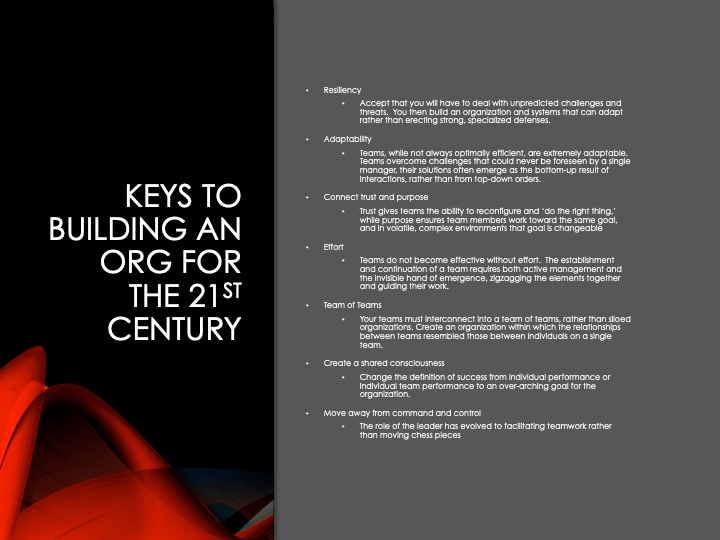
- The difference between complexity and complicated is central to building an organization that works in the 21st century. Things that are complicated may have many parts, but those parts are joined, one to the next, in straightforward and simple ways and are like an equation that needs to be solved. Things that are complex, such as insurgencies or the mobile gaming ecosystem, have a diverse range of connected parts that interact regularly.
- Accept that you will have to deal with unpredicted challenges and threats. You then build an organization and systems that can adapt rather than erecting strong, specialized defenses.
- Teams, while not always optimally efficient, are extremely adaptable. Teams overcome challenges that could never be foreseen by a single manager, their solutions often emerge as the bottom-up result of interactions, rather than from top-down orders. Your teams must then interconnect into a team of teams, rather than siloed organizations. Create an organization within which the relationships between teams resembled those between individuals on a single team.
Adjacent User Theory Shows How to Supercharge Your Game’s Growth
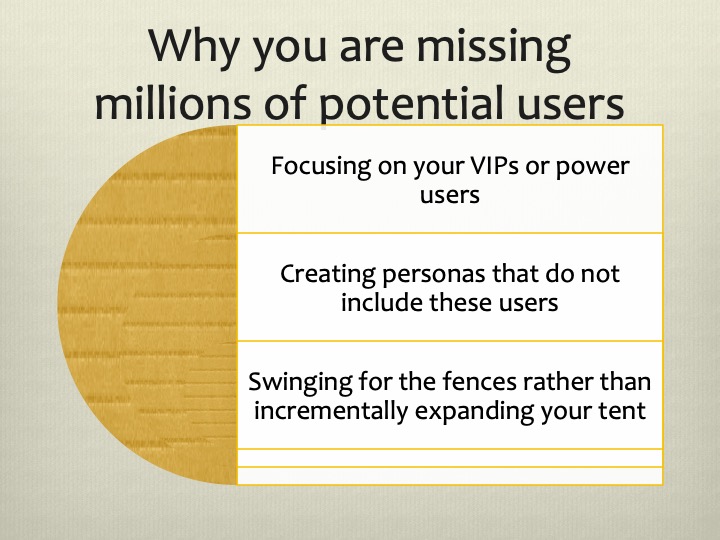
- Adjacent users represent a great opportunity for growth. These are potential players (adjacent users) are aware of the product, maybe tried it, but are not engaged customers.
- You solve for these players by looking at different states of your product (i.e. registration, play, purchase) and seeing who drops off at each of these states, then understand why these potential customers are dropping off.
- You can make your product attractive by putting yourself in the place of the adjacent user, watching them use your game or product and talking to them.
What really went wrong at Quibi
- Quibi’s failure was very predictable and these predictors provide a framework of what companies need to do to succeed in the entertainment space.
- Quibi relied on a unique technology, the ability to watch content seamlessly in portrait or landscape mode, rather than relying on creating content people wanted. You cannot succeed in entertainment by relying on technology.
- Other key lessons are that great entertainment companies need to deliver a overabundance of content, much more than you expect even your heaviest users to consume, and some flagship products that forces people to try your offering.
Building a strategy around doing the opposite
- A powerful way to find a competitive advantage is to do the opposite of what other companies in the industry are doing. Mature industries tend to converge, creating an opportunity to appeal to customers who do not like the homogenous offerings.
- To uncover the opportunity, first list the primary characteristics and elements currently in the category and then ask yourself what would an offering look like if we did the exact opposite.
- This strategy represents a particularly appealing opportunity in the social casino and real money gaming spaces, where the offering has largely converged.
How to become successful CEO
- Being a great CEO or leader is very hard. CEOs and others leading business units are responsible not only for their fate but the fate of their company, having to make potentially life or death decisions.
- To meet The Struggle of leading a company, you need to rely on teamwork, think outside the box for solutions and continuously self-reflect.
- Great leaders must learn to be comfortable doing inherently uncomfortable things. Great CEOs have to make their unnatural job feel natural.
Ways to improve your game (or product) using neuroscience
- Neuromarketing, using brain imaging, scanning, or other brain activity measurement technology to measure a subject’s response, shows you can price more effectively by minimizing the customers pain, by not forcing them to make multiple purchase decisions, spreading out the cost or bundling items.
- Neuromarketing also shows you can improve customers’ trust by trusting them and specifically telling them you are trustworthy.
- It also shows that branding forms an emotional attachment you’re your customer and prompts them to recommend you enthusiastically to their friends.
Up-skillOR vs Up-skillEE
- Recruiting candidates with the expectation you will train (upskill) them to do the target job well shows an arrogance that you think you can train them better than anyone else has.
- Upskilling people ensures your team does not go to the next level, you set your current skillset as the ceiling.
- You also miss the opportunity to bring new skills and experiences to your team, where the new hire can make everyone else more valuable.
Word-of-machine effect with recommendation engines
-
- AI driven recommendation engines, popularized on Amazon and Netflix, have gone from being a competitive advantage in online and mobile apps to part of the cost of doing business.
- While AI recommendations are often closer to what customers want, people trust human recommendations more when it is based on hedonic or experiential factors, and trust machines more when it is based on utilitarian factors; this is referred to as word-of-machine effect.
- When presenting recommendations, you must be cognizant of word-of-machine effect; for recommendations around hedonistic properties try to bring in a human element (augmented intelligence) or explain that these are better recommendations.
Turn Your Company Around
- Less than 50 percent of people are satisfied with that job, and Covid has made the situation more dire.
- The key to improving employee satisfaction, and growing productivity, is evolving from a leader-follower approach (where you tell people what to do) to a leader-leader approach (where people control their decision-making.
- To move to a leader-leader organization, you need to empower your team (including asking them how to empower them better) and encourage deliberate action where they vocalize what they are doing rather than ask what to do.
The Power of Content
- Disney has enjoyed phenomenal growth with Disney+ and last week announced it’s plans to accelerate this growth, showing what is critical to the success of an entertainment brand.
- The first pillar of this strategy is to release a plethora of new content in 2021, more than 25 new television series plus multiple movies, showing how critical new content is (especially telling as Disney has the strongest back catalog of content in the world).
- The second pillar is to rely on its franchises (Star Wars, Marvel, Disney characters) for this new content, showing the value of Forever Franchises in the entertainment space.
2021 Pre-Mortem: What went wrong in 2021
- Rather than trying to guess (predict) the future, conduct a pre-mortem, where you put yourself in December 2021 and look back at what went terribly wrong for your business. The exercise will help you identify the biggest risks you face.
- Some of the areas you should look at include the impact of Covid, spread of Real Money gaming in the US, challenges to RMG in Europe, the new gaming consoles and how work from home is changing the workplace.
- You also need to realize that risks come in many forms and some are impossible to anticipate. You need to detect these quickly and respond with improvisation, speed and an iterative approach, since not every action taken will work as intended.
 The Business of Social Games and Casino