Skip to content

The Business of Social Games and Casino

How to succeed in the mobile game space by Lloyd Melnick

Tag: appsflyer

Why your game’s metrics mean nothing

From the beginning of time (or at least 2009), companies have been basing decisions on game metrics, investors have used performance metrics to base investment decisions and outside analysts have used game metrics to estimate the health of a company. Unfortunately, all of these applications of metrics are deeply flawed and often mislead the decision-makers, investors and analysts (sometimes intentionally, sometimes not).

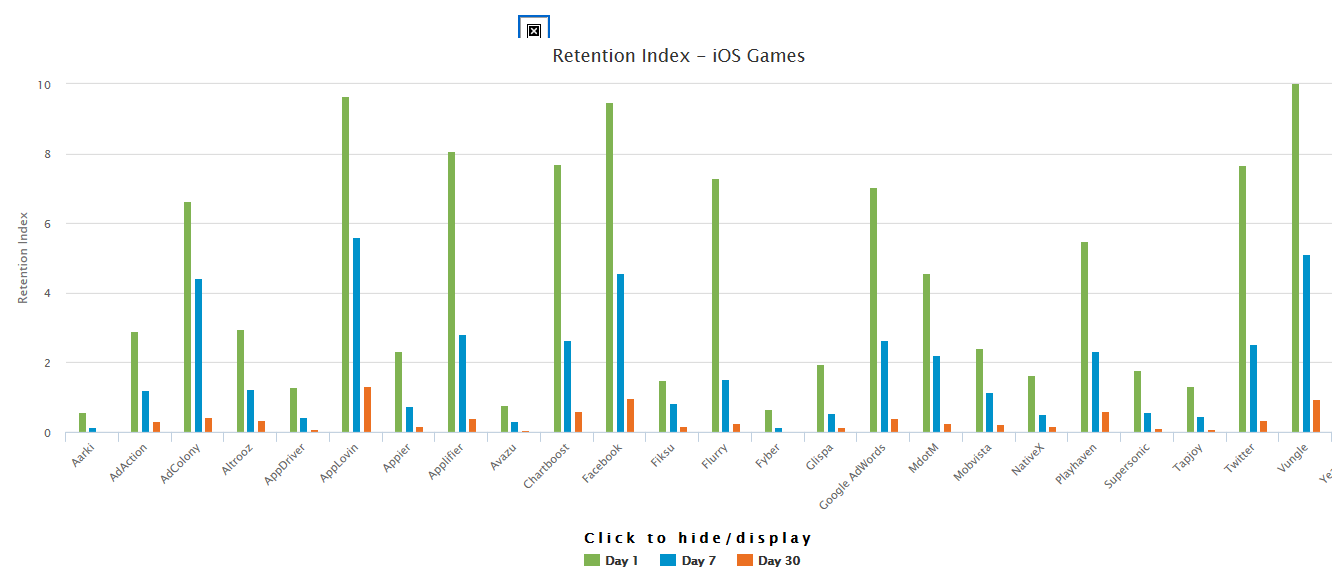
The charts below from Appsflyer show the critical flaw in looking at a game’s metrics:
Appsflyer iOS

Retention performance on Android by source:
AppsFlyerAndroid

It all depends on the source

The first lesson from these charts is that performance depends largely on the source of users. Although these charts show retention metrics, I am certain monetization and virality performance shows similar behavior. Thus, your performance metrics are incredibly biased by the source of traffic and metrics for your game overall only reflect the quality of the various user sources.

As an example, assume your Bingo game has D7 (Day 7) retention of 20% and an ARPDAU (average revenue per daily active user) of $0.25. Your main competitor’s game had D7 retention of 10% and an ARPDAU of $0.15. Based on this information, you may decide to cancel other projects and focus on this game. As a corporate development expert, you may aggressively try to acquire this company. The problem, however, is that the competitive game may be three years old and the company is using a very weak user acquisition channel that does not have a high cost because they have gotten all potential users from the better channels. Conversely, you may have acquired users through a Facebook mobile ad campaign targeting high-value Bingo players. Thus, your new users are of much higher quality than those from competitive Bingo game.

Even if your game is significantly worse, its metrics would look better at this stage. If you decide to focus on this game, the new users you bring in end up performing much worse than when you made the decision. This deterioration is not due to the game getting worse; it’s just based on a different set of users. If you end up acquiring the company for $100 million, you will then find out that as you try to grow it, you have trouble getting new profitable users.

Trends can be misleading

Trends one of are the most powerful analytics tools in your arsenal, as they show how your product or game is performing over time and if it is improving or deteriorating. Looking at the Appsflyer charts, however, it’s easy to see that that trends can largely be created by changes in the user mix. As the user acquisition team changes the mix of players, the new mix could create upward trends even if the game has not improved or deteriorated. The changes in behavior will be caused by the changes in user mix.

The only metric that counts

I have written many times about customer lifetime value (LTV), and the variance in metrics by source shows the central importance of focusing on the lifetime value to CPI (cost-per-install) equation. To summarize, LTV is how much profit a new player will generate for you in total and is a function of retention, monetization and virality. As long as your LTV is higher than the cost of acquiring that customer (CPI for paid user acquisition on mobile or web), you want to continue acquiring players.

Given the variance in performance by source that the AppsFlyer charts show, the LTV by source will also have huge variance. Thus, the goal is to have an LTV higher than the cost of user for that source. The LTV on a global scale is not important, it is finding pockets where LTV is greater than CPI and then acquiring against those targets. Any target KPIs (key performance indicators) outside of LTV being greater than CPI are worthless because this last equation will determine the success of your game. Anything else can be manipulated (e.g., buying users from certain sources who generate your “goals”). As long as LTV exceeds CPI for a source, you can acquire users from that source and grow your game. Once there are no sources where the LTV for that source are higher than the CPI (even if overall LTV is higher than many sources but not higher by source), you cannot buy users and the game will stop growing and start withering.

What it means

The high variance in performance of players by source has several important implications:

  • You must track performance of users on a cohort/source basis. Only by comparing similar users can you understand how your game is performing.
  • The sophistication of your user acquisition/growth team is critical. Managing CPIs is meaningless if it is not tied to the performance of the users; you need growth experts who can get you users with the highest yield (delta between LTV and CPI). You also may otherwise miss opportunities where your metrics may not appear to support buying expensive traffic, but that traffic will perform so well that it is a good value.
  • Holistic game metrics (sometimes referred to as vanity metrics) are meaningless or even misleading. You need to focus on keeping LTV higher than CPI for your sources of traffic.

The critical point is not to focus on vanity metrics that can be manipulated and are not actionable. Instead, focus on the performance of your product for specific cohorts of customers.

Key takeaways

  1. There is an extremely high variance in performance of users based on the source of the users. Thus, it is misleading to look at overall metrics as they are largely a result of your user sources.
  2. You must track performance of users on a cohort/source basis. Only by comparing similar users can you understand how your game is performing.
  3. It is critical to build a strong growth or user acquisition team. Managing CPIs is meaningless if it is not tied to the performance of the users, you need growth experts who can get you users with the highest yield (delta between LTV and CPI).
Like Loading...
Unknown's avatarAuthor Lloyd MelnickPosted on June 4, 2015January 4, 2016Categories Analytics, General Social Games Business, General Tech Business, Growth, Lloyd's favorite posts, LTVTags analytics, appsflyer, CPI, LTV, metricsLeave a comment on Why your game’s metrics mean nothing

Get my book on LTV

The definitive book on customer lifetime value, Understanding the Predictable, is now available in both print and Kindle formats on Amazon.

Understanding the Predictable delves into the world of Customer Lifetime Value (LTV), a metric that shows how much each customer is worth to your business. By understanding this metric, you can predict how changes to your product will impact the value of each customer. You will also learn how to apply this simple yet powerful method of predictive analytics to optimize your marketing and user acquisition.

For more information, click here

Follow The Business of Social Games and Casino on WordPress.com

Enter your email address to follow this blog and receive notifications of new posts by email.

Join 791 other subscribers

Most Recent Posts

  • Join me at PDMA Inspire for my talk on new product prioritization
  • Why keep studying?
  • The next three years of this blog
  • Interview with the CEO of Murka on the biggest growth opportunity in gaming, Barak David

Lloyd Melnick

This is Lloyd Melnick’s personal blog.  All views and opinions expressed on this website are mine alone and do not represent those of people, institutions or organizations that I may or may not be associated with in professional or personal capacity.

I am a serial builder of businesses (senior leadership on three exits worth over $700 million), successful in big (Disney, Stars Group/PokerStars, Zynga) and small companies (Merscom, Spooky Cool Labs) with over 20 years experience in the gaming and casino space.  Currently, I am the GM of VGW’s Chumba Casino and on the Board of Directors of Murka Games and Luckbox.

Topic Areas

  • Analytics (114)
  • Bayes' Theorem (8)
  • behavioral economics (8)
  • blue ocean strategy (14)
  • Crowdfunding (4)
  • DBA (2)
  • General Social Games Business (459)
  • General Tech Business (195)
  • Growth (88)
  • International Issues with Social Games (50)
  • Lloyd's favorite posts (101)
  • LTV (54)
  • Machine Learning (10)
  • Metaverse (1)
  • Mobile Platforms (37)
  • Prioritization (1)
  • Social Casino (52)
  • Social Games Marketing (105)
  • thinking fast and slow (5)
  • Uncategorized (33)

Social

  • View CasualGame’s profile on Facebook
  • View @lloydmelnick’s profile on Twitter
  • View lloydmelnick’s profile on LinkedIn

RSS

RSS Feed RSS - Posts

RSS Feed RSS - Comments

Categories

  • Analytics (114)
  • Bayes' Theorem (8)
  • behavioral economics (8)
  • blue ocean strategy (14)
  • Crowdfunding (4)
  • DBA (2)
  • General Social Games Business (459)
  • General Tech Business (195)
  • Growth (88)
  • International Issues with Social Games (50)
  • Lloyd's favorite posts (101)
  • LTV (54)
  • Machine Learning (10)
  • Metaverse (1)
  • Mobile Platforms (37)
  • Prioritization (1)
  • Social Casino (52)
  • Social Games Marketing (105)
  • thinking fast and slow (5)
  • Uncategorized (33)

Archives

  • September 2023
  • December 2021
  • July 2021
  • March 2021
  • February 2021
  • January 2021
  • December 2020
  • November 2020
  • October 2020
  • September 2020
  • August 2020
  • July 2020
  • June 2020
  • May 2020
  • April 2020
  • March 2020
  • February 2020
  • January 2020
  • November 2019
  • October 2019
  • September 2019
  • June 2019
  • May 2019
  • April 2019
  • March 2019
  • February 2019
  • January 2019
  • December 2018
  • June 2018
  • May 2018
  • April 2018
  • March 2018
  • February 2018
  • January 2018
  • December 2017
  • June 2017
  • May 2017
  • April 2017
  • March 2017
  • February 2017
  • January 2017
  • December 2016
  • November 2016
  • October 2016
  • September 2016
  • June 2016
  • May 2016
  • April 2016
  • March 2016
  • February 2016
  • January 2016
  • December 2015
  • November 2015
  • October 2015
  • September 2015
  • July 2015
  • June 2015
  • May 2015
  • April 2015
  • March 2015
  • February 2015
  • January 2015
  • December 2014
  • November 2014
  • October 2014
  • September 2014
  • August 2014
  • July 2014
  • June 2014
  • May 2014
  • April 2014
  • March 2014
  • February 2014
  • January 2014
  • December 2013
  • November 2013
  • October 2013
  • September 2013
  • August 2013
  • July 2013
  • June 2013
  • May 2013
  • April 2013
  • March 2013
  • February 2013
  • January 2013
  • December 2012
  • November 2012
  • October 2012
  • September 2012
  • August 2012
  • July 2012
  • June 2012
  • May 2012
  • April 2012
  • March 2012
  • February 2012
  • January 2012
  • December 2011
  • November 2011
  • October 2011
  • September 2011
  • August 2011
  • July 2011
  • June 2011
  • May 2011
  • December 2010
December 2025
S M T W T F S
 123456
78910111213
14151617181920
21222324252627
28293031  
« Sep    

by Lloyd Melnick

All posts by Lloyd Melnick unless specified otherwise
Google+

Enter your email address to subscribe to this blog and receive notifications of new posts by email.

Join 791 other subscribers
Follow Lloyd Melnick on Quora

RSS HBR Blog

  • How One Manufacturer Achieved Net Zero at Zero Cost
  • What Can U.S. Employers Do About Rising Healthcare Costs?
  • When You Have to Execute a Strategy You Disagree With
  • 4 Ways to Build Durable Relationships with Your Most Important Customers
  • What Jargon Says About Your Company Culture
  • Research: When Used Correctly, LLMs Can Unlock More Creative Ideas
  • Your New Role Requires Strategic Thinking…But You’re Stuck in the Weeds
  • For Circular Economy Innovation, Look to the Global South
  • Why Great Leaders Focus on the Details
  • Corporate Disclosure in the Age of AI

RSS Techcrunch

  • An error has occurred; the feed is probably down. Try again later.

RSS MIT Sloan Management Review Blog

  • AI Coding Tools: The Productivity Trap Most Companies Miss
  • How Procter & Gamble Uses AI to Unlock New Insights From Data
  • Rewire Organizational Knowledge With GenAI
  • Hungry for Learning: Wendy’s Will Croushorn
  • Beat Burnout: 10 Essential MIT SMR Reads
  • How Leaders Stay True to Themselves and Their Stakeholders
  • Our Guide to the Winter 2026 Issue
  • Broadening Future Perspectives at the Bank of England
  • A Faster Way to Build Future Scenarios
  • Assess What Is Certain in a Sea of Unknowns
The Business of Social Games and Casino Website Powered by WordPress.com.
  • Subscribe Subscribed
    • The Business of Social Games and Casino
    • Join 726 other subscribers
    • Already have a WordPress.com account? Log in now.
    • The Business of Social Games and Casino
    • Subscribe Subscribed
    • Sign up
    • Log in
    • Report this content
    • View site in Reader
    • Manage subscriptions
    • Collapse this bar
 

Loading Comments...
 

    %d