Skip to content

The Business of Social Games and Casino

How to succeed in the mobile game space by Lloyd Melnick

Tag: competitive advantage

Building a strategy around doing the opposite

Building a strategy around doing the opposite

One of the most important issues any business founder or leader must tackle is how they are going to differentiate their offering. Everyone in your industry is trying to build a better mousetrap, counting on doing the same is not a wise move. Your competitors are looking at ways to be more efficient. They are looking at offering new features customers want. They are looking at pricing strategies that will give them an advantage. It’s the height of arrogance to think you are going to succeed along these attributes by being smarter or more creative, there are a lot of very smart people at your competitors.

Part of the answer in addressing this situation is to pursue a Blue Ocean strategy, which I have written about several times. The core of Blue Ocean Strategy is that rather than trying to win against entrenched competitors you find and target uncontested market space where the competition is irrelevant. Red oceans are a known market space with many competitors where you fight for market share. In red oceans, it is all about beat the competition and exploiting existing demand. Blue oceans is an unknown market with few competitors where you are creating market share.

Another, or complementary, way to approach building a competitive advantage outside the red ocean is by doing the opposite. A blog post by Growth strategy legend Brian Balfour, Doing the Opposite, highlights the opportunity with this approach. As Balfour writes, “categories tend to converge on value props, features, messaging, and even design over time. It’s why every SaaS website looks exactly the same. This means you need to reinvent yourself on a consistent cycle.”

As sectors mature, it leaves opportunities for doing the opposite. Balfour points out “[w]hen a category converges, there tends to be an audience looking for something completely different. One of many ways to find this open space is to ask what the opposite is….”
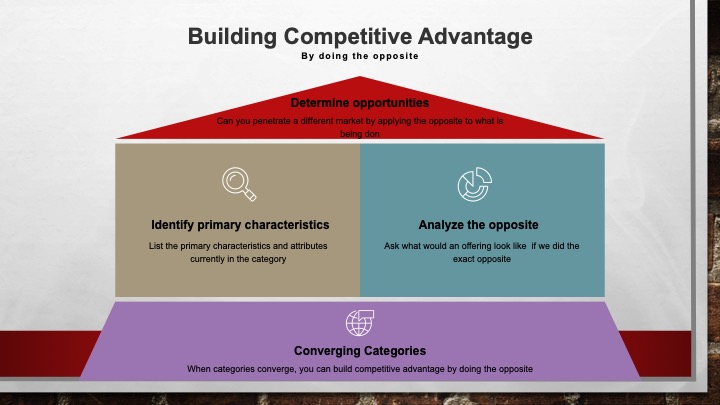
Slide1

Finding the opposite

To address this opportunity, there are two steps. First, you should list the primary characteristics and elements currently in the category. Then ask yourself (or your team), what would an offering look like if we did the exact opposite of each of these characteristics. It could be pricing, target market, marketing creative, key features, look and feel, platform, etc.

From this analysis, determine if there is an opportunity to penetrate a different market that current companies are not appealing to. Balfour uses the example of a gym. While most of the companies in the space were promoting “X-minute abs,” there was an opportunity to focus on experienced professionals at a high price point who did not like inflated claims (i.e. look like Chris Hemsworth in three weeks).

hemsworth

Applications in social casino and iGaming

Doing the opposite is a tremendous opportunity for both social casino and real money gaming companies. The space is largely defined with all competitors competing in almost exactly the same manner. They increase the number of slot machines, improve in-product events, and add in some progression and social features. While the space has grown, in part a shift away from land-based gaming due to Coronavirus, it has not appealed to “adjacent users.” By looking at ways to do the opposite, a company can find a much less competitive space with a potentially huge untapped market.

Key takeaways

  • A powerful way to find a competitive advantage is to do the opposite of what other companies in the industry are doing. Mature industries tend to converge, creating an opportunity to appeal to customers who do not like the homogenous offerings.
  • To uncover the opportunity, first list the primary characteristics and elements currently in the category and then ask yourself what would an offering look like if we did the exact opposite.
  • This strategy represents a particularly appealing opportunity in the social casino and real money gaming spaces, where the offering has largely converged.

Share this:

  • Click to share on Facebook (Opens in new window) Facebook
  • Click to share on LinkedIn (Opens in new window) LinkedIn
Like Loading...
Unknown's avatarAuthor Lloyd MelnickPosted on November 4, 2020October 11, 2020Categories blue ocean strategy, General Social Games Business, General Tech Business, GrowthTags blue ocean strategy, competitive advantage, Opposites1 Comment on Building a strategy around doing the opposite

Keeping the edge you built with analytics

Now that virtually every game company, and every tech company, understands and uses analytics in its operations, simply having strong analytics is no longer a competitive advantage. If everyone is doing the same thing, it becomes the cost of doing business. In the early days of social gaming, Zynga, Playdom and the other leaders built a huge advantage because they had great (at the time) analytics system and used the information to adjust their games based on player demands. Now, even the most traditional game companies (yes, I mean EA) are using analytics to optimize live games and third party providers allow even start-ups access to advanced analytics.

Slide1

Sustaining competitive advantage

A recent article in the MIT Sloan Management Review, “Sustaining an Analytics Advantage” by Peter Bell, shows ways companies can still use analytics to build competitive advantage even when analytics are prevalent. While some of the suggestions are not relevant to game or tech companies, there are some that are invaluable: Continue reading “Keeping the edge you built with analytics”

Like Loading...
Unknown's avatarAuthor Lloyd MelnickPosted on April 14, 2015January 4, 2016Categories Analytics, General Social Games BusinessTags analytics, big data, competitive advantageLeave a comment on Keeping the edge you built with analytics

Why acquisitions and new business initiatives often fail

I was recently reading Playing to Win by A.G. Lafley and Roger Martin and realized that acquisitions and new initiatives only work when they build on your company’s existing skills. This insight sheds light on why some many acquisitions or extensions in the game industry fail. In order to win (to use the authors’ language), or what I would describe as building sustainable competitive advantage, the book shows you need to build systems that support winning. If an acquisition or new initiative requires different systems, however, being part of a company that wins in its space a different way can doom your efforts. This insight is crucial when considering an acquisition (either as a buyer or seller) or pursuing a new business unit.

Playing to Win

You need competitive advantage

One of the themes of this blog, and my conversations with almost everyone, is that you need to have unique, sustainable competitive advantages if you are going to succeed. There are a lot of smart people, there are a lot of people who have raised investment, and if you think factors like these are going to make your company a success you probably need to start thinking about the next company you want to start because you will fail. Very rarely does a strategy of trying to be smarter than your competitor actually work. It is an arrogance that I have seen lead to the waste of millions of dollars of investment and years of sweat equity. Instead, great businesses are built by creating processes, technologies and other unique and non-replicable systems that make your product or services more valuable to customers (or cheaper) than your competitors. Continue reading “Why acquisitions and new business initiatives often fail”

Share this:

  • Click to share on Facebook (Opens in new window) Facebook
  • Click to share on LinkedIn (Opens in new window) LinkedIn
Like Loading...
Unknown's avatarAuthor Lloyd MelnickPosted on October 30, 2013November 15, 2013Categories General Social Games BusinessTags Acquisition, competitive advantage, Merscom, Playing to WinLeave a comment on Why acquisitions and new business initiatives often fail

Get my book on LTV

The definitive book on customer lifetime value, Understanding the Predictable, is now available in both print and Kindle formats on Amazon.

Understanding the Predictable delves into the world of Customer Lifetime Value (LTV), a metric that shows how much each customer is worth to your business. By understanding this metric, you can predict how changes to your product will impact the value of each customer. You will also learn how to apply this simple yet powerful method of predictive analytics to optimize your marketing and user acquisition.

For more information, click here

Follow The Business of Social Games and Casino on WordPress.com

Enter your email address to follow this blog and receive notifications of new posts by email.

Join 791 other subscribers

Most Recent Posts

  • Join me at PDMA Inspire for my talk on new product prioritization
  • Why keep studying?
  • The next three years of this blog
  • Interview with the CEO of Murka on the biggest growth opportunity in gaming, Barak David

Lloyd Melnick

This is Lloyd Melnick’s personal blog.  All views and opinions expressed on this website are mine alone and do not represent those of people, institutions or organizations that I may or may not be associated with in professional or personal capacity.

I am a serial builder of businesses (senior leadership on three exits worth over $700 million), successful in big (Disney, Stars Group/PokerStars, Zynga) and small companies (Merscom, Spooky Cool Labs) with over 20 years experience in the gaming and casino space.  Currently, I am the GM of VGW’s Chumba Casino and on the Board of Directors of Murka Games and Luckbox.

Topic Areas

  • Analytics (114)
  • Bayes' Theorem (8)
  • behavioral economics (8)
  • blue ocean strategy (14)
  • Crowdfunding (4)
  • DBA (2)
  • General Social Games Business (459)
  • General Tech Business (195)
  • Growth (88)
  • International Issues with Social Games (50)
  • Lloyd's favorite posts (101)
  • LTV (54)
  • Machine Learning (10)
  • Metaverse (1)
  • Mobile Platforms (37)
  • Prioritization (1)
  • Social Casino (52)
  • Social Games Marketing (105)
  • thinking fast and slow (5)
  • Uncategorized (33)

Social

  • View CasualGame’s profile on Facebook
  • View @lloydmelnick’s profile on Twitter
  • View lloydmelnick’s profile on LinkedIn

RSS

RSS Feed RSS - Posts

RSS Feed RSS - Comments

Categories

  • Analytics (114)
  • Bayes' Theorem (8)
  • behavioral economics (8)
  • blue ocean strategy (14)
  • Crowdfunding (4)
  • DBA (2)
  • General Social Games Business (459)
  • General Tech Business (195)
  • Growth (88)
  • International Issues with Social Games (50)
  • Lloyd's favorite posts (101)
  • LTV (54)
  • Machine Learning (10)
  • Metaverse (1)
  • Mobile Platforms (37)
  • Prioritization (1)
  • Social Casino (52)
  • Social Games Marketing (105)
  • thinking fast and slow (5)
  • Uncategorized (33)

Archives

  • September 2023
  • December 2021
  • July 2021
  • March 2021
  • February 2021
  • January 2021
  • December 2020
  • November 2020
  • October 2020
  • September 2020
  • August 2020
  • July 2020
  • June 2020
  • May 2020
  • April 2020
  • March 2020
  • February 2020
  • January 2020
  • November 2019
  • October 2019
  • September 2019
  • June 2019
  • May 2019
  • April 2019
  • March 2019
  • February 2019
  • January 2019
  • December 2018
  • June 2018
  • May 2018
  • April 2018
  • March 2018
  • February 2018
  • January 2018
  • December 2017
  • June 2017
  • May 2017
  • April 2017
  • March 2017
  • February 2017
  • January 2017
  • December 2016
  • November 2016
  • October 2016
  • September 2016
  • June 2016
  • May 2016
  • April 2016
  • March 2016
  • February 2016
  • January 2016
  • December 2015
  • November 2015
  • October 2015
  • September 2015
  • July 2015
  • June 2015
  • May 2015
  • April 2015
  • March 2015
  • February 2015
  • January 2015
  • December 2014
  • November 2014
  • October 2014
  • September 2014
  • August 2014
  • July 2014
  • June 2014
  • May 2014
  • April 2014
  • March 2014
  • February 2014
  • January 2014
  • December 2013
  • November 2013
  • October 2013
  • September 2013
  • August 2013
  • July 2013
  • June 2013
  • May 2013
  • April 2013
  • March 2013
  • February 2013
  • January 2013
  • December 2012
  • November 2012
  • October 2012
  • September 2012
  • August 2012
  • July 2012
  • June 2012
  • May 2012
  • April 2012
  • March 2012
  • February 2012
  • January 2012
  • December 2011
  • November 2011
  • October 2011
  • September 2011
  • August 2011
  • July 2011
  • June 2011
  • May 2011
  • December 2010
December 2025
S M T W T F S
 123456
78910111213
14151617181920
21222324252627
28293031  
« Sep    

by Lloyd Melnick

All posts by Lloyd Melnick unless specified otherwise
Google+

Enter your email address to subscribe to this blog and receive notifications of new posts by email.

Join 791 other subscribers
Follow Lloyd Melnick on Quora

RSS HBR Blog

  • How One Manufacturer Achieved Net Zero at Zero Cost
  • What Can U.S. Employers Do About Rising Healthcare Costs?
  • When You Have to Execute a Strategy You Disagree With
  • 4 Ways to Build Durable Relationships with Your Most Important Customers
  • What Jargon Says About Your Company Culture
  • Research: When Used Correctly, LLMs Can Unlock More Creative Ideas
  • Your New Role Requires Strategic Thinking…But You’re Stuck in the Weeds
  • For Circular Economy Innovation, Look to the Global South
  • Why Great Leaders Focus on the Details
  • Corporate Disclosure in the Age of AI

RSS Techcrunch

  • An error has occurred; the feed is probably down. Try again later.

RSS MIT Sloan Management Review Blog

  • AI Coding Tools: The Productivity Trap Most Companies Miss
  • How Procter & Gamble Uses AI to Unlock New Insights From Data
  • Rewire Organizational Knowledge With GenAI
  • Hungry for Learning: Wendy’s Will Croushorn
  • Beat Burnout: 10 Essential MIT SMR Reads
  • How Leaders Stay True to Themselves and Their Stakeholders
  • Our Guide to the Winter 2026 Issue
  • Broadening Future Perspectives at the Bank of England
  • A Faster Way to Build Future Scenarios
  • Assess What Is Certain in a Sea of Unknowns
The Business of Social Games and Casino Website Powered by WordPress.com.
  • Subscribe Subscribed
    • The Business of Social Games and Casino
    • Join 726 other subscribers
    • Already have a WordPress.com account? Log in now.
    • The Business of Social Games and Casino
    • Subscribe Subscribed
    • Sign up
    • Log in
    • Report this content
    • View site in Reader
    • Manage subscriptions
    • Collapse this bar
 

Loading Comments...
 

    %d