Skip to content

The Business of Social Games and Casino

How to succeed in the mobile game space by Lloyd Melnick

Tag: customer service

How CS can impact LTV

Two personal, and comparable, experiences recently showed directly how customer service impacts lifetime value. As many of you know, I travel frequently on business and rent a car about 40 weeks per year, making me a “whale” to car rental companies. I am also relatively loyal to companies, I limit my choices to two companies and probably use my favorite 75 percent of the time.

Slide1

The Ace Rent-A-Car story

A few months ago, I rented a car from ACE Rent-A-Car. I had rented from Ace about 15 times already in 2014, for 30+ weeks, from its Chicago location.

After going out for dinner one night, I discovered that my rental car had a flat tire. Unfortunately, the car I rented did not have a spare tire (yes, there are cars now that are sold without a spare). It was about midnight in Chicago and it was cold so I called Ace with my problem even though I had waived roadside assistance. The first two times I called I was placed on hold 5-10 minutes and the person had no idea how to help. The third time I called they were friendly but explained they could not help because they were acquired by Budget Rent-A-Car (still not sure if it was a system-wide acquisition or the O’Hare location) and gave me a phone number for Budget. I was annoyed as it was getting quite late and I did not feel it was appropriate to rent cars that did not have a spare (and not let the customer know). Continue reading “How CS can impact LTV”

Like Loading...
Unknown's avatarAuthor Lloyd MelnickPosted on February 17, 2015March 19, 2015Categories General Social Games Business, General Tech Business, LTVTags Ace Rent-A-Car, customer service, Enterprise Rent-A-Car, lifetime value, LTVLeave a comment on How CS can impact LTV

How to avoid a product change or new feature debacle

A recent post on TechCrunch about TaskRabbit’s roll-out of a new market structure, largely seen as a failed roll-out, offers many lessons for all types of companies. TaskRabbit rolled out a very different version of its market place last July and faced what many called a “revolt” and “rabbit revolution.” Outside of the business reasons for the change and whether it was a net positive for the company (still debatable), there are many lessons from the experience for any company.

TaskRabbit logo

Do not surprise your customers

TaskRabbit’s change to a new platform caught many of its customers by surprise, leading to immediate protests. TaskRabbit had tested its new platform in the United Kingdom (where it previously did not have a presence) and saw substantial improvement in its metrics. Based on these results, it decided to replace its platform in the U.S. with the new model. As TechCruch wrote, “as soon as the launch actually went live, the protests and confusion started to pour in.” The company underestimated just how strong the bidding and auction model was ingrained in its brand identity here in the U.S., and how that resonated emotionally with users. Continue reading “How to avoid a product change or new feature debacle”

Like Loading...
Unknown's avatarAuthor Lloyd MelnickPosted on January 27, 2015January 29, 2015Categories Analytics, General Social Games Business, General Tech BusinessTags customer service, metrics, new feature, taskrabbitLeave a comment on How to avoid a product change or new feature debacle

Use smart CRM to avoid being dumb

I recently read an interesting book, Smart Customers Stupid Companies by Michael Hinshaw and Bruce Kasanoff, that made an excellent case on why you should make your CRM (customer retention management) systems more sophisticated. The underlying idea is that customers, players, users, etc., are very connected, they regularly use mobile devices and tablets, have easy access to a computers and thus can find almost any data quickly (ever hear of Google?). As customers have and take advantage of instant access to information, they thus expect the companies they deal with to be equally sophisticated.

Consumers and businesses alike research, connect, and purchase online and over their phones. As Hinshaw and Kasanoff write, “[w]ith these tools come radically higher customer expectations. Higher expectations of experience. Greater demands for personalization and customization. Lower tolerance for mistakes, for running through inane hoops, or for interactions that require mindless repetition.”

What are smart customers?

Customers these days have immediate access to almost all information, with Google, Wikipedia, Angie’s List, etc., literally in the palm of their hands. Customers can outwit salespeople, easily spot misstatements by customer service reps, and have near-instant access to the accumulated knowledge of human civilization. The trend is continuing to accelerate; with each new generation of devices people have access to more information.

Customers are also getting less patient, and younger customers never had much patience to begin with. Anyone 20 or younger has never known a world without the Web. The oldest of this generation are now adults, soon to graduate from college and start households of their own. Continue reading “Use smart CRM to avoid being dumb”

Like Loading...
Unknown's avatarAuthor Lloyd MelnickPosted on January 22, 2015January 29, 2015Categories General Social Games Business, General Tech BusinessTags CRM, customer experience, customer service, segmentation, smart CRM, smart customers, smart customers dumb companies1 Comment on Use smart CRM to avoid being dumb

Turning unhappy customers

I have always said the best measure of a company and its customer relationships is not how they avoid unhappy customers but how they deal with unpleasant situations. Inevitably, you will do something that some customers do not like. Rather than focusing on avoiding the inevitable, there is more value in building a strong plan to react to these unhappy people and turning them into a resource. In fact, if they are engaged enough to complain to you rather than just go to a competitor, unhappy customers have the potential to be VIPs if you handle them appropriately.

A recent KISSmetrics blog post by Josh Brown, “5 Ways to Turn Your Unhappy Customer Into A Valuable Resource,” provides strong tactical advice on addressing unhappy customers. By applying these tactics, you not only improve the word of mouth the users generate, but also increase lifetime value by building customers (or players) who will continue to purchase your product.

Slide1

Make your customers feel heard

The most effective way to be liked and admired is by listening to other people, a philosophy around which Dale Carnegie built a career. It is no different when dealing with your customers. An unhappy customer often cares more about being heard and understood than having their issue resolved. This means you need to listen to them and acknowledge their problem, not simply fix it.

As the Brown writes, “if you respond to an unhappy customer by immediately trying to get to a solution, it can possibly backfire and make the customer even more upset. Being unhappy or angry with a company or product puts the customer in a highly emotional state, so the first thing you should try to do is get them into a more agreeable frame of mind.”

Social media is often an opportunity to leverage this principle. You may see multiple Facebook posts about a problem and immediately fix it. While that sounds great, if you do not acknowledge the posts and communicate with the active community, they may not be satisfied and can negate the impact of the fix. Continue reading “Turning unhappy customers”

Share this:

  • Click to share on Facebook (Opens in new window) Facebook
  • Click to share on LinkedIn (Opens in new window) LinkedIn
Like Loading...
Unknown's avatarAuthor Lloyd MelnickPosted on November 6, 2014December 1, 2014Categories General Social Games Business, General Tech BusinessTags customer, Customer satisfaction, customer service, unhappy1 Comment on Turning unhappy customers

How to make your brand trustworthy

In a time when people are very cynical about businesses, earning the trust of your customers or players is increasingly important. Trust gives validity to your marketing messages, allowing you to communicate with your customers, inform them of new products and features and thus increase their long-term lifetime value (LTV). Conversely, if customers do not trust you, there is very little you can do to retain them or reactivate them other than just compete on price.

Trust

A recent article, “How Do You Know if a brand is TRUSTworthy?!,” polled readers to list what makes a brand trustworthy. The responses are very enlightening in terms of building trust for your company or product:

  • Create social media content that is not simply marketing. By creating useful content, not just sales collateral, you are building trust with your customers.
  • Handle negativity well. Rather than ignore or avoid problems, get in front of them and clean up the issue.
  • Do not worry about simply getting a large number of followers, focus on getting followers who are truly engaged with your product or game.

Continue reading “How to make your brand trustworthy”

Share this:

  • Click to share on Facebook (Opens in new window) Facebook
  • Click to share on LinkedIn (Opens in new window) LinkedIn
Like Loading...
Unknown's avatarAuthor Lloyd MelnickPosted on August 6, 2014August 24, 2014Categories General Social Games Business, Social Games MarketingTags customer service, trust2 Comments on How to make your brand trustworthy

Lifetime Value Part 20: What others are doing to optimize lifetime value

There was an article recently that cited a study from Econsultancy and Sitecore that highlighted what companies and advertising agencies are doing across multiple industries to increase customer lifetime value. I have written many times about the importance of lifetime value (LTV), and how it is the core of whether your company or product is successful. The article points out that 75 percent of global company marketers agree that LTV is crucially important. I think it is important to understand what companies in other industries are doing to optimize lifetime value so rather than just following your peers, you can build an advantage over them.

A single customer view

The most common response when asked, “What is the most effective tool to optimize LTV ?” was a single customer view. The recognition that key insights are being missed also supports recent findings showing that marketers are struggling to develop a holistic view of their customers. For example, you may have data from inside your product how consumers act, survey data from your users, focus test results and feedback from customer service. What you may not be doing is integrating all of this data to understand the customer experience and their frustrations. Many companies just look at the in-product metrics but by looking at the data holistically you are more likely to find the levers to optimize best your product. Continue reading “Lifetime Value Part 20: What others are doing to optimize lifetime value”

Share this:

  • Click to share on Facebook (Opens in new window) Facebook
  • Click to share on LinkedIn (Opens in new window) LinkedIn
Like Loading...
Unknown's avatarAuthor Lloyd MelnickPosted on July 2, 2014August 20, 2014Categories General Social Games Business, LTV, Social Games MarketingTags cross-selling, customer experience, customer service, customer view, lifetime value, LTV, personalized interaction, up-selling1 Comment on Lifetime Value Part 20: What others are doing to optimize lifetime value

The empty chair and how it can make your business succeed

I recently read about techniques Amazon CEO’s Jeff Bezos uses to create a great customer experience and one has really stuck with me as a brilliant way to get the whole organization focused on creating a product users love. It is something I am planning to replicate and it can help any company create products that delight users and get them to switch from competitors.

According to the article, even during the fledgling days of Amazon, Bezos worked hard to establish the philosophy of a company that obsesses over their customers from top to bottom. An overwhelming figure that used to always set the tone of his meetings was “the empty chair.” From the first days of Amazon, Bezos brought an empty chair into meetings and informed his top executives that they should consider that seat occupied by their customer, “the most important person in the room.” Throughout these meetings, a different weight was held on all decisions as the invisible but clear presence of the customer was always considered.

The empty chair

Multiple benefits to the empty chair

There are at least three benefits of Bezos’ empty chair strategy:

  • First, features and new products are evaluated through the customer’s perspective. Think of all the products that have come to market, particularly technology products, that did not have a clear value to customers.
  • Second, it keeps you from putting in features that are not in your customer’s or player’s interest. If people would be embarrassed to discuss a feature or new product openly in front of a real customer, there is a problem with that feature. Products that work against the customer will fail immediately or be replaced by a product consistent with the user’s interests, over time there are no secrets in product design.
  • Third, if the product is an improvement or substitute for an existing good, the empty chair forces you to understand if you are creating enough unique value to prompt the user to switch. By having the customer in the room, you need to consider whether that customer would use your product and why they would switch to it from their current product. Given that a product must be 5 or 9 times better to get someone to switch, you can use the empty chair to determine if and how your new offering is that much better.

Continue reading “The empty chair and how it can make your business succeed”

Share this:

  • Click to share on Facebook (Opens in new window) Facebook
  • Click to share on LinkedIn (Opens in new window) LinkedIn
Like Loading...
Unknown's avatarAuthor Lloyd MelnickPosted on June 10, 2014June 15, 2014Categories General Social Games Business, Growth, Lloyd's favorite postsTags amazon, customer service, empty chair, Jeff Bezos, user experience2 Comments on The empty chair and how it can make your business succeed

Lifetime Value Part 14: Machine learning and LTV

Last week I discussed how you need to manage your customers based on their expected lifetime value, and machine learning technology is a powerful tool to execute this strategy. When applied effectively, machine learning can reduce your service and support costs while increasing your profit margin. Machine learning lets you tailor virtually any part of your business to each individual customer so you optimize the value of that customer.

Slide1

Predicting and placing users in the right bucket

The first key in maximizing profitability is segmenting your customers based on expected lifetime value. You can accomplish this manually by examining their past behaviors and key metrics, but most analytic teams do not have the resources to analyze how all the metrics and data interact. Machine learning algorithms, however, can not only incorporate hundreds of variables, but also predict future behavior based on these patterns. Thus, two customers who may have both spent $500 may warrant very different treatment, if the first one is likely to spend $20,000 while the latter is projected to spend $750. Machine learning is a strong tool for making these projections and optimizing the segmentation of your users. Continue reading “Lifetime Value Part 14: Machine learning and LTV”

Share this:

  • Click to share on Facebook (Opens in new window) Facebook
  • Click to share on LinkedIn (Opens in new window) LinkedIn
Like Loading...
Unknown's avatarAuthor Lloyd MelnickPosted on May 13, 2014May 29, 2014Categories Analytics, General Social Games Business, LTV, Machine LearningTags customer service, lifetime value, LTV, Machine learning, pricingLeave a comment on Lifetime Value Part 14: Machine learning and LTV

Lifetime Value Part 13: Managing users and customers profitably

I have written many times about the importance of customer lifetime value (LTV), about its central role in determining a company’s success and how to impact it. In this post, In this post, I will address how to manage users (customers, players, etc.) based on LTV.

Profitability, success and LTV

Slide1

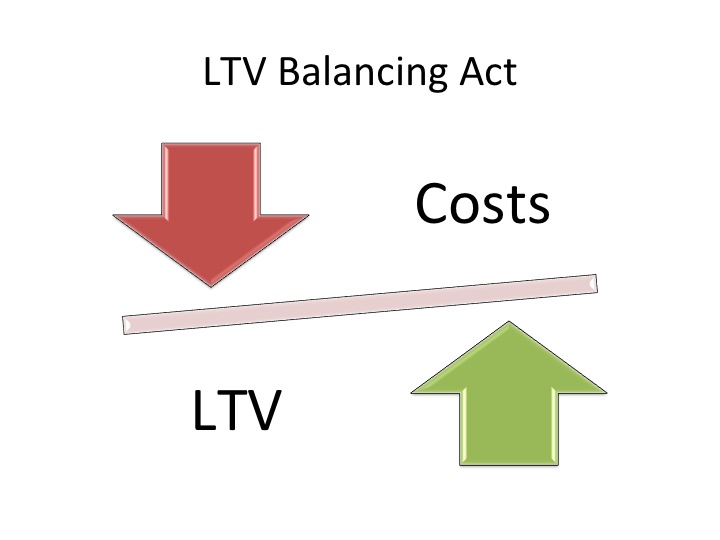
The success and growth of your company comes down to one basic principle, your customer LTV needs to be greater than the cost of acquiring and servicing the customer. The larger the difference between the value you get from a user and the costs associated with that user, the greater your profits. The greater the difference, the more resources you can devote to user acquisition. The greater the difference, the more someone will pay for your company.

The key to optimize the value of a customer versus their costs is not treating all customers the same. Each customer has a different LTV, which can be estimated from everything nearly all the data you are collecting, including from how you acquired the user, their demographic, their initial behavior, etc. The first step to optimizing your business is to determine your different customer segments (VIPs, heavy spenders, occasional spenders, one time spenders, social whales, browsers, etc.). You then put all of your users (hopefully automate this process) into these segments.

Managing a customer portfolio

Once you have segmented your users based on their behavior and predicted lifetime value, you need to manage actively this portfolio of users to optimize your profitability. For each segment, you need to build a strategy that maximizes the difference between the LTV and the costs. For users who spend frequently, you may want to give them enhanced customer service and free gifts so they come back (and spend) even more often. The costs of this additional service and gifts are more than offset by the additional revenue you generate. Conversely, for the one-time purchasers, you want to minimize expenses tied to them. Since they have a low lifetime value, you do not want to devote any resources (costs) to them. By allocating resources only where it increases the difference between LTV and costs, you optimize your profitability. Continue reading “Lifetime Value Part 13: Managing users and customers profitably”

Share this:

  • Click to share on Facebook (Opens in new window) Facebook
  • Click to share on LinkedIn (Opens in new window) LinkedIn
Like Loading...
Unknown's avatarAuthor Lloyd MelnickPosted on May 6, 2014May 29, 2014Categories General Social Games Business, Growth, LTVTags analytics, customer service, lifetime value, LTV, profitabilityLeave a comment on Lifetime Value Part 13: Managing users and customers profitably

Optimizing customer service is not about keeping everyone happy

Customer service is a function that is usually neglected in the tech or game space. A recent article in the MIT Sloan Management Review, “The High Price of Customer Satisfaction,” shows companies can also err by focusing on creating too much customer delight. The article points out that customer satisfaction is the most widely used metric to measure and manage customer loyalty because companies assume highly satisfied customers are good for business. The article points out that the reality is not as simple as the belief that high customer satisfaction optimizes profitability. In the article, the authors look across industries and find the correlation between companies’ customer-satisfaction levels for a given year and the company’s performance (as measured by stock price) only explains 1 percent of the variation in a company’s market return. Another study by Bloomberg’s Business Week actually shows a negative relationship. Although you can poke holes in these studies, overall the relationship between customer spending and customer satisfaction is very weak. Because of this and similar research, many consultants and authors have argued that achieving customer satisfaction is a waste of money. The authors, however, conducted extensive research and uncovered three critical issues that keep customer satisfaction from generating higher revenue. By understanding these three issues, any tech or game company (which I think will find them very familiar) can create a better customer service strategy.

Avoid money losing delighters

Strong customer service (CS) scores are normally considered universally good for business but the data is not as clear-cut. There is a downside to devoting resources continually to raise customer satisfaction levels. As companies cannot usually quantify the costs associated with raising customer satisfaction levels, you cannot determine the value of an increase. Often, the return on investment for improving customer satisfaction is trivial or negative. Although higher satisfaction scores can increase revenue, the costs of getting the higher scores frequently outweigh the benefits. Pricing is a great example of this phenomenon.

One key factor that drives customer satisfaction is low prices, as satisfaction and price are almost inversely related. Thus, lowering price tends to be one of the easiest ways to improve satisfaction levels (in the game industry, which could be the same as giving away premium currency). The problem is that most companies and products, low prices are often bad for business and there is not much room to drop prices and remain profitable. The authors used examples of a large financial services institution and Groupon to illustrate this point. With the financial institution, the majority of customers were highly satisfied. Unfortunately, over two-thirds of these highly satisfied customers were also unprofitable for the company. The customers’ high satisfaction was driven primarily by their belief that they were getting great deals, which they were. Each time the company underpriced its offer, these customers bought in large quantities. The problem was exacerbated as the more they spent, the more additional services they expected. With Groupon, there is a usually negative relationship between customer satisfaction and merchant profitability. Four of the six top performing categories of Groupon offers in terms of satisfaction were money losers for the merchants. These four categories, as they were so popular, generate half of Groupon’s volume.

These examples show that customer satisfaction and profitability are often not aligned. There are other ways to improve customer satisfaction, a better customer experience or more innovative products. However, not all alternatives will be profitable. Moreover, not all customers can be profitably satisfied; some will not pay the necessary price for the level of service being offered. Others demand a level of service that more than offsets any revenue they provide. The point of this issue: you must understand the profit impact of efforts to improve customer satisfaction.

Smaller often equals happier

While conventional wisdom suggests that higher satisfaction would lead to higher market share, the author’s research shows that high satisfaction is a negative predictor of market share. They use some very obvious examples to make their point. McDonalds has lower customer satisfaction scores than Wendy’s but much higher sales. Target, Sears and JC Penney all consistently outperform Wal-Mart on customer satisfaction but there sales and profits fall way behind. The primary reason for this seeming contradiction is that the broader a company’s market appeal relative to the offerings of competitors, the lower the level of satisfaction. Gaining market share normally comes from attracting customers whose needs are not completely aligned with the company’s core target market. Thus, smaller niche companies can better serve their customers while companies with large market share must serve a more diverse set of customers. This data suggests you should not necessarily benchmark against the companies in your space with the highest customer satisfaction levels, they are probably niche players that by design are tailored to their individual audience. It also shows that you a focus on improving your score may not improve your profitability.

The importance of being number one

Improving customers’ share of spending with your brand often represents a far greater opportunity than efforts to improve customer retention. Many companies assume that higher customer satisfaction scores will result in a greater share of customer’s wallet. The research, however, shows virtually no correlation between satisfaction and wallet share. They hypothesize this occurs because customers now have divided loyalty (they are not committed to a single brand), more customers partially defect than completely defect from a business or brand. This is particularly true in the free to play game space, where players will partially defect to another game or app. The weak relationship between satisfaction and wallet share leaves many companies unable to identify what they can do to capture a greater share of customer spending. They tend to believe that customers who consider themselves completely satisfied are more likely to give the bulk of their spending in the category to their brand. The goal then becomes to get that number up. Unfortunately, company’s satisfaction or NPS (Net Promoter Score) is a poor indicator of the relative preference that customers have toward the brands they use. Customers normally divide their spending among multiple competing games or brands. Since not all are equal in satisfying customers, those that better satisfy will get a greater share of customers’ spending. The measure that really impacts revenue is the relative rank that your brand’s satisfaction level represents compared to your competitors. Satisfaction is relative to competitive alternatives.

How to succeed with customer satisfaction

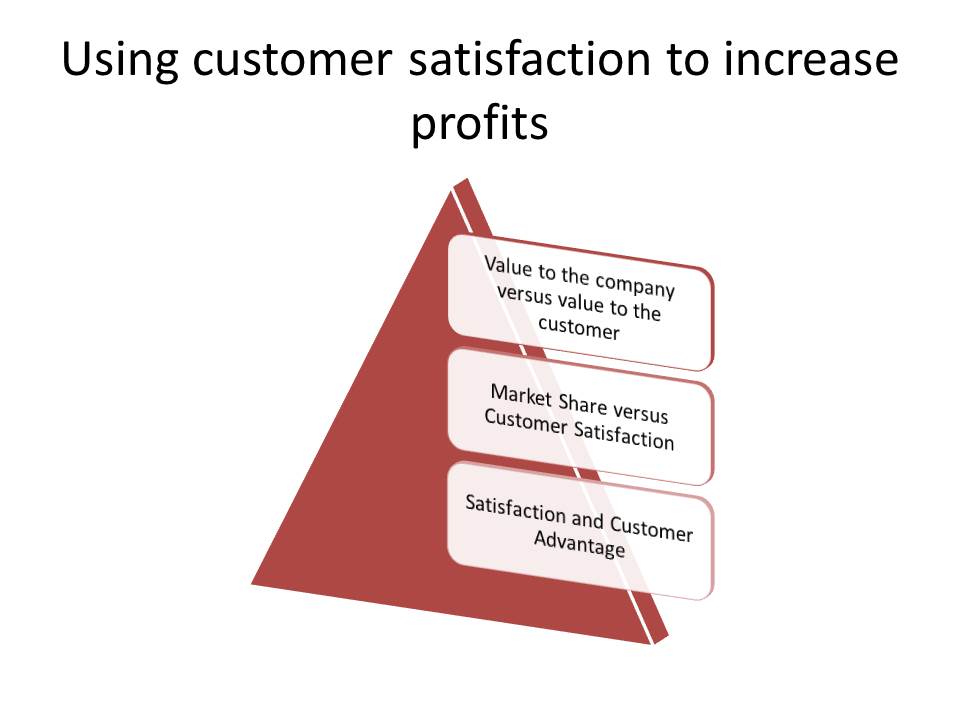
Using customer satisfaction to increase profits While focusing simply on high customer satisfaction is not a profitable strategy, using it appropriately has huge benefits. Continue reading “Optimizing customer service is not about keeping everyone happy”
Share this:

  • Click to share on Facebook (Opens in new window) Facebook
  • Click to share on LinkedIn (Opens in new window) LinkedIn
Like Loading...
Unknown's avatarAuthor Lloyd MelnickPosted on April 8, 2014April 14, 2014Categories General Social Games Business, Growth, Lloyd's favorite postsTags Customer satisfaction, customer service, NPS1 Comment on Optimizing customer service is not about keeping everyone happy

Posts pagination

Previous page Page 1 Page 2 Page 3 Next page

Get my book on LTV

The definitive book on customer lifetime value, Understanding the Predictable, is now available in both print and Kindle formats on Amazon.

Understanding the Predictable delves into the world of Customer Lifetime Value (LTV), a metric that shows how much each customer is worth to your business. By understanding this metric, you can predict how changes to your product will impact the value of each customer. You will also learn how to apply this simple yet powerful method of predictive analytics to optimize your marketing and user acquisition.

For more information, click here

Follow The Business of Social Games and Casino on WordPress.com

Enter your email address to follow this blog and receive notifications of new posts by email.

Join 791 other subscribers

Most Recent Posts

  • Join me at PDMA Inspire for my talk on new product prioritization
  • Why keep studying?
  • The next three years of this blog
  • Interview with the CEO of Murka on the biggest growth opportunity in gaming, Barak David

Lloyd Melnick

This is Lloyd Melnick’s personal blog.  All views and opinions expressed on this website are mine alone and do not represent those of people, institutions or organizations that I may or may not be associated with in professional or personal capacity.

I am a serial builder of businesses (senior leadership on three exits worth over $700 million), successful in big (Disney, Stars Group/PokerStars, Zynga) and small companies (Merscom, Spooky Cool Labs) with over 20 years experience in the gaming and casino space.  Currently, I am the GM of VGW’s Chumba Casino and on the Board of Directors of Murka Games and Luckbox.

Topic Areas

  • Analytics (114)
  • Bayes' Theorem (8)
  • behavioral economics (8)
  • blue ocean strategy (14)
  • Crowdfunding (4)
  • DBA (2)
  • General Social Games Business (459)
  • General Tech Business (195)
  • Growth (88)
  • International Issues with Social Games (50)
  • Lloyd's favorite posts (101)
  • LTV (54)
  • Machine Learning (10)
  • Metaverse (1)
  • Mobile Platforms (37)
  • Prioritization (1)
  • Social Casino (52)
  • Social Games Marketing (105)
  • thinking fast and slow (5)
  • Uncategorized (33)

Social

  • View CasualGame’s profile on Facebook
  • View @lloydmelnick’s profile on Twitter
  • View lloydmelnick’s profile on LinkedIn

RSS

RSS Feed RSS - Posts

RSS Feed RSS - Comments

Categories

  • Analytics (114)
  • Bayes' Theorem (8)
  • behavioral economics (8)
  • blue ocean strategy (14)
  • Crowdfunding (4)
  • DBA (2)
  • General Social Games Business (459)
  • General Tech Business (195)
  • Growth (88)
  • International Issues with Social Games (50)
  • Lloyd's favorite posts (101)
  • LTV (54)
  • Machine Learning (10)
  • Metaverse (1)
  • Mobile Platforms (37)
  • Prioritization (1)
  • Social Casino (52)
  • Social Games Marketing (105)
  • thinking fast and slow (5)
  • Uncategorized (33)

Archives

  • September 2023
  • December 2021
  • July 2021
  • March 2021
  • February 2021
  • January 2021
  • December 2020
  • November 2020
  • October 2020
  • September 2020
  • August 2020
  • July 2020
  • June 2020
  • May 2020
  • April 2020
  • March 2020
  • February 2020
  • January 2020
  • November 2019
  • October 2019
  • September 2019
  • June 2019
  • May 2019
  • April 2019
  • March 2019
  • February 2019
  • January 2019
  • December 2018
  • June 2018
  • May 2018
  • April 2018
  • March 2018
  • February 2018
  • January 2018
  • December 2017
  • June 2017
  • May 2017
  • April 2017
  • March 2017
  • February 2017
  • January 2017
  • December 2016
  • November 2016
  • October 2016
  • September 2016
  • June 2016
  • May 2016
  • April 2016
  • March 2016
  • February 2016
  • January 2016
  • December 2015
  • November 2015
  • October 2015
  • September 2015
  • July 2015
  • June 2015
  • May 2015
  • April 2015
  • March 2015
  • February 2015
  • January 2015
  • December 2014
  • November 2014
  • October 2014
  • September 2014
  • August 2014
  • July 2014
  • June 2014
  • May 2014
  • April 2014
  • March 2014
  • February 2014
  • January 2014
  • December 2013
  • November 2013
  • October 2013
  • September 2013
  • August 2013
  • July 2013
  • June 2013
  • May 2013
  • April 2013
  • March 2013
  • February 2013
  • January 2013
  • December 2012
  • November 2012
  • October 2012
  • September 2012
  • August 2012
  • July 2012
  • June 2012
  • May 2012
  • April 2012
  • March 2012
  • February 2012
  • January 2012
  • December 2011
  • November 2011
  • October 2011
  • September 2011
  • August 2011
  • July 2011
  • June 2011
  • May 2011
  • December 2010
December 2025
S M T W T F S
 123456
78910111213
14151617181920
21222324252627
28293031  
« Sep    

by Lloyd Melnick

All posts by Lloyd Melnick unless specified otherwise
Google+

Enter your email address to subscribe to this blog and receive notifications of new posts by email.

Join 791 other subscribers
Follow Lloyd Melnick on Quora

RSS HBR Blog

  • How One Manufacturer Achieved Net Zero at Zero Cost
  • What Can U.S. Employers Do About Rising Healthcare Costs?
  • When You Have to Execute a Strategy You Disagree With
  • 4 Ways to Build Durable Relationships with Your Most Important Customers
  • What Jargon Says About Your Company Culture
  • Research: When Used Correctly, LLMs Can Unlock More Creative Ideas
  • Your New Role Requires Strategic Thinking…But You’re Stuck in the Weeds
  • For Circular Economy Innovation, Look to the Global South
  • Why Great Leaders Focus on the Details
  • Corporate Disclosure in the Age of AI

RSS Techcrunch

  • An error has occurred; the feed is probably down. Try again later.

RSS MIT Sloan Management Review Blog

  • AI Coding Tools: The Productivity Trap Most Companies Miss
  • How Procter & Gamble Uses AI to Unlock New Insights From Data
  • Rewire Organizational Knowledge With GenAI
  • Hungry for Learning: Wendy’s Will Croushorn
  • Beat Burnout: 10 Essential MIT SMR Reads
  • How Leaders Stay True to Themselves and Their Stakeholders
  • Our Guide to the Winter 2026 Issue
  • Broadening Future Perspectives at the Bank of England
  • A Faster Way to Build Future Scenarios
  • Assess What Is Certain in a Sea of Unknowns
The Business of Social Games and Casino Website Powered by WordPress.com.
  • Subscribe Subscribed
    • The Business of Social Games and Casino
    • Join 726 other subscribers
    • Already have a WordPress.com account? Log in now.
    • The Business of Social Games and Casino
    • Subscribe Subscribed
    • Sign up
    • Log in
    • Report this content
    • View site in Reader
    • Manage subscriptions
    • Collapse this bar
 

Loading Comments...
 

    %d