Skip to content

The Business of Social Games and Casino

How to succeed in the mobile game space by Lloyd Melnick

Tag: epic games

Lessons and insights from social casino and gaming M&A activity in Q1

Lessons and insights from social casino and gaming M&A activity in Q1

Last quarter saw some interesting deals in the gaming space. Several of the deals, and non-deals, suggest trends that are likely to continue in 2019.

Playtika acquires Wooga rather than another social casino

The most interesting deal was Playtika acquiring Wooga for ~$100MM. The thought-provoking element to me was that Playtika decided to invest outside the social casino space. In the past, acquisitions such as House of Fun, Buffalo Studios, etc., were focused on explanding Playtika’s social casino portfolio. Wooga, however, has no presence in the social casino space, instead is a casual, primarily puzzle, game developer. Playtika’s move suggests one of the following:

  1. Given the stagnant user numbers in social casino, there are better growth opportunities in other genres.
  2. Valuations in casino are too high compared with growth potential in the space.
  3. Most likely, social casino companies will continue to expand (and acquire) in casino but also are maturing to want a more robust and diversified portfolio (consistent with Aristocrat’s acquisition in 2017 of Plarium at the same time it purchased Big Fish).

Zynga spent $560+ million for one title, Empires & Puzzles

Zynga’s $560MM acquisition of 80 percent of Small Giant Games (thus valuing the company at $700MM) shows CEO Frank Gibeau’s strategy of focusing on controlling large, long-term franchises. Small Giant’s core product, Empires & Puzzles, is the 13th highest grossing title on mobile. Empires & Puzzles is Small Giant’s only game live, they are not known to have any other big projects in the pipeline (unlike Natural Motion, which had Dawn of Titans in the works when Zynga acquired it), so the acquisition is to add Empires & Puzzles to Zynga’s list of franchises.

This strategy is consistent with what Gibeau learned at EA, that franchises transform a game company from a hit driven business, with wide revenue fluctuations, to a company with sustainable and predictable growth (and thus higher valuation). He is collecting evergreen franchises to try to turn Zynga into the EA of mobile. These franchises include his purchase of Gram Games, which provided the hypercasual franchise Merge Dragons, and Harpin, which gave him Patience – Solitaire. In addition, acquiring rights to Star Wars, Harry Potter and Game of Thrones for gaming creates additional franchise opportunities. Coupled with existing Zynga franchises Zynga Poker, Words with Friends, CSR Racing and to a lesser extent Hit It Rich!, Wizard of Oz Casino Slots and Farmville, Zynga now has a stable revenue base to build on.

Epic raises $1.25BN at a valuation of $5BN-$6BN, showing the breadth and value of its business

Last October, Epic raised $1.25 billion from KKR, Kleiner Perkins, Vulcan Capital and other blue chip investors at a valuation probably well over $5 billion. What is most impressive about Epic is how it has consistently succeeded in different parts of the game industry. While companies frequently are unable to repeat successes in the gaming space or expand beyond their expertise, Epic seems to do it at ease. Fortnite is only the latest in a string of successes that I find incredibly surprising, given the challenges other companies in the game industry experience. I remember Epic when they were still a small North Carolina company, largely an indie developer. Their odds-defying achievements include (and I am probably forgetting some):

  • I first learned about Epic from a CNN story (I think 1998) about someone who created a first person shooter (FPS) in their basement that was soon to be released but getting much buzz. At the time, the FPS market was dominated by id Software (Doom) and all the other FPS were fringe products. They might have a loyal following, like Bungee’s Marathon, but nobody challenged id. I did not expect Epic to launch the top FPS but they did. Unreal turned into the biggest FPS for years, making id an afterthought.
  • With the success of Unreal, Epic decided to license its game engine (creatively branded the Unreal Engine). At the time, the game engine industry was awful. Companies like NDL (Emergent) scraped by to make payroll as no major developers were using third party engines. There was very much a not invented here mentality in the video game industry. Fast forward ten years later and Epic built a game engine company that powers many hit products and is worth hundreds of millions of dollars.
  • Most successful games are followed with…not another successful game. The video game industry is known as being hit driven and even the strongest companies have had difficulty replicating their big successes. While Epic surprised me by successfully creating a huge franchise with Unreal, it did not seem likely that they could ever replicate their success. Then they launched Gears of War in 2006 and ended up with a bigger franchise than Unreal.
  • I have written several times about the challenge of traditional gaming companies competing successfully in the free to play space, most recently Nintendo. Not only is much of what a game company learned in the traditional videogame space worthless in free to play gaming, it actually hinders the ability to create a successful F2P product. Outside of acquisition, I did not foresee a traditional company succeeding in F2P. Then Epic, which had built its business around traditional console game (Unreal, Gears, etc), launched a title you may have heard of, Fortnite, which has now generated billions of dollars. Not only did it succeed in F2P, it helped build a new F2P monetization mechanic. Yet again Epic proved me wrong.

This fundraising deal shows Epic is arguably the strongest company in the gaming sector and one that can expand its footprint into other gaming areas. Although I consider the Google/Apple duopoly over mobile gaming unshakeable, same for Steam on PC, it is hard to bet against Epic. Its ability to expand from Unreal to one of the largest core gaming companies also suggest that Fortnite will not be a one-hit wonder but we should anticipate more Epic titles dominating free to play gaming.

What Q4 means for 2019

The big deals in Q4 suggest several M&A trends I expect to see in 2019:

  1. There will be a pick-up in consolidation among social casino companies, but these companies will also look at growing in other game genres.
  2. The major game companies (all genres and all platforms) will focus acquisition efforts on acquiring franchises, not talent.
  3. Epic will continue to defy the odds

Key takeaways

  • The three most important deals in the gaming space in Q4 2018 were Zynga’s acquisition of Small Giant Games, Playtika’s acquisition of Wooga and a $1.25BN investment in Epic at a valuation of $5BN-$6BN
  • Playtika’s deal shows that social casino companies are looking outside the space to grow
  • Zynga’s deal demonstrates the value of franchises is increasing in mobile gaming
Share this:

  • Click to share on Facebook (Opens in new window) Facebook
  • Click to share on LinkedIn (Opens in new window) LinkedIn
Like Loading...
Unknown's avatarAuthor Lloyd MelnickPosted on January 15, 2019January 11, 2019Categories General Social Games Business, Social CasinoTags epic games, M&A, playtika, wooga, zynga1 Comment on Lessons and insights from social casino and gaming M&A activity in Q1

Finally, a new approach to monetization in free-to-play games

I am excited that the latest gaming phenomenon, Fortnite, is not only a hit game because of its content but also because it has brought a unique monetization mechanic to the mass market. For over ten years, people have been optimizing the free-to-play model, improving monetization primarily through in-app purchases. We have all talked about finding new or additional revenue mechanics but there have been no dramatic changes. Many companies have gotten better at getting players to pay more (or more players to pay) but nobody had changed the paradigm. Yet, as I have written many times, the real opportunity for growth is to find a blue ocean, do something your competitors are not.

Why Epic

Epic Games has overcome this challenge with Fortnite, creating a monetization mechanic previously seen only in niche titles. Initially, I have to admit I was particularly surprised this innovation came from Epic, as I frequently wrote that traditional game companies ( most recently Nintendo) could not succeed in the mobile space because they were too wedded to the old monetization model of discrete purchases. Epic is definitely a company that has benefitted mightily from the old model, from Unreal to Gears of War to their other hits, they have made billions of dollars from selling great games in pretty boxes. Now, though, they have disrupted the free-to-play space.

In retrospect, it is not that surprising that innovation did not come from a mobile game company. Just as traditional game companies could not embrace the free-to-play model fully, the “what are now” traditional free-to-play company cannot discard their in-app purchase (IAP) optimization strategy fully. Thus, Epic, which did not have the IAP optimization baggage, could look holistically at the opportunity and come up with a new approach.

What Epic did

Fortnite’s Battle Pass system is a unique approach to drive monetization that is showing great results. According to a recent article by Adam Telfer and Joseph Kim, Fortnite has generated $126 million in revenue, including $5.3 million mobile revenue in its first 10 days.

The Battle Pass is a mechanic that avoids pay to win (spending to get a competitive advantage over other players) but finds a way to get players to pay significantly for cosmetic benefits. Traditional thinking in free-to-play is that cosmetic accessories (avatars, skins, emotes, etc.) can only generate limited incremental revenue. With Fortnite, however, they have made the cosmetics the only way to show success and progression, so players are motivated to acquire (and show off) more and better items, and subsequently monetize to get the great cosmetics.

Battle Passes are largely a challenges mechanic, and even in traditional IAP games challenges are a proven monetization mechanic. They are a great way to drive player activity, guide them to specific activities and provide a sense of completion. It’s not surprising that the evolution from challenge systems to Battle Passes yields a new monetization mechanic.

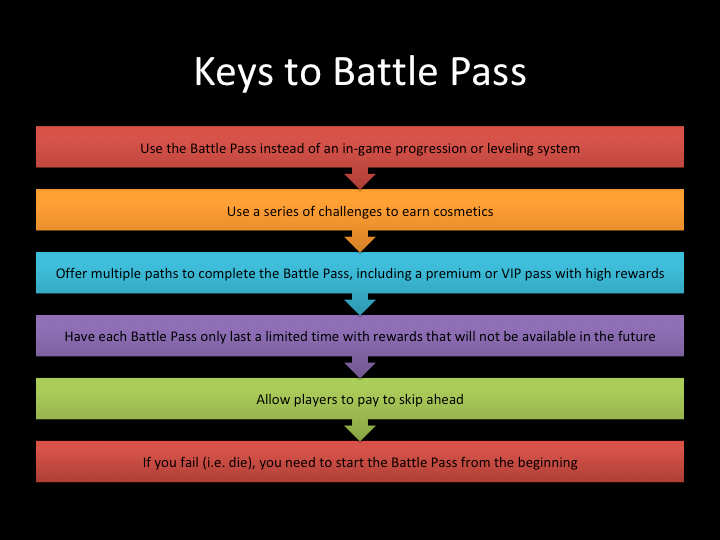
Slide1

The first key element is that there is not a leveling or stats system. Thus, you cannot show others how skilled you are by pointing out you are level 5,274. Instead, status is conveyed by how great your cosmetics are. The more, and better, cosmetics, implicitly the better Fortnite player you are.

The second key element is the Battle Pass, a series of challenges to earn cosmetics. The Battle Pass is a series of challenges with each one providing cosmetic rewards.

The third key to the Battle Pass is offering multiple paths. In addition to the free path is a premium path that provides significantly more rewards. Epic is also very loose in providing rewards for the premium path, players feel they are getting an incredible value.

Fourth, each Battle Pass only lasts a season. Each of these seasons has its own cosmetics, so if you miss a season you never get them. This creates an incentive for the player to play each Battle Pass so they do not miss any content forever.

Fifth, and a key difference with traditional IAP models, players can pay to skip ahead in tiers. Since tiers are not levels, players are not actually paying to win anything, just to get to higher value cosmetics.

Sixth, if you fail at a challenge, you need to start the entire path again unless you monetize. Critically, if you die during a challenge (which happens to most players of Fortnite), you have to start at the beginning of the challenge. Thus, there is a strong incentive not to lose your progress (and plays to people’s loss aversion). People do not want to start from zero repeatedly.

How you can use Battle Passes

Battle passes effectively change monetization from the core game loop to the challenge mechanic. By eliminating levels and points, you can move monetization from interrupting gameplay to super-charging it. Challenges work in many genres but the Battle Pass takes it to the next level. Zynga credits much of its current success with Zynga Poker to challenges. Virtually any PvP game, and even some single player games, can integrate a challenge system. The key to success though will be recentering monetization on this system rather than the traditional IAP model, making it the source of showing progression and providing a VIP path.

Key takeaways

  • Fortnite is one of the biggest gaming successes ever, and it is being driven by a monetization system previously not seen in mass market free-to-play games, Battle Passes.
  • Battle Passes allow players to earn cosmetic rewards, which have a high value because they are the only way players can show progress in Fortnite.
  • By centering your monetization on a challenge system, you can develop a similar mechanic as Battle Passes.

Share this:

  • Click to share on Facebook (Opens in new window) Facebook
  • Click to share on LinkedIn (Opens in new window) LinkedIn
Like Loading...
Unknown's avatarAuthor Lloyd MelnickPosted on May 15, 2018May 13, 2018Categories General Social Games BusinessTags Battle Pass, epic games, Fortnite, free to play, monetization2 Comments on Finally, a new approach to monetization in free-to-play games

The most important company in the game industry

The most important company in the game industry

Key takeaways

  1. The most significant company in the video and computer game space is one that people do not frequently think of Tencent, which has a market value of $229 billion (more than the market value of Apple, Google, Microsoft, Sony and EA combined).
  2. Tencent’s game properties include the biggest PC game (League of Legends), the strongest mobile franchise (Clash, as in Clash of Clans and Clash Royale) and the most important console game company (Epic, maker of Unreal and Gears of War).
  3. Tencent is also a very progressive company, allowing is investments the autonomy to make decisions and grow.

The most important company in the game industry

I was doing some research last week, when I was surprised at a company with a $200+ billion market value (market capitalization). The company was Tencent, with a market cap $229 billion. For comparison Microsoft has a market value is $479 billion. Apple is at $614 billion. It is definitely more than Sony, who only has a $37 billion market. Want to try EA, forget it, only $24 billion.

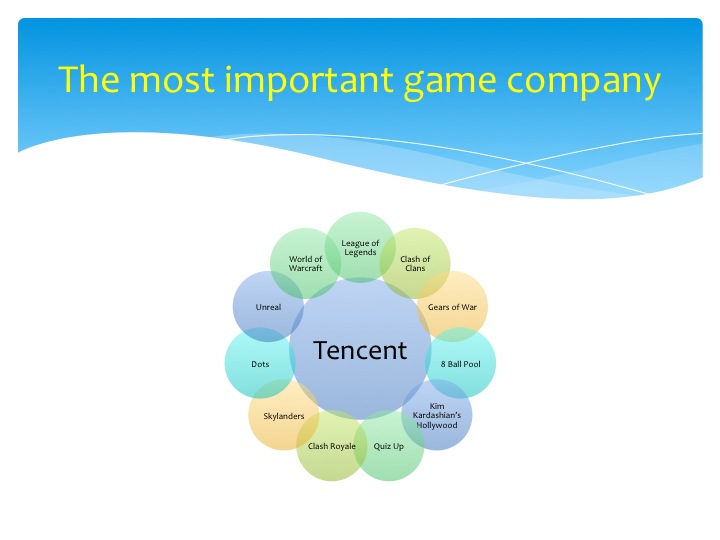
While you can argue that Tencent is not a game company (and the bulk of its income does come from other operations), looking closely it becomes apparent that they also dominate in the (western) game space. Among their assets in the game space:

  • Clash of Clans and Clash Royale from Supercell. Tencent acquired Supercell this Spring.
  • Unreal and Gears of War developer Epic Games. Tencent is the largest shareholder in Epic, probably the most important developer in the console game space. Unreal is the engine (a suite of game development tools) used to create many of the most popular games in the world, from Dragon Quest and Final Fantasy to Moto Racer to Street Fighter to Assassins Creed to Brothers in Arms to…. Not only is it the most successful game development engine, Epic’s first party titles include Unreal (big surprise), Gears of War and Infinity Blade.
  • League of Legends creator Riot Games. Tencent controls the largest PC game in the world, League of Legends.
  • 8 Ball Pool and Agar.io developer Miniclip is another Tencent company. Miniclip always sems to have multiple games in the top-10 mobile charts and has tens of millions of daily players.
  • Kim Kardashian Hollywood developer Glu Mobile. Tencent is a minority investor in the most prolific mobile developer that uses big name IP, such as Kim Kardashian, Nicki Minaj and Gordon Ramsey.
  • QuizUp from Plain Vanilla is another part of the Tencent empire, as Tencent is one of Plain Vanilla’s largest investors.
  • Skylanders, World of Warcraft, Destiny and Call of Duty owner Activision/Blizzard is also part of the Tencent empire. Tencent owns 25 percent of Activision/Blizzard.
  • And there is more. Tencent is also one of the largest shareholders in PocketGems, Dots, Robot Entertainment and I am sure some I have missed.

slide1

When you look at the properties that Tencent controls (Clash of Clans, League of Legends, etc), it is clearly the most important company in our space.

The other interesting element of Tencent

In my conversations with people at some of the companies above (and this data is totally anecdotal), Tencent is a very interesting parent. People often group it with Japanese and Korean companies, which are often very challenging to work at. My friends who have worked for Japanese companies complain about how western employees and executives had virtually no autonomy to make decisions (they were all made at the Japan level) and even then decision making was excruciatingly slow.

From what I have heard, Tencent, and Chinese companies in general, are pretty much the opposite and often more progressive than western companies. Tencent has left the companies above very autonomous and business has barely changed on the day-to-day level. Tencent, however, has helped these companies grow by expanding into the Asia. Most surprisingly, in the incredibly cynical game space, I have not heard anyone say anything bad about working for Tencent.

Chinese multinationals are often much more progressive than other Asian and often western competitors. In 2013, I wrote about how Haier (a Chinese white goods manufacturer) eliminated all of its middle management, a concept here that companies (other than Zappos) are just starting to look at. I have never worked at a Chinese company and have actually interacted very little with them, but between Tencent, Haier and Alibaba (the world’s most successful retailer), Chinese companies show many progressives traits that lead to success in the game industry.

The game industry’s most important player

When you combine Tencent’s market valuation with its network of the most important game properties, it is clear that they are the most important game company in the world. Over time, Tencent’s performance will be more parallel to that of the game. When Tencent does well, the game industry does well. When the game industry does well, Tencent will do well.

Share this:

  • Click to share on Facebook (Opens in new window) Facebook
  • Click to share on LinkedIn (Opens in new window) LinkedIn
Like Loading...
Unknown's avatarAuthor Lloyd MelnickPosted on December 14, 2016December 14, 2016Categories General Social Games BusinessTags Activision, clash of clans, clash royale, epic games, Glu Mobile, Kim Kardashian, league of legends, miniclip, Pocket Gems, quiz-up, riot games, supercell, Tencent1 Comment on The most important company in the game industry

Get my book on LTV

The definitive book on customer lifetime value, Understanding the Predictable, is now available in both print and Kindle formats on Amazon.

Understanding the Predictable delves into the world of Customer Lifetime Value (LTV), a metric that shows how much each customer is worth to your business. By understanding this metric, you can predict how changes to your product will impact the value of each customer. You will also learn how to apply this simple yet powerful method of predictive analytics to optimize your marketing and user acquisition.

For more information, click here

Follow The Business of Social Games and Casino on WordPress.com

Enter your email address to follow this blog and receive notifications of new posts by email.

Join 791 other subscribers

Most Recent Posts

  • Join me at PDMA Inspire for my talk on new product prioritization
  • Why keep studying?
  • The next three years of this blog
  • Interview with the CEO of Murka on the biggest growth opportunity in gaming, Barak David

Lloyd Melnick

This is Lloyd Melnick’s personal blog.  All views and opinions expressed on this website are mine alone and do not represent those of people, institutions or organizations that I may or may not be associated with in professional or personal capacity.

I am a serial builder of businesses (senior leadership on three exits worth over $700 million), successful in big (Disney, Stars Group/PokerStars, Zynga) and small companies (Merscom, Spooky Cool Labs) with over 20 years experience in the gaming and casino space.  Currently, I am the GM of VGW’s Chumba Casino and on the Board of Directors of Murka Games and Luckbox.

Topic Areas

  • Analytics (114)
  • Bayes' Theorem (8)
  • behavioral economics (8)
  • blue ocean strategy (14)
  • Crowdfunding (4)
  • DBA (2)
  • General Social Games Business (459)
  • General Tech Business (195)
  • Growth (88)
  • International Issues with Social Games (50)
  • Lloyd's favorite posts (101)
  • LTV (54)
  • Machine Learning (10)
  • Metaverse (1)
  • Mobile Platforms (37)
  • Prioritization (1)
  • Social Casino (52)
  • Social Games Marketing (105)
  • thinking fast and slow (5)
  • Uncategorized (33)

Social

  • View CasualGame’s profile on Facebook
  • View @lloydmelnick’s profile on Twitter
  • View lloydmelnick’s profile on LinkedIn

RSS

RSS Feed RSS - Posts

RSS Feed RSS - Comments

Categories

  • Analytics (114)
  • Bayes' Theorem (8)
  • behavioral economics (8)
  • blue ocean strategy (14)
  • Crowdfunding (4)
  • DBA (2)
  • General Social Games Business (459)
  • General Tech Business (195)
  • Growth (88)
  • International Issues with Social Games (50)
  • Lloyd's favorite posts (101)
  • LTV (54)
  • Machine Learning (10)
  • Metaverse (1)
  • Mobile Platforms (37)
  • Prioritization (1)
  • Social Casino (52)
  • Social Games Marketing (105)
  • thinking fast and slow (5)
  • Uncategorized (33)

Archives

  • September 2023
  • December 2021
  • July 2021
  • March 2021
  • February 2021
  • January 2021
  • December 2020
  • November 2020
  • October 2020
  • September 2020
  • August 2020
  • July 2020
  • June 2020
  • May 2020
  • April 2020
  • March 2020
  • February 2020
  • January 2020
  • November 2019
  • October 2019
  • September 2019
  • June 2019
  • May 2019
  • April 2019
  • March 2019
  • February 2019
  • January 2019
  • December 2018
  • June 2018
  • May 2018
  • April 2018
  • March 2018
  • February 2018
  • January 2018
  • December 2017
  • June 2017
  • May 2017
  • April 2017
  • March 2017
  • February 2017
  • January 2017
  • December 2016
  • November 2016
  • October 2016
  • September 2016
  • June 2016
  • May 2016
  • April 2016
  • March 2016
  • February 2016
  • January 2016
  • December 2015
  • November 2015
  • October 2015
  • September 2015
  • July 2015
  • June 2015
  • May 2015
  • April 2015
  • March 2015
  • February 2015
  • January 2015
  • December 2014
  • November 2014
  • October 2014
  • September 2014
  • August 2014
  • July 2014
  • June 2014
  • May 2014
  • April 2014
  • March 2014
  • February 2014
  • January 2014
  • December 2013
  • November 2013
  • October 2013
  • September 2013
  • August 2013
  • July 2013
  • June 2013
  • May 2013
  • April 2013
  • March 2013
  • February 2013
  • January 2013
  • December 2012
  • November 2012
  • October 2012
  • September 2012
  • August 2012
  • July 2012
  • June 2012
  • May 2012
  • April 2012
  • March 2012
  • February 2012
  • January 2012
  • December 2011
  • November 2011
  • October 2011
  • September 2011
  • August 2011
  • July 2011
  • June 2011
  • May 2011
  • December 2010
January 2026
S M T W T F S
 123
45678910
11121314151617
18192021222324
25262728293031
« Sep    

by Lloyd Melnick

All posts by Lloyd Melnick unless specified otherwise
Google+

Enter your email address to subscribe to this blog and receive notifications of new posts by email.

Join 791 other subscribers
Follow Lloyd Melnick on Quora

RSS HBR Blog

  • When There’s Nowhere to Promote a Star Employee
  • Why AI Boosts Creativity for Some Employees but Not Others
  • Where McKinsey—and Consulting—Go From Here
  • How Equitable Confronted Its Inertia After 160 Years in Business
  • Our Favorite Management Tips on Creating Meaning and Happiness at Work
  • The Case for Sharpening Your Math Skills in the Age of AI
  • Don’t Underestimate the Value of Professional Friendships
  • New Research on Copycat Products, Your Pitch-Day Dress Code, When Hand Gestures Help Persuasion, and More
  • Leaders, Bring Your Best Self into the New Year
  • What Actually Works to Change Someone’s Mind

RSS Techcrunch

  • An error has occurred; the feed is probably down. Try again later.

RSS MIT Sloan Management Review Blog

  • Five Trends in AI and Data Science for 2026
  • Stop Making Hollow Apologies at Work
  • Calm: The Underrated Capability Every Leader Needs Now
  • The Top Five MIT SMR Videos of 2025
  • Three Steps Toward Fairer Talent Management
  • From Crisis to Coopetition: What Leaders Can Learn From Anesthesiologists
  • AI Coding Tools: The Productivity Trap Most Companies Miss
  • How Procter & Gamble Uses AI to Unlock New Insights From Data
  • Rewire Organizational Knowledge With GenAI
  • Hungry for Learning: Wendy’s Will Croushorn
The Business of Social Games and Casino Website Powered by WordPress.com.
  • Subscribe Subscribed
    • The Business of Social Games and Casino
    • Join 726 other subscribers
    • Already have a WordPress.com account? Log in now.
    • The Business of Social Games and Casino
    • Subscribe Subscribed
    • Sign up
    • Log in
    • Report this content
    • View site in Reader
    • Manage subscriptions
    • Collapse this bar
 

Loading Comments...
 

    %d