Skip to content

The Business of Social Games and Casino

How to succeed in the mobile game space by Lloyd Melnick

Tag: game design

Taste, why creating a beautiful product is a key to success

Taste, why creating a beautiful product is a key to success

In the gaming world, we often deconstruct design into a set of data and AB tests to create products and features that will resonate with players. Design is sometimes even considered a bad word, implying that we are not data driven. Yet, companies like Apple (who I wrote about a few of weeks ago), have shown that valuing design highly can lead to billions in revenue. Additionally, I have seen many data driven companies where Product Managers create compelling beautiful PowerPoint presentations while share prices drop because customers do not flock to their products.

At the heart of the contempt of design is a feeling that it is based on taste and that taste is entirely subjective. Thus, the logic goes that there is no way to design for taste. A great blog post by Paul Graham, Taste for Makers, however, not only points out this thinking is false but also how designers can create beautiful products. To drive home that taste is not a subjective exercise, Graham mentions that, “[m]athematicians call good work ‘beautiful,’ and so, either now or in the past, have scientists, engineers, musicians, architects, designers, writers, and painters. Is it just a coincidence that they used the same word, or is there some overlap in what they meant? If there is an overlap, can we use one field’s discoveries about beauty to help us in another?”

Graham then breaks down the elements designers need to focus on to create something beautiful, something will be truly tasteful. If taste were entirely subjective a van Gogh would have no more value than a van Lloyd. Graham writes, “[s]aying that taste is just personal preference is a good way to prevent disputes. The trouble is, it’s not true. You feel this when you start to design things….[I]f your job is to design things, and there is no such thing as beauty, then there is no way to get better at your job. If taste is just personal preference, then everyone’s is already perfect: you like whatever you like, and that’s it.”

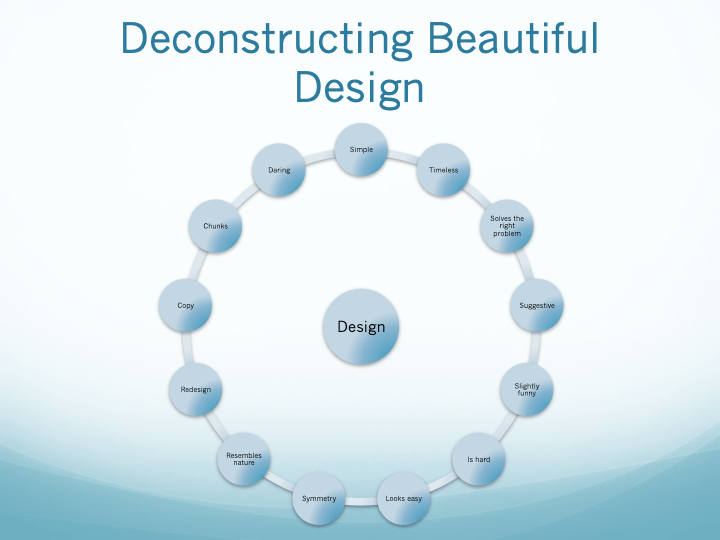
By looking into what is, and is not, appealing to people’s tastes, how design has evolved and what designs have failed, there are thirteen concept from Graham that can help guide good design. By following these principles, you are most likely to design a beautiful product.
Slide1

Good design is simple

The first key to good design is the same as the one that led to Apple’s success, a simple design is better than a complex one. Again, using mathematics to show that good design is not a subjective exercise, Graham points out that shorter math proofs are generally better.

While it seems like it would be easy to create a simple design, it is actually more difficult. It feels like extra work to create something ornate, to add features to a product or even to paint more objects in a picture. In practice, though, it is easier to create more mindlessly or not make difficult decisions on what people truly value than taking the time to understand what people want and eliminating what will be superfluous. Graham writes, “when you’re forced to be simple, you’re forced to face the real problem. When you can’t deliver ornament, you have to deliver substance.”

ipod shuffle

Good design is timeless

If you focus on designing a product that is “timeless,” by definition you are trying to create the best product design, not one that will be surpassed. Again, if you look at mathematics, a proof is timeless unless it includes a mistake.

Focusing on timelessness avoids falling for trends that are currently popular but short lived. Trends change over time and as Graham writes, “if you can make something that will still look good far into the future, then its appeal must derive more from merit and less from [trends].”

Good design solves the right problem

To create a beautiful design, you have to first understand what user problem it solves. Prior to finding an eloquent solution, you should ensure you are solving the right or underlying problem. As Graham writes, “[i]n software, an intractable problem can usually be replaced by an equivalent one that’s easy to solve. Physics progressed faster as the problem became predicting observable behavior, instead of reconciling it with scripture.”

If you look at bad design, it is often the result of solving the wrong problem. Why did Stadia fail, not because of its UI or UX but because it solved a problem that very few customers experienced (access to virtually unlimited content).

Graham uses the example of the stove top to illustrate the importance of solving the problem rather than designing in a vacuum. According to Graham, “the typical stove has four burners arranged in a square, and a dial to control each. How do you arrange the dials? The simplest answer is to put them in a row. But this is a simple answer to the wrong question. The dials are for humans to use, and if you put them in a row, the unlucky human will have to stop and think each time about which dial matches which burner. Better to arrange the dials in a square like the burners.”

Good design is suggestive

Rather than proscribing every step a customer takes, a great design will help customers envision how to use the product. Going back to mathematics, a proof that becomes the basis for new work is more beautiful than one that does not lead to future discoveries. Graham highlights several other examples, “In architecture and design, this principle means that a building or object should let you use it how you want: a good building, for example, will serve as a backdrop for whatever life people want to lead in it, instead of making them live as if they were executing a program written by the architect. In software, it means you should give users a few basic elements that they can combine as they wish.”

Opera house

If you look at the most successful design driven company of all time, Apple, you see this principle in practice. The iPhone was not great because its UI or design was limited, instead it let people use it the way they wanted to. It even let external companies (App developers) integrate with the design, something that would not have been possible (or at least as broad) if it was a very prescribed interfact. Apple products are not great because it is clear and easy how to do everything, I still have to Google functionality occasionally for my iPad and Mac, but they encourage consumers to explore the product and push it to its boundaries.

Good design is often slightly funny

Products that do not take themselves too seriously are more likely to be considered beautiful designs. Graham writes, “[t]o have a sense of humor is to be strong: to keep one’s sense of humor is to shrug off misfortunes, and to lose one’s sense of humor is to be wounded by them. And so the mark– or at least the prerogative– of strength is not to take oneself too seriously.”

The value of humor is often seen in movies (using movies as I can’t think of a funny mathematics proof). Marvel movies generally outperform those about DC characters, not because the superheroes are more famous or the special effects are better but because they incorporate humor into the stories.

Good design is hard

Design cannot be an afterthought but instead needs sufficient resources to create something beautiful. As form should follow function, if function is hard enough, form is forced to follow it, because there is no effort to spare for error. In math, difficult proofs require ingenious solutions that do not happen overnight. Graham writes, “[i]n art, the highest place has traditionally been given to paintings of people. There is something to this tradition, and not just because pictures of faces get to press buttons in our brains that other pictures don’t. We are so good at looking at faces that we force anyone who draws them to work hard to satisfy us. If you draw a tree and you change the angle of a branch five degrees, no one will know. When you change the angle of someone’s eye five degrees, people notice.”

While design is hard, you should not pursue difficulty for its own. There is beneficial pain and unnecessary pain. Graham explains, “[y]ou want the kind of pain you get from going running, not the kind you get from stepping on a nail.”

Good design looks easy

While good design is hard, it should appear easy to users. A mathematician might create brilliant proofs through months or years of hard work but the great ones will appear as if they created the proof overnight while reading the morning newspaper. Some of the best inventions are ones where we ask ourselves why we did not think of them previously. The great athlete looks like they are barely exerting themself while they are actually probably training 100+ hours/week.

In design what looks easy comes from practice. The more you train yourself, the more your subconscious handles the basic tasks freeing your mind on creating beautiful.

Good design uses symmetry

Symmetry is a powerful tool in helping achieve simplicity. There are two types of symmetry, repetition and recursion. Recursion is defining a problem in terms of itself. The reflection in a mirror of a mirror is recursive: the reflected mirror is reflecting its own image and doing so indefinitely. In math and engineering, recursion, especially, is a big win. Inductive proofs are wonderfully short.
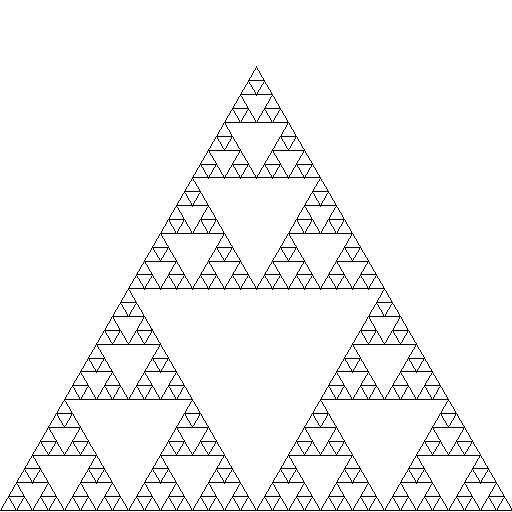
Recursion

While you do not want to use symmetry to replace original thought, it is a powerful design principle that can create both striking and very understandable designs. As the user only has to learn a concept ones, using it in a repetitive or recursive manner becomes easy for the customer.

Good design resembles nature

By designing to resemble nature, you are capturing both what people already know and what nature may have taken centuries to perfect. As Graham writes, “[i]t’s not cheating to copy.” Using ideas from nature in your design allows you to build on proven schemes.

Good design is redesign

One key to success, not only in design but in most areas of product development and marketing, is iterate, iterate, iterate. Most books are barely readable the first time the author puts pen to paper but are the result of painstaking editing. The best games have gone through months of prototyping, user testing and feedback. It is the same with design.

Part of the iteration process is abandoning some, or most, of the earlier design. As Graham writes, “[i]t’s rare to get things right the first time. Experts expect to throw away some early work. They plan for plans to change. It takes confidence to throw work away. You have to be able to think, there’s more where that came from….Mistakes are natural. Instead of treating them as disasters, make them easy to acknowledge and easy to fix. ”

Good design can copy

Starting with a good existing design will often lead to a more beautiful design. While I did write that a key to the most innovative creators is don’t copy, that concept is not counter to beautiful design copying existing design. Creating a beautiful design is not about creating an innovative design; it is about creating a product that beautifully solves the right problem. Thus, if you base your design on something that has already approached solving the problem, it frees you up to solve it even better.

If the beauty of your design is about how to solve the problem, then you have a responsibility to incorporate existing best practices. Graham writes, “I think the greatest masters go on to achieve a kind of selflessness. They just want to get the right answer, and if part of the right answer has already been discovered by someone else, that’s no reason not to use it. They’re confident enough to take from anyone without feeling that their own vision will be lost in the process.”

Good design happens in chunks

Beautiful design does not have to come from just one designer. A team or group of designers can sometimes create a better design than just one brilliant designer. While Jony Ive is often credited with Apple’s design success, the key to Apple’s successes was creating an Industrial Design Group, under Ive, with some of the best designers in the world. They would collaborate on projects, often focusing on different elements, in creating products that captured the world’s attention and hearts.

Good design is often daring

The most successful designs and new products are ones that required the champion to be daring. Apple would not have created the iPhone or iPad if they wanted a safe solution, they would have just improved on existing devices. Amazon would not have created a billion dollar business if they had tried to create a better bookstore. Graham writes, “at every period of history, people have believed things that were just ridiculous, and believed them so strongly that you risked ostracism or even violence by saying otherwise…. Today’s experimental error is tomorrow’s new theory. If you want to discover great new things, then instead of turning a blind eye to the places where conventional wisdom and truth don’t quite meet, you should pay particular attention to them.”

daring design

Using these principles in creating games

Design is critical to creating great products. To have long-term success and build a competitive position, you are going to need beautiful products that reflect great taste, not simply a lot of data and optimization. Creating beauty, however, is not easy. If you follow the steps above, however, you improve your chances of creating the next hit product.

Key takeaways

  • While many game and tech companies focus on data and testing to create product, the key to building a game-changing product is beautiful design (see Apple) that represent great taste.
  • At the core of creating a beautiful product is simplicity and timeliness, rather than focusing on making something pretty focus on solving the user’s true problem.
  • Another key to creating beautiful products is understanding it will not be easy, great design is very difficult and requires painstaking work and iteration.
Share this:

  • Click to share on Facebook (Opens in new window) Facebook
  • Click to share on LinkedIn (Opens in new window) LinkedIn
Like Loading...
Unknown's avatarAuthor Lloyd MelnickPosted on May 20, 2020April 25, 2020Categories General Social Games Business, General Tech Business, Social CasinoTags Design process, game design, Product designLeave a comment on Taste, why creating a beautiful product is a key to success

How to build a Leaderboard that actually works and drives KPIs

Leaderboards are a common feature in games but developers are often surprised because they are ineffectual or quickly lose impact. The problem is not in the underlying value of leaderboards but in how they are often designed. A recent blog post by Omar Ganai and Steven Ledbetter, How to Motivate with Leaderboards, does a great job of presenting the underlying psychology driving leaderboards and best practices.

What makes leaderboards work

The key principle behind leaderboards is that people want to win and winning improves status. What is often neglected, however, is that some players do not want to win, they want to avoid losing. The latter is important as players who want to avoid losing perform worse when competing. Competition is good for motivation and achievement only when it helps users feel competent. You need to design your leaderboards so it does not make your players feel incompetent.

Ganai and Ledbetter point out that self-determination theory shows people seek and engage in undertakings that fulfill three basic needs. Thus, a well designed leaderboard is consistent with these three needs:

  1. Competence. The emotion a player feels when they successfully complete a challenging goal. The opposite feeling is ineffective or helpless.
  2. Relatedness. The feeling a player has when they are understood and liked by other players. The opposite feeling is rejection and disconnection.
  3. Autonomy. The satisfaction a player gets resulting from a personal commitment and choice. The opposite here is coercion and manipulation.

An effective leaderboard will combine competence, relatedness and autonomy while not making the player feel helpless, disconnected or manipulated.

Best practices in designing leaderboards

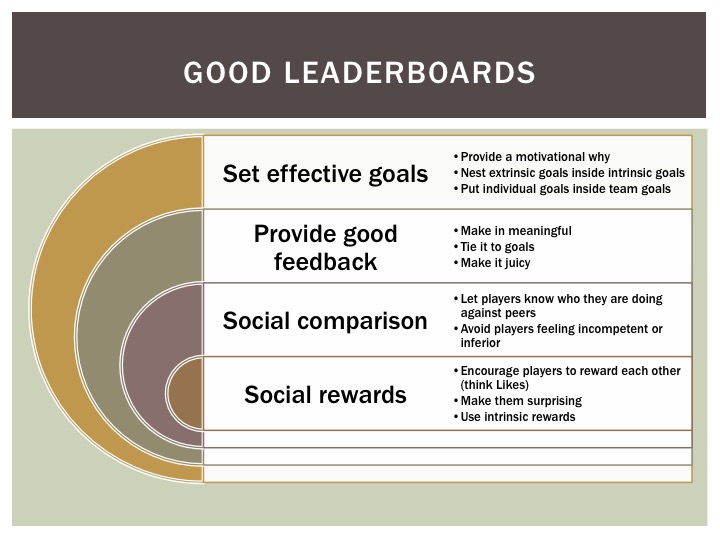
To design a leaderboard that drives behavior and incorporates the three needs above, the authors point to four “ingredients”:

Slide1

  • Goal-setting.Goal-setting involves giving or guiding a user toward a goal, and has become recommended as an effective building block for behavior change. The goal of most leaderboards implicitly is to be number one. You need to go beyond this implicit goal and guide your player toward a goal. Effective goals include having fun, learning and showing autonomy. They also recommend nesting intrinsic goals with the extrinsic goals, like making yourself a better poker player by competing on the leaderboard. Finally, an effective technique nests individual goals inside team goals, so the leaderboard is more about playing with others than being number one.

    There are also some goals you should avoid as they will prove demotivating. These goals include meaningless rewards (get more worthless points by finishing number one), emphasizing outcomes players cannot control and focusing on pride (i.e. you should win because only the smartest win).

  • Feedback. A strong feedback mechanic can promote feelings of mastery and competence. You should provide feedback for players on how they are progressing tied to the above goals they have set. The authors also suggest proving juicy feedback, “juicy feedback is varied, unexpectedly excessive sensual positive feedback on small user actions and achievements.”
  • Social comparison. Social comparison helps players understand how they are doing compared to others. Rankings are inherently a form of social comparison. The trick is doing it right because social comparison can make people feel ineffective and unrelated. People tend to compare themselves with people above them so it is easy for them to then feel incompetent.

    There are some techniques to mitigate the risks in social comparison. First, you can tell players they have achieved a standard, even if they did not finish first. Second, explain why players got the score they did and explain how they can do better. Third, give players a choice of playing more or stopping (putting them in control). Finally, acknowledge losing is not fun. If you keep players focused on improving and playing well, they are likely to stay engaged. Also, if they lose as part of a team, the impact of the loss will not be as great, thus it is critical to emphasize connections and relationships.

  • Social rewards. Just as Facebook uses the Like button, let other players reward a player for their activity. You can achieve this impact by letting them follow the player or just sending a virtual high-five. It also helps to make the rewards surprising, as predictable rewards undermine intrinsic motivation.

What to do

Rather than avoiding leaderboards, build them but build them correctly. If you employ a lazy approach and just rank players 1 to one million, the leaderboard will not work well and impact will diminish over time. If you take the time, however, to set up effective goal setting, provide good feedback, employ social comparison and have strong social rewards, you will have a winning feature and move up the AppStore leaderboard.

Key takeaways

  1. While leaderboards are a central feature in many games, for them to be effective you must build them properly or else they will be ineffective.
  2. A key to good design is keeping players from feeling incompetent or inferior.
  3. The other critical components of powerful leaderboards are clear goals, a strong feedback loop, social comparison and rewards that are social.

Share this:

  • Click to share on Facebook (Opens in new window) Facebook
  • Click to share on LinkedIn (Opens in new window) LinkedIn
Like Loading...
Unknown's avatarAuthor Lloyd MelnickPosted on June 19, 2018June 18, 2018Categories General Social Games Business, General Tech Business, Social CasinoTags Feedback, game design, goals, leaderboards3 Comments on How to build a Leaderboard that actually works and drives KPIs

Using consumer behavior to design your leveling or challenge system

I came across an interesting article on how you can learn from consumer behavior theory to build an effective leveling system, Using Psychology to Design Leveling Systems
by James Madigan
.  Although there are some holes in the analysis, it raises a very useful connection between loss aversion and leveling and challenge systems in games. Although intended for mobile and video games, the lessons are also applicable to any gamified application.

Madigan starts by reminding readers that customers react differently to gains than to losses. If a player is rewarded with one bonus of 750 chips and an additional reward of 250 chips, they would be less happier than if they got a single reward of 1,000 chips (even though rewards are the same). People like gains lumped together. However, if a player gets killed in a game and has to use 750 chips and then 250 chips to keep playing they would be happier than having to spend a lump sum of 1,000 chips to keep playing. Players prefer losses that are spread out. This concept was popularized by Richard Thaler and won him a Noble Prize in Economics.

These findings are tied to the principal of loss aversion, the fact that people dislike a loss of X more than they appreciate a gain of the same X. They will thus avoid situations where they can lose compared to ones where they can win. This situation becomes an interesting opportunity in game design, Madigan points out, because you can bundle wins and losses. Since we give losses more weight, a 100 chip loss coupled with a 300 chip gain does not feel like a 200 chip gain, it feels closer to zero since the loss is overvalued. Slot designers have known this for centuries, most slot math couples lots of small losses (each spin) with some big wins.

This concept also is very relevant in product design, you do not want to take something away from your players. If a player has worked to unlock a level or a slot machine, locking it later in the game would feel like a bigger loss than the gain from unlocking it or another level/machine.

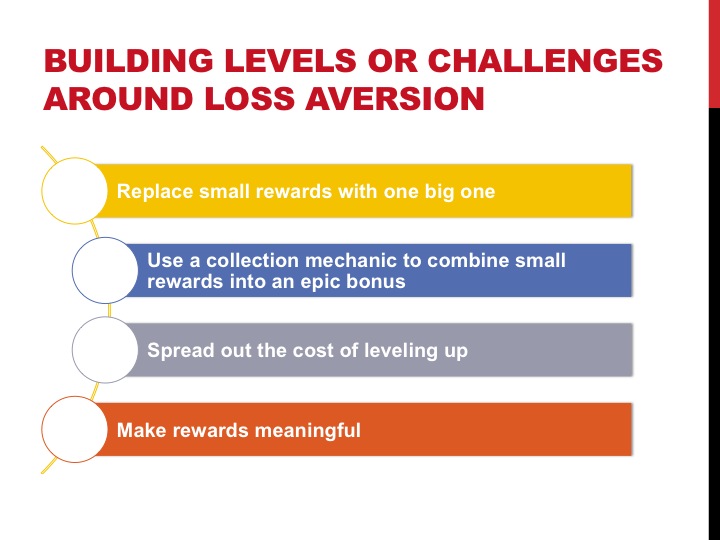
There are several key implications to optimizing your leveling system (or challenge system):

Slide1

  • Rather than give small rewards each time you level up (or complete a challenge), have them build up to one big reward. This could be by combining your leveling or challenge system with a collection mechanic, you get a piece each level and then every 10 levels can turn it in for a big reward.
  • Spread the costs of leveling up out. Rather than forcing players to win a big costly tournament or defeat an uber-boss, have the player go through multiple sinks to gain access to the big leveling reward.
  • Ensure your rewards for either leveling up or completing challenges are meaningful. Players need something big to overcome the perceived cost of the activity.

Key takeaways

  1. People, and gamers, place a higher negative value on a loss than they place a positive value on an equal gain.
  2. People prefer that their losses are spread out but their gains are large.
  3. You thus need to ensure big, meaningful rewards for leveling up or completing challenges to offset the costs (losses) of the activity. You can do this by creating a collection mechanic that leads to a large reward.

Share this:

  • Click to share on Facebook (Opens in new window) Facebook
  • Click to share on LinkedIn (Opens in new window) LinkedIn
Like Loading...
Unknown's avatarAuthor Lloyd MelnickPosted on March 27, 2018February 18, 2018Categories General Social Games BusinessTags challenges, game design, leveling, loss aversionLeave a comment on Using consumer behavior to design your leveling or challenge system

How motivation can improve the performance of social games

One of the best books I read last year was Payoff: The Hidden Logic that Shapes our Motivation by Dan Ariely and I wrote about how to apply some of Ariely’s idea to improving your team’s motivation. In addition to showing how to improve employee’s motivation, Ariely’s book also has lessons that can be applied to increasing the motivation of players to engage more with your game.

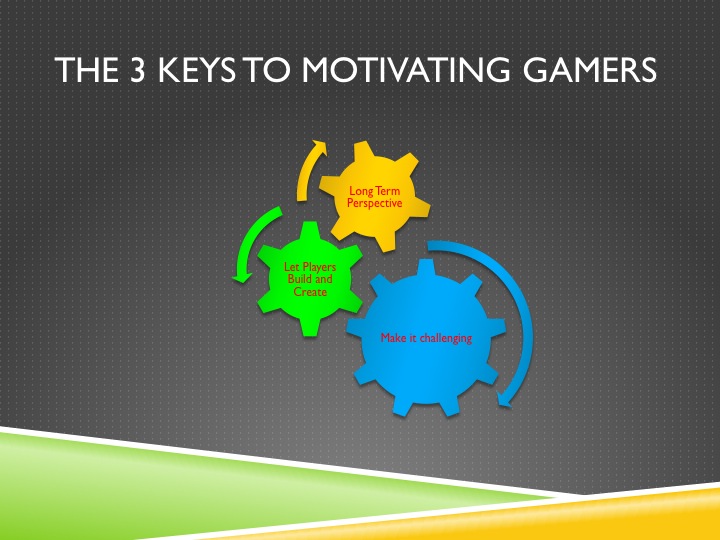
slide1

Make it challenging

The first insight is that people are often motivated to achieve things that are “difficult, challenging, and even painful.” Moreover, it they work harder and put in more effort, they enjoy a greater sense of ownership what they create and enjoy it more than if it is given to them.

Give people ownership

The second key to motivating players is to help them feel like owners of the content. In Ariely’s research, he had one group of people create origami creatures. He then offered to sell the origamis both to a group that was not involved in building them and to their creators. It turned out that the builders were willing to pay five times more for their handmade creations than the buyers were. As Ariely wrote, “our participants’ behavior clearly revealed that we are strongly motivated by identity, the need for recognition, a sense of accomplishment, and feeling of creation. “

The early invest express (invest your time and express yourself) games, such as Farmville and Hay Day, leveraged this motivation by allowing people to build their own farms. Since it was theirs, people would spend significant sums to keep and improve it. Even today, Clash of Clans and other games allow players to build their own forts or cities and this drives more engagement and monetization.

Create a long-term perspective

The final lesson from Ariely’s book is to create a long-term perspective. Rather than give people a one-time or short-term experience, players are most motivated if they have a long-term vision. Players would not bother putting a lot of energy into a short-term relationship, as Ariely writes, “whether with a romantic partner, employer, colleague, or apartment. But if you think of that relationship as a long-term investment, then you will be motivated to deposit more of your love, trust, energy, and time. This sense of investment is the basis of the marriage vow, and it is the basis of true dedication and loyalty….”

If you look at what turned social casino from a small niche part of the social game space to one of the largest is when they evolved from discrete slots experiences to a long-term meta-game where the goal was to continue unlocking content and progressing. This progression created a long-term perspective that motivates players to engage (and spend) more.

Another example would be the match-3 space. Bejeweled Blitz is a brilliant match-3 game. It is expertly designed for many exciting moments and perfect game balancing. Yet it never monetized as its creators had hoped (other than helping get the company sold to EA for about $1 billion). King entered the space with yet another match-3 game, Candy Crush Saga, but one that had a long-term goal, as you continuously wanted to progress. Candy Crush was able to transform an industry where customers were not motivated to spend to one of the most profitable in the mobile game space.

Motivation is critical

The better motivated your players, the more they will enjoy your game. The more they enjoy it, the more engaged they will be. And with engagement comes a successful product.

Key takeaways

  1. The first key to motivation is make it challenging.
  2. The second key to motivating players is to give them a sense of ownership.
  3. The final key to motivating players is give them a long-term perspective, not a one-off game play experience.

Share this:

  • Click to share on Facebook (Opens in new window) Facebook
  • Click to share on LinkedIn (Opens in new window) LinkedIn
Like Loading...
Unknown's avatarAuthor Lloyd MelnickPosted on January 11, 2017January 9, 2017Categories General Social Games Business, Social CasinoTags dan ariely, game design, motivationLeave a comment on How motivation can improve the performance of social games

Lessons from Overwatch to help you create a hit

One of the biggest hits in the gaming space this year has been Overwatch from Blizzard and there are several lessons game companies can learn from it. An article in Rolling Stone, Blizzard Reveals How to Make a Hit Game in 9 Easy Steps, highlights these lessons, though grossly underestimating the difficult in making a hit. I have been in the game industry since 1993 and have seen many companies do everything right but still fail. Actually, that is still the likely outcome with more than 80 percent of games failing but the expected value of a hit still makes it a (sometimes) profitable business.

By looking into the success of Overwatch, you can improve the odds of creating a successful game. Some of the keys that Blizzard’s team pointed to and that I agree with, with my prioritization:

  1. Ditch everything that gets in the way of players. According to Blizzard VP Jeffrey Kaplan, “Blizzard doesn’t focus on reducing game difficulty across the board. Instead, it preserves a game’s ‘core fantasy’ and gets rid of friction points: needlessly complex aspects where ‘normal’ human beings will step away from the computer in a moment of frustration, but the more-hardcore will stick around.”

    Blizzard looked at all the conventional norms of the industry and then asked the question of each, can they be reduced to make a simpler but still great experience. The key here, and one of the keys to great game (and product) design, is the more you eliminate, the better the product. This runs counter to conventional wisdom about always adding features.

  2. Appeal to new players with a subtle learning curve. Blizzard’s games take a long time to master, and any product that appeals to core players will need to so they can satisfy those hardcore players. These days, however, even the most hardcore gamers will not put up with a tutorial that lasts in the days or hours (and probably even minutes). The game industry has to face the same reality as electronics or car makers, the manual (or in this case tutorial) will not be opened or at most not read carefully.

    Rather than a long boring tutorial, Blizzard on boards players by controlling the early experience. “In most of its games, players start with a [short] tutorial, then play against the A.I. Finally, they start to battle other players, but in a very shallow pool amongst other beginners. They join the main group only after they figure out what’s going on. Even then, the learning process continues. In Overwatch, the “Kill Cam” and “Play of the Game” features showcase short videos that might prove instructive to beginners.”

    The key is for players to get immersed in the game quickly by controlling the competition, not by teaching. Thus they are already enjoying the game when they decide whether to come back (or monetize).

  3. Blow up your games and start over. A lot of your development efforts will fail, even if you are Blizzard or Supercell. Supercell “pops champagne” when a game fails. Blizzard has cancelled as many games as it has shipped. By canceling the games that were once promising but no longer have the magic they need to succeed, it allows your company to focus on the product most likely to succeed.

  4. Polish and prune as you go. One thing that I have not heard from other companies but makes ultimate sense is to polish and tweak your game throughout the development process, rather than at the end. I have seen many times how the last 20 percent is the difference between a hit and a failure. This reality is most obvious in the shooter space, where so many developers have great technology it is not a competitive advantage. It is the little features that generate hits, first shown by Duke Nukem’s unexpected rise in the market in 1996. At Blizzard, “instead of blocking out the larger elements and leaving the fine tweaks for the last stages, they pour effort into polishing each step as they go.” This is a great way to ensure you have a polished product that delights players even for your soft launch.

  5. Pick your genre. Blizzard has done a great job of focusing on a genre, allowing it to create product expertise, customer insight and brand equity. It’s titles, starting with World of Warcraft (or Diablo) and going to Overwatch, have all been markets targeting hardcore gamers. They know what these gamers want and have been able to create appealing products. This focus on a genre has allowed them to not only weather, but also thrive, during platform shifts (Hearthstone quickly established them as a leader on mobile).

    Conversely, Zynga shows what happens when you do not follow this strategy. After building a great business and deep customer knowledge of the casual female player with titles like Farmville and Fishville (and anything else ville they could think of), they tried to dominate the mid-core mobile space. Three CEOs later, they are still trying to gain a leadership position on mobile (where, not coincidentally, they are seeing their biggest success in social casino, which unsurprisingly targets an older female demographic).

Give yourself a fighting chance

I would summarize the key to great game development as eliminate, eliminate, eliminate and tweak, tweak, tweak. As I mentioned earlier, at least 80 percent of game launches fail (and I’m not talking Indie, look at King or Kabam or anyone not located in Finland). By creating a game that immerses players quickly and is not unduly complicated; and by focusing on a genre where you have expertise, you will have a chance to succeed where others fail. And, as Blizzard does, do not be afraid to kill projects and start tweaking from day one.

Key takeaways

  • The most important key to creating a successful game is eliminating elements and mechanics that are not really necessary. Less is more and good design is not adding more features.
  • You need to plan the early user journey so the player gets immersed and learns the game naturally, while having fun, rather than using a long tutorial as a crutch.
  • Be willing to kill projects quickly so you can focus on the games with the best chance of success.

overwatch

Share this:

  • Click to share on Facebook (Opens in new window) Facebook
  • Click to share on LinkedIn (Opens in new window) LinkedIn
Like Loading...
Unknown's avatarAuthor Lloyd MelnickPosted on September 21, 2016September 10, 2016Categories General Social Games Business, General Tech BusinessTags Blizzard, game design, Game development, Overwatch, social game designLeave a comment on Lessons from Overwatch to help you create a hit

You need a good game, not a feature

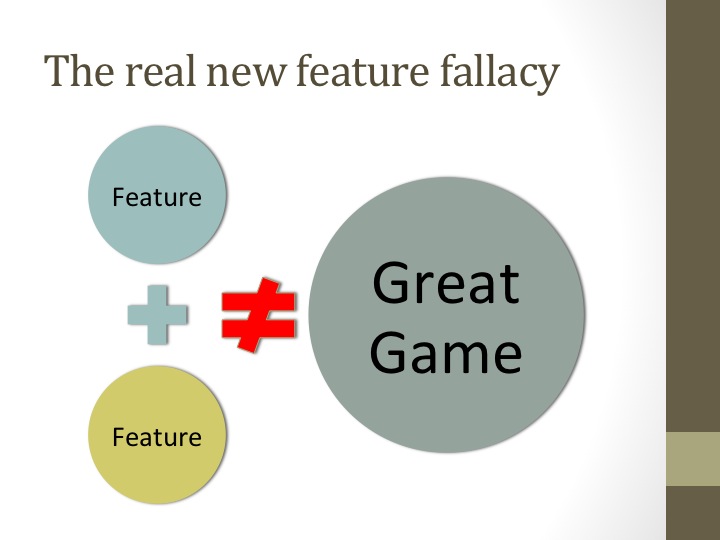
Last week, I summarized Andrew Chen’s “New Feature Fallacy,” which your new features need to touch players at the top of the funnel to improve your game. Several colleagues offered suggestion why the fallacy is a fallacy. In thinking further, the true fallacy is that any feature can fix a broken product.

Games are not a collection of features, there needs to be a core game loop that is fun. Then you can improve your LTV by building on that game loop, but if the loop does not exist there are no features that can help.

Slide1

You often see this problem in the free-to-play game space, where product management teams believe that successful products are a collection of features. Their roadmaps list each feature with the improvement in metrics it will generate. They then add up all of these improvements and come up with estimates that show how the game will generate millions of dollars. The company then invests because it wants to make millions of dollars (or investors buy shares in the company) and a year or so later they wonder why the game does not work.

Related, they look at each feature in a vacuum and AB test it. All of the features show positive improvement in metrics. The game, however, fails. A senior product who is probably the best PM I ever met once said to me it was curious how every AB test an unnamed game company we worked out had fantastic results, so good the PMs would create presentations so others in the company could copy them, yet the company’s revenue and user base continued to decline rather dramatically. Unfortunately, he was one of the few who found it “curious.” Continue reading “You need a good game, not a feature”

Like Loading...
Unknown's avatarAuthor Lloyd MelnickPosted on June 16, 2015April 5, 2021Categories General Social Games Business, Lloyd's favorite posts, Social CasinoTags core loop, feature, game design3 Comments on You need a good game, not a feature

Get my book on LTV

The definitive book on customer lifetime value, Understanding the Predictable, is now available in both print and Kindle formats on Amazon.

Understanding the Predictable delves into the world of Customer Lifetime Value (LTV), a metric that shows how much each customer is worth to your business. By understanding this metric, you can predict how changes to your product will impact the value of each customer. You will also learn how to apply this simple yet powerful method of predictive analytics to optimize your marketing and user acquisition.

For more information, click here

Follow The Business of Social Games and Casino on WordPress.com

Enter your email address to follow this blog and receive notifications of new posts by email.

Join 791 other subscribers

Most Recent Posts

  • Join me at PDMA Inspire for my talk on new product prioritization
  • Why keep studying?
  • The next three years of this blog
  • Interview with the CEO of Murka on the biggest growth opportunity in gaming, Barak David

Lloyd Melnick

This is Lloyd Melnick’s personal blog.  All views and opinions expressed on this website are mine alone and do not represent those of people, institutions or organizations that I may or may not be associated with in professional or personal capacity.

I am a serial builder of businesses (senior leadership on three exits worth over $700 million), successful in big (Disney, Stars Group/PokerStars, Zynga) and small companies (Merscom, Spooky Cool Labs) with over 20 years experience in the gaming and casino space.  Currently, I am the GM of VGW’s Chumba Casino and on the Board of Directors of Murka Games and Luckbox.

Topic Areas

  • Analytics (114)
  • Bayes' Theorem (8)
  • behavioral economics (8)
  • blue ocean strategy (14)
  • Crowdfunding (4)
  • DBA (2)
  • General Social Games Business (459)
  • General Tech Business (195)
  • Growth (88)
  • International Issues with Social Games (50)
  • Lloyd's favorite posts (101)
  • LTV (54)
  • Machine Learning (10)
  • Metaverse (1)
  • Mobile Platforms (37)
  • Prioritization (1)
  • Social Casino (52)
  • Social Games Marketing (105)
  • thinking fast and slow (5)
  • Uncategorized (33)

Social

  • View CasualGame’s profile on Facebook
  • View @lloydmelnick’s profile on Twitter
  • View lloydmelnick’s profile on LinkedIn

RSS

RSS Feed RSS - Posts

RSS Feed RSS - Comments

Categories

  • Analytics (114)
  • Bayes' Theorem (8)
  • behavioral economics (8)
  • blue ocean strategy (14)
  • Crowdfunding (4)
  • DBA (2)
  • General Social Games Business (459)
  • General Tech Business (195)
  • Growth (88)
  • International Issues with Social Games (50)
  • Lloyd's favorite posts (101)
  • LTV (54)
  • Machine Learning (10)
  • Metaverse (1)
  • Mobile Platforms (37)
  • Prioritization (1)
  • Social Casino (52)
  • Social Games Marketing (105)
  • thinking fast and slow (5)
  • Uncategorized (33)

Archives

  • September 2023
  • December 2021
  • July 2021
  • March 2021
  • February 2021
  • January 2021
  • December 2020
  • November 2020
  • October 2020
  • September 2020
  • August 2020
  • July 2020
  • June 2020
  • May 2020
  • April 2020
  • March 2020
  • February 2020
  • January 2020
  • November 2019
  • October 2019
  • September 2019
  • June 2019
  • May 2019
  • April 2019
  • March 2019
  • February 2019
  • January 2019
  • December 2018
  • June 2018
  • May 2018
  • April 2018
  • March 2018
  • February 2018
  • January 2018
  • December 2017
  • June 2017
  • May 2017
  • April 2017
  • March 2017
  • February 2017
  • January 2017
  • December 2016
  • November 2016
  • October 2016
  • September 2016
  • June 2016
  • May 2016
  • April 2016
  • March 2016
  • February 2016
  • January 2016
  • December 2015
  • November 2015
  • October 2015
  • September 2015
  • July 2015
  • June 2015
  • May 2015
  • April 2015
  • March 2015
  • February 2015
  • January 2015
  • December 2014
  • November 2014
  • October 2014
  • September 2014
  • August 2014
  • July 2014
  • June 2014
  • May 2014
  • April 2014
  • March 2014
  • February 2014
  • January 2014
  • December 2013
  • November 2013
  • October 2013
  • September 2013
  • August 2013
  • July 2013
  • June 2013
  • May 2013
  • April 2013
  • March 2013
  • February 2013
  • January 2013
  • December 2012
  • November 2012
  • October 2012
  • September 2012
  • August 2012
  • July 2012
  • June 2012
  • May 2012
  • April 2012
  • March 2012
  • February 2012
  • January 2012
  • December 2011
  • November 2011
  • October 2011
  • September 2011
  • August 2011
  • July 2011
  • June 2011
  • May 2011
  • December 2010
December 2025
S M T W T F S
 123456
78910111213
14151617181920
21222324252627
28293031  
« Sep    

by Lloyd Melnick

All posts by Lloyd Melnick unless specified otherwise
Google+

Enter your email address to subscribe to this blog and receive notifications of new posts by email.

Join 791 other subscribers
Follow Lloyd Melnick on Quora

RSS HBR Blog

  • How One Manufacturer Achieved Net Zero at Zero Cost
  • What Can U.S. Employers Do About Rising Healthcare Costs?
  • When You Have to Execute a Strategy You Disagree With
  • 4 Ways to Build Durable Relationships with Your Most Important Customers
  • What Jargon Says About Your Company Culture
  • Research: When Used Correctly, LLMs Can Unlock More Creative Ideas
  • Your New Role Requires Strategic Thinking…But You’re Stuck in the Weeds
  • For Circular Economy Innovation, Look to the Global South
  • Why Great Leaders Focus on the Details
  • Corporate Disclosure in the Age of AI

RSS Techcrunch

  • An error has occurred; the feed is probably down. Try again later.

RSS MIT Sloan Management Review Blog

  • AI Coding Tools: The Productivity Trap Most Companies Miss
  • How Procter & Gamble Uses AI to Unlock New Insights From Data
  • Rewire Organizational Knowledge With GenAI
  • Hungry for Learning: Wendy’s Will Croushorn
  • Beat Burnout: 10 Essential MIT SMR Reads
  • How Leaders Stay True to Themselves and Their Stakeholders
  • Our Guide to the Winter 2026 Issue
  • Broadening Future Perspectives at the Bank of England
  • A Faster Way to Build Future Scenarios
  • Assess What Is Certain in a Sea of Unknowns
The Business of Social Games and Casino Website Powered by WordPress.com.
  • Subscribe Subscribed
    • The Business of Social Games and Casino
    • Join 726 other subscribers
    • Already have a WordPress.com account? Log in now.
    • The Business of Social Games and Casino
    • Subscribe Subscribed
    • Sign up
    • Log in
    • Report this content
    • View site in Reader
    • Manage subscriptions
    • Collapse this bar
 

Loading Comments...
 

    %d