Skip to content

The Business of Social Games and Casino

How to succeed in the mobile game space by Lloyd Melnick

Tag: M&A

Are the glory days of social casino over? Probably!

Are the glory days of social casino over? Probably!

While revenue in the social casino space continues to increase (a streak that has not been broken since the first days of Zynga Poker and Slotomania), dark clouds on the horizon have started to dampen the enthusiasm. Most social casino companies would not publicly disclose that they are expecting growth to slow (or reverse) but unspoken indicators are bearish.

Stagnant player growth

The greatest threat to the social casino industry is that the user base is not growing. Over the past couple of years industry revenue has continued to increase but active players has remained virtually stagnant. The revenue growth has been driven by certain companies (particularly Playtika) becoming increasingly adept at growing revenue per customer, especially among their VIPs. At some point, however, social casino operators will hit a ceiling as VIPs cannot and will not spend more.

Actions show that the top companies do not believe in the space

While no social casino operator has publicly warned about the challenges they are facing, their actions speak more loudly. Playtika, the largest social casino company, acquired Seriously last month, after acquiring Wooga last year.

Huuuge Games, the biggest success story in the social casino space in the last three years, launched a publishing arm. Critically, it is focused on hypercasual and traditional social games (such as Traffic Puzzle) rather than social casino. Given how involved Huuuge is with social casino, if it expected tremendous growth it would almost certainly be focusing its efforts to further increase market share in this space.

The public markets are also talking

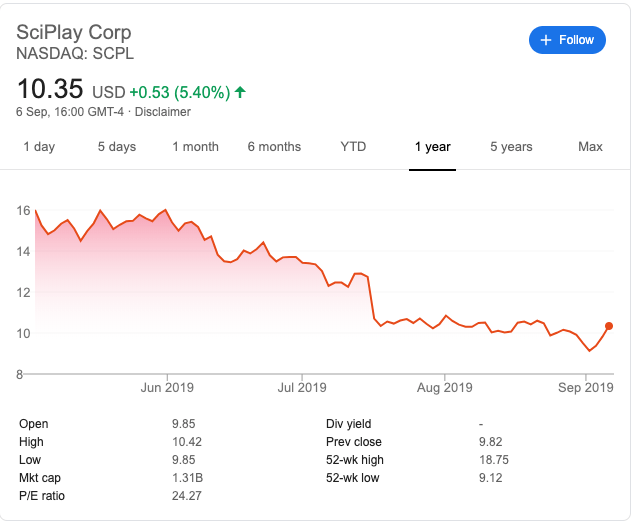
While social casino operators are showing how they look at the industry through their actions, the public markets also show how investors view the opportunities in social casino. The first pure play social casino IPO, SciPlay (the social casino operations of Scientific Gaming), has seen its share price drop from $16 when it went public in May to $10.35, losing over 30 percent of its value.
SciPlay Stock price

From 2015 to 2017, virtually every Zynga’s earnings call highlighted its social casino division. Initially, it focused on the growth of its slots products (primarily Hit It Rich!), which was largely the only bright spot for the company. Not only did it tout the success of its slots products, but the big IP licenses it was signing for future products (such as Willy Wonka). The calls then incorporated Zynga’s success with Poker, which experienced a renaissance. Very noticeably, over the last year, Zynga has downplayed or even ignored the role of social casino in its growth projections. In part, this is due to the success it has experienced with recent acquisitions (and the struggles it has experienced recently in the social casino space), but it also highlights that investors are not very receptive to initiatives in the social casino space.

Again, actions speak louder than words. While investors are not perfect (The Big Short, anyone), they are focused on optimizing return and look across a broad spectrum to find the best opportunities. The lack of appetite for social casino shows that investors no longer think social casino is easy money.

The other looming risk

Another cloud dampening the prospects for social casino is real money gaming. The US is disproportionally important for the social casino industry, it derives a much higher percentage of total revenue (over two thirds) than other areas of the video game industry (which derives over 50 percent of revenue outside the US). While there are too many factors to determine causality, the US is the only major social casino market where real money online casino is largely illegal. Thus, many customers who would normally play in a real money environment can only get their online casino experience through social casino.

Eventually, as real money casino play becomes legal in more US states, it represents an existential risk to the social casino industry. This risk is not an immediate one, legislation has to be approved on a state-by-state basis and I do not expect a significant number of states to approve legislation until 2022-2023 at the earliest (sports betting is a very different phenomenon). Investors and companies, however, do look beyond the next few years to determine their best opportunities and real money gaming is an acute part of that equation.

What social casino companies should do

First, innovate. While it sounds trite, innovation is the key to revitalizing the sector. The industry (and many other parts of the game industry) has been driven by copying what is already working, trying to do it a little better and continued optimization. They are thus relying on fewer players to generate more revenue. Coin Master is a great example of how a company can generate hundreds of millions of dollars in the social casino space by breaking the mold and creating a casino product for new customers. Finding Blue Ocean opportunities using casino mechanics can reverse the dynamics threatening the industry.

Second, embrace Real Money gaming. While Real Money is a risk, it is also potentially salvation. Land based casino companies largely resisted social casino for years (one particularly reactionary one still does) only to find that customers who also play social casino have a higher lifetime value. MGM’s relationship with Play Studios (MyVegas) has driven millions of dollars of value to MGM, displayed by MGM’s increasing its support (actions speak louder than words).

While the relationship between social and real money online has not yet been proven, the size of the opportunity should generate more attention from social casino operators. Real Money online gaming, a $54+ billion industry, dwarfs social casino. If social casino companies can learn how to capture a portion of that revenue (and player base), it can exceed greatly the growth rates of the past.

Key takeaways

    • Despite growing every year since the first social casino products launched, the industry faces significant risks. There are highlighted by recent growth driven by improved monetization of existing players rather than appealing to new customers.
    • Further corroborating this problem is how leading social casino companies are looking outside the space for acquisitions while investors are showing little interest in social casino.
    • To combat these trends, social casino companies need to look for Blue Ocean opportunities (use social casino mechanics to appeal to new customers) and leverage the roll out of real money gaming.


     

    Share this:

    • Click to share on Facebook (Opens in new window) Facebook
    • Click to share on LinkedIn (Opens in new window) LinkedIn
    Like Loading...
Unknown's avatarAuthor Lloyd MelnickPosted on September 10, 2019September 8, 2019Categories General Social Games Business, Social CasinoTags investment, M&A, playtika, sciplay, social casino1 Comment on Are the glory days of social casino over? Probably!

Lessons and insights from social casino and gaming M&A activity in Q1

Lessons and insights from social casino and gaming M&A activity in Q1

Last quarter saw some interesting deals in the gaming space. Several of the deals, and non-deals, suggest trends that are likely to continue in 2019.

Playtika acquires Wooga rather than another social casino

The most interesting deal was Playtika acquiring Wooga for ~$100MM. The thought-provoking element to me was that Playtika decided to invest outside the social casino space. In the past, acquisitions such as House of Fun, Buffalo Studios, etc., were focused on explanding Playtika’s social casino portfolio. Wooga, however, has no presence in the social casino space, instead is a casual, primarily puzzle, game developer. Playtika’s move suggests one of the following:

  1. Given the stagnant user numbers in social casino, there are better growth opportunities in other genres.
  2. Valuations in casino are too high compared with growth potential in the space.
  3. Most likely, social casino companies will continue to expand (and acquire) in casino but also are maturing to want a more robust and diversified portfolio (consistent with Aristocrat’s acquisition in 2017 of Plarium at the same time it purchased Big Fish).

Zynga spent $560+ million for one title, Empires & Puzzles

Zynga’s $560MM acquisition of 80 percent of Small Giant Games (thus valuing the company at $700MM) shows CEO Frank Gibeau’s strategy of focusing on controlling large, long-term franchises. Small Giant’s core product, Empires & Puzzles, is the 13th highest grossing title on mobile. Empires & Puzzles is Small Giant’s only game live, they are not known to have any other big projects in the pipeline (unlike Natural Motion, which had Dawn of Titans in the works when Zynga acquired it), so the acquisition is to add Empires & Puzzles to Zynga’s list of franchises.

This strategy is consistent with what Gibeau learned at EA, that franchises transform a game company from a hit driven business, with wide revenue fluctuations, to a company with sustainable and predictable growth (and thus higher valuation). He is collecting evergreen franchises to try to turn Zynga into the EA of mobile. These franchises include his purchase of Gram Games, which provided the hypercasual franchise Merge Dragons, and Harpin, which gave him Patience – Solitaire. In addition, acquiring rights to Star Wars, Harry Potter and Game of Thrones for gaming creates additional franchise opportunities. Coupled with existing Zynga franchises Zynga Poker, Words with Friends, CSR Racing and to a lesser extent Hit It Rich!, Wizard of Oz Casino Slots and Farmville, Zynga now has a stable revenue base to build on.

Epic raises $1.25BN at a valuation of $5BN-$6BN, showing the breadth and value of its business

Last October, Epic raised $1.25 billion from KKR, Kleiner Perkins, Vulcan Capital and other blue chip investors at a valuation probably well over $5 billion. What is most impressive about Epic is how it has consistently succeeded in different parts of the game industry. While companies frequently are unable to repeat successes in the gaming space or expand beyond their expertise, Epic seems to do it at ease. Fortnite is only the latest in a string of successes that I find incredibly surprising, given the challenges other companies in the game industry experience. I remember Epic when they were still a small North Carolina company, largely an indie developer. Their odds-defying achievements include (and I am probably forgetting some):

  • I first learned about Epic from a CNN story (I think 1998) about someone who created a first person shooter (FPS) in their basement that was soon to be released but getting much buzz. At the time, the FPS market was dominated by id Software (Doom) and all the other FPS were fringe products. They might have a loyal following, like Bungee’s Marathon, but nobody challenged id. I did not expect Epic to launch the top FPS but they did. Unreal turned into the biggest FPS for years, making id an afterthought.
  • With the success of Unreal, Epic decided to license its game engine (creatively branded the Unreal Engine). At the time, the game engine industry was awful. Companies like NDL (Emergent) scraped by to make payroll as no major developers were using third party engines. There was very much a not invented here mentality in the video game industry. Fast forward ten years later and Epic built a game engine company that powers many hit products and is worth hundreds of millions of dollars.
  • Most successful games are followed with…not another successful game. The video game industry is known as being hit driven and even the strongest companies have had difficulty replicating their big successes. While Epic surprised me by successfully creating a huge franchise with Unreal, it did not seem likely that they could ever replicate their success. Then they launched Gears of War in 2006 and ended up with a bigger franchise than Unreal.
  • I have written several times about the challenge of traditional gaming companies competing successfully in the free to play space, most recently Nintendo. Not only is much of what a game company learned in the traditional videogame space worthless in free to play gaming, it actually hinders the ability to create a successful F2P product. Outside of acquisition, I did not foresee a traditional company succeeding in F2P. Then Epic, which had built its business around traditional console game (Unreal, Gears, etc), launched a title you may have heard of, Fortnite, which has now generated billions of dollars. Not only did it succeed in F2P, it helped build a new F2P monetization mechanic. Yet again Epic proved me wrong.

This fundraising deal shows Epic is arguably the strongest company in the gaming sector and one that can expand its footprint into other gaming areas. Although I consider the Google/Apple duopoly over mobile gaming unshakeable, same for Steam on PC, it is hard to bet against Epic. Its ability to expand from Unreal to one of the largest core gaming companies also suggest that Fortnite will not be a one-hit wonder but we should anticipate more Epic titles dominating free to play gaming.

What Q4 means for 2019

The big deals in Q4 suggest several M&A trends I expect to see in 2019:

  1. There will be a pick-up in consolidation among social casino companies, but these companies will also look at growing in other game genres.
  2. The major game companies (all genres and all platforms) will focus acquisition efforts on acquiring franchises, not talent.
  3. Epic will continue to defy the odds

Key takeaways

  • The three most important deals in the gaming space in Q4 2018 were Zynga’s acquisition of Small Giant Games, Playtika’s acquisition of Wooga and a $1.25BN investment in Epic at a valuation of $5BN-$6BN
  • Playtika’s deal shows that social casino companies are looking outside the space to grow
  • Zynga’s deal demonstrates the value of franchises is increasing in mobile gaming

Share this:

  • Click to share on Facebook (Opens in new window) Facebook
  • Click to share on LinkedIn (Opens in new window) LinkedIn
Like Loading...
Unknown's avatarAuthor Lloyd MelnickPosted on January 15, 2019January 11, 2019Categories General Social Games Business, Social CasinoTags epic games, M&A, playtika, wooga, zynga1 Comment on Lessons and insights from social casino and gaming M&A activity in Q1

Bayes’ Theorem Part 4: Making the right decisions in corporate development

I previously wrote about how Bayes’ Rule is the foundation of good decision making and last month posted about how it could be applied to your green light process, today I will address another application of Bayes’ Rule: Applying it to corporate development (mergers and acquisitions). As discussed in my first two posts about Bayes’ Theorem, it shows how to use past data to optimize your decision making process. There are three areas of corporate development in which Bayes’ Rule can help optimize your strategy: building a company for exit, selling to the right partner and acquiring companies that improve your value.

Creating a company for exit

Many founders start and build their business for eventual exit (e.g., sale or IPO) but if they fail to take into account Bayes’ Rule they are not optimizing their chances for a successful one. If your goal in launching a business (or pivoting your business) is to sell it, then you need to look at past data. The best indicator of whether you will be able to sell—and for how much—is other M&A (mergers and acquisitions) activity. You may have a great idea for a business, and it may be unique, but if it is in a space where there is no M&A activity you are not likely to sell eventually the company (however, that is not to say you should not start it, if your goal is something other than a sale).

To show how Bayes’ Rule applies, let’s consider two opportunities. One is a building a game company in a space where 60 percent of the companies are selling to larger companies. You have a decent idea and good team but it is not great; looking objectively you have a 50 percent chance of success. Conversely, you have a fantastic idea for a different type of game company. You are convinced that in that space you have a 90 percent chance of success. Buyers, however, are not showing much activity there and only one percent of companies in that space have an exit. Bayes’ Rule shows that if your goal is an exit, then you should launch the company where you have a 50 percent chance of success (you will have a 30 percent chance of selling your company versus less than 1 percent for starting the company that is much more likely to succeed).

My personal experience reaffirms this math. At Merscom, we were a very successful casual game publisher (downloadable games targeting women sold primarily on Big Fish and Real) . There, however, was not much M&A activity in the space. So we decided to abandon a profitable, highly successful business in 2009 to enter the social gaming space because there was an acquisition almost every week. A few months after our pivot, we were acquired by Playdom, and a few months after we were acquired, Playdom was acquired by Disney.

Continue reading “Bayes’ Theorem Part 4: Making the right decisions in corporate development”

Share this:

  • Click to share on Facebook (Opens in new window) Facebook
  • Click to share on LinkedIn (Opens in new window) LinkedIn
Like Loading...
Unknown's avatarAuthor Lloyd MelnickPosted on March 4, 2014March 25, 2014Categories Bayes' Theorem, General Social Games BusinessTags Acquisition, Bayes' Theorem, corp dev, corporate development, M&ALeave a comment on Bayes’ Theorem Part 4: Making the right decisions in corporate development

When Founders And Investors Split Over An Acquisition Offer

When Founders And Investors Split Over An Acquisition Offer

Great post for any Founder or member of the Exec team of a start-up on the reality of diverging investor/entrepreneur interests. Neither side is wrong, but it’s good to understand the underlying motivations.

Share this:

  • Click to share on Facebook (Opens in new window) Facebook
  • Click to share on LinkedIn (Opens in new window) LinkedIn
Like Loading...
Unknown's avatarAuthor Lloyd MelnickPosted on February 23, 2014March 5, 2014Categories General Social Games BusinessTags Acquisition, Founders, Investors, M&A, Tornio Geron, Venture CapitalLeave a comment on When Founders And Investors Split Over An Acquisition Offer

The thrill of the deal

A few weeks ago I gave some suggestions on how to build a company for exit, but today I wanted to write a more personal entry about the emotions tied to being part of an exit. My post today is not meant to apply to everyone; as I wrote previously some will find creating a long-term profitable business very satisfying. But for me—and many of you that I know—there is no better feeling in business than the day you are part of big M&A transaction.

Image from SBNation

It is like winning the World Cup or Super Bowl or NCAA Championship (though obviously I have never been part of any of these): A combination of pure joy, relief, camaraderie and satisfaction. Continue reading “The thrill of the deal”

Share this:

  • Click to share on Facebook (Opens in new window) Facebook
  • Click to share on LinkedIn (Opens in new window) LinkedIn
Like Loading...
Unknown's avatarAuthor Lloyd MelnickPosted on August 20, 2013September 4, 2013Categories General Social Games Business, Lloyd's favorite postsTags Deals, M&A, Victory2 Comments on The thrill of the deal

How to build a company you can sell

After being part of three big exits (total value over $600 million) in three years, I am frequently asked, “What must an entrepreneur do to successfully build and sell a company?” I have one piece of advice I give—not necessarily what you would hear from an uber-VC—that I think is the key to creating and selling a business. It comes down to building a company another company needs.

Victory

Think about your customer

Just as it is crucial to understand the consumer need when creating a product, you must also understand why your company would be attractive as an acquisition target. In a competitive marketplace, you need unique selling points to gain market share. As I have previously written, your best chance of success is pursuing a blue ocean strategy;  rather than competing with everyone else (in a red ocean) you create a unique offering. In other words, rather than create another hamburger store, sell fast food hot dogs and sausages. The same can be said for building a business that will have an exit. Continue reading “How to build a company you can sell”

Share this:

  • Click to share on Facebook (Opens in new window) Facebook
  • Click to share on LinkedIn (Opens in new window) LinkedIn
Like Loading...
Unknown's avatarAuthor Lloyd MelnickPosted on August 6, 2013August 19, 2013Categories General Social Games Business, Lloyd's favorite postsTags Acquisition, customer, Exit, M&A2 Comments on How to build a company you can sell

Get my book on LTV

The definitive book on customer lifetime value, Understanding the Predictable, is now available in both print and Kindle formats on Amazon.

Understanding the Predictable delves into the world of Customer Lifetime Value (LTV), a metric that shows how much each customer is worth to your business. By understanding this metric, you can predict how changes to your product will impact the value of each customer. You will also learn how to apply this simple yet powerful method of predictive analytics to optimize your marketing and user acquisition.

For more information, click here

Follow The Business of Social Games and Casino on WordPress.com

Enter your email address to follow this blog and receive notifications of new posts by email.

Join 791 other subscribers

Most Recent Posts

  • Join me at PDMA Inspire for my talk on new product prioritization
  • Why keep studying?
  • The next three years of this blog
  • Interview with the CEO of Murka on the biggest growth opportunity in gaming, Barak David

Lloyd Melnick

This is Lloyd Melnick’s personal blog.  All views and opinions expressed on this website are mine alone and do not represent those of people, institutions or organizations that I may or may not be associated with in professional or personal capacity.

I am a serial builder of businesses (senior leadership on three exits worth over $700 million), successful in big (Disney, Stars Group/PokerStars, Zynga) and small companies (Merscom, Spooky Cool Labs) with over 20 years experience in the gaming and casino space.  Currently, I am the GM of VGW’s Chumba Casino and on the Board of Directors of Murka Games and Luckbox.

Topic Areas

  • Analytics (114)
  • Bayes' Theorem (8)
  • behavioral economics (8)
  • blue ocean strategy (14)
  • Crowdfunding (4)
  • DBA (2)
  • General Social Games Business (459)
  • General Tech Business (195)
  • Growth (88)
  • International Issues with Social Games (50)
  • Lloyd's favorite posts (101)
  • LTV (54)
  • Machine Learning (10)
  • Metaverse (1)
  • Mobile Platforms (37)
  • Prioritization (1)
  • Social Casino (52)
  • Social Games Marketing (105)
  • thinking fast and slow (5)
  • Uncategorized (33)

Social

  • View CasualGame’s profile on Facebook
  • View @lloydmelnick’s profile on Twitter
  • View lloydmelnick’s profile on LinkedIn

RSS

RSS Feed RSS - Posts

RSS Feed RSS - Comments

Categories

  • Analytics (114)
  • Bayes' Theorem (8)
  • behavioral economics (8)
  • blue ocean strategy (14)
  • Crowdfunding (4)
  • DBA (2)
  • General Social Games Business (459)
  • General Tech Business (195)
  • Growth (88)
  • International Issues with Social Games (50)
  • Lloyd's favorite posts (101)
  • LTV (54)
  • Machine Learning (10)
  • Metaverse (1)
  • Mobile Platforms (37)
  • Prioritization (1)
  • Social Casino (52)
  • Social Games Marketing (105)
  • thinking fast and slow (5)
  • Uncategorized (33)

Archives

  • September 2023
  • December 2021
  • July 2021
  • March 2021
  • February 2021
  • January 2021
  • December 2020
  • November 2020
  • October 2020
  • September 2020
  • August 2020
  • July 2020
  • June 2020
  • May 2020
  • April 2020
  • March 2020
  • February 2020
  • January 2020
  • November 2019
  • October 2019
  • September 2019
  • June 2019
  • May 2019
  • April 2019
  • March 2019
  • February 2019
  • January 2019
  • December 2018
  • June 2018
  • May 2018
  • April 2018
  • March 2018
  • February 2018
  • January 2018
  • December 2017
  • June 2017
  • May 2017
  • April 2017
  • March 2017
  • February 2017
  • January 2017
  • December 2016
  • November 2016
  • October 2016
  • September 2016
  • June 2016
  • May 2016
  • April 2016
  • March 2016
  • February 2016
  • January 2016
  • December 2015
  • November 2015
  • October 2015
  • September 2015
  • July 2015
  • June 2015
  • May 2015
  • April 2015
  • March 2015
  • February 2015
  • January 2015
  • December 2014
  • November 2014
  • October 2014
  • September 2014
  • August 2014
  • July 2014
  • June 2014
  • May 2014
  • April 2014
  • March 2014
  • February 2014
  • January 2014
  • December 2013
  • November 2013
  • October 2013
  • September 2013
  • August 2013
  • July 2013
  • June 2013
  • May 2013
  • April 2013
  • March 2013
  • February 2013
  • January 2013
  • December 2012
  • November 2012
  • October 2012
  • September 2012
  • August 2012
  • July 2012
  • June 2012
  • May 2012
  • April 2012
  • March 2012
  • February 2012
  • January 2012
  • December 2011
  • November 2011
  • October 2011
  • September 2011
  • August 2011
  • July 2011
  • June 2011
  • May 2011
  • December 2010
December 2025
S M T W T F S
 123456
78910111213
14151617181920
21222324252627
28293031  
« Sep    

by Lloyd Melnick

All posts by Lloyd Melnick unless specified otherwise
Google+

Enter your email address to subscribe to this blog and receive notifications of new posts by email.

Join 791 other subscribers
Follow Lloyd Melnick on Quora

RSS HBR Blog

  • The Most Popular HBR Podcast Episodes of 2025
  • How the Best Leaders Develop and Spend “Innovation Capital”
  • The 10 Most Popular HBR Articles of 2025
  • How Work Changed in 2025, According to HBR Readers
  • What Leaders Can Learn from a Formula 1 Turnaround
  • Climate Rising: Extending Apparel Lifespan with ThredUp
  • Bring Your Extended Leadership Team into Strategy Decisions
  • 15 Reasons to Be Optimistic About Globalization
  • How a French Spirits Company Created Employee Buy-In for AI
  • AI Is Changing How We Learn at Work

RSS Techcrunch

  • An error has occurred; the feed is probably down. Try again later.

RSS MIT Sloan Management Review Blog

  • Three Steps Toward Fairer Talent Management
  • From Crisis to Coopetition: What Leaders Can Learn From Anesthesiologists
  • AI Coding Tools: The Productivity Trap Most Companies Miss
  • How Procter & Gamble Uses AI to Unlock New Insights From Data
  • Rewire Organizational Knowledge With GenAI
  • Hungry for Learning: Wendy’s Will Croushorn
  • Beat Burnout: 10 Essential MIT SMR Reads
  • How Leaders Stay True to Themselves and Their Stakeholders
  • Our Guide to the Winter 2026 Issue
  • Broadening Future Perspectives at the Bank of England
The Business of Social Games and Casino Website Powered by WordPress.com.
  • Subscribe Subscribed
    • The Business of Social Games and Casino
    • Join 726 other subscribers
    • Already have a WordPress.com account? Log in now.
    • The Business of Social Games and Casino
    • Subscribe Subscribed
    • Sign up
    • Log in
    • Report this content
    • View site in Reader
    • Manage subscriptions
    • Collapse this bar
 

Loading Comments...
 

    %d