Skip to content

The Business of Social Games and Casino

How to succeed in the mobile game space by Lloyd Melnick

Tag: micro-segmentation

NOT predictions for 2018

This time of year always makes me chuckle at the arrogance of some but more the desire of others to accept proclamations of what the new year will bring. I am not a big fan of predictions. First, regardless of experts’ success or intelligence, there are too many variables to predict accurately what will happen in 2018. As much as I respect Bill Gates, Warren Buffett, Mary Meeker, etc., they cannot predict the future. If they could, they would even be wealthier (who has not played the mental game of what you would invest in if you could go back in time five years). It’s the same underlying reason why the best and brightest mutual fund managers cannot regularly beat the market indexes they are targeting.

Second, and a little more sinister, most people who claim to predict what will happen in 2018 are little more than fortune tellers you would meet at a State Fair (or social gaming conference). The predictions are generally broad enough that regardless of what happens next year they will be able to pull some “victories” from their predictions. It may be things as simple as bitcoin will have a volatile 2018 to there will be at least one major acquisition in the video gaming space; these are either broad enough that you can always claim victory or predictable by anyone who looks at the past trends. The point is, they are not providing any information that is actionable unless they get lucky. Again, if they were so visionary, they would act on it rather than talk about it.

So with that said, it is time for my predictions. Seriously, rather than predictions, I do feel it is helpful to look at trends that have gained momentum in 2017 and are likely to have a disproportionate impact in 2018.

The convergence of micro-segmentation, AI and machine learning to create extreme personalization

The most important trend that is gaining momentum is personalization. Various related technologies are allowing game and technology companies to optimize experiences for every individual. From Amazon showing you products you are most interested in to Supercell pairing you with a player whose gameplay style best complements yours, everyone will have an experience personal to them in ecommerce, gaming and pretty much anywhere in 2018.

Microsegmentation

Three related technologies are driving this personalization: micro-segmentation, artificial intelligence and machine learning. Micro-segmentation allows companies to create hundreds or thousands of different clusters of customers and then provides the best experience for each of these segments. One segment may be players who have monetized 3-6 months ago and continue to play but not spend and are more open to free offers than sales; micro-segmentation will help create offers to optimize their experience and make them more likely to spend. Another segment might also have spent at some time 3-6 months ago and remain active but these players are more likely to spend if encouraged to play at higher stakes. Micro-segmentation allows companies to create the best path for each player.

Machine learning allows for more and better micro-segmentation, as it automatically creates hundreds, thousands or millions of segments. And artificial intelligence then determines what to offer each micro-segment.

The key takeaway is that customers will get very personal experiences on the successful sites, apps and games in 2018. They will then come to expect experiences and offers tailored to their needs, directing their money to those that deliver.

Voice recognition

I wrote in 2016 about the increasing importance of voice recognitionand this is likely to accelerate in 2018. Providing directions verbally is much more natural and simpler than having to type them. While the technology is still largely a novelty, everyone uses Alexa or Siri but primarily to listen to music or set a timer, in 2018 voice recognition will become more integrated on how you use/consume technology. In particular, I see it becoming a central part of the social/mobile game user interface, it will be much easier to play a game by speaking to it rather than typing or navigating with a mouse.

Big change in social casino

I have been in the social casino space (online free to play slot, poker, etc) for almost five years and have seen it mature and continue to grow revenue but it is still largely the same as it was in 2012. The interface, gameplay mechanics even art have changed very little. Companies have gotten better at monetizing their players but the games have not evolved. Even land-based casinos look more different now than they did five years ago than social casinos do.

While I do not expect an entirely new gaming mechanic to surface, one or two companies will innovate and create a very different product that not only steals existing market share but also brings new customers into the market. There is enough money in social casino that new entrants will try to innovate to build a competitive position and the company(ies) that is able to create a new market space will be the next Playtika.

Devices and platforms will become less important

When I first entered the game space, one of the biggest determinants of success was anticipating what platforms (Playstation, X-box, DS, etc.) would become big, getting on them early and not getting tied to a dying platform. Platforms (iOS, Android, Kindle, etc.), however, are becoming increasingly less important. Tools and underlying technology are allowing the best content to be used regardless of device. This trend should accelerate and companies that spend the bulk of their time trying to optimize for the next big thing will lose out to companies looking to create the next great content.

Privacy

I am one of those people who never really cares about privacy settings, have not read a Terms & Conditions in my life before clicking continue, and never worry about sharing my personal information. I am, however, in the minority. More and more people are concerned about privacy and products that either ignore this fact or try to trick customers and players into sharing information they do not want to share will fail in 2018. Successful products will empower customers to share the information they want to share, which will be different by individual (see first point on personalization). This is also the area where Blockchain can have the greatest impact, even more so than the crypto-currency space.

Dual devices

Not a 2018 trend (or even a 2015 trend) but more of a 2018 fact of life. People virtually never use only one screen. It is not only using your phone or tablet while watching television. It is using your phone while on your tablet. Using your tablet while on your work computer. Watching television while on your phone. Giving Alexa directions while watching television. You get the idea.

Your games and applications need to be sensitive both to people not focusing 100 percent and also provide a good experience as the second device your customer is focused on using. You also need to understand the different use cases and allow people to consume your product in different cases, whether they are also watching TV or working on their computer.

Big players will enter free to play, and fail

Remember how I said the hallmark of a good fortune teller is to include in their predictions something that definitely will happen (ie. there will be a lot of vitriol on Facebook about politics), here is my prediction that will come true in 2018. At least one major multi-billion company not currently in free to play will enter the space either through a new venture or acquisition because it just seems so easy to make money selling virtual goods; and they will fail miserably. It’s happened every year since social gaming took off and will probably happen for the next ten years.

Other trends

I would love to know what trends you are seeing and how they will help shape 2018. Let me know your thoughts on what we will be writing about this time next year.

Key Takeaways

  1. Personalization will dominate 2018. Successful games, sites and retailers will provide a hyper-personal experience to all customers with a combination of machine learning, artificial intelligence and micro-segmentation.
  2. Voice recognition will go from the domain of Alexa and Siri to become a primary and powerful user interface for people playing games, shopping or doing virtually anything.
  3. The social casino space will experience a disruptive product that not only takes significant existing market share but brings new customers to the market.
Share this:

  • Click to share on Facebook (Opens in new window) Facebook
  • Click to share on LinkedIn (Opens in new window) LinkedIn
Like Loading...
Unknown's avatarAuthor Lloyd MelnickPosted on January 2, 2018December 30, 2017Categories General Social Games Business, General Tech Business, Machine Learning, Social CasinoTags alexa, artificial intelligence, Blockchain, Machine learning, micro-segmentation, privacy, social casino, Voice recognitionLeave a comment on NOT predictions for 2018

Why data is more important than hair: The Donald Trump story

There is a great article on Politico, How Trump Let Himself Get Out-Organized, that explains how Trump’s Iowa debacle was a result of a failed analytics strategy. Trump made the same mistake many companies commit, he felt a strong brand and what he believe compelling product allowed him to under-invest in analytics. This issue was compounded by the aggressive use of analytics by competitors. Although this occurred in the political arena, there are lessons for all businesses.

The article explains that despite Trump’s strength in the polls, he did not have “the tools they needed, which is why they overpromised and underperformed.”

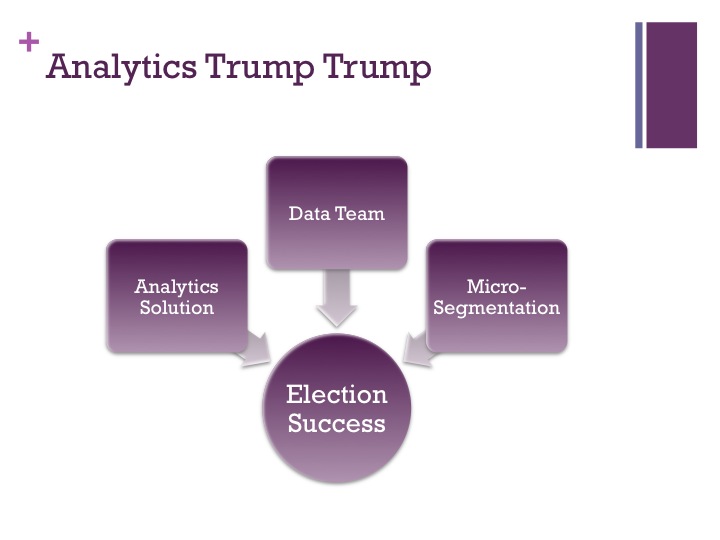
Slide1

Penny wise and pound foolish

While Ted Cruz and Marco Rubio spent millions building sophisticated voter targeting machines, Trump did not start building a data operation to target voters until mid-October. It did not even start buying data (i.e. voter lists, etc) until November and waited to December to start using the Republican National Committee’s (RNC’s) voter file.

The Trump campaign declined to use Cambridge Analytica, a behavioral modeling company with political expertise, due to cost. Cruz, however, retained Cambridge Analytica’s services and the firm is now widely credited with engineering Cruz’s cutting-edge targeting operation. Rubio, who also over delivered on expectations, spent $750,000 for an outside company to assist in its data operations. Trump overall spent $560,000 on data services in 2015, compared to $3.6 million by the Cruz campaign. It is also about $700,000 less than Trump spent on hats.

You also need the analytics team

The Iowa caucas also showed the value of having a strong analytics team, not simply software. Cruz’s data team, which they call the Oorlog (the Afrikaner word for ‘war’) project, includes four full-time data scientists and embedded talent from Cambridge Analytics.

The Rubio campaign, which also exceeded expectations, has also invested heavily in its analytics team. It has a 22-person data war room in DC.

The Cruz campaign also hired ten canvassers (and recruited many volunteers) to go door-to-door to contact people the analytics suggested were supportive or could be persuaded. Traditionally, these so-called match rate initiatives are 50 percent successful but with Cruz’s advanced analytics the success rate reached 70 percent. The Cruz campaign also used the voter profiles to shape its strategies for most marketing activities, from television ad buys to telephone banks.

Micro-segmentation

Micro-segmentation, or creating very small customer segments and treating them uniquely, is another area where Trump fell down compared to Cruz. As Politico wrote, the Cruz campaign, “built a list of more than 9,000 Iowans who were still on the fence between their candidate and Trump. The team divided the undecided voters ― who were heavily evangelical and 91 percent male ― into more than 150 different subgroups based off ideology, religion and personality type, Wilson said. It used Facebook experiments to determine which issues jazzed up their voters the most.”

The lesson

No matter how strong you feel your product is, or how well it has performed in the past, you are vulnerable to competitors who may have a superior analytics solution. To combat this risk, you not only need to match the investment your competitor’s are making in analytics and look at micro-segmentation but also build a world class data team.

Key Takeaways

  • Donald Trump’s loss to Ted Cruz in Iowa can be attributed to Cruz’s superior use of analytics to build a competitive advantage.
  • Cruz invested much more in both analytic products and a great data team and it helped him get pro-Cruz people to caucus.
  • Cruz also did a great job of micro-segmenting potential voters into more than 150 different subgroups based off ideology, religion and personality type and used Facebook experiments to determine which issues were most relevant for each subgroup.

Share this:

  • Click to share on Facebook (Opens in new window) Facebook
  • Click to share on LinkedIn (Opens in new window) LinkedIn
Like Loading...
Unknown's avatarAuthor Lloyd MelnickPosted on February 3, 2016Categories Analytics, General Social Games Business, General Tech Business, UncategorizedTags analytics, data, Donald Trump, iowa, micro-segmentation, politico, Ted Cruz1 Comment on Why data is more important than hair: The Donald Trump story

Get my book on LTV

The definitive book on customer lifetime value, Understanding the Predictable, is now available in both print and Kindle formats on Amazon.

Understanding the Predictable delves into the world of Customer Lifetime Value (LTV), a metric that shows how much each customer is worth to your business. By understanding this metric, you can predict how changes to your product will impact the value of each customer. You will also learn how to apply this simple yet powerful method of predictive analytics to optimize your marketing and user acquisition.

For more information, click here

Follow The Business of Social Games and Casino on WordPress.com

Enter your email address to follow this blog and receive notifications of new posts by email.

Join 791 other subscribers

Most Recent Posts

  • Join me at PDMA Inspire for my talk on new product prioritization
  • Why keep studying?
  • The next three years of this blog
  • Interview with the CEO of Murka on the biggest growth opportunity in gaming, Barak David

Lloyd Melnick

This is Lloyd Melnick’s personal blog.  All views and opinions expressed on this website are mine alone and do not represent those of people, institutions or organizations that I may or may not be associated with in professional or personal capacity.

I am a serial builder of businesses (senior leadership on three exits worth over $700 million), successful in big (Disney, Stars Group/PokerStars, Zynga) and small companies (Merscom, Spooky Cool Labs) with over 20 years experience in the gaming and casino space.  Currently, I am the GM of VGW’s Chumba Casino and on the Board of Directors of Murka Games and Luckbox.

Topic Areas

  • Analytics (114)
  • Bayes' Theorem (8)
  • behavioral economics (8)
  • blue ocean strategy (14)
  • Crowdfunding (4)
  • DBA (2)
  • General Social Games Business (459)
  • General Tech Business (195)
  • Growth (88)
  • International Issues with Social Games (50)
  • Lloyd's favorite posts (101)
  • LTV (54)
  • Machine Learning (10)
  • Metaverse (1)
  • Mobile Platforms (37)
  • Prioritization (1)
  • Social Casino (52)
  • Social Games Marketing (105)
  • thinking fast and slow (5)
  • Uncategorized (33)

Social

  • View CasualGame’s profile on Facebook
  • View @lloydmelnick’s profile on Twitter
  • View lloydmelnick’s profile on LinkedIn

RSS

RSS Feed RSS - Posts

RSS Feed RSS - Comments

Categories

  • Analytics (114)
  • Bayes' Theorem (8)
  • behavioral economics (8)
  • blue ocean strategy (14)
  • Crowdfunding (4)
  • DBA (2)
  • General Social Games Business (459)
  • General Tech Business (195)
  • Growth (88)
  • International Issues with Social Games (50)
  • Lloyd's favorite posts (101)
  • LTV (54)
  • Machine Learning (10)
  • Metaverse (1)
  • Mobile Platforms (37)
  • Prioritization (1)
  • Social Casino (52)
  • Social Games Marketing (105)
  • thinking fast and slow (5)
  • Uncategorized (33)

Archives

  • September 2023
  • December 2021
  • July 2021
  • March 2021
  • February 2021
  • January 2021
  • December 2020
  • November 2020
  • October 2020
  • September 2020
  • August 2020
  • July 2020
  • June 2020
  • May 2020
  • April 2020
  • March 2020
  • February 2020
  • January 2020
  • November 2019
  • October 2019
  • September 2019
  • June 2019
  • May 2019
  • April 2019
  • March 2019
  • February 2019
  • January 2019
  • December 2018
  • June 2018
  • May 2018
  • April 2018
  • March 2018
  • February 2018
  • January 2018
  • December 2017
  • June 2017
  • May 2017
  • April 2017
  • March 2017
  • February 2017
  • January 2017
  • December 2016
  • November 2016
  • October 2016
  • September 2016
  • June 2016
  • May 2016
  • April 2016
  • March 2016
  • February 2016
  • January 2016
  • December 2015
  • November 2015
  • October 2015
  • September 2015
  • July 2015
  • June 2015
  • May 2015
  • April 2015
  • March 2015
  • February 2015
  • January 2015
  • December 2014
  • November 2014
  • October 2014
  • September 2014
  • August 2014
  • July 2014
  • June 2014
  • May 2014
  • April 2014
  • March 2014
  • February 2014
  • January 2014
  • December 2013
  • November 2013
  • October 2013
  • September 2013
  • August 2013
  • July 2013
  • June 2013
  • May 2013
  • April 2013
  • March 2013
  • February 2013
  • January 2013
  • December 2012
  • November 2012
  • October 2012
  • September 2012
  • August 2012
  • July 2012
  • June 2012
  • May 2012
  • April 2012
  • March 2012
  • February 2012
  • January 2012
  • December 2011
  • November 2011
  • October 2011
  • September 2011
  • August 2011
  • July 2011
  • June 2011
  • May 2011
  • December 2010
December 2025
S M T W T F S
 123456
78910111213
14151617181920
21222324252627
28293031  
« Sep    

by Lloyd Melnick

All posts by Lloyd Melnick unless specified otherwise
Google+

Enter your email address to subscribe to this blog and receive notifications of new posts by email.

Join 791 other subscribers
Follow Lloyd Melnick on Quora

RSS HBR Blog

  • When You’ve Stopped Growing with Your Executive Coach
  • Research: LLMs Respond Differently in English and Chinese
  • Bring More Discipline to Your Decision-Making
  • 5 Ways Organizations Can Pivot with Purpose
  • Your AI Strategy Needs to Expand Beyond the U.S. and China
  • Most Employees Don’t Trust Their Leaders. Here’s What to Do About It.
  • Could Your Company Benefit from Fastvertising?
  • Why Your Company Needs a Chief Data, Analytics, and AI Officer
  • Do I Really Want to Be CEO?
  • What’s Lost When We Work with AI, According to Neuroscience

RSS Techcrunch

  • An error has occurred; the feed is probably down. Try again later.

RSS MIT Sloan Management Review Blog

  • How Nesting Changes Platform Strategy
  • Ask Sanyin: Why Is It So Hard to Pull the Plug on a Project?
  • Resilience Means Fewer Recoveries, Not Faster Ones
  • What Retailers Must Get Right This Holiday Season
  • Are You an Authentic Leader or an Authentic Jerk?
  • Creating More, Not Less, With AI: GeekWire’s Todd Bishop
  • Negotiation Skills: How to Beat Anxiety and Boost Results
  • How Grocery Retail Innovations Change Customer Behavior
  • Scaling GenAI: Get Big Value From Smaller Efforts
  • Effective Allies Don’t Just Offer Support — They Change Systems
The Business of Social Games and Casino Website Powered by WordPress.com.
  • Subscribe Subscribed
    • The Business of Social Games and Casino
    • Join 726 other subscribers
    • Already have a WordPress.com account? Log in now.
    • The Business of Social Games and Casino
    • Subscribe Subscribed
    • Sign up
    • Log in
    • Report this content
    • View site in Reader
    • Manage subscriptions
    • Collapse this bar
 

Loading Comments...
 

    %d