Skip to content

The Business of Social Games and Casino

How to succeed in the mobile game space by Lloyd Melnick

Tag: neuromarketing

Ways to improve your game (or product) using neuroscience

Ways to improve your game (or product) using neuroscience

Earlier this year, I wrote a post that highlighted ways behavioral economics could be applied to gaming, and I recently read a book that provided additional opportunities by layering on neuromarketing. I read Brainfluence: 100 Ways to Persuade and Convince Customers with Neuromarketing by Roger Dooley and while not the perfect book (it was more a collection of articles and many were not truly neuromarketing) it did provide some strong tidbits that you can use to optimize your product.
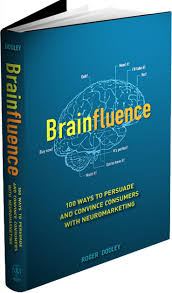
Brainfluence

Neuromarketing is the science of studying the brain to predict consumer behavior and decision making in different situations. Neuromarketing includes the direct use of brain imaging, scanning, or other brain activity measurement technology to measure a subject’s response to specific products, packaging, advertising, or other marketing elements. Researchers use these tools to measure changes in activity in parts of the brain and to learn why consumers make decisions.

Based on this science, Dooley shows multiple applications not only for marketing but product design.

Neuroscience can help with your pricing strategy

Neuromarketing is particularly powerful in driving pricing strategy. Successful pricing strategy minimizes the pain caused in your customer’s brain while amplifying the pleasure. There are many areas of pricing where you should apply a strategy that minimizes this pain:

  • Dooley shows that absolute cost (a high price) is not the only variable that causes pain. Instead, it is the perceived fairness or unfairness of the deal that creates the reaction. Noble Prize winning behavioral economist, Richard Thaler, showed that thirsty beachgoers would pay nearly twice as much for a beer from a resort hotel than for the same beer from a rundown grocery store.Thus, the price you charge must be perceived as fair. If it is more expensive than competitors, explain why it is a premium product.
  • People do not weigh the current gratification versus future gratifications. Instead, they experience an immediate pang of pain when they think about the cost of an item (whether virtual or real). Dooley asks, “[w]hy do people love to prepay for things or pay a flat rate for things? Again, it mutes the pang of pain.”Thus, to minimize this pain you do not want to constantly be asking your customers to make purchases. According to Dooley, [t]he worst-case alternative is when you pay for sushi and you’re paying per piece. Or watching the taxi meter; you know how much every inch of the way is costing you….Selling products in a way that the consumer sees the price increase with every bit of consumption causes the most pain…. Avoid “drip-drip-drip” pricing structures that punish the buyer every time she does something.”
  • Another way to reduce the pain caused by a purchase decision is moving the cost to the future and breaking it into smaller bits. A credit card reduces the pain level by transferring the cost to a future period where it can be paid in small increments. Dooley writes, “not only does a credit card enable a consumer to buy something without actually having the cash, but it also tips the scale as one’s brain weighs the pain versus the benefit of the purchase.”
  • Bundling is another strategy to lower the pain that purchases cause for consumers. Cost is relative, it is not simply the cash value but it is the context around the deal. People can spend hundreds of dollars on accessories when buying a car with little pain, but a vending machine that takes 75 cents and produces nothing is very aggravating.Auto luxury bundles minimize negative activation because their price tag covers multiple items. The consumer cannot relate a specific price to each component in the bundle (cruise control, power steering, metallic paint, etc.) and thus the customer’s equation will change in determining if it is a fair deal or whether each item is worth the price to them.
  • According to Dooley, “if you find yourself in a situation where, for cost or other reasons, the price of a product is likely to produce an “ouch!” reaction from your customers, see if some kind of a bundle with complementary items will dull the pain.”
  • Another area of pricing strategy relevant to gaming is priming. Priming occurs whenever exposure to one thing can subsequently alter behavior or thoughts. Research conducted by my favorite behavioral economist, Dan Ariely, showed that by getting subjects to think of a random number, in this study it was the last two digits of their Social Security number, the price they were willing to pay was impacted by that random number. A higher random number led to higher prices. Thus associating the price of an item with a high number would make the virtual good or item you are selling appear cheaper.
  • Another application of neuromarketing to pricing is by offering huge potential reward for a purchase. According to Dooley, a “Stanford University study shows that big potential rewards produce big responses, even if they are unlikely outcomes. In other words, our brain is very responsive to the size of the reward and far less sensitive to the probability of actually receiving that reward.The clear message is that it’s the magnitude of the grand prize that is the most important factor in a giveaway. When choosing a topline prize, think big—even if the odds are lower, people will respond better if there are more zeros at the end of the number. Here are a few ways to maximize the prize value: Concentrate the prize budget on one prize. Use a play-off system or other approach to permit a huge prize with tightly controlled probability of awarding it.”
  • Pricing not only impacts monetization but customer satisfaction. A higher price frequently assists customers in percieving a product as being higher quality. According to Dooley, studies found that “wine thought to be more expensive really does taste better at the most fundamental level of perception. The important aspect of these findings is that people aren’t fibbing on a survey; that is, they aren’t reporting that a wine tastes better because they know it’s more expensive and they don’t want to look dumb. Rather, they are actually experiencing a tastier wine.”

Creating trust

In many businesses, including iGaming, building trust is critical. Neuroscience points to several techniques that can help create this bond with your customers.

The first is reciprocity. Dooley writes, “[w]ant your customers to trust you? Show that you trust them! The concept revolves around that seemingly magical neurochemical oxytocin, which is a key factor in forming trust relationships.”

You also need to stress that you are trustful. According to Dooley, “[r]esearchers found that placing the following statement at the end of an ad for an auto service firm caused their trust scores to jump as much as 33 percent! — ‘You can trust us to do the job for you.’”

Neuroscience research also showed listening to customers directly increased their perceived trust. The customer needs to believe his or her concerns are being heard, and you can accomplish this not only face to face (which is impractical for customers of most games or apps) but with phone calls or web chats.

Building this trust also insulates your business. Almost every customer relationship is tested some time. For customers and players to not only work through the issue but still promote your company, you must invest the time in cultivating the relationship before that relationship is put to the test.

Asking your customers what they want is counter-productive

Dooley begins by showing how neuroscience confirms the challenges with market research. I have written about The Risks of Market Research and better research options, and Dooley explains that neuroscience investigation has shown that 95 percent of our thoughts, emotions, and learning occur without our conscious awareness. Given that customers do not know why they make choices 95 percent of the time, research efforts asking them questions are doomed. Dooley writes, “although there are conscious and rational parts in most decisions, marketers need to focus first on appealing to the buyer’s emotions and unconscious needs.”

Neuromarketing to build a loyalty program

I have always been a big advocate of loyalty programs, having started two at game companies that both vastly exceeded expectations, and Dooley shows how neuromarketing can also help improve the performance of these programs. Dooley points to several factors needed for an effective program:

  • The underlying product or service must be at least comparable to the competition
  • Neuroscience also points to the need to show people progress. The mere illusion of progress caused people to buy coffee more frequently. In one study, the group that started with apparent progress on their card bought coffee more frequently than the empty-card group. When building your program, you should not only allow players to progress to better tiers but also give them a head start on their first goal.
  • The rewards offered must be attractive to the consumer.
  • Brand preferences and other factors may undermine loyalty programs. “Switching costs” may increase loyalty to the current brand and reduce the impact of competing loyalty programs.
  • Purchase frequency must be high enough to keep customers engaged.

Neuromarketing research shows that even when the value of loyalty points is less than the value of a real-money price difference, the consumers are often persuaded by the loyalty points (this fact is reflected in airline frequent flier programs valued at more than the underlying airlines).

Brands Matter

Another key learning from neuromarketing is that brands matter. As marketing, especially in the gaming industry, focuses on performance marketing (advertising where you pay based on a customer’s specific action, such as downloading your game), opportunities with brand marketing are often neglected. Dooley, however, presents data that branding does have a strong impact on customer’s perception of your game. If your customer believes a product is better, it will be better.

He shows that a lack of action or even attention does not mean an ad has no impact. The presence of familiar things, even if the customer (or potential customer) is unaware of the exposure, makes them feel better when they see or play the product. Dooley writes, “the key point for marketers is to keep your brand visible even when people don’t seem to be paying attention.”

Additionally, branding increases the social value of your product, both generating more usage and more referrals. According to Dooley, “[i]n neuromarketing terms, our brains are hardwired to want to be in one or more groups. Brands that can be positioned to put their customers into a group will find that their efforts will be enhanced by their customers’ own need to belong…. [Neuroscience experiments] led to the theory of social identity, which states that people have an inherent tendency to categorize themselves into groups.”

Branding that drives social identity then drives passion. Passion brands are those with which consumers form an emotional attachment and recommend enthusiastically to their friends. Your customers can sense the passion of your people, even if they don’t process it consciously.

Neuroscience also shows that branding should not be confined to one sense, ie. the written word, but should appeal to as many senses as possible. Research cited shows that brands that appeal to multiple senses will be more successful than brands that focus on only one or two. While it is hard for a gaming product (or any app) to appeal to all five senses, by thinking in multiple sense you can create stronger branding. For example, you may want to associate songs or sounds with your product. Dooley writes, “consistency is the key in building the sensory aspects of your brand. Consistent use is the key to effective audio branding. Constant repetition breeds familiarity, whether it is a cell phone chirp or a variation on Rhapsody in Blue.”

Use neuromarketing to improve your advertising creative

Branding is not the only area neuroscience helps marketing. Neuromarketing provides multiple ways to create more effective copy.

  1. Use a familiar feeling visual. If you present a viewer with a familiar image or situation, that person’s brain will automatically predict what will happen next. This will allow your customer to fill in the story.
  2. Do not use a familiar feeling visual. Conversely, if you insert an unexpected image, word, or event, it will grab the audience’s attention to a much greater degree than had the predictable occurred.
  3. Use a word or phrase in a new way.Just as you can jolt someone’s attention by using an image in an unexpected way, you can do the same with copy. Take a word that people know, and use it in an unexpected way.
  4. Create a savings message. A study found that exposing consumers to a “savings” message caused them to spend more than when they saw a “luxury” message.
  5. Numbers over percentages. The brain reacts stronger to real numbers, not percentages. Rather than 25 percent off of a $100 item, say $25 off.
  6. Use the word Free. According to Dooley, “FREE! is more powerful than any rational economic analysis would suggest. If you want to sell more of something, use that power. I often see department store offers such as, “Buy one pair of slacks at regular price, get a second pair for only one penny!” That may sound clever — ’ Wow, pants for just a penny!’ — but I think free will outperform the penny offer. Want to spark sales of a product? Try offering something free with it. Want to get the widest possible sampling of a new product? Use a free sample.”
  7. Use the word New. Neuroscience has shown that the appeal of NEW! is hardwired into our brains. Novelty activates our brain’s reward center.
  8. Create personal stories. To engage potential customers, write a vivid story involving your product or brand. Include action, motion, dialogue, and other aspects that will activate different parts of your customers’ brains. Turning a testimonial into a personal anecdote will greatly increase its impact. Adding a name, a face, and a story will play to the way our brains evolved and be more convincing and more memorable.
  9. Strategically decide between simplicity and complexity. Asking customers to make simple decisions work out best if you are selling a complex product like an automobile, give the customer a simple reason to buy your product.

Fonts are critical

Another area where neuromarketing helps is in appearance. The way people perceive information can be affected intensely by how simple or complex the font is. In one experiment, readers of a promotion in a simple font were more likely to make a commitment than if the font was complex. In a similar experiment involving a sushi recipe, subjects who saw the instructions in a simple font believed that preparation would take 5.6 minutes, while those who read the directions in a more complicated font, expected it to take 9.3 minutes.”

Font can then drive your conversion rates. As Dooley writes, if “you need to convince a customer, client, or donor to perform some kind of task, you should describe that task in a simple, easy-to-read font…. Since the perception of lower effort is related to the concept of cognitive fluency, you should also make the type size easy to read and use simpler words and sentence structure.”

Simpler is not always better, though. If you are selling a costly product, describing it using a hard-to-read font will suggest to the viewer that more effort went into creating that product. Further neuroscience research shows that the additional effort required to read complex fonts leads to deeper processing, and ultimately better recall.

The important point is that the font you choose should support what you are trying to achieve. It may not be obvious if a simple or complex font is best, so test both, and understand what drives the desired behavior.

Use images of people

Neuromarketing also reinforces the value of incorporating images of faces in your product and marketing. According to Dooley, a “face in your ad will attract attention, but be sure the face is looking at what you want the viewer to see — your headline, a product image, or whatever is key. Viewers will examine the face, and then subconsciously be drawn to what the eyes appear to be looking at.” Images are another area where testing makes a huge impact, different images, different looks will have varying impact; it is worth the effort to test various images and angles to optimize influence.

Tactics for optimizing your landing page or website

Neuroscience can help you design your website or landing pages. Dooley writes, “[r]esearchers … were stunned to find that showing users an image of a website for a mere 50 milliseconds — that’s just a twentieth of a second — was sufficient for them to decide how appealing a website was. 1. The 50-millisecond rating for visual appeal correlated highly with ratings given after much longer exposures. 2. The visual appeal rating was found to correlate highly with other ratings—whether a site was boring or interesting, clear or confusing, and so on.”

Part of the impact on getting the website correct is confirmation bias. Confirmation bias amplifies the power of the first impression. Once your minds forms an opinion, you easily accept new information that agrees with that opinion but reject contradictory information.

Reciprocity also impacts effectiveness of websites. Requiring a user to give up contact data before viewing good content is a reward strategy. Most users, however, will not complete a form even for a reward. Instead, a reciprocity strategy can work better; give people something they want prior to asking for their information.

Neuromarketing shows where not to put important items. Dooley writes, “what’s the worst place to put your logo, and where do advertisers most often put their logo in print ads, TV spots, and direct-mail pieces? The answer is the same: the lower right corner, an area dubbed the corner of death.” Thus, it is critical to understand what parts of your site customers are likely to notice and which ones they will ignore.

Finally neuroscience shows that your website or landing page design should incorporate the age of your customers. According to Dooley, using “fMRI scans to examine younger and older adult brains during memory tasks, … both young and old brains were able to activate their brains effectively for building memories but the older brains were far worse at suppressing irrelevant information…. [F]or marketers hoping to appeal to baby boomers and seniors: Keep the message obvious. Use an uncluttered layout for copy and images. Include some white space around the message. Avoid distractions like running screens, sounds, and animations.”

Key takeaways

  • Neuromarketing, using brain imaging, scanning, or other brain activity measurement technology to measure a subject’s response, shows you can price more effectively by minimizing the customers pain, by not forcing them to make multiple purchase decisions, spreading out the cost or bundling items.
  • Neuromarketing also shows you can improve customers’ trust by trusting them and specifically telling them you are trustworthy.
  • It also shows that branding forms an emotional attachment you’re your customer and prompts them to recommend you enthusiastically to their friends
Share this:

  • Click to share on Facebook (Opens in new window) Facebook
  • Click to share on LinkedIn (Opens in new window) LinkedIn
Like Loading...
Unknown's avatarAuthor Lloyd MelnickPosted on November 18, 2020February 28, 2021Categories behavioral economics, General Social Games Business, Social Games MarketingTags behavioral economics, brand marketing, neuromarketing, neuroscience, pricing1 Comment on Ways to improve your game (or product) using neuroscience

How to change bad habits, the neuroscience way

How to change bad habits, the neuroscience way

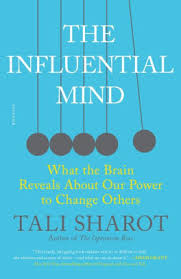
I have written repeatedly that people do not often behave rationally, and Tali Sharot’s book, An Influential Mind,helps show that much of this irrationality is hardwired into our brains. Sharot writes how our brains are “hard-wired”, which makes it challenging to break bad habits. Instead, by understanding how we our brain works, we can adjust both our own bad habits and help others.

influential mind

We are all hedonists

Not much of a surprise but people are wired to strive for pleasure. The corollary, and more important takeaway, is that this principle cannot be unlearned. It is a waste of time and resources to try to get people (or yourself) not to pursue pleasure. Instead, it is best to channel this pursuit in yourself and in others.

When motivating your employees or potential customers, it is much stronger if you do it by offering them “pleasure.” When offered a reward, the brain kicks into gear, and people experience quick and alert responses. If the potential result is something bad, the brain turns sluggish, and their responses suffer. Thus, the carrot is better than the stick in driving optimal behavior.

Control is important

Having control of one’s life is a very instinctual desire, it provides happiness. People are happier when they are in control. Sharot points out the same situation exists in the office. If you want happier employees, make sure they have input in making decisions that touch their daily work.

Studies have shown people are happier, and even live longer, if they have to participate and work for something rather than be served. Elderly people did better at a care home where they had to prepare their own meals. In the work environment, it is often superior to have the team that needs to create a product or develop software involved in crafting the product specifications, rather than just handing them the final spec and asking them to build it.

Humans are not flexible

One negative way of thinking that Sharot attacks is how once someone has made up their mind, they tend to ignore contrary information and forge ahead regardless. I have experience (all too frequently) how a colleague is sure they have the right strategy or process, does not listen to others, and then fails. This happens even when everyone else sees the negative outcome. It may have been launching a new product that will have no demand or analysing data incorrectly and making decisions based on that analysis, then when the product is launched or project is done, it turns out to be an abject failure. Upon retrospection, the question is asked how did this mistake happen.

Research has found this inflexible decision-making is programmed into the brain. In an experiment, brain activity of participants was measured during the decision-making process and brain activity dropped significantly upon receiving bad information (that is, information that was contradictory to their original decision). This shows that when people commit to a decision, there is a natural defense mechanism that helps them avoid learning it is a bad decision.

To combat this defense mechanism, Sharot shows it is better to focus on presenting new factual information rather than arguing against the preconception. If you are trying to convince somebody their mobile game project will fail, do not attack the concept or the demo but present new information. Talk about new games on the market or new options. Do not try to discredit the belief, as people become resistant and defensive, often getting stronger in original idea. Instead, provide different, positive information.

Moods are contagious

The moods of others around you helps determine your mood. Based on MRI scans during political speeches, researchers learned that listeners often feel connected to the rest of the audience. This learning shows why people at a rally often react the same at particular points of a speech. Other research showed that negative posts on FB lead to more negative posts, while the inverse is also true. Good and bad moods are contagious, people’s brains synchronize. Their brains are connected, so moods are contagious.

There are several implications of contagious moods:

  • In a workplace, it is critical to maintain the mood and morale of your team. If several people on the team (or company) turn negative, it is likely to infect the entire organization.
  • Negative social media sentiment about a product could not only turn a few people against it but create a negative overall perception.
  • On a personal level, one or two family members can put the entire family in a good or bad mood, especially if they bring experiences from work or school home with them.

Entertainment trumps information

Related to the pursuit of pleasure, people pay more attention to entertainment than they do important information. Politics provide a great validation of this concept, Trump has tens of million Twitter followers because his tweets are entertaining. More people view a video of Congresswoman Alexandria Ocasio-Cortez dancing on a roof than discussing healthcare.

Another great example is the safety warnings on airplanes. It is probably more important to know what to do if there is an emergency landing than if you can reach the next level on Clash, but which one do most people focus on?

The lesson when building a product or game is that most tutorials will fail, instead people need to learn while being entertained. It also impacts how you communicate, an email or pop up listing benefits or features is not as effective as a fun GIF.

There is also a workplace impact of preferring entertainment to information. Sharot discusses that it might be easier to resolve a workplace conflict with a fun, novel solution rather than a lecture on the right way to do things.

Understanding the brain helps motivate yourself and others

The better you understand how the brain is structured and people’s motivation, the better you can interact with your family, colleagues and customers. Some of the most robust methods encompass remembering that everyone is motivated by pleasure seeking and reward and that people like to feel in control.

Key takeaways

  1. Our brains are “hard-wired”, which makes it challenging to break bad habits. By understanding how we our brain works, we can adjust both our own habits while helping others be more productive.
  2. People’s brains are designed to seek pleasure. Related to the pursuit of pleasure, people pay more attention to entertainment than they do important information.
  3. Having control of one’s life is a very instinctual desire, it provides happiness.

Share this:

  • Click to share on Facebook (Opens in new window) Facebook
  • Click to share on LinkedIn (Opens in new window) LinkedIn
Like Loading...
Unknown's avatarAuthor Lloyd MelnickPosted on May 28, 2019March 14, 2019Categories General Social Games Business, General Tech BusinessTags An Influential Mind, Consumer behavior, neuromarketing, PsychologyLeave a comment on How to change bad habits, the neuroscience way

Neuromarketing and gaming

I recently finished a class on Coursera, An Introduction to Consumer Neuroscience & Neuromarketing, that gave some great insights applicable to gaming and the greater tech sector.

Neuromarketing is a very exciting new field that is driving business growth, think Big Data ten years ago. The course, taught by Neuromarketing pioneer Thomas Zoëga Ramsøy of the Copenhagen Business School, delves into neuroscience and how both small and large companies can use it. It leverages increasing understanding in how the brain works with the emergence of behavioral economics and data-driven marketing.

While marketing in the past largely relied on intuition, surveys and focus groups, neuromarketing starts by understanding how the brain functions and what parts of the brain drive different behavior. By understanding what parts of the brain drive emotion, motivation, etc., you can then create products and marketing campaign most likely to get customers to purchase.

While I am not the person to summarize how the brain works, below are some of the key learnings from Professor Ramsøy’s course and implications for the game industry.

Cognitive Load

The concept of cognitive load is critical to the success of many products, from games like slots to apps like Uber. Given the the human brain consumers 20 percent of the body’s energy but only is 2 percent of the body’s mass, it is important to understand that people will subconsciously work to reduce the amount of energy the brain is using.

Cognitive load is how much info people are processing at any one time. Cognitive load is tied to working memory, the more information in that short-term memory the higher the cognitive load. As cognitive load increases, consumers are less likely to make a purchasing decision.

The concept of cognitive load also confirms why UIUX is often better when simpler. A simple user experience minimizes cognitive load, thus not creating too much strain.

Implications

It is important to manage proactively consumers’ cognitive load. Giving consumers many choices increases their cognitive load, thus making them less likely to purchase. Thus, it is critical that rather than giving your customer 25 different packages they can buy, keep the purchasing decision simple.

While simpler is better is often considered the goal of UIUX, it often is abandoned so new features can be added. The reality is that simpler is more important than features and you need to build your products not as a tradeoff between the two but as something that focuses on minimizing customers cognitive load.

Uber is a great example of the success of this strategy. From a very simple interface to only a few options to not even letting customers think about tipping to not even having to worry about paying, using Uber requires very little thought. Yet this incredibly simple app has made Uber worth over $60 billion.

Not only is cognitive load important when creating the overall product but also the underlying mechanic in the product. People often question the enduring popularity of slot machines. There are, however, virtually no game mechanics that have lower cognitive load than slots. The slot mechanic provides entertainment without using too much energy. When creating other mechanics, it is critical to understand how much mental energy they will consume.

Search and attention

One of the most powerful applications of neuromarketing is related to search and what consumers select following the search process. Critically, there are two types of search, and each is driven by different parts of the brain.

First there is bottom-up search, which is largely unconscious. This is where a person comes across something and it grabs your attention. Certain receptors in eyes more receptive to things like contrast and density. The best example is when you are in a grocery store and you notice something you were not planning on buying. This type of search is generally driven by colors, shape and density. Consumers are likely to buy some that grabs their attention. As much of consumer behavior is unconscious,

The other type of search is top-down, which is primarily conscious. This is when somebody is searching for something in particular. You may again be in a grocery store and looking for eggs. You will focus your mental energy on thinking hard and finding what you need.

Implications

You need to design your UIUX based on what type of search your customers will be conducting. If they are conducting a top-down search, then you do not have to prioritize making it that visible. They will find it regardless. Conversely, if you want to engage your easier (get them to try a new feature or new content or have them think about monetizing), then you want to stand out during a bottom-up search.

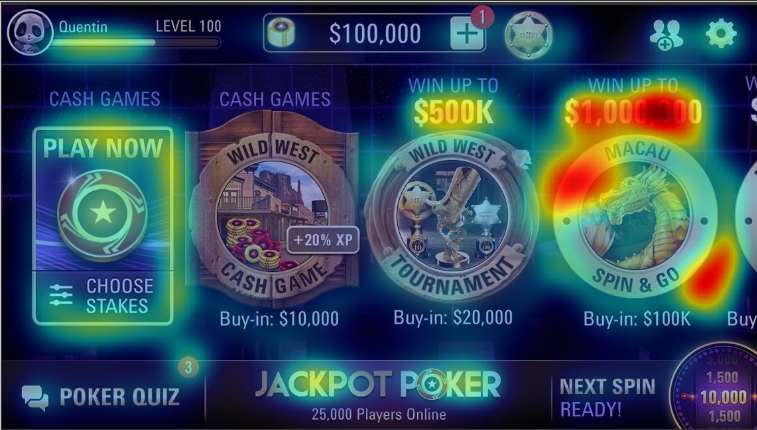
In this case, there are some great new tools for UIUX to optimize visual search results. Professor Ramsøy, who taught the course, has a commercial product called Neurovision. Neurovision allows you to put in an image of your game (in our case) and see what players will notice without the need of a fancy heat test, thus what will jump out in a bottom-up search (see example below):

Screen Shot 2017-03-19 at 4.39.45 PM

It is also often used by retailers (including Walmart and Home Depot) to understand what consumers will see while walking through their store, it can even analyze what people will notice during videos. Neurovision is one of a host of new products based on Neuroscience that help you scientifically improve your products rather than relying on anecdotal experience with a limited number of users.

Branding

The value of brands is often debated but neuromarketing shows the value of a brand. Brands impact how we perceive and enjoy a product and stimulate additional parts of the brain that the product would not normally impact.

As discussed with cognitive load, the brain uses a lot of energy and consumers are constantly looking at ways to minimize this energy usage. Brands help consumers save energy because when they see a brand they are familiar with, the branding fills in a lot of information that they do not have to then ascertain (quality, style, etc.). Thus, when deciding between a branded product and a brand they are not familiar with (or no brand) the branded product has an advantage as choosing it requires less energy.

While this analysis may not seem like neuromarketing, neuromarketing confirms it. When people who have been exposed to branding for a certain paint are then in the paint section of a hardware store, eye-tracking confirms that they spend more attention on products from brands they are aware of. This phenomenon then leads to a higher likelihood of purchase.

Branding also helps with search, particularly bottom up search. While a consumer focused on finding a specific product or specific feature set may not respond to branding, as they are doing a top-down search, someone who is browsing for a new product (say a new casino app), a familiar brand would make it more likely to gain a customer’s attention.

Finally, branding stimulates parts of the brain that then impact how consumers feel about a product. A strong brand will create positive emotions around a product even before the consumer evaluates the product.

Implications

Branding is not dead or useless in a performance marketing world. Strong brand can translate into a higher impact from your performance marketing, customers are more likely to click on your ads. They are also more likely to pick your product when searching organically for one.

Using Neuroscience

Neuroscience is a strong tool to help improve your product and marketing. By understanding how the brain processes information, you can tailor your product and marketing to optimize your chances for success.

Key takeaways

  1. Neuromarketing, based on neuroscience, uses understanding of the brain to drive product and marketing decisions, just as big data creates much higher returns.
  2. You can increase sales and satisfaction by minimizing cognitive load, how much your customer’s brain has to process navigating your app or store
  3. Your UIUX should account for whether your customer is conducint a top-down search (looking for something in particular) or bottom-up search where you want them to find something.

Share this:

  • Click to share on Facebook (Opens in new window) Facebook
  • Click to share on LinkedIn (Opens in new window) LinkedIn
Like Loading...
Unknown's avatarAuthor Lloyd MelnickPosted on March 22, 2017March 19, 2017Categories General Social Games Business, General Tech Business, Growth, Lloyd's favorite posts, Social Casino, Social Games MarketingTags cognitive load, neuromarketing, Product design, search, Thomas Zoëga Ramsøy, uiux1 Comment on Neuromarketing and gaming

Get my book on LTV

The definitive book on customer lifetime value, Understanding the Predictable, is now available in both print and Kindle formats on Amazon.

Understanding the Predictable delves into the world of Customer Lifetime Value (LTV), a metric that shows how much each customer is worth to your business. By understanding this metric, you can predict how changes to your product will impact the value of each customer. You will also learn how to apply this simple yet powerful method of predictive analytics to optimize your marketing and user acquisition.

For more information, click here

Follow The Business of Social Games and Casino on WordPress.com

Enter your email address to follow this blog and receive notifications of new posts by email.

Join 791 other subscribers

Most Recent Posts

  • Join me at PDMA Inspire for my talk on new product prioritization
  • Why keep studying?
  • The next three years of this blog
  • Interview with the CEO of Murka on the biggest growth opportunity in gaming, Barak David

Lloyd Melnick

This is Lloyd Melnick’s personal blog.  All views and opinions expressed on this website are mine alone and do not represent those of people, institutions or organizations that I may or may not be associated with in professional or personal capacity.

I am a serial builder of businesses (senior leadership on three exits worth over $700 million), successful in big (Disney, Stars Group/PokerStars, Zynga) and small companies (Merscom, Spooky Cool Labs) with over 20 years experience in the gaming and casino space.  Currently, I am the GM of VGW’s Chumba Casino and on the Board of Directors of Murka Games and Luckbox.

Topic Areas

  • Analytics (114)
  • Bayes' Theorem (8)
  • behavioral economics (8)
  • blue ocean strategy (14)
  • Crowdfunding (4)
  • DBA (2)
  • General Social Games Business (459)
  • General Tech Business (195)
  • Growth (88)
  • International Issues with Social Games (50)
  • Lloyd's favorite posts (101)
  • LTV (54)
  • Machine Learning (10)
  • Metaverse (1)
  • Mobile Platforms (37)
  • Prioritization (1)
  • Social Casino (52)
  • Social Games Marketing (105)
  • thinking fast and slow (5)
  • Uncategorized (33)

Social

  • View CasualGame’s profile on Facebook
  • View @lloydmelnick’s profile on Twitter
  • View lloydmelnick’s profile on LinkedIn

RSS

RSS Feed RSS - Posts

RSS Feed RSS - Comments

Categories

  • Analytics (114)
  • Bayes' Theorem (8)
  • behavioral economics (8)
  • blue ocean strategy (14)
  • Crowdfunding (4)
  • DBA (2)
  • General Social Games Business (459)
  • General Tech Business (195)
  • Growth (88)
  • International Issues with Social Games (50)
  • Lloyd's favorite posts (101)
  • LTV (54)
  • Machine Learning (10)
  • Metaverse (1)
  • Mobile Platforms (37)
  • Prioritization (1)
  • Social Casino (52)
  • Social Games Marketing (105)
  • thinking fast and slow (5)
  • Uncategorized (33)

Archives

  • September 2023
  • December 2021
  • July 2021
  • March 2021
  • February 2021
  • January 2021
  • December 2020
  • November 2020
  • October 2020
  • September 2020
  • August 2020
  • July 2020
  • June 2020
  • May 2020
  • April 2020
  • March 2020
  • February 2020
  • January 2020
  • November 2019
  • October 2019
  • September 2019
  • June 2019
  • May 2019
  • April 2019
  • March 2019
  • February 2019
  • January 2019
  • December 2018
  • June 2018
  • May 2018
  • April 2018
  • March 2018
  • February 2018
  • January 2018
  • December 2017
  • June 2017
  • May 2017
  • April 2017
  • March 2017
  • February 2017
  • January 2017
  • December 2016
  • November 2016
  • October 2016
  • September 2016
  • June 2016
  • May 2016
  • April 2016
  • March 2016
  • February 2016
  • January 2016
  • December 2015
  • November 2015
  • October 2015
  • September 2015
  • July 2015
  • June 2015
  • May 2015
  • April 2015
  • March 2015
  • February 2015
  • January 2015
  • December 2014
  • November 2014
  • October 2014
  • September 2014
  • August 2014
  • July 2014
  • June 2014
  • May 2014
  • April 2014
  • March 2014
  • February 2014
  • January 2014
  • December 2013
  • November 2013
  • October 2013
  • September 2013
  • August 2013
  • July 2013
  • June 2013
  • May 2013
  • April 2013
  • March 2013
  • February 2013
  • January 2013
  • December 2012
  • November 2012
  • October 2012
  • September 2012
  • August 2012
  • July 2012
  • June 2012
  • May 2012
  • April 2012
  • March 2012
  • February 2012
  • January 2012
  • December 2011
  • November 2011
  • October 2011
  • September 2011
  • August 2011
  • July 2011
  • June 2011
  • May 2011
  • December 2010
December 2025
S M T W T F S
 123456
78910111213
14151617181920
21222324252627
28293031  
« Sep    

by Lloyd Melnick

All posts by Lloyd Melnick unless specified otherwise
Google+

Enter your email address to subscribe to this blog and receive notifications of new posts by email.

Join 791 other subscribers
Follow Lloyd Melnick on Quora

RSS HBR Blog

  • How One Manufacturer Achieved Net Zero at Zero Cost
  • What Can U.S. Employers Do About Rising Healthcare Costs?
  • When You Have to Execute a Strategy You Disagree With
  • 4 Ways to Build Durable Relationships with Your Most Important Customers
  • What Jargon Says About Your Company Culture
  • Research: When Used Correctly, LLMs Can Unlock More Creative Ideas
  • Your New Role Requires Strategic Thinking…But You’re Stuck in the Weeds
  • For Circular Economy Innovation, Look to the Global South
  • Why Great Leaders Focus on the Details
  • Corporate Disclosure in the Age of AI

RSS Techcrunch

  • An error has occurred; the feed is probably down. Try again later.

RSS MIT Sloan Management Review Blog

  • AI Coding Tools: The Productivity Trap Most Companies Miss
  • How Procter & Gamble Uses AI to Unlock New Insights From Data
  • Rewire Organizational Knowledge With GenAI
  • Hungry for Learning: Wendy’s Will Croushorn
  • Beat Burnout: 10 Essential MIT SMR Reads
  • How Leaders Stay True to Themselves and Their Stakeholders
  • Our Guide to the Winter 2026 Issue
  • Broadening Future Perspectives at the Bank of England
  • A Faster Way to Build Future Scenarios
  • Assess What Is Certain in a Sea of Unknowns
The Business of Social Games and Casino Website Powered by WordPress.com.
  • Subscribe Subscribed
    • The Business of Social Games and Casino
    • Join 726 other subscribers
    • Already have a WordPress.com account? Log in now.
    • The Business of Social Games and Casino
    • Subscribe Subscribed
    • Sign up
    • Log in
    • Report this content
    • View site in Reader
    • Manage subscriptions
    • Collapse this bar
 

Loading Comments...
 

    %d