Skip to content

The Business of Social Games and Casino

How to succeed in the mobile game space by Lloyd Melnick

Tag: NPS

Making happy customers more profitable

While the key to business success is creating happy and loyal customers, you still need to get them to generate more revenue. A good NPS score and low churn rate shows your customers are satisfied but you only benefit when these customers act on their positive feelings. An article in Harvard Business Review, Make it Easier for Customers to Buy More by Bain Capital’s Rob Markey, shows how to convert this satisfaction into profits.

Slide1.png

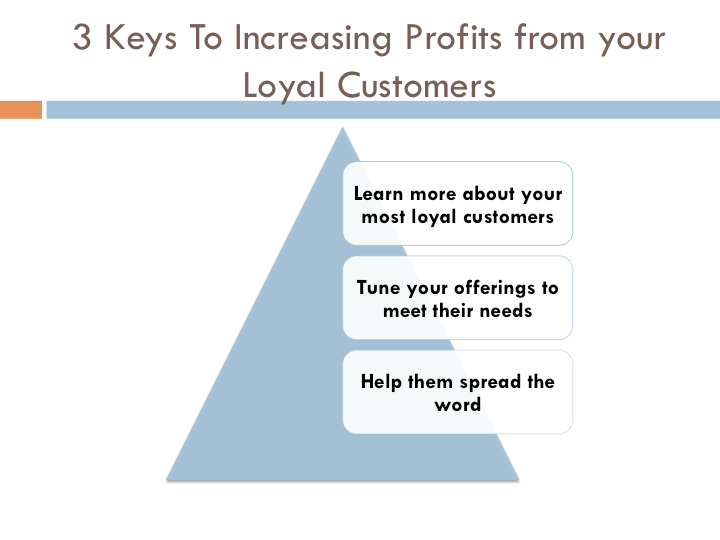
Learn more about your most loyal customers

The first key to generate more profits from your loyal customers is to understand them better. Markey makes the point that companies focus on learning why detractors, or unhappy customers, are dissatisfied but they do not put the same effort in understanding why the happy customers are happy. As Markey writes, “Converting feelings into action requires knowing exactly what you did to earn their loyalty, so you can replicate the action and extend it. To maintain that kind of intimate relationship with your most loyal customers, you have to create effective mechanisms for staying in close touch.”

Add to all of your communication channels feedback loops to ascertain why they love your company. Have your account or customer service reps ask customers why they first became enthusiastic. When sending out NPS surveys, make sure you ask those providing high scores the reason they gave such a score. Have customers post stories on social media on why they like your offering. Have events for your top customers and ensure part of the agenda is having customers discuss how they fell in love with your brand. Use all of your channels not only to help your customers but to learn from them.

Tune your offerings to meet their needs

When communicating with your best customers, you will learn both what they like and do not like about your offering. You will also understand if your competitors are offering something they want that you do not offer. Markey writes, “ideally, your offerings should be so attractive to your loyalists that they have no reason to look elsewhere for additional products or services.”

Once you understand your customers needs, then adjust your product to meet these needs. It may be by providing additional features or more support services. It could also entail offering your product through new distribution channels or in another format. The key is understanding what your best customers want from your product but are not getting, then adjusting your product to fill this need so they do not move to competitors.

Help them spread the word

Since your most loyal customers by definition love your offering, you want to harness this positive vibe by getting them to promote you to their friends. As people communicate best via stories, you need to provide them with stories that they can share. These stories can range from great interaction with your staff (maybe customer service, VIP management or on Facebook), a great experience with your game or product or even a little bonus you got via email. Once they have the stories, you need to facilitate them sharing the stories. This sharing often is by social media but it can be video testimonials on your website or even quotes in your game.

Loyal customers drive profits

While it is critical to create incredibly satisfied customers, that is not the end of the battle. You need to learn from them, use this knowledge to make your products even more suited to them and then turn them into advocates.

Key takeaways

  1. The first key to generate higher profits is learning from your most loyal customers why they love your product.
  2. The second key is taking this knowledge and further tweaking your product to meet your loyal customers’ needs.
  3. The final key is getting these loyal customers to advocate for you by sharing stories that show their friends why your product or company is great.

Share this:

  • Click to share on Facebook (Opens in new window) Facebook
  • Click to share on LinkedIn (Opens in new window) LinkedIn
Like Loading...
Unknown's avatarAuthor Lloyd MelnickPosted on May 10, 2017April 18, 2017Categories General Social Games Business, General Tech BusinessTags customer service, loyalty, NPSLeave a comment on Making happy customers more profitable

NPS is not just for customers

Key takeaways

  1. Net Promoter Score (NPS), a great tool to measure customer satisfaction and create a user experience that generates higher growth, and it can also be applied to internal interactions between business units to enhance efficiency.
  2. Most companies simply measure internal efficiency by budget, with a lower budget implying higher efficiency even if it is not the optimal way of driving the business.
  3. NPS allows fast feedback and allows business units to uncover the root cause of issues.

NPS is not just for customers

I am a big fan of Net Promoter Score (NPS), Bain’s system for looking at promoters and detractors among your customers and leveraging this information to make your company better and grow. I recently came across a post that shows how NPS can also be used internally to improve how people in your company work with each other. The post shows how a robust internal NPS system can alleviate this problem. For those not familiar with NPS , its beauty is in its simplicity. It asks customers (internal or external), on a scale of 1 to 10 (10 being the best), whether they would recommend the product or service. 9 and 10s are considered promoters, 7 and 8s are neutral and the rest are detractors. All are then asked why and companies follow up with detractors to move them up.

While most companies have internal support functions (finance, legal, IT, etc.), it is frequently difficult to measure how well they are performing. We often default at looking at the budget of each function, and measure improvements by lowering costs. This approach, however, does not judge if the unit is providing good value. While most units would welcome feedback, the oft-used system makes them fear any attention as it is likely to result in budget cuts or redundancies.

A robust NPS system can alleviate this issue. Rather than just looking at costs, it can look at every interaction between a business unit and the other parts of the business. It will not only give an overall score but also, by asking why someone gave them a score, understand the issues that internal customers are experiencing. The unit can then launch root-cause analysis to determine the ultimate source of failures, and it could escalate issues that it could not resolve on its own.

slide1

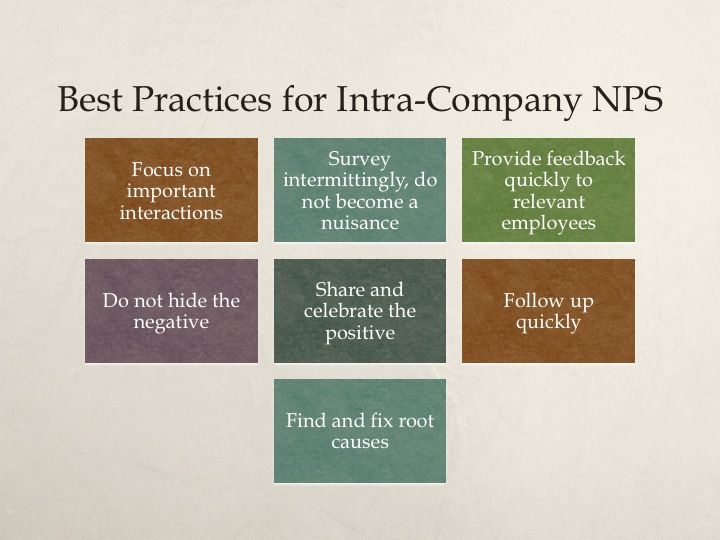
The post points out several keys to implementing an internal NPS system successfully:

  • Focus on the business unit interactions that are important, no need to measure everything.
  • Only survey internal customers intermittingly, do not allow it to become a nuisance or distraction.
  • Quickly provide the NPS feedback to the relevant employees.
  • Do not hide or degrade the harsh comments, they are very important for improvement.
  • Share positive feedback and celebrate the successes.
  • Quickly follow up, particularly with any dissatisfaction or problems that NPS helps identify.
  • Dig deep, use root cause analysis to find why problems are occurring or recurring.

NPS can help improve your business

A good internal NPS system can help improve your company’s operations as much as NPS helps your company create satisfied customers. With better internal efficiency, you will experienced higher productivity and stronger competitiveness.

Share this:

  • Click to share on Facebook (Opens in new window) Facebook
  • Click to share on LinkedIn (Opens in new window) LinkedIn
Like Loading...
Unknown's avatarAuthor Lloyd MelnickPosted on November 9, 2016May 23, 2021Categories General Social Games Business, General Tech BusinessTags NPSLeave a comment on NPS is not just for customers

How to manage your algorithms

While everyone is focused on creating the most advanced algorithms for their predictive analytics and optimizing your team’s performance, I have not seen anything on how to manage your algorithms. A great article in Harvard Business Review – Algorithms Need Managers, Too by Michael Luca, Jon Kleinberg and Sandhil Mullainathan – does a great job of combining the two issues and providing a solution.

The authors begin by pointing out most businesses rely on predictions throughout their organization. The decisions can range from predicting a candidate’s performance and whether to hire them, what initiatives will have the highest ROI and what distribution channels will yield the most sales. Companies increasingly are using computational algorithms to make these predictions more accurate.

The issue is, if the predictions are inaccurate (and although they are computer generated, they are still predictions not facts) they can lead you into bad decisions. Netflix learned this the hard way when its algorithms for recommending movies to DVD customers did not hold when its users moved to streaming. More relevant to digital marketers, algorithms that generate high click through rates may actually bring in poor users not interested in your underlying game or product. As the authors write, “to avoid missteps, managers need to understand what algorithms do well – what questions they answer and what questions they do not.”

How algorithms can lead you amiss

An underlying issue when using algorithms is that they are different than people. They behave quite differently in two key ways:

  • Algorithms are extremely literal, they do exactly what they are told and ignore any other information. While a human would understand quickly that an algorithm that gets users that generate no revenue is useless, if the algorithms was just built to maximize the number of users acquired it would continue attracting worthless users.
  • Algorithms are often black boxes, they may predict accurately but not what is causing the action or why. The problem here is that you do not know when there is incomplete information or what information may be missing.

Once you realize these two limitations of algorithms, you can then develop strategies to combat these problems. The authors then provide a plan for managing algorithms better.

Slide1

Be explicit about all of your goals

When initiating the creation of an algorithm, you need to understand and state everything you want the algorithm to achieve. Unlike people, algorithms do not understand the implied needs and trade-offs necessary often to optimize performance. People understand the end goal and then backward process how to best achieve that eventual goal. There are also soft goals to most initiatives, and these goals are often difficult to measure (and thus input into your algorithms). There could also be a goal of fairness, for example a bank using an algorithm to optimize loan behavior may not provide enough loans in areas where it feels a moral obligation to do so. Another example could be where you may want to optimize your business units sales but the behavior could negatively impact overall sales of your company.

The key is to be explicit about everything you hope to achieve. Ask everyone involved to list their soft goals as well as the primary objective. Ask people to be candid and up-front. With a core objective and a list of concerns in front of them, the algorithm’s designer can then build trade-offs into the algorithm. This process may entail extending the objective to include multiple outcomes, weighted by importance.

Minimize myopia

Algorithms tend to be myopic, they focus on the data at hand and that data often pertains to short-term outcomes. There can be a tension between short-term success and long-term profits and broader corporate goals. People understand this, computer algorithms do not.

The authors use the example of a consumer goods company that used an algorithm to decide to sell a fast-moving product from China in the US. While initial sales were great, they ended up suffering a high level of returns and negative customer satisfaction that impacted the brand and overall company sales. I often see this problem in the game industry, where product managers find a way to increase in-app purchases short term but it breaks player’s connection with the game and long-term results in losses.

The authors suggest that this problem can be solved at the objective-setting phase by identifying and specifying long-term goals. But when acting on an algorithm’s predictions, managers should also adjust for the extent to which the algorithm is consistent with long-term aims.

I recommend using NPS to balance out short term objectives with the long-term health of the product and company. I have written before about NPS, Net Promoter Score, which is probably the most powerful tool to measure customer satisfaction. It is also highly correlated with growth and success. By ensuring you keep your NPS high, you are providing a great way to look holistically at the success of specific initiatives.

Chose the right data inputs

Using the right data can make your algorithms much more effective. When looking at a game like Candy Crush, you can create levels by looking at when people abandon the game and decompose the levels before abandonment. However, by adding social media posts to the your data, you could get a more holistic view of which levels players are enjoying and thus build a more compelling product.

The authors also point to an example with the City of Boston. By adding Yelp reviews to what health inspectors use to determine what restaurants to inspect, they were able to maintain their exact same performance but with 40 percent fewer inspectors. Thus, the new data source had a huge impact on productivity.

The authors point to two areas of data that can improve your algorithms:

    • Wider is better. Rather than focusing on more data, the amount of data you know about each customer determines the width. Leveraging comprehensive data is at the heart of prediction. As the authors write, “every additional detail you learn about an outcome is like one more clue, and it can be combined with clues you’ve already collected. Text documents are a great source of wide data, for instance; each word is a clue.”
    • Diversity matters. Similar to your investment strategy, you should use data sources that are largely uncorrelated. If you use data that moves closely to your data sources, you will have the illusion of using multiple data sources but really only be looking at one angle of the data. If each data set has a unique perspective, it creates much more value and accuracy.

Understand the limitations

As with anything, it is also critical to understand the limitations of algorithms. Knowing what your algorithm will not do is equally important as understanding how it helps. Algorithms use existing data to make predictions about what might happen with a slightly different setting, population, time, or question. “In essence, you are transferring an insight from one context to another. It’s a wise practice, therefore, to list the reasons why the algorithm might not be transferable to a new problem and assess their significance,” according to the authors.

As the authors point out, “ remember that correlation still doesn’t mean causation. Suppose that an algorithm predicts that short tweets will get retweeted more often than longer ones. This does not in any way suggest that you should shorten your tweets. This is a prediction, not advice. It works as a prediction because there are many other factors that correlate with short tweets that make them effective. This is also why it fails as advice: Shortening your tweets will not necessarily change those other factors.”

Use algorithms, just use them smartly

This post is not intended for you to avoid using algorithms, it is actually the opposite goal. Algorithms are increasingly powerful and central to business success. Whether you are predicting how consumers will react with a feature, where to launch your product or who to hire, algorithms are necessary to get great results. Given the central importance of these algorithms, however, it is even more crucial to use them correctly and optimize their benefit to your company.

Key takeaways

  1. Algorithms are increasingly powerful and central to business success. Given the central importance of these algorithms it is even more crucial to use them correctly and optimize their benefit to your company.<
  2. Problems with algorithms result from them being literal (they do exactly what you ask) and are largely a black box (they do not explain why they are offering certain recommendations).
  3. When building algorithms, be explicit about all your goals, consider the long-term implications and make sure you are using as broad data as possible.

Share this:

  • Click to share on Facebook (Opens in new window) Facebook
  • Click to share on LinkedIn (Opens in new window) LinkedIn
Like Loading...
Unknown's avatarAuthor Lloyd MelnickPosted on March 23, 2016February 28, 2016Categories Analytics, General Social Games Business, General Tech Business, Machine LearningTags algorithms, analytics, goals, Machine learning, Net Promoter Score, NPSLeave a comment on How to manage your algorithms

How bad profits can kill your company

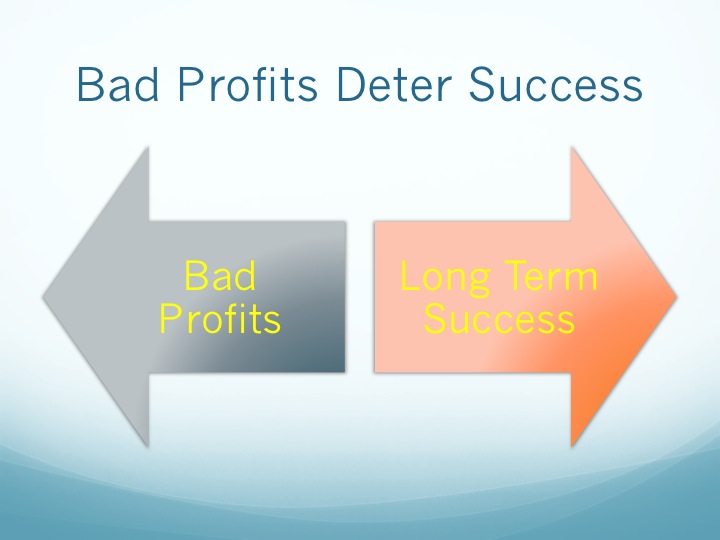
I came across an article from 2012, “Is Your Company Hooked on bad profits?” by Fred Reichheld, a Bain Fellow, that is very relevant to today’s tech companies. Bad profits are revenues earned at the expense of customer relationships. These bad profits are generated usually with short-term revenue goals that over a longer period make your customers more likely to churn.

Slide1

Examples of bad profits

As a consumer, you probably have many examples you can list of bad profits. Some of these are banks charging late payment or bounced check fees not in line with their costs. It could also be rental car agencies charging you more per gallon if you do not return your vehicle with a full tank of gasoline than you would pay for a fine French Bordeaux. It could be a wireless phone company charging you crazy international roaming fees. Maybe a fitness center locks you into a one year contract because they know you won’t be happy in a month. And it could be a free to play game company tricking players into spending premium currency by creating misleading buttons. Remember how AOL made you jump through about twenty agents to cancel its service? Unfortunately, these examples are too numerous to list. Continue reading “How bad profits can kill your company”

Like Loading...
Unknown's avatarAuthor Lloyd MelnickPosted on February 26, 2015April 6, 2015Categories General Social Games Business, General Tech Business, GrowthTags Bad Profits, Customer satisfaction, NPSLeave a comment on How bad profits can kill your company

How to measure customer satisfaction

Although I have written many times about customer satisfaction and how good experiences positively impact customer lifetime value, I have not presented a good way to measure it. As we all know, if you do not measure something, it usually does not get done. A recent article in Bain & Company’s Insights newsletter, “Who Should Run Your Net Promoter System,” does a great job of explaining how to measure customer satisfaction and how to manage the measurement process.

What is the Net Promoter Score?

For such a powerful metric, the net promoter score is very straightforward. It is the answer to one question, on a scale of 1-10: How likely is it that you would recommend the company to a friend? Those who are answer with a 9 or 10 are considered loyal enthusiasts who will keep buying and refer others. Those who answer 7 or 8 are passives, satisfied but unenthusiastic customers who are vulnerable to churning. Those with a score of 0-6 are considered detractors, unhappy customers who can damage your brand and impede growth through negative word-of-mouth. Continue reading “How to measure customer satisfaction”

Like Loading...
Unknown's avatarAuthor Lloyd MelnickPosted on February 19, 2015March 19, 2015Categories General Social Games Business, General Tech BusinessTags Bain, CS, customer service, Net Promoter Score, NPS6 Comments on How to measure customer satisfaction

Optimizing customer service is not about keeping everyone happy

Customer service is a function that is usually neglected in the tech or game space. A recent article in the MIT Sloan Management Review, “The High Price of Customer Satisfaction,” shows companies can also err by focusing on creating too much customer delight. The article points out that customer satisfaction is the most widely used metric to measure and manage customer loyalty because companies assume highly satisfied customers are good for business. The article points out that the reality is not as simple as the belief that high customer satisfaction optimizes profitability. In the article, the authors look across industries and find the correlation between companies’ customer-satisfaction levels for a given year and the company’s performance (as measured by stock price) only explains 1 percent of the variation in a company’s market return. Another study by Bloomberg’s Business Week actually shows a negative relationship. Although you can poke holes in these studies, overall the relationship between customer spending and customer satisfaction is very weak. Because of this and similar research, many consultants and authors have argued that achieving customer satisfaction is a waste of money. The authors, however, conducted extensive research and uncovered three critical issues that keep customer satisfaction from generating higher revenue. By understanding these three issues, any tech or game company (which I think will find them very familiar) can create a better customer service strategy.

Avoid money losing delighters

Strong customer service (CS) scores are normally considered universally good for business but the data is not as clear-cut. There is a downside to devoting resources continually to raise customer satisfaction levels. As companies cannot usually quantify the costs associated with raising customer satisfaction levels, you cannot determine the value of an increase. Often, the return on investment for improving customer satisfaction is trivial or negative. Although higher satisfaction scores can increase revenue, the costs of getting the higher scores frequently outweigh the benefits. Pricing is a great example of this phenomenon.

One key factor that drives customer satisfaction is low prices, as satisfaction and price are almost inversely related. Thus, lowering price tends to be one of the easiest ways to improve satisfaction levels (in the game industry, which could be the same as giving away premium currency). The problem is that most companies and products, low prices are often bad for business and there is not much room to drop prices and remain profitable. The authors used examples of a large financial services institution and Groupon to illustrate this point. With the financial institution, the majority of customers were highly satisfied. Unfortunately, over two-thirds of these highly satisfied customers were also unprofitable for the company. The customers’ high satisfaction was driven primarily by their belief that they were getting great deals, which they were. Each time the company underpriced its offer, these customers bought in large quantities. The problem was exacerbated as the more they spent, the more additional services they expected. With Groupon, there is a usually negative relationship between customer satisfaction and merchant profitability. Four of the six top performing categories of Groupon offers in terms of satisfaction were money losers for the merchants. These four categories, as they were so popular, generate half of Groupon’s volume.

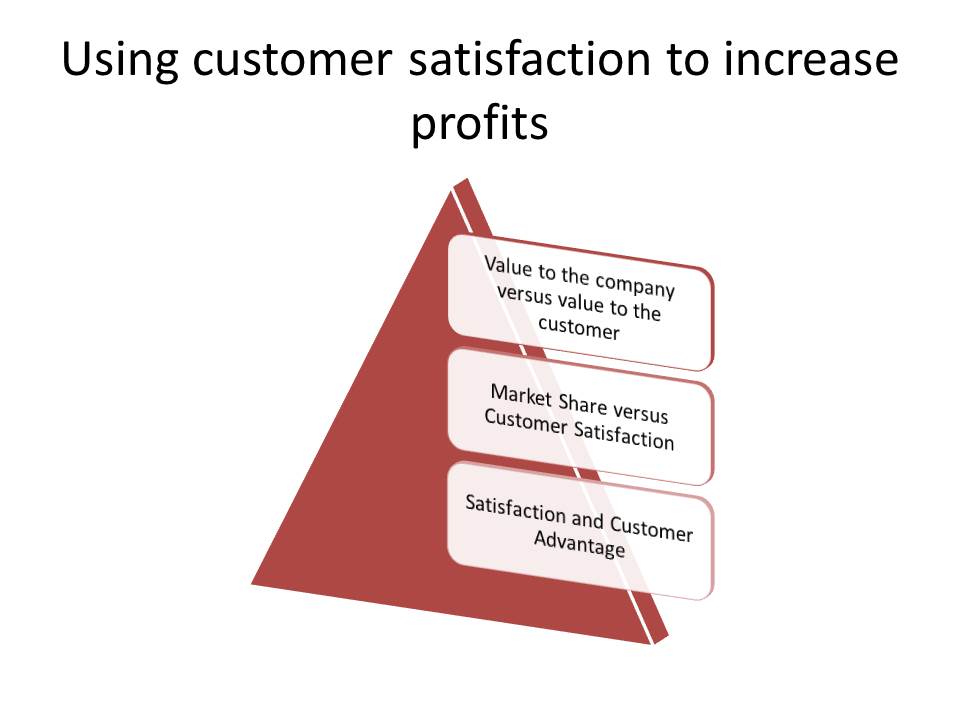
These examples show that customer satisfaction and profitability are often not aligned. There are other ways to improve customer satisfaction, a better customer experience or more innovative products. However, not all alternatives will be profitable. Moreover, not all customers can be profitably satisfied; some will not pay the necessary price for the level of service being offered. Others demand a level of service that more than offsets any revenue they provide. The point of this issue: you must understand the profit impact of efforts to improve customer satisfaction.

Smaller often equals happier

While conventional wisdom suggests that higher satisfaction would lead to higher market share, the author’s research shows that high satisfaction is a negative predictor of market share. They use some very obvious examples to make their point. McDonalds has lower customer satisfaction scores than Wendy’s but much higher sales. Target, Sears and JC Penney all consistently outperform Wal-Mart on customer satisfaction but there sales and profits fall way behind. The primary reason for this seeming contradiction is that the broader a company’s market appeal relative to the offerings of competitors, the lower the level of satisfaction. Gaining market share normally comes from attracting customers whose needs are not completely aligned with the company’s core target market. Thus, smaller niche companies can better serve their customers while companies with large market share must serve a more diverse set of customers. This data suggests you should not necessarily benchmark against the companies in your space with the highest customer satisfaction levels, they are probably niche players that by design are tailored to their individual audience. It also shows that you a focus on improving your score may not improve your profitability.

The importance of being number one

Improving customers’ share of spending with your brand often represents a far greater opportunity than efforts to improve customer retention. Many companies assume that higher customer satisfaction scores will result in a greater share of customer’s wallet. The research, however, shows virtually no correlation between satisfaction and wallet share. They hypothesize this occurs because customers now have divided loyalty (they are not committed to a single brand), more customers partially defect than completely defect from a business or brand. This is particularly true in the free to play game space, where players will partially defect to another game or app. The weak relationship between satisfaction and wallet share leaves many companies unable to identify what they can do to capture a greater share of customer spending. They tend to believe that customers who consider themselves completely satisfied are more likely to give the bulk of their spending in the category to their brand. The goal then becomes to get that number up. Unfortunately, company’s satisfaction or NPS (Net Promoter Score) is a poor indicator of the relative preference that customers have toward the brands they use. Customers normally divide their spending among multiple competing games or brands. Since not all are equal in satisfying customers, those that better satisfy will get a greater share of customers’ spending. The measure that really impacts revenue is the relative rank that your brand’s satisfaction level represents compared to your competitors. Satisfaction is relative to competitive alternatives.

How to succeed with customer satisfaction

Using customer satisfaction to increase profits While focusing simply on high customer satisfaction is not a profitable strategy, using it appropriately has huge benefits. Continue reading “Optimizing customer service is not about keeping everyone happy”

Share this:

  • Click to share on Facebook (Opens in new window) Facebook
  • Click to share on LinkedIn (Opens in new window) LinkedIn
Like Loading...
Unknown's avatarAuthor Lloyd MelnickPosted on April 8, 2014April 14, 2014Categories General Social Games Business, Growth, Lloyd's favorite postsTags Customer satisfaction, customer service, NPS1 Comment on Optimizing customer service is not about keeping everyone happy

Get my book on LTV

The definitive book on customer lifetime value, Understanding the Predictable, is now available in both print and Kindle formats on Amazon.

Understanding the Predictable delves into the world of Customer Lifetime Value (LTV), a metric that shows how much each customer is worth to your business. By understanding this metric, you can predict how changes to your product will impact the value of each customer. You will also learn how to apply this simple yet powerful method of predictive analytics to optimize your marketing and user acquisition.

For more information, click here

Follow The Business of Social Games and Casino on WordPress.com

Enter your email address to follow this blog and receive notifications of new posts by email.

Join 791 other subscribers

Most Recent Posts

  • Join me at PDMA Inspire for my talk on new product prioritization
  • Why keep studying?
  • The next three years of this blog
  • Interview with the CEO of Murka on the biggest growth opportunity in gaming, Barak David

Lloyd Melnick

This is Lloyd Melnick’s personal blog.  All views and opinions expressed on this website are mine alone and do not represent those of people, institutions or organizations that I may or may not be associated with in professional or personal capacity.

I am a serial builder of businesses (senior leadership on three exits worth over $700 million), successful in big (Disney, Stars Group/PokerStars, Zynga) and small companies (Merscom, Spooky Cool Labs) with over 20 years experience in the gaming and casino space.  Currently, I am the GM of VGW’s Chumba Casino and on the Board of Directors of Murka Games and Luckbox.

Topic Areas

  • Analytics (114)
  • Bayes' Theorem (8)
  • behavioral economics (8)
  • blue ocean strategy (14)
  • Crowdfunding (4)
  • DBA (2)
  • General Social Games Business (459)
  • General Tech Business (195)
  • Growth (88)
  • International Issues with Social Games (50)
  • Lloyd's favorite posts (101)
  • LTV (54)
  • Machine Learning (10)
  • Metaverse (1)
  • Mobile Platforms (37)
  • Prioritization (1)
  • Social Casino (52)
  • Social Games Marketing (105)
  • thinking fast and slow (5)
  • Uncategorized (33)

Social

  • View CasualGame’s profile on Facebook
  • View @lloydmelnick’s profile on Twitter
  • View lloydmelnick’s profile on LinkedIn

RSS

RSS Feed RSS - Posts

RSS Feed RSS - Comments

Categories

  • Analytics (114)
  • Bayes' Theorem (8)
  • behavioral economics (8)
  • blue ocean strategy (14)
  • Crowdfunding (4)
  • DBA (2)
  • General Social Games Business (459)
  • General Tech Business (195)
  • Growth (88)
  • International Issues with Social Games (50)
  • Lloyd's favorite posts (101)
  • LTV (54)
  • Machine Learning (10)
  • Metaverse (1)
  • Mobile Platforms (37)
  • Prioritization (1)
  • Social Casino (52)
  • Social Games Marketing (105)
  • thinking fast and slow (5)
  • Uncategorized (33)

Archives

  • September 2023
  • December 2021
  • July 2021
  • March 2021
  • February 2021
  • January 2021
  • December 2020
  • November 2020
  • October 2020
  • September 2020
  • August 2020
  • July 2020
  • June 2020
  • May 2020
  • April 2020
  • March 2020
  • February 2020
  • January 2020
  • November 2019
  • October 2019
  • September 2019
  • June 2019
  • May 2019
  • April 2019
  • March 2019
  • February 2019
  • January 2019
  • December 2018
  • June 2018
  • May 2018
  • April 2018
  • March 2018
  • February 2018
  • January 2018
  • December 2017
  • June 2017
  • May 2017
  • April 2017
  • March 2017
  • February 2017
  • January 2017
  • December 2016
  • November 2016
  • October 2016
  • September 2016
  • June 2016
  • May 2016
  • April 2016
  • March 2016
  • February 2016
  • January 2016
  • December 2015
  • November 2015
  • October 2015
  • September 2015
  • July 2015
  • June 2015
  • May 2015
  • April 2015
  • March 2015
  • February 2015
  • January 2015
  • December 2014
  • November 2014
  • October 2014
  • September 2014
  • August 2014
  • July 2014
  • June 2014
  • May 2014
  • April 2014
  • March 2014
  • February 2014
  • January 2014
  • December 2013
  • November 2013
  • October 2013
  • September 2013
  • August 2013
  • July 2013
  • June 2013
  • May 2013
  • April 2013
  • March 2013
  • February 2013
  • January 2013
  • December 2012
  • November 2012
  • October 2012
  • September 2012
  • August 2012
  • July 2012
  • June 2012
  • May 2012
  • April 2012
  • March 2012
  • February 2012
  • January 2012
  • December 2011
  • November 2011
  • October 2011
  • September 2011
  • August 2011
  • July 2011
  • June 2011
  • May 2011
  • December 2010
December 2025
S M T W T F S
 123456
78910111213
14151617181920
21222324252627
28293031  
« Sep    

by Lloyd Melnick

All posts by Lloyd Melnick unless specified otherwise
Google+

Enter your email address to subscribe to this blog and receive notifications of new posts by email.

Join 791 other subscribers
Follow Lloyd Melnick on Quora

RSS HBR Blog

  • How One Manufacturer Achieved Net Zero at Zero Cost
  • What Can U.S. Employers Do About Rising Healthcare Costs?
  • When You Have to Execute a Strategy You Disagree With
  • 4 Ways to Build Durable Relationships with Your Most Important Customers
  • What Jargon Says About Your Company Culture
  • Research: When Used Correctly, LLMs Can Unlock More Creative Ideas
  • Your New Role Requires Strategic Thinking…But You’re Stuck in the Weeds
  • For Circular Economy Innovation, Look to the Global South
  • Why Great Leaders Focus on the Details
  • Corporate Disclosure in the Age of AI

RSS Techcrunch

  • An error has occurred; the feed is probably down. Try again later.

RSS MIT Sloan Management Review Blog

  • AI Coding Tools: The Productivity Trap Most Companies Miss
  • How Procter & Gamble Uses AI to Unlock New Insights From Data
  • Rewire Organizational Knowledge With GenAI
  • Hungry for Learning: Wendy’s Will Croushorn
  • Beat Burnout: 10 Essential MIT SMR Reads
  • How Leaders Stay True to Themselves and Their Stakeholders
  • Our Guide to the Winter 2026 Issue
  • Broadening Future Perspectives at the Bank of England
  • A Faster Way to Build Future Scenarios
  • Assess What Is Certain in a Sea of Unknowns
The Business of Social Games and Casino Website Powered by WordPress.com.
  • Subscribe Subscribed
    • The Business of Social Games and Casino
    • Join 726 other subscribers
    • Already have a WordPress.com account? Log in now.
    • The Business of Social Games and Casino
    • Subscribe Subscribed
    • Sign up
    • Log in
    • Report this content
    • View site in Reader
    • Manage subscriptions
    • Collapse this bar
 

Loading Comments...
 

    %d