Skip to content

The Business of Social Games and Casino

How to succeed in the mobile game space by Lloyd Melnick

Tag: relaxation

Why people gamble, and pay real money to play social casino games

When I accepted my first job in the social casino (free to play slot machines) space, I did not understand fully (or believe) why anyone would pay to play a casino game (slots, poker, bingo, etc.) if they could not win money. After all, people gambled to win money, or so I thought. It was, however, difficult to argue with the data that showed social casino consistently the most profitable genre in social and mobile gaming. Moreover, I also did not fully understand why people would spend real money for a virtual good (i.e. a virtual tractor) and assumed the two must be related.

Those questions prompted me to do research before starting my position in the social casino, which led to my blog post Why would anyone buy a virtual good? . The post also included information that people gamble for three reasons – economic, symbolic and pleasure-seeking – and only one of them was tied to making money.

Recently, I came across an article, Segmenting slot machine players: a factor-cluster analysis by Sandy Chen, Stowe Shoemaker and Dina Marie Zemke, that provides even more insight into why people would spend money on a social casino game. While the research was about real money slots players, it shows their motivations are often non-financial; that is they are not playing to make money.

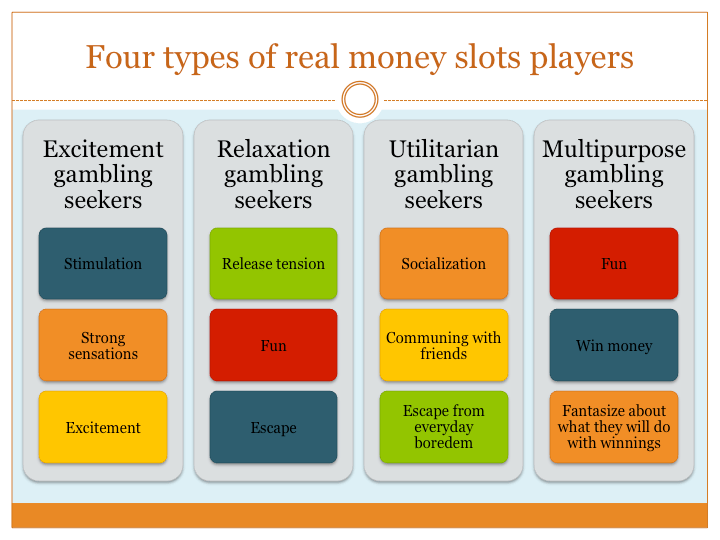
Chen, Shoemaker and Zemke segmented slots players into four clusters based on five sets of factors, and by looking at each cluster it provides a good understanding of the people who play and monetize on social slots products. The five factors are ego-driven, learning, relaxation, excitement and financial rewards. Based on how players ranked the various factors, the authors were able to create four distinct clusters that show different types of players. Below, I recap the four clusters, which you can then use to make your products and marketing better fit for your target customers.
Slide1

The “excitement gambling seekers” cluster

Players who are excitement gambling seekers are playing for the stimulation. Their primary motivation is the strong sensations they experience while playing, the positive memories from winning moments and the thrill of winning or losing. Excitement seekers were the largest cluster of slots players (27.5%) in the research.

The key takeaway about this cluster is they are not playing to win or make money, they are playing for the same reason someone rides a roller coaster, excitement.

The “relaxation gambling seekers” cluster

These customers are playing slots to escape. Their key motivation is to release tension and because the game is fun. They will often credit slots as the best way to relax completely. This cluster is more interested in the experience of playing rather than focusing on winning. This is has more men than women (51.5% to 49.5% respectively). 25.5 percent of slots players make up this cluster.

The key takeaway with this cluster is that they are playing largely for the same reason someone goes to the cinema or reads a book, to relax and escape. As with the excitement cluster, they are not looking for financial rewards.

The “utilitarian gambling seekers” cluster

These are players who play as a means of socialization, communing with friends or as an escape from everyday boredom. It is referred to as utilitarian because the purpose is functional (utilitarian) and players gamble to satisfy experiential motives. About 20 percent of the players sampled fell into this cluster (which was also the oldest group).

These players place little value in some of the features many social casinos focus on. They do not care about themes or progressive jackpots. One of their most important considerations is the minimum bet of the slot machines.

Earlier this month, I wrote about Robert Thaler’s work on behavioural economics, including his theory regarding mental accounting. Mental accounting is a psychological theory of how limited cognition affects spending, saving, and other household behavior. In particular, people group their expenditures into different categories (housing, food, clothes, etc.), with each category corresponding to a separate mental account. Each account has its own budget and its own separate reference point, which results in restricted movement between the accounts. When integrated with the research of Chen, Shoemaker and Zemke, mental accounting explains how people have a set sum to spend on slots and will chose the purchase that allows them to optimize use of those funds.

The “multipurpose gambling seekers” cluster

The multi-purpose cluster, as its name suggests, play for several reasons. Players in this cluster play because slots are fun but also because there is a good chance to win and it is in their budget. These are players who think (fantasize) about what they will do with their winnings and want to make a lot of money. These players normally do not care about themes around games. About 27 percent of slots players are in the multipurpose cluster.

The takeaway with this cluster is that it combines a desire to win money with the entertainment value of playing. These are the players who might seek a real money alternative when it is available but play free to play (social) slots if they are in a location where they do not have access to real money.

How men and women differ

One other interesting insight in this research is the difference between male and female slots players. Many female players were excitement gambling seekers or utilitarian gambling seekers, while male players were relaxation or multipurpose gambling seekers. Thus, if you target different genders, your messaging and promotions should apply to what they are more likely to find important.

Remember these are real money players

The most important takeaway from the above cluster analysis is that it was done with real money land based slots players, not social players. This is critical because even people gambling in the traditional sense are largely not gambling to make money but for excitement, relaxation, etc. Once their motivations are understood, it is obvious why people would spend to play slot machines where the real money opportunity does not exist. As the authors write, “American slot players were mainly motivated by hedonic and experiential motives…gambling is a type of recreation or entertainment in America.” Hence, why social casino is such a strong and growing genre.

Key takeaways

  1. Research shows that there are four types of slots players, with each group having different motivations.
  2. Three of the four groups are driven by non-economic reasons (excitement, relaxation, fun, etc.) to play slots, thus they get the same satisfaction from social casino products that they get from playing real money slots.
  3. Gambling is primarily recreation and entertainment in the US.

Share this:

  • Click to share on Facebook (Opens in new window) Facebook
  • Click to share on LinkedIn (Opens in new window) LinkedIn
Like Loading...
Unknown's avatarAuthor Lloyd MelnickPosted on January 23, 2018January 14, 2018Categories General Social Games Business, Growth, Lloyd's favorite posts, Social CasinoTags excitement, gambling, online gambling, real money online gambling, relaxation, slots, social casino6 Comments on Why people gamble, and pay real money to play social casino games

Get my book on LTV

The definitive book on customer lifetime value, Understanding the Predictable, is now available in both print and Kindle formats on Amazon.

Understanding the Predictable delves into the world of Customer Lifetime Value (LTV), a metric that shows how much each customer is worth to your business. By understanding this metric, you can predict how changes to your product will impact the value of each customer. You will also learn how to apply this simple yet powerful method of predictive analytics to optimize your marketing and user acquisition.

For more information, click here

Follow The Business of Social Games and Casino on WordPress.com

Enter your email address to follow this blog and receive notifications of new posts by email.

Join 791 other subscribers

Most Recent Posts

  • Join me at PDMA Inspire for my talk on new product prioritization
  • Why keep studying?
  • The next three years of this blog
  • Interview with the CEO of Murka on the biggest growth opportunity in gaming, Barak David

Lloyd Melnick

This is Lloyd Melnick’s personal blog.  All views and opinions expressed on this website are mine alone and do not represent those of people, institutions or organizations that I may or may not be associated with in professional or personal capacity.

I am a serial builder of businesses (senior leadership on three exits worth over $700 million), successful in big (Disney, Stars Group/PokerStars, Zynga) and small companies (Merscom, Spooky Cool Labs) with over 20 years experience in the gaming and casino space.  Currently, I am the GM of VGW’s Chumba Casino and on the Board of Directors of Murka Games and Luckbox.

Topic Areas

  • Analytics (114)
  • Bayes' Theorem (8)
  • behavioral economics (8)
  • blue ocean strategy (14)
  • Crowdfunding (4)
  • DBA (2)
  • General Social Games Business (459)
  • General Tech Business (195)
  • Growth (88)
  • International Issues with Social Games (50)
  • Lloyd's favorite posts (101)
  • LTV (54)
  • Machine Learning (10)
  • Metaverse (1)
  • Mobile Platforms (37)
  • Prioritization (1)
  • Social Casino (52)
  • Social Games Marketing (105)
  • thinking fast and slow (5)
  • Uncategorized (33)

Social

  • View CasualGame’s profile on Facebook
  • View @lloydmelnick’s profile on Twitter
  • View lloydmelnick’s profile on LinkedIn

RSS

RSS Feed RSS - Posts

RSS Feed RSS - Comments

Categories

  • Analytics (114)
  • Bayes' Theorem (8)
  • behavioral economics (8)
  • blue ocean strategy (14)
  • Crowdfunding (4)
  • DBA (2)
  • General Social Games Business (459)
  • General Tech Business (195)
  • Growth (88)
  • International Issues with Social Games (50)
  • Lloyd's favorite posts (101)
  • LTV (54)
  • Machine Learning (10)
  • Metaverse (1)
  • Mobile Platforms (37)
  • Prioritization (1)
  • Social Casino (52)
  • Social Games Marketing (105)
  • thinking fast and slow (5)
  • Uncategorized (33)

Archives

  • September 2023
  • December 2021
  • July 2021
  • March 2021
  • February 2021
  • January 2021
  • December 2020
  • November 2020
  • October 2020
  • September 2020
  • August 2020
  • July 2020
  • June 2020
  • May 2020
  • April 2020
  • March 2020
  • February 2020
  • January 2020
  • November 2019
  • October 2019
  • September 2019
  • June 2019
  • May 2019
  • April 2019
  • March 2019
  • February 2019
  • January 2019
  • December 2018
  • June 2018
  • May 2018
  • April 2018
  • March 2018
  • February 2018
  • January 2018
  • December 2017
  • June 2017
  • May 2017
  • April 2017
  • March 2017
  • February 2017
  • January 2017
  • December 2016
  • November 2016
  • October 2016
  • September 2016
  • June 2016
  • May 2016
  • April 2016
  • March 2016
  • February 2016
  • January 2016
  • December 2015
  • November 2015
  • October 2015
  • September 2015
  • July 2015
  • June 2015
  • May 2015
  • April 2015
  • March 2015
  • February 2015
  • January 2015
  • December 2014
  • November 2014
  • October 2014
  • September 2014
  • August 2014
  • July 2014
  • June 2014
  • May 2014
  • April 2014
  • March 2014
  • February 2014
  • January 2014
  • December 2013
  • November 2013
  • October 2013
  • September 2013
  • August 2013
  • July 2013
  • June 2013
  • May 2013
  • April 2013
  • March 2013
  • February 2013
  • January 2013
  • December 2012
  • November 2012
  • October 2012
  • September 2012
  • August 2012
  • July 2012
  • June 2012
  • May 2012
  • April 2012
  • March 2012
  • February 2012
  • January 2012
  • December 2011
  • November 2011
  • October 2011
  • September 2011
  • August 2011
  • July 2011
  • June 2011
  • May 2011
  • December 2010
December 2025
S M T W T F S
 123456
78910111213
14151617181920
21222324252627
28293031  
« Sep    

by Lloyd Melnick

All posts by Lloyd Melnick unless specified otherwise
Google+

Enter your email address to subscribe to this blog and receive notifications of new posts by email.

Join 791 other subscribers
Follow Lloyd Melnick on Quora

RSS HBR Blog

  • How One Manufacturer Achieved Net Zero at Zero Cost
  • What Can U.S. Employers Do About Rising Healthcare Costs?
  • When You Have to Execute a Strategy You Disagree With
  • 4 Ways to Build Durable Relationships with Your Most Important Customers
  • What Jargon Says About Your Company Culture
  • Research: When Used Correctly, LLMs Can Unlock More Creative Ideas
  • Your New Role Requires Strategic Thinking…But You’re Stuck in the Weeds
  • For Circular Economy Innovation, Look to the Global South
  • Why Great Leaders Focus on the Details
  • Corporate Disclosure in the Age of AI

RSS Techcrunch

  • An error has occurred; the feed is probably down. Try again later.

RSS MIT Sloan Management Review Blog

  • AI Coding Tools: The Productivity Trap Most Companies Miss
  • How Procter & Gamble Uses AI to Unlock New Insights From Data
  • Rewire Organizational Knowledge With GenAI
  • Hungry for Learning: Wendy’s Will Croushorn
  • Beat Burnout: 10 Essential MIT SMR Reads
  • How Leaders Stay True to Themselves and Their Stakeholders
  • Our Guide to the Winter 2026 Issue
  • Broadening Future Perspectives at the Bank of England
  • A Faster Way to Build Future Scenarios
  • Assess What Is Certain in a Sea of Unknowns
The Business of Social Games and Casino Website Powered by WordPress.com.
  • Subscribe Subscribed
    • The Business of Social Games and Casino
    • Join 726 other subscribers
    • Already have a WordPress.com account? Log in now.
    • The Business of Social Games and Casino
    • Subscribe Subscribed
    • Sign up
    • Log in
    • Report this content
    • View site in Reader
    • Manage subscriptions
    • Collapse this bar
 

Loading Comments...
 

    %d