Skip to content

The Business of Social Games and Casino

How to succeed in the mobile game space by Lloyd Melnick

Tag: Sales

Optimal tools to measure the impact from sales and promotions

Optimal tools to measure the impact from sales and promotions

One of the biggest challenges game and iGaming companies face is measuring the impact of sales but a presentation by Google’s Adam Carpenter shows effective analytic tools for optimizing your promotional strategy. Most social game companies regularly run offers, from 20 percent off to double your chips to free tournament tickets with purchases; and these offers increase revenue immediately.

The problem is that it is very challenging to measure the overall and long-term impact of the sales. While it may have tripled revenue the three days the sale ran, how much did it depress revenue the following days or weeks (or preceding days/week if people waited for the sale). Many very smart analysts and product managers believe that sales and promotions create zero additional revenue, it only shifts revenue between periods (which is great if you are trying to hit a quarterly goal, not as good if you are trying to grow a product). Analysis of before and after the promotion or estimates of hangover are somewhat arbitrary and self-serving (when do you start, when do you end, what baseline do you take, etc.).

It is also important to understand what sales frequency is most beneficial Every game is different and some games generate the most absolute revenue from running frequent sales while others do best running a few large sales. It depends on your target customer, their expectations, competitive products, the game mechanics, frequency of content releases, etc. Just looking at revenue generated from the sales, however, makes it very challenging to understand how the type of sales are driving performance. The graph below, comparing regular sales to running big sale events, is difficult to interpret and could easily be misinterpreted:
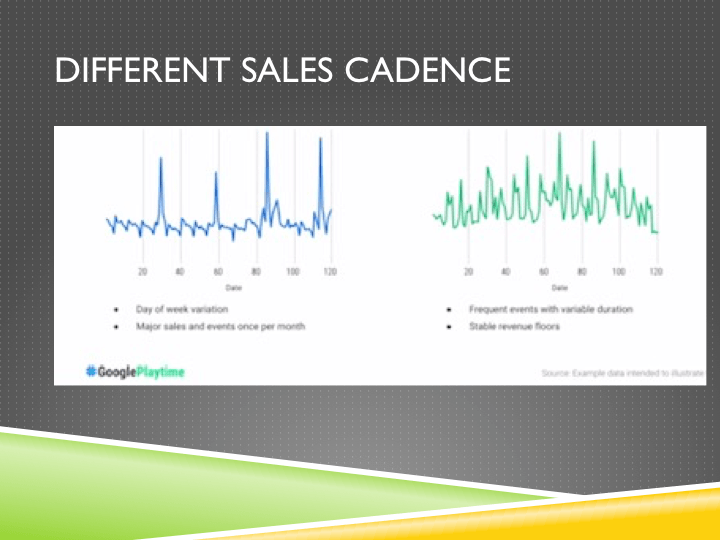
slide7

The lack of a good technique for measuring the impact of sales has far-reaching implications. Companies do not know if they should run sales, how frequently to run them and the best offers to make. Getting it wrong not only could shift revenue but it may significantly depress it if players are waiting for sales and do not monetize. A mistake can also lead to a misallocation of resources, are the two product managers planning sales more valuable creating events or new features?

Monetization Tree

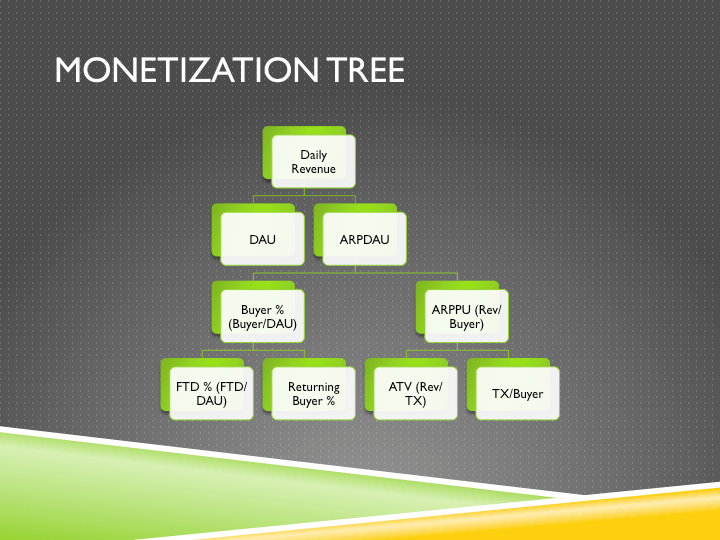
Prior to being able to analyze promotions, Carpenter suggests you understand how your game generates revenue. He does this with the revenue tree, which shows how daily revenue is driven by DAU (daily average users) and average revenue per daily unique (ARPDAU):
slide1

When Carpenter breaks down the drivers of ARPDAU, he points out that focusing on buyer percentage creates a healthier product than those that generate most of their revenue from big purchases (a high ARPPU) from a few players. He also points out it is much easier to increase ARPPU because those players have already chosen to pay but long-term your game will be safer and grow better by impacting buyer percentage.

Revenue heartbeat

After initially watching Carpenter’s presentation, we implemented the revenue heartbeat and I found it provides great insights into the effectiveness of your sale calendar. It allows you to visualize how sales are working over time.

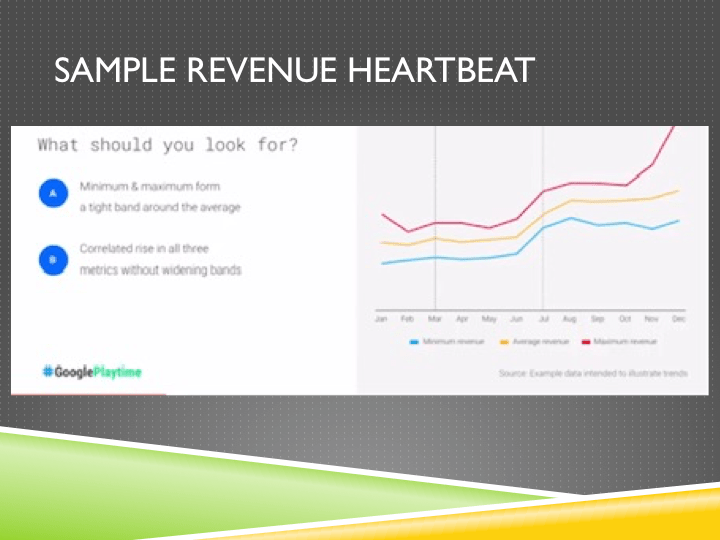
To create a revenue heartbeat, for any given month, calculate the minimum revenue day, the maximum revenue day and the average revenue for the month. Below is a sample revenue heartbeat from Carpenter’s deck:
slide2

Your game has a healthy heartbeat if there is a tight band around the average daily revenue. You do not want to see wild variations on a monthly basis, instead you want to see that min and max form a tight band around the average. No wild variations on a month to month basis and that average revenue is growing, showing the game is growing healthily and players are engaged. The image below shows a healthy revenue heartbeat, despite the boost due to a Black Friday sale:
slide3

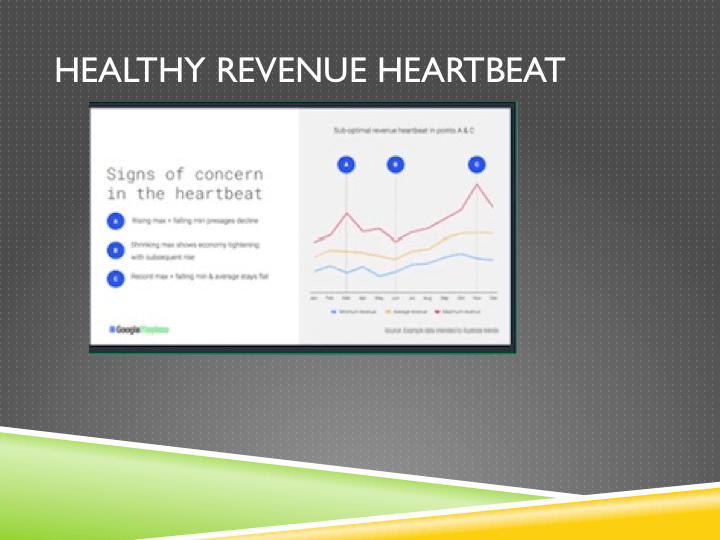
Conversely, if average revenue is regularly decreasing and you see multiple months with big gaps between average revenue and min/max, then you should be concerned. Products rarely grow when there is a negative heartbeat, below is an example from Carpenter:
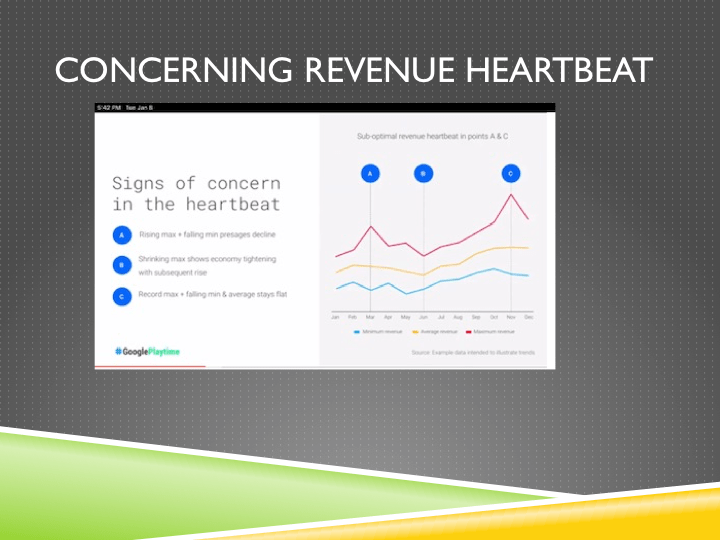
slide4

When using the revenue heartbeat, do not focus on the average revenue but instead the spread between average and min/max and how it changes over time. Average revenue is also dependent on DAU (see revenue tree) and steady growth in average revenue could be due to marketing spend while masking a sick product.

Coefficient of Variation (CoV)

The coefficient of variation (CoV) complements the monetization heartbeat in helping understand if your promotional and sale behavior is optimal. Carpenter points out that CoV correlates highly with revenue growth, a low CoV means your game is much more likely to see strong growth. Games with the lowest CoV have highest month over month growth, games with high volatility experience much less growth.
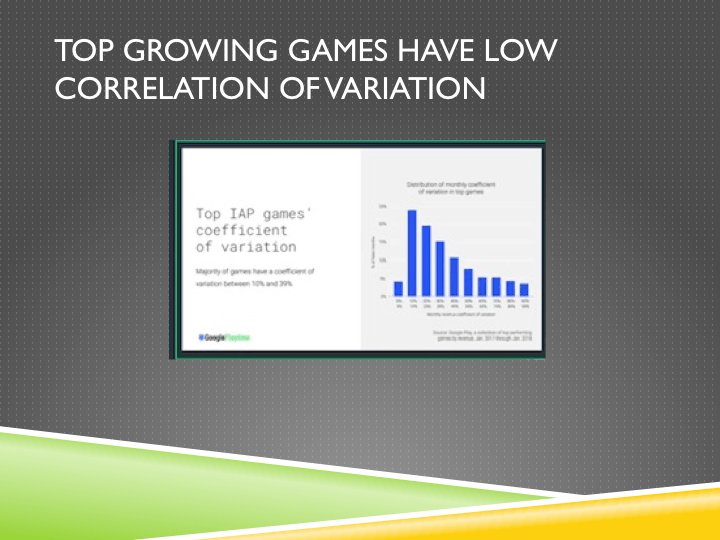
slide5

It is a great KPI to understand the effectiveness of your sales and whether you are running them too frequently. To calculate the CoV, you take the monthly standard deviation of daily revenue and divide it by the mean revenue.

The chart below shows you want to have a CoV between 10-39 percent, as that is where the majority of fast growing games fall:
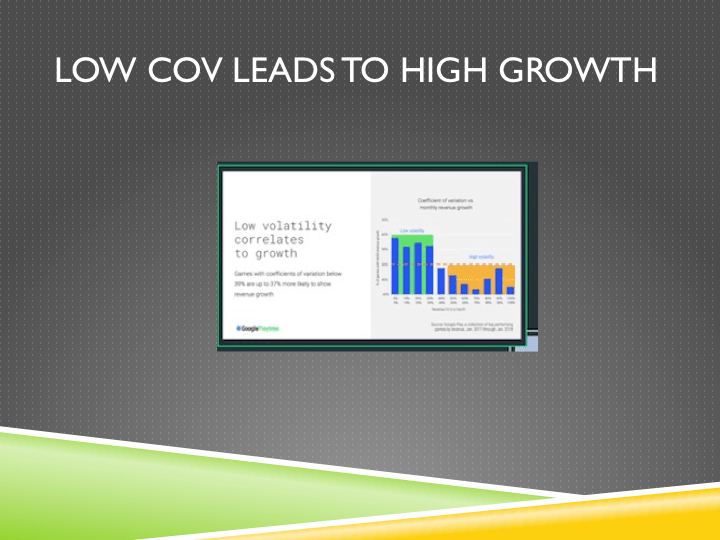
Slide6.png

If you are experiencing a high CoV, you should work on finding alternatives to large sales. Some options you can try include:

  • Increasing the frequency but lowering the value of the promotion, many small sales.
  • Tie sales to the release of new content, so there is a drain on resources
  • Become predictably unpredictable, have players expect something good every time they play but not know what to expect
  • Run demand events targeted to increase player engagement
  • Release time limited content
  • Use elite gatcha crates/offers

Understanding sales performance allows for optimization

By tracking your revenue heartbeat and Coefficient of Variation, you can understand how sales are impacting your performance. Given that growth is tied to low volatility, it helps you identify whether you should adjust your sales and promotion strategy. These tools also allow you to track your game over time; so even if the strategy does not change you will see if players start adapting their behavior, thus requiring a change in your strategy. While these metrics were built for mobile games, they actually can apply to any product or business, even retail.

Key Takeaways

  1. Understanding how sales and promotions are impacting your game is critical to growing revenue.
  2. The revenue heartbeat visually shows how well revenue is tracking with your big sales, you want to see a small gap between the three lines. To create a revenue heartbeat, for any given month, calculate the minimum revenue day, the maximum revenue day and the average revenue for the month.
  3. The coefficient of variation (CoV) shows how volatile your revenue is and a low CoV is correlated with growth. To calculate the CoV take the monthly standard deviation of daily revenue and divide it by the mean revenue.
Adam Carpenter’s full presentation:

Share this:

  • Click to share on Facebook (Opens in new window) Facebook
  • Click to share on LinkedIn (Opens in new window) LinkedIn
Like Loading...
Unknown's avatarAuthor Lloyd MelnickPosted on March 12, 2019January 9, 2019Categories Analytics, General Social Games Business, General Tech Business, Lloyd's favorite posts, Social CasinoTags Coefficient of variation, promotions, revenue, Revenue Heartbeat, SalesLeave a comment on Optimal tools to measure the impact from sales and promotions

Using scarcity to increase revenue

I recently came across a great post, 9 Essential Ways to Use Scarcity to Increase Sales, on how to use scarcity to increase sales, something we all strive for. Scarcity is a technique used by traditional retailers for ages but something that applies to digital and virtual goods as well. By creating a perceived scarcity, customers are more likely to make a purchase quickly. It boils down to the phrase, “you always want what you can’t get.”

Scarcity promotions

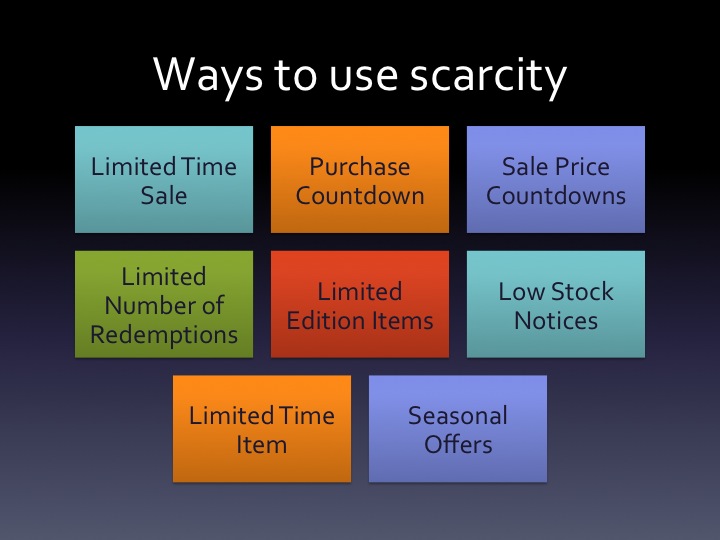
There are several ways to use scarcity, including for virtual items:

  • Limited time sale. Make an offer that lasts for only a limited time. For example, players can get twice the normal amount of virtual currency with a purchase if the purchase is made in the next 24 hours.
  • Purchase countdown. Building on a limited time sale, Putting a timer or countdown within a sales context means defining some scarcity parameters. When the customer has a firm grasp on how much time he or she has left to make a decision, it adds a sense of urgency to the process.
  • Sale price countdowns. Countdowns can also be used in the context of a limited time sale price to remind viewers how much time is left to act before the discounted offer goes away.
  • Limited number of redemptions. Offer a sale that is only available for the first X customers.
  • Limited edition item. Sell a product where there are only a limited number made. This can be modified for virtual goods, there will only be a certain number of the good sold.
  • Low stock notices. While largely for retail, this can also be used with virtual goods, particularly limited edition virtual goods.
  • Limited time item. A virtual item or package that is only available for a certain number of days or hours.
  • Seasonal offers. A sale or item only available for a certain season. It can be anything from a Halloween Pumpkin latte to a Independence Day Virtual Chip bundle.

Slide1

Scarcity basics

For scarcity to work, there are several criteria that you need to meet. The first key is that it is useful. Making something that has no value scarce does not magically impart value on the item or offering. There needs to be an underlying value that can be accentuated by scarcity.

The offering should be transferable. By allowing people to share the offer, the offer filters to those who value it. Finally, you need to be able to own it, even a virtual good. One of the values of scarcity is that you can show it off and there is no way to show off something you cannot possess.

There are several reasons why scarcity works, and understand these reasons can help you create a stronger offering:

  • Scarce items feel exclusive.
  • Scarce items appear more valuable.
  • Scarce items make people feel powerful.

In the article, the authors also point to four limits on using scarcity:

  1. Test to know what works. As with anything, testing is always recommended. AB test different techniques, time limits, product limits, etc.
  2. Too much pressure is a bad thing. Give the user or customer time to make their decision.
  3. Everything in moderation. Limited edition or limited time sales work if they feel special, if there is one every day people soon realize they are only a sales tactic.
  4. Scarcity tactics are not a fix for lagging sales. If your product is not appealing, offering less of it will not turn things around. These tactics make a good product more successful, they are not a way to trick people into using a bad product.

Scarcity is a tool

Scarcity can be a very useful tool when building your promotion strategy. It is not a silver bullet but used effectively can help improve sales and conversions.

Key takeaways

  • Scarcity, or perceived scarcity, is a very useful tool for increasing sales.
  • Scarcity works because it makes items feel exclusive, appear more valuable and make the buyers feel powerful.
  • Scarcity is best used in limited time sales or limited edition items.

Share this:

  • Click to share on Facebook (Opens in new window) Facebook
  • Click to share on LinkedIn (Opens in new window) LinkedIn
Like Loading...
Unknown's avatarAuthor Lloyd MelnickPosted on May 4, 2016April 18, 2016Categories General Social Games Business, Growth, Social Games MarketingTags promotions, Sales, ScarcityLeave a comment on Using scarcity to increase revenue

Getting coffee is not a sales strategy

One issue I find perpetually frustrating is how often companies neglect the goal of their sales efforts: Getting a deal. As someone who has been on both sides of the fence—initiating partnerships and being sold to –—I am particularly sensitive when I see people making fundamental mistakes.

Focus on the goal

The first manifestation of this problem is when people focus on arranging meetings (or calls), rather than qualifying potential partners and seeing if there is a reason to meet. There is no value in a meeting just for meeting’s sake.

Trade shows are a great example of people losing track of the goal. Prior to a major trade show, even if I am not attending, I got multiple meeting requests. Very rarely do people try to qualify whether or not it is worth their time meeting. Given that everyone has a limited schedule, they are potentially not only wasting 30 minutes with me but more importantly losing the opportunity to meet with someone who may need their product.

Also, make sure you are meeting with the right person. I am also often not the right person they should be meeting with at my company yet people still persist in trying to meet. If the area is one I focus on, not only will I not be able to understand completely the value that you are offering but I also will not be able to convey what our company is looking for. By not qualifying the person you are meeting with, or worse insisting on a meeting with someone who is not involved in your product area, you not only waste your time but set up a bad meeting that could hurt your company’s reputation at the partner company.

The corollary to this mistake is not pursuing an opportunity just because the person cannot meet. If you email someone to arrange a trade show meeting and they respond that they are not attending, that should not be the end of the conversation. Just because they are not attending does not mean they do not need your product or service. If you get a response that someone cannot meet at a trade show because they are not going, you should then discuss further your offering and see if it is a fit. The fact that the person even responded to your meeting request suggests there is some underlying opportunity. Continue reading “Getting coffee is not a sales strategy”

Share this:

  • Click to share on Facebook (Opens in new window) Facebook
  • Click to share on LinkedIn (Opens in new window) LinkedIn
Like Loading...
Unknown's avatarAuthor Lloyd MelnickPosted on September 23, 2014October 15, 2014Categories General Social Games BusinessTags business development, meeting, Sales5 Comments on Getting coffee is not a sales strategy

How to sell

In this post, I want to share what I consider the key to being successful in business development and corporate development. Sales has probably generated more books, conferences, motivational speakers, etc., than any other business topic. While some provide useful tidbits, many are a waste of time, and success is much simpler than they make it out to be.

First, I want to provide some background on why you should listen to me about sales, business development (bizdev) and corporate development (corpdev). I have been doing bizdev and corpdev for over 20 years (since 1993), have been self-taught and have had some success. I have been part of the executive team that sold three companies for a total value of over $650 million, including initiating and leading the negotiations on one of the deals. I have arranged over 200 licensing deals, including when I was at a principal in a very small publisher and was still able to consummate deals with companies like Paramount, National Geographic, Starz, A+E, CAA and many others. In fact, a few years ago in my cover letters I used to liken my bizdev acumen to Michael Jordan’s basketball talent (I was more arrogant in those days).

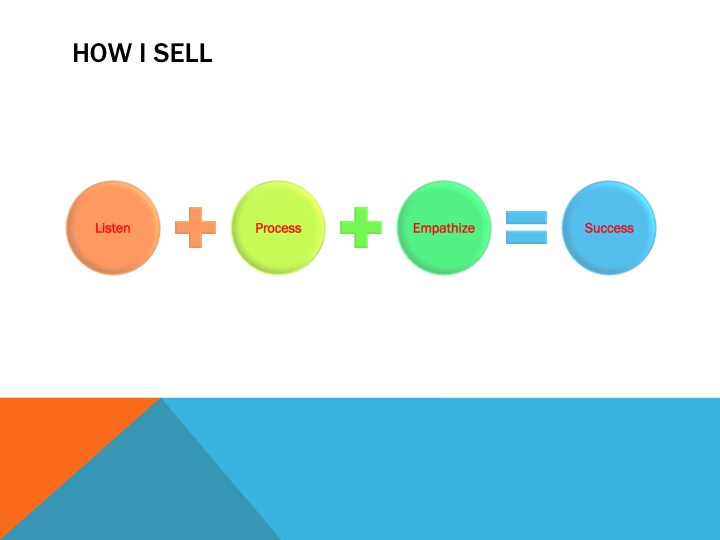
I am not writing to brag about what I have done (please don’t take it that way) but because the process is not as difficult as many “sales professionals” make it out to be. It all comes down to truly listening to the person on the other side of the negotiations and empathizing with that person. Both the listening and the emphasizing are crucial, and that is where many people fail.

Slide1

Listening

Let’s start with listening. Almost everyone has heard and knows that an effective sales person has to listen, but funny thing is about 75 percent of those I run into actually do. Most people, including (and maybe largely) salespeople like to hear themselves talk. They may be talking about how great their product or service is, they may be talking about what they did on Saturday night, they may be talking about who they think will win the World Cup, but most sales people prefer to talk. Rather than thinking about how you sell, think about the sales people you have come across and I will bet you agree with my 75-percent-plus estimation.

The extension of this problem is asking a lot of canned questions but not listening to the answers. Even if you overcome your desire to talk, it is not sufficient to get the other party to spend the bulk of the meeting or call talking. Many bizdev professionals have a checklist of questions they will ask to a potential partner (or have acquired a checklist from one of the many aforementioned books or seminars). They may write down the response but they do not actually process the information, which is the key to really listening . Continue reading “How to sell”

Share this:

  • Click to share on Facebook (Opens in new window) Facebook
  • Click to share on LinkedIn (Opens in new window) LinkedIn
Like Loading...
Unknown's avatarAuthor Lloyd MelnickPosted on September 11, 2014October 14, 2014Categories General Social Games Business, Lloyd's favorite postsTags business development, corporate development, Listening, Sales4 Comments on How to sell

Get my book on LTV

The definitive book on customer lifetime value, Understanding the Predictable, is now available in both print and Kindle formats on Amazon.

Understanding the Predictable delves into the world of Customer Lifetime Value (LTV), a metric that shows how much each customer is worth to your business. By understanding this metric, you can predict how changes to your product will impact the value of each customer. You will also learn how to apply this simple yet powerful method of predictive analytics to optimize your marketing and user acquisition.

For more information, click here

Follow The Business of Social Games and Casino on WordPress.com

Enter your email address to follow this blog and receive notifications of new posts by email.

Join 791 other subscribers

Most Recent Posts

  • Join me at PDMA Inspire for my talk on new product prioritization
  • Why keep studying?
  • The next three years of this blog
  • Interview with the CEO of Murka on the biggest growth opportunity in gaming, Barak David

Lloyd Melnick

This is Lloyd Melnick’s personal blog.  All views and opinions expressed on this website are mine alone and do not represent those of people, institutions or organizations that I may or may not be associated with in professional or personal capacity.

I am a serial builder of businesses (senior leadership on three exits worth over $700 million), successful in big (Disney, Stars Group/PokerStars, Zynga) and small companies (Merscom, Spooky Cool Labs) with over 20 years experience in the gaming and casino space.  Currently, I am the GM of VGW’s Chumba Casino and on the Board of Directors of Murka Games and Luckbox.

Topic Areas

  • Analytics (114)
  • Bayes' Theorem (8)
  • behavioral economics (8)
  • blue ocean strategy (14)
  • Crowdfunding (4)
  • DBA (2)
  • General Social Games Business (459)
  • General Tech Business (195)
  • Growth (88)
  • International Issues with Social Games (50)
  • Lloyd's favorite posts (101)
  • LTV (54)
  • Machine Learning (10)
  • Metaverse (1)
  • Mobile Platforms (37)
  • Prioritization (1)
  • Social Casino (52)
  • Social Games Marketing (105)
  • thinking fast and slow (5)
  • Uncategorized (33)

Social

  • View CasualGame’s profile on Facebook
  • View @lloydmelnick’s profile on Twitter
  • View lloydmelnick’s profile on LinkedIn

RSS

RSS Feed RSS - Posts

RSS Feed RSS - Comments

Categories

  • Analytics (114)
  • Bayes' Theorem (8)
  • behavioral economics (8)
  • blue ocean strategy (14)
  • Crowdfunding (4)
  • DBA (2)
  • General Social Games Business (459)
  • General Tech Business (195)
  • Growth (88)
  • International Issues with Social Games (50)
  • Lloyd's favorite posts (101)
  • LTV (54)
  • Machine Learning (10)
  • Metaverse (1)
  • Mobile Platforms (37)
  • Prioritization (1)
  • Social Casino (52)
  • Social Games Marketing (105)
  • thinking fast and slow (5)
  • Uncategorized (33)

Archives

  • September 2023
  • December 2021
  • July 2021
  • March 2021
  • February 2021
  • January 2021
  • December 2020
  • November 2020
  • October 2020
  • September 2020
  • August 2020
  • July 2020
  • June 2020
  • May 2020
  • April 2020
  • March 2020
  • February 2020
  • January 2020
  • November 2019
  • October 2019
  • September 2019
  • June 2019
  • May 2019
  • April 2019
  • March 2019
  • February 2019
  • January 2019
  • December 2018
  • June 2018
  • May 2018
  • April 2018
  • March 2018
  • February 2018
  • January 2018
  • December 2017
  • June 2017
  • May 2017
  • April 2017
  • March 2017
  • February 2017
  • January 2017
  • December 2016
  • November 2016
  • October 2016
  • September 2016
  • June 2016
  • May 2016
  • April 2016
  • March 2016
  • February 2016
  • January 2016
  • December 2015
  • November 2015
  • October 2015
  • September 2015
  • July 2015
  • June 2015
  • May 2015
  • April 2015
  • March 2015
  • February 2015
  • January 2015
  • December 2014
  • November 2014
  • October 2014
  • September 2014
  • August 2014
  • July 2014
  • June 2014
  • May 2014
  • April 2014
  • March 2014
  • February 2014
  • January 2014
  • December 2013
  • November 2013
  • October 2013
  • September 2013
  • August 2013
  • July 2013
  • June 2013
  • May 2013
  • April 2013
  • March 2013
  • February 2013
  • January 2013
  • December 2012
  • November 2012
  • October 2012
  • September 2012
  • August 2012
  • July 2012
  • June 2012
  • May 2012
  • April 2012
  • March 2012
  • February 2012
  • January 2012
  • December 2011
  • November 2011
  • October 2011
  • September 2011
  • August 2011
  • July 2011
  • June 2011
  • May 2011
  • December 2010
December 2025
S M T W T F S
 123456
78910111213
14151617181920
21222324252627
28293031  
« Sep    

by Lloyd Melnick

All posts by Lloyd Melnick unless specified otherwise
Google+

Enter your email address to subscribe to this blog and receive notifications of new posts by email.

Join 791 other subscribers
Follow Lloyd Melnick on Quora

RSS HBR Blog

  • How One Manufacturer Achieved Net Zero at Zero Cost
  • What Can U.S. Employers Do About Rising Healthcare Costs?
  • When You Have to Execute a Strategy You Disagree With
  • 4 Ways to Build Durable Relationships with Your Most Important Customers
  • What Jargon Says About Your Company Culture
  • Research: When Used Correctly, LLMs Can Unlock More Creative Ideas
  • Your New Role Requires Strategic Thinking…But You’re Stuck in the Weeds
  • For Circular Economy Innovation, Look to the Global South
  • Why Great Leaders Focus on the Details
  • Corporate Disclosure in the Age of AI

RSS Techcrunch

  • An error has occurred; the feed is probably down. Try again later.

RSS MIT Sloan Management Review Blog

  • AI Coding Tools: The Productivity Trap Most Companies Miss
  • How Procter & Gamble Uses AI to Unlock New Insights From Data
  • Rewire Organizational Knowledge With GenAI
  • Hungry for Learning: Wendy’s Will Croushorn
  • Beat Burnout: 10 Essential MIT SMR Reads
  • How Leaders Stay True to Themselves and Their Stakeholders
  • Our Guide to the Winter 2026 Issue
  • Broadening Future Perspectives at the Bank of England
  • A Faster Way to Build Future Scenarios
  • Assess What Is Certain in a Sea of Unknowns
The Business of Social Games and Casino Website Powered by WordPress.com.
  • Subscribe Subscribed
    • The Business of Social Games and Casino
    • Join 726 other subscribers
    • Already have a WordPress.com account? Log in now.
    • The Business of Social Games and Casino
    • Subscribe Subscribed
    • Sign up
    • Log in
    • Report this content
    • View site in Reader
    • Manage subscriptions
    • Collapse this bar
 

Loading Comments...
 

    %d