Skip to content

The Business of Social Games and Casino

How to succeed in the mobile game space by Lloyd Melnick

Tag: scheduling

More effective project management

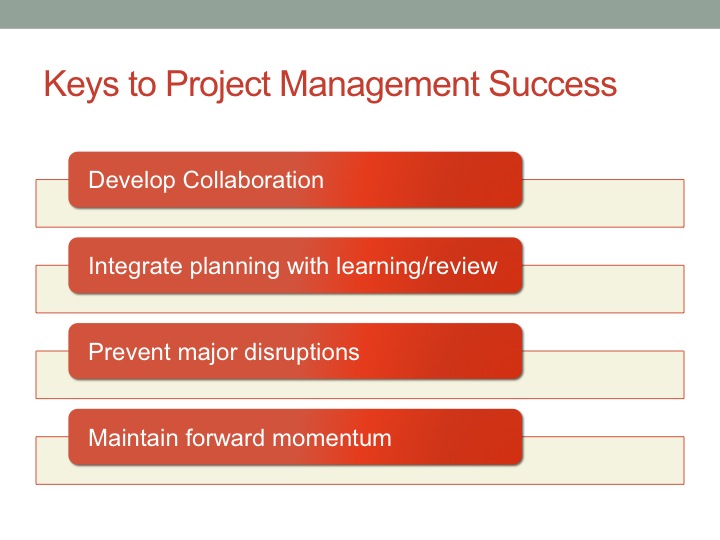
One of the biggest challenges in the game space, and the overall tech space, is project management. Many companies do not even expect to hit the dates they have set. This situation creates planning issues, cash flow problems and prompts investors to lose confidence. An article in the MIT Sloan Management Review, “What Successful Project Managers Do,” studied 150 successful projects and determined four key initiatives by project managers tied to success.

The article first shows three different types of events that can impact schedule. These events can be classified according to their level of predictability as follows:

  • Events that were anticipated but whose impacts were much stronger than expected
  • Events that could not have been predicted
  • Events that could have been predicted but were not

All three types of events can become problems that need to be addressed by a project manager.
Slide1

Develop collaboration

Since project progress depends on the contribution of individuals who represent different disciplines (e.g., art, design, programming) and are affiliated with diverse parties, collaboration is crucial for the early detection of problems as well as the quick development and smooth implementation of solutions.

As the authors point out, “most projects are characterized by an inherent incompatibility: The various parties to the project are loosely coupled, whereas the tasks themselves are tightly coupled. When unexpected events affect one task, many other interdependent tasks are quickly affected. Yet the direct responsibility for these tasks is distributed among various loosely coupled parties, who are unable to coordinate their actions and provide a timely response. Project success, therefore, requires both interdependence and trust among the various parties.”

If one or several of the people involved in the project believes that project planning and contractual documents provide sufficient protection from unexpected problems, developing collaboration among all the parties may require creative and bold practices. Thus, it is important to select the right people for the project and develop mutual interdependence and trust.

Integrate planning and review with learning

Project managers faced with unexpected events employ a “rolling wave” approach to planning. Recognizing that firm commitments cannot be made on the basis of volatile information, they create plans in waves as the project unfolds and information becomes more reliable. With their teams, they develop detailed short-term plans with firm commitments while also preparing tentative long-term plans with fewer details. To ensure that project milestones and objectives are met, these long-term plans include backup systems or surplus human resources.

One key difference between the traditional planning approach, in which both short- and long-term plans are prepared in great detail, and the rolling wave approach becomes evident when implementation deviates from the plan. In the traditional planning approach, the project team attempts to answer the question: Why didn’t our performance yesterday conform to the original plan? In the rolling wave approach, project managers also attempt to answer the question: What can we learn from the performance data to improve the next cycle of planning? In particular, they attempt to learn from their mistakes—to prevent an unexpected event from recurring. The successful project manager develops stable short-term plans and flexible long term plans while conducting learning-based project reviews.

Prevent Major Disruptions

Successful project managers never stop expecting surprises, even though they may effect major remedial changes only a few times during a project. They are constantly anticipating disruptions and maintaining the flexibility to respond proactively. The key is to anticipate and cope proactively with a few major problems.

Maintain Forward Momentum

When unexpected events affect one task, many other interdependent tasks may also be quickly impacted. Thus, solving problems as soon as they emerge is vital for maintaining work progress. Also in many situations, corrective action is possible only during a brief window.

In working to maintain a forward momentum, the manager seeks to avoid stalemates. A good project manager resolves problems by hands-on engagement, frequent face-to-face communication and moving about frequently.

What you should do as a leader

Although every project manager tries to minimize the frequency and negative impact of unexpected events, in today’s dynamic environment such events will still occur. Acknowledging the emergence of a problem is a necessary first step, allowing the project manager to respond quickly and effectively. Some organizations assume that almost all problems can be prevented if the project manager is competent enough—resulting in project managers who are hesitant to admit that they are facing an emerging problem.

By assuming the four roles discussed in this article, the successful project managers we studied are both intention- and event-driven and embrace all three orientations. Developing collaboration requires them to be people-oriented. Integrating planning and review with learning requires them to be information-oriented. Preventing major disruptions requires them to be action-oriented. Finally, maintaining forward momentum, which is pursued throughout a project, requires them to adopt all three orientations. Senior managers must ensure that all three orientations are considered when selecting project managers and developing project management methodologies.

Key takeaways

  1. Good project managers are critical for getting projects done on schedule.
  2. Effective project managers develop collaboration between different disciplines on their team, integrate planning with review and learning, focus on preventing major disruptions and maintain forward momentum.
  3. An effective leader will let their project managers respond quickly and effectively rather than create a culture of fear so problems are hidden.
Like Loading...
Unknown's avatarAuthor Lloyd MelnickPosted on April 28, 2015January 4, 2016Categories General Social Games Business, General Tech BusinessTags collaboration, disruptions, project management, scheduling2 Comments on More effective project management

Get my book on LTV

The definitive book on customer lifetime value, Understanding the Predictable, is now available in both print and Kindle formats on Amazon.

Understanding the Predictable delves into the world of Customer Lifetime Value (LTV), a metric that shows how much each customer is worth to your business. By understanding this metric, you can predict how changes to your product will impact the value of each customer. You will also learn how to apply this simple yet powerful method of predictive analytics to optimize your marketing and user acquisition.

For more information, click here

Follow The Business of Social Games and Casino on WordPress.com

Enter your email address to follow this blog and receive notifications of new posts by email.

Join 791 other subscribers

Most Recent Posts

  • Join me at PDMA Inspire for my talk on new product prioritization
  • Why keep studying?
  • The next three years of this blog
  • Interview with the CEO of Murka on the biggest growth opportunity in gaming, Barak David

Lloyd Melnick

This is Lloyd Melnick’s personal blog.  All views and opinions expressed on this website are mine alone and do not represent those of people, institutions or organizations that I may or may not be associated with in professional or personal capacity.

I am a serial builder of businesses (senior leadership on three exits worth over $700 million), successful in big (Disney, Stars Group/PokerStars, Zynga) and small companies (Merscom, Spooky Cool Labs) with over 20 years experience in the gaming and casino space.  Currently, I am the GM of VGW’s Chumba Casino and on the Board of Directors of Murka Games and Luckbox.

Topic Areas

  • Analytics (114)
  • Bayes' Theorem (8)
  • behavioral economics (8)
  • blue ocean strategy (14)
  • Crowdfunding (4)
  • DBA (2)
  • General Social Games Business (459)
  • General Tech Business (195)
  • Growth (88)
  • International Issues with Social Games (50)
  • Lloyd's favorite posts (101)
  • LTV (54)
  • Machine Learning (10)
  • Metaverse (1)
  • Mobile Platforms (37)
  • Prioritization (1)
  • Social Casino (52)
  • Social Games Marketing (105)
  • thinking fast and slow (5)
  • Uncategorized (33)

Social

  • View CasualGame’s profile on Facebook
  • View @lloydmelnick’s profile on Twitter
  • View lloydmelnick’s profile on LinkedIn

RSS

RSS Feed RSS - Posts

RSS Feed RSS - Comments

Categories

  • Analytics (114)
  • Bayes' Theorem (8)
  • behavioral economics (8)
  • blue ocean strategy (14)
  • Crowdfunding (4)
  • DBA (2)
  • General Social Games Business (459)
  • General Tech Business (195)
  • Growth (88)
  • International Issues with Social Games (50)
  • Lloyd's favorite posts (101)
  • LTV (54)
  • Machine Learning (10)
  • Metaverse (1)
  • Mobile Platforms (37)
  • Prioritization (1)
  • Social Casino (52)
  • Social Games Marketing (105)
  • thinking fast and slow (5)
  • Uncategorized (33)

Archives

  • September 2023
  • December 2021
  • July 2021
  • March 2021
  • February 2021
  • January 2021
  • December 2020
  • November 2020
  • October 2020
  • September 2020
  • August 2020
  • July 2020
  • June 2020
  • May 2020
  • April 2020
  • March 2020
  • February 2020
  • January 2020
  • November 2019
  • October 2019
  • September 2019
  • June 2019
  • May 2019
  • April 2019
  • March 2019
  • February 2019
  • January 2019
  • December 2018
  • June 2018
  • May 2018
  • April 2018
  • March 2018
  • February 2018
  • January 2018
  • December 2017
  • June 2017
  • May 2017
  • April 2017
  • March 2017
  • February 2017
  • January 2017
  • December 2016
  • November 2016
  • October 2016
  • September 2016
  • June 2016
  • May 2016
  • April 2016
  • March 2016
  • February 2016
  • January 2016
  • December 2015
  • November 2015
  • October 2015
  • September 2015
  • July 2015
  • June 2015
  • May 2015
  • April 2015
  • March 2015
  • February 2015
  • January 2015
  • December 2014
  • November 2014
  • October 2014
  • September 2014
  • August 2014
  • July 2014
  • June 2014
  • May 2014
  • April 2014
  • March 2014
  • February 2014
  • January 2014
  • December 2013
  • November 2013
  • October 2013
  • September 2013
  • August 2013
  • July 2013
  • June 2013
  • May 2013
  • April 2013
  • March 2013
  • February 2013
  • January 2013
  • December 2012
  • November 2012
  • October 2012
  • September 2012
  • August 2012
  • July 2012
  • June 2012
  • May 2012
  • April 2012
  • March 2012
  • February 2012
  • January 2012
  • December 2011
  • November 2011
  • October 2011
  • September 2011
  • August 2011
  • July 2011
  • June 2011
  • May 2011
  • December 2010
December 2025
S M T W T F S
 123456
78910111213
14151617181920
21222324252627
28293031  
« Sep    

by Lloyd Melnick

All posts by Lloyd Melnick unless specified otherwise
Google+

Enter your email address to subscribe to this blog and receive notifications of new posts by email.

Join 791 other subscribers
Follow Lloyd Melnick on Quora

RSS HBR Blog

  • How One Manufacturer Achieved Net Zero at Zero Cost
  • What Can U.S. Employers Do About Rising Healthcare Costs?
  • When You Have to Execute a Strategy You Disagree With
  • 4 Ways to Build Durable Relationships with Your Most Important Customers
  • What Jargon Says About Your Company Culture
  • Research: When Used Correctly, LLMs Can Unlock More Creative Ideas
  • Your New Role Requires Strategic Thinking…But You’re Stuck in the Weeds
  • For Circular Economy Innovation, Look to the Global South
  • Why Great Leaders Focus on the Details
  • Corporate Disclosure in the Age of AI

RSS Techcrunch

  • An error has occurred; the feed is probably down. Try again later.

RSS MIT Sloan Management Review Blog

  • AI Coding Tools: The Productivity Trap Most Companies Miss
  • How Procter & Gamble Uses AI to Unlock New Insights From Data
  • Rewire Organizational Knowledge With GenAI
  • Hungry for Learning: Wendy’s Will Croushorn
  • Beat Burnout: 10 Essential MIT SMR Reads
  • How Leaders Stay True to Themselves and Their Stakeholders
  • Our Guide to the Winter 2026 Issue
  • Broadening Future Perspectives at the Bank of England
  • A Faster Way to Build Future Scenarios
  • Assess What Is Certain in a Sea of Unknowns
The Business of Social Games and Casino Website Powered by WordPress.com.
  • Subscribe Subscribed
    • The Business of Social Games and Casino
    • Join 726 other subscribers
    • Already have a WordPress.com account? Log in now.
    • The Business of Social Games and Casino
    • Subscribe Subscribed
    • Sign up
    • Log in
    • Report this content
    • View site in Reader
    • Manage subscriptions
    • Collapse this bar
 

Loading Comments...
 

    %d