I, and many others, have written multiple times on how important VIPs are for free-to-play games but one area that is opaque is how do you get VIPs. In most free-to-play games, VIPs (which I define as a player who spends over $2,000 lifetime but is genre and game dependent) represent less than 0.5 percent of all players but generate 60-80 percent of revenue. It is thus critical for a game’s success to find and nurture VIPs.
Given the importance of VIPs, many think the road to success is stealing VIPs from competitors. This technique works in land based casinos, to a degree, and some other industries, but should not form the foundation of your efforts. If you are focused on winning competitors’ VIPs, you are likely to fail in the long term. You will be disappointed in the number of VIPs you can steal and will find that overall your game is deficient. Instead, you need to focus on creating VIPs, as that will ensure long-term success.
Why you should not rely on stealing VIPs
There are many techniques to woo competitors’ VIPs in social games but they yield surprisingly disappointing results. You can recruit competitors’ VIP hosts, troll VIP forums, target players based on their level in competitors’ games, etc. Surprisingly, however, this strategy fails to have a higher ROI than traditional user acquisition, where you cast a wide net.
VIPs love the game they are already playing
The first reason that it is very challenging to win over VIPs is that, by definition, they love the game they are currently spending in. They are VIPs because they are highly engaged and thus willing to spend liberally. If they were not happy with your competitor’s game, they would not be spending large sums of money there. A typical new product has to be 9 times better than an existing product to win over a customer. A VIP is going to be even more committed to the existing product, so your game will need to be 10X or 20X better to prompt the VIP switch. It also has to be better in areas the VIP cares about because their needs are already served with their current game.
All games are different
Unlike with some businesses, all mobile and social games are different. While players and developers often lament the copycat nature of the industry, there are no identical products in the market. It may just be a different theme or user interface, but there is a difference between games. In social slots games, everyone has different slot machines. In match-3 games, there are different themes and animations even in games that are largely the same.
Some other industries, where VIP “stealing” is easier, do not have this differentiation. In land-based casinos, most high-end casinos have the same slot machines. With department stores, most stores targeting the affluent will carry Gucci. Thus, a VIP at an MGM casino is likely to go to the casino for a game they can play at Caesars or a customer at Nordstrom can find the same product at Nieman Marcus. Conversely, it you love the slots in Hit It Rich!, you cannot play them in Heart of Vegas.
Your spender is not my spender
One thing that has surprised me in the mobile game space is that a spender in one game probably will not spend in another. I have been part of or around multiple initiatives in major mobile gaming companies to move spenders and VIPs to other products. Sometimes we have tried because the games were being phased out or we thought they would continue spending in the existing game and start spending the new game. All of these efforts have failed. They have not failed due to cannibalization but almost always there has been no correlation between spend in one game and spend in other games.
This surprising result is probably due to the reasons a person monetizes in a particular game. As discussed above, someone will spend in a game because they really love that game. They are not spending to spend, they are spending to enjoy. Thus, they are no more likely to fall in love with the new game than any other (non-spending) player.
How you should build your VIP base
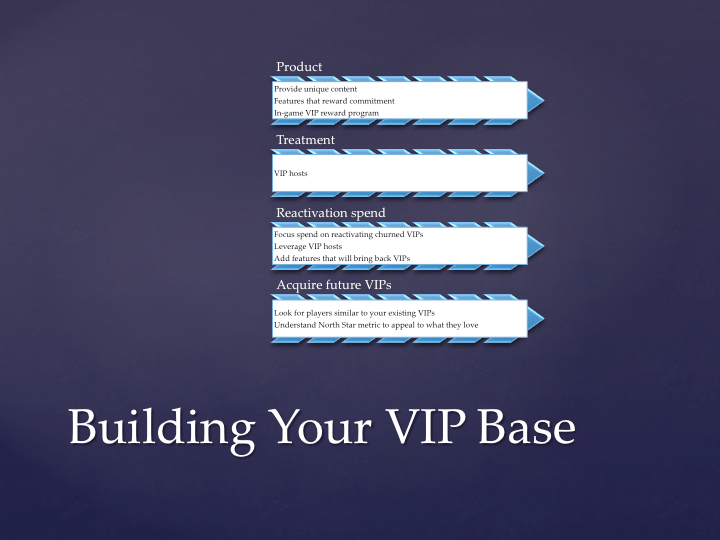
If winning over VIPs will not drive your VIP revenue, you need to create your own VIPs. Having a strong VIP base is critical to a successful game, and like most things that drive success; it requires hard work. These efforts range from developing products focused on fostering VIPs, treating your VIPs right and acquiring players most likely to become VIPs.
Building products to create VIPs
People become VIPs because they love your game, so you have to create a product with something for them to love. If your game is a weak copy of the market leader, why should they spend in an inferior lookalike (unless you are competing on price, which does not work in mobile gaming). Instead, you need to give players something unique so the 0.5 percent who could become VIPs has something to fall in love with. Give players unique content that they cannot find anywhere else, if you are in social casino, that means slot machines that are unlike your competitors.
Also, give them features that reward a huge commitment. Love is mutual, and if you are asking for their commitment you must reciprocate. Rather than having some superficial features that get boring after a few hours or days of gameplay, make very deep features that only a few players may ever get through but gives those few VIPs an incredibly deep and fulfilling experience.
Create an in-game VIP program that shows VIPs they are important and advancing. Airlines were the first to roll out frequent flyer programs; you need to have a program focused on rewarding your top players. A few months ago, I wrote about how to create a top in-product VIP program and the key is creating compelling differentiated benefits and experiences.
Treating your VIPs right
The second critical element in building a strong VIP base is to have an effective VIP host program. VIPs are very valuable (hence the V in VIP) and you need to treat them properly. Many game companies have treated a player who never spends exactly the same as someone who spends thousands. The cost, however, of losing someone who is a great customer is huge so the ROI on investing in keeping this player is also very high. A good VIP host program will proactively deal with its top customers, ensuring they are happy and anticipating problems before they arise.
Spend to reactivate
If someone loved your game at one point, there are likely still elements of the product they love. Rather than focusing on bringing in new players, also focus on bringing back your VIPs. If you have good VIP hosts, one of their priorities should be to bring back players. Spending part of your user acquisition budget to reacquire churned VIPs is likely to generate higher returns than hunting for new ones. Adding features or content that your VIPs wanted, and then letting those who left know what you now have, is often a better investment than creating generic new features.
Acquiring players who will become VIPs
Finally, although you are not likely to grow your VIP base through acquiring competitors’ VIPs, you can still increase the likelihood that your user acquisition will find future VIPs. You need first to recognize what it is about your game that VIPs love. I have found it very helpful to understand what is your North Star metric, the metric that indicates if a player will become a VIP (i.e. makes three purchases in their first seven days). You can then optimize your paid user acquisition on players that achieve this North Star metric, even moving to a CPA model where you only pay (though pay much more) for players who perform this action(s). You can also run lookalike campaigns that target players who look like your VIPs. Unlike targeting players who look like VIPs of competitors, your VIPs love something in your game and if you find similar players, there is a high likelihood they will also love it.
It’s not easy but it is worth it
There is no silver bullet in building your VIP base but it is critical for your success. Regardless of your available funds, you cannot just go out and buy your competitor’s VIPs. Instead, you need to focus your business on creating a VIP receptive product. From the product development to your marketing, you need to create a holistic experience that appeals to the customers who will drive your business.
Key takeaways
- VIPs, less than 0.5% of all of your players, will drive 60-80 percent of revenue for a typical social game, so it is critical you have a strong VIP base.
- It is virtually impossible to build VIP base by wooing your competitor’s VIPs as they already love the competitive product and thus will probably not like yours better.
- You should focus on building a game that gives people something unique, something they can love, so they will become VIPs.
 The Business of Social Games and Casino