While almost every company professes and often tries to get its employees to speak freely, most are unsuccessful. Employees either feel retribution for speaking openly or believe their efforts will be fruitless. An article in the Harvard Business Review, Can Your Employees Really Speak Freely by James Detert and Ethan Burris, shows the value of getting employees to speak up and how to do it.
Many leaders believe that by professing to have an open door policy, employees will come to them to raise issues or suggest improvements. It could be a project is going to miss its schedule or one of your manager’s is putting in a lackluster effort, Detert and Burris’ research shows your team is more likely to keep quiet than to question initiatives or suggest new ideas. When employees freely express their concerns, companies experience higher retention and better performance.
As Detert and Burris write, “leaders use a variety of tools to get people to speak up, like “climate” surveys and all-staff feedback sessions. Many of these efforts focus on improving communication up and down the hierarchy. But they usually fall short, regardless of good intentions, for two key reasons: a fear of consequences (embarrassment, isolation, low performance ratings, lost promotions, and even firing) and a sense of futility (the belief that saying something won’t make a difference, so why bother?).“
Why your team keeps quiet
There are two key reasons why employees fail to express their concerns, fear and futility. While you may think you are encouraging your team to speak up, you actually may be doing the opposite and leaving them afraid to openly discuss issues.
Part of the problem comes from relying on anonymous feedback. This policy has multiple problems:
- Encouraging anonymous feedback implicitly says it is not safe to raise issues publicly. If you were truly an open organization, people would not have to comment anonymously.
- Rather than focus on the content of the anonymous comment, the focus often becomes a hunt for who made or could have made the comment.
- It can be difficult to address issues while protecting the identify of the people who raised them.
Another element that contributes to the fear factor is sending signals that you are in charge. While you may be encouraging open conversation, forcing someone to sit in a small chair in your large office or set up an appointment can create a power situation. In this atmosphere, people may not be willing to tell you the unvarnished truth.
The other enemy of open conversation is futility, people feel it just will not make a difference to raise issues. This is referred to as the why-bother attitude. One contributor to this attitude is when leaders fail to convey issues to their superiors. If your team members raise concerns but you fail to address them with your superior, they feel they have wasted their time.
Another contributor to this problem is leaders who are unclear about the input they want. They may encourage “all” feedback but you have your own priorities and will only act on input that can help you advance these priorities (it could be improving efficiency, making marketing more user driven, etc.). By telling your team to bring you all issues but then not acting on all issues, and we all need to prioritize, they will feel their input is fruitless.
The most frustrating area to me that leads to people suppressing comments is a lack of resources to address the issues raised. You may spend excessive time getting ideas for new products or software that could improve efficiency, but you then do not have the resources to create the product or license the software. Devoting resources to collecting ideas without making commitments, financial and otherwise, to see some of them to fruition can lead your team to feel their input will have no impact.
How to create a more vocal culture
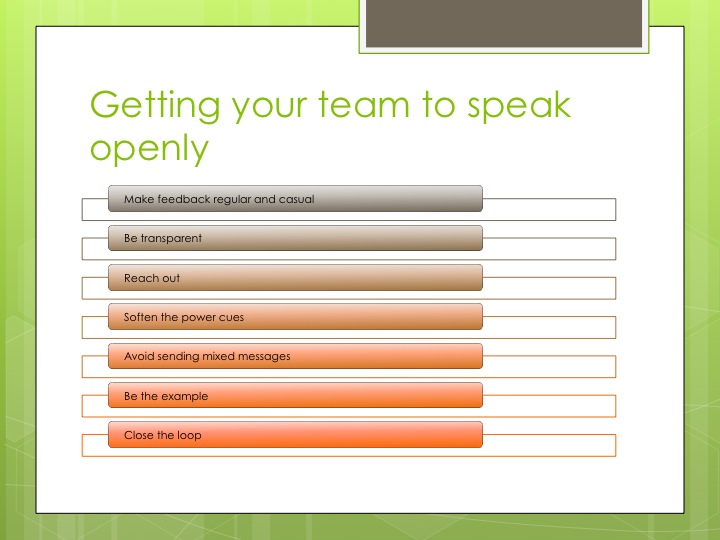
While saying be open and not always closing your door probably will not generate open conversation, there are ways to get strong feedback from your team.
- Make feedback a regular and casual exchange. Try to schedule regular one-to-one meetings with your team, this will make it less of a special even when they have something to share. The meetings also should not be with only your direct reports, but try to reach out to all the units you oversee, the ideas are not limited to your direct reports. Even when there is nothing to discuss, still hold the meeting and see what comes out. Often, if there is not a set agenda, the true issues will rise to the top.
- Be transparent. As Detert and Burris write, “transparency about feedback processes can reduce anxiety and increase participation…. Spelling out guidelines and commitements up front made contributing feel less daunting and futile to employees.”
- Reach out. When you want to understand what your team thinks of something, ask them. Call people in and ask them what are the company’s biggest problems or where they feel costs can be reduced or what is wrong with your product. Soliciting feedback proactively is more effective than just listening to it when someone brings an issue to you. First, it allows you to focus on your biggest problems. Second, since it is an issue you are already trying to address, there is a higher likelihood you will act on the employee’s feedback.
- Soften the power cues. To get earnest feedback, play down the power relationship. Walk over to your employee to talk to them rather than asking them to your office. Sit with them at a table rather than having them sit across from your desk. Join your employees for lunch or a drink. The key is to interact with your team as peers rather than subordinates.
- Avoid sending mixed messages. Do not encourage ideas and then cut them apart. Make sure not to focus the employee on process, it does not matter if their Powerpoint is awful, but instead pull the ideas out of the conversation and see which ideas will help the company.
- Be the example. Employees feel inspired when they see you advocating for them. It is important to help move the ideas along. Unless you feel they will hurt the company, and provide visibility to the team on your efforts in getting their ideas implemented. As Detert and Burris write, “Employees feel inspired when they see you advocating for them. While it’s great when your subordinates can see you speaking up, in many cases that’s not possible, because they aren’t present when you interact with your own boss. But you can tell them what happened and involve them directly in any follow-up steps.”
- Close the loop.The most critical element in creating a culture where people are truly open with their feedback and suggestions is telling them what you did with their idea and what they can expect as a result. Even in cases where the idea was not implemented, tell them why it was not moved forward so that they both see it was taken seriously and can adjust future suggestions to the reality of the business. Also, where possible, tell the entire team about the feedback you received and how it was acted upon.
While it is much easier to say you have an open door policy than follow through on the seven suggestions above, these suggestions will prompt your team to raise important issues to improve your company. You will find the effort is well worth it both in increased morale and a better business.
Key takeaways
- Open feedback and suggestions improve retention and the company’s performance, yet just having an “open door policy is not effective at soliciting feedback.
- Most people do not speak openly out of fear that there will be negative consequences or a belief that nothing will happen if they do.
- To counteract this reluctance, make feedback regular, be transparent, proactively reach out to employees, soften the power position, set an example by bringing ideas up the corporate chain and provide feedback on what action came from the suggestion or criticism.
 The Business of Social Games and Casino