
Skip to content

The Business of Social Games and Casino

How to succeed in the mobile game space by Lloyd Melnick

Day: April 13, 2016

Why the fear of cannibalization is fear of the inevitable

One of the worst reasons to take action (or not launch a product) is fear of cannibalization. Companies in almost all industries, including game companies, often create strategy to minimize how much some of their products or promotions pull users away from other products from the company. The concept is that you want to optimize your company’s profits by driving users to the most profitable products and ensuring that you do not move a customer or player to a product that costs less.

Some companies have very advanced algorithms to ensure they only move customers to new or other products if it does not have a greater negative impact on the product they are using or playing. Other times they will only release products in certain markets to protect their core market.

While in the short term these strategies can enhance sales, they have a long-term negative impact on profitability and can even endanger your company. The problem with this approach is that while cannibalization may diminish short term profits, it prevents competitors from winning over your customers.

The logic for forgetting about cannibalization

The argument against focusing on cannibalization is simple logic. If a customer or player will switch to one of your other offering, even if they spend less in that offering, they prefer it, otherwise they would not switch. They might prefer the price point or just like the product better but they are happier with the new offering than the existing one they are consuming. If the customer prefers the new product, then any competitive offering will have to be that much better to entice them away from your company.

You can create a simple equation to show the cost of cannibalization. To put it into mathematical terms, lets call your existing product X. Your new product is Y. You earn A per week for X and 0.5A per week for Y. Your analysis says to keep your customer from switching from X to Y, even if you need to ban the customer from Y.

The problem is that your company does not exist in a vacuum. Your competitor will eventually launch its own product Z which costs your customer 0.75A per week (or A per week but provides more value). Even if it takes 8 weeks for your competitor to launch, they eventually will. Thus, you may earn 8A from the customer but nothing else. Instead, if you have a six month (24 week) typical customer lifetime, you earn 12A from that customer instead of 8A. While cannibalization seems like a negative, moving your customer to the less expensive offering actually increases your revenue 50 percent.

Your competition will kill your product if you do not

The primary reason that you cannot avoid cannibalizing your product is that virtually all companies are in a competitive ecosystem. As smart as you think you are, your competitors are also smart and always trying to make their products better. If you can build your product at a lower price, they can build a pretty good copy at a lower price. If you can improve the product by adding certain features or changing the theme, one of your competitors has probably had the same idea and will also try it. While it may take some time for your customer to learn about the competitive product, they will in time. If you keep your customer from their optimal product, a competitor will offer it to them.

Retention, retention, retention

I have written about retention many times and how it impacts the lifetime value of your customer or player. Retention is the key to optimizing a user’s lifetime value, even if they spend a lot if they only do it once or twice it is hard to generate much revenue compared to a loyal user for years. Additionally, as the costs of acquiring users not only in games but in many businesses continues to increase, the relative value of existing customers also increases. It becomes more expensive to replace these customers with new ones so keeping existing customers is critical.

Focusing on cannibalization, however, means you are not giving customers the product they most want to consume. If you let your customer choose which offering they prefer, they will chose the one that puts them on the highest indifference curve (in non-economics speak, the one that makes them happiest). If instead, you decide to limit their options, you are putting them on a lower indifference curve (they are less happy). The less content a customer is, the more likely they are to churn.

The 9X rule strikes again

Further compounding the value of giving your customer their best possible experience is the 9X rule. I wrote about this rule a couple of years ago but in effect it says that a new product needs to be nine times better for someone to switch to it. That’s why a product like the Microsoft Surface, which may be a better tablet, garners very little market share because it is not nine times better than the iPad most people are already using.

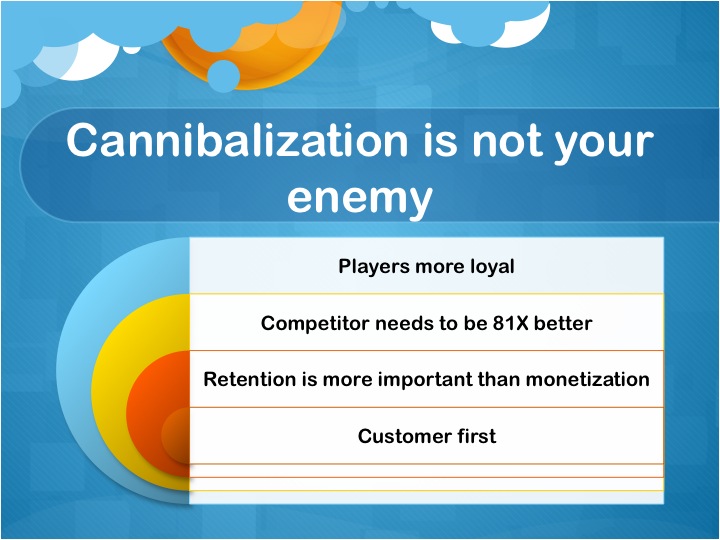
The need for a product to be 9X better to get someone to switch compounds the argument above about the value of moving people to their favorite product even if it cannibalizes another offering from your company. They would not switch unless the new offering was 9X better. For a competitor then to win them over, it needs to be another 9X better. So rather than winning your customer over with something 9X better than your original product, they need to release a product 81X (9X9) better than the original product. This simple equation shows how much more competitive you are by disregarding cannibalization.

Focus on the customer

The bottom line is that rather than creating complex and sophisticated algorithms to minimize cannibalization, you should focus on providing as much value to your existing customer as possible. If this value causes a revenue loss, that is the price you have to pay to keep the customer longer and maximize their lifetime value to your company.

Key takeaways

  1. Concern about product cannibalization, customers switching to a less profitable product of your’s, are misguided and potentially cost your company revenue.
  2. If you do not direct your customers to the offerings they prefer from your company competitor’s will give them a reason to switch and you will permanently lose that customer.
  3. By allowing your customers to move to one of your offerings that they prefer, a competitor will need to offer them something 81X better than the product they are currently using rather than just 9X better.
Slide1

Share this:

  • Click to share on Facebook (Opens in new window) Facebook
  • Click to share on LinkedIn (Opens in new window) LinkedIn
Like Loading...
Unknown's avatarAuthor Lloyd MelnickPosted on April 13, 2016May 1, 2021Categories General Social Games Business, General Tech Business, GrowthTags 9X, CannibalizationLeave a comment on Why the fear of cannibalization is fear of the inevitable

Get my book on LTV

The definitive book on customer lifetime value, Understanding the Predictable, is now available in both print and Kindle formats on Amazon.

Understanding the Predictable delves into the world of Customer Lifetime Value (LTV), a metric that shows how much each customer is worth to your business. By understanding this metric, you can predict how changes to your product will impact the value of each customer. You will also learn how to apply this simple yet powerful method of predictive analytics to optimize your marketing and user acquisition.

For more information, click here

Follow The Business of Social Games and Casino on WordPress.com

Enter your email address to follow this blog and receive notifications of new posts by email.

Join 791 other subscribers

Most Recent Posts

  • Join me at PDMA Inspire for my talk on new product prioritization
  • Why keep studying?
  • The next three years of this blog
  • Interview with the CEO of Murka on the biggest growth opportunity in gaming, Barak David

Lloyd Melnick

This is Lloyd Melnick’s personal blog.  All views and opinions expressed on this website are mine alone and do not represent those of people, institutions or organizations that I may or may not be associated with in professional or personal capacity.

I am a serial builder of businesses (senior leadership on three exits worth over $700 million), successful in big (Disney, Stars Group/PokerStars, Zynga) and small companies (Merscom, Spooky Cool Labs) with over 20 years experience in the gaming and casino space.  Currently, I am the GM of VGW’s Chumba Casino and on the Board of Directors of Murka Games and Luckbox.

Topic Areas

  • Analytics (114)
  • Bayes' Theorem (8)
  • behavioral economics (8)
  • blue ocean strategy (14)
  • Crowdfunding (4)
  • DBA (2)
  • General Social Games Business (459)
  • General Tech Business (195)
  • Growth (88)
  • International Issues with Social Games (50)
  • Lloyd's favorite posts (101)
  • LTV (54)
  • Machine Learning (10)
  • Metaverse (1)
  • Mobile Platforms (37)
  • Prioritization (1)
  • Social Casino (52)
  • Social Games Marketing (105)
  • thinking fast and slow (5)
  • Uncategorized (33)

Social

  • View CasualGame’s profile on Facebook
  • View @lloydmelnick’s profile on Twitter
  • View lloydmelnick’s profile on LinkedIn

RSS

RSS Feed RSS - Posts

RSS Feed RSS - Comments

Categories

  • Analytics (114)
  • Bayes' Theorem (8)
  • behavioral economics (8)
  • blue ocean strategy (14)
  • Crowdfunding (4)
  • DBA (2)
  • General Social Games Business (459)
  • General Tech Business (195)
  • Growth (88)
  • International Issues with Social Games (50)
  • Lloyd's favorite posts (101)
  • LTV (54)
  • Machine Learning (10)
  • Metaverse (1)
  • Mobile Platforms (37)
  • Prioritization (1)
  • Social Casino (52)
  • Social Games Marketing (105)
  • thinking fast and slow (5)
  • Uncategorized (33)

Archives

  • September 2023
  • December 2021
  • July 2021
  • March 2021
  • February 2021
  • January 2021
  • December 2020
  • November 2020
  • October 2020
  • September 2020
  • August 2020
  • July 2020
  • June 2020
  • May 2020
  • April 2020
  • March 2020
  • February 2020
  • January 2020
  • November 2019
  • October 2019
  • September 2019
  • June 2019
  • May 2019
  • April 2019
  • March 2019
  • February 2019
  • January 2019
  • December 2018
  • June 2018
  • May 2018
  • April 2018
  • March 2018
  • February 2018
  • January 2018
  • December 2017
  • June 2017
  • May 2017
  • April 2017
  • March 2017
  • February 2017
  • January 2017
  • December 2016
  • November 2016
  • October 2016
  • September 2016
  • June 2016
  • May 2016
  • April 2016
  • March 2016
  • February 2016
  • January 2016
  • December 2015
  • November 2015
  • October 2015
  • September 2015
  • July 2015
  • June 2015
  • May 2015
  • April 2015
  • March 2015
  • February 2015
  • January 2015
  • December 2014
  • November 2014
  • October 2014
  • September 2014
  • August 2014
  • July 2014
  • June 2014
  • May 2014
  • April 2014
  • March 2014
  • February 2014
  • January 2014
  • December 2013
  • November 2013
  • October 2013
  • September 2013
  • August 2013
  • July 2013
  • June 2013
  • May 2013
  • April 2013
  • March 2013
  • February 2013
  • January 2013
  • December 2012
  • November 2012
  • October 2012
  • September 2012
  • August 2012
  • July 2012
  • June 2012
  • May 2012
  • April 2012
  • March 2012
  • February 2012
  • January 2012
  • December 2011
  • November 2011
  • October 2011
  • September 2011
  • August 2011
  • July 2011
  • June 2011
  • May 2011
  • December 2010
April 2016
S M T W T F S
 12
3456789
10111213141516
17181920212223
24252627282930
« Mar   May »

by Lloyd Melnick

All posts by Lloyd Melnick unless specified otherwise
Google+

Enter your email address to subscribe to this blog and receive notifications of new posts by email.

Join 791 other subscribers
Follow Lloyd Melnick on Quora

RSS HBR Blog

  • How One Manufacturer Achieved Net Zero at Zero Cost
  • What Can U.S. Employers Do About Rising Healthcare Costs?
  • When You Have to Execute a Strategy You Disagree With
  • 4 Ways to Build Durable Relationships with Your Most Important Customers
  • What Jargon Says About Your Company Culture
  • Research: When Used Correctly, LLMs Can Unlock More Creative Ideas
  • Your New Role Requires Strategic Thinking…But You’re Stuck in the Weeds
  • For Circular Economy Innovation, Look to the Global South
  • Why Great Leaders Focus on the Details
  • Corporate Disclosure in the Age of AI

RSS Techcrunch

  • An error has occurred; the feed is probably down. Try again later.

RSS MIT Sloan Management Review Blog

  • AI Coding Tools: The Productivity Trap Most Companies Miss
  • How Procter & Gamble Uses AI to Unlock New Insights From Data
  • Rewire Organizational Knowledge With GenAI
  • Hungry for Learning: Wendy’s Will Croushorn
  • Beat Burnout: 10 Essential MIT SMR Reads
  • How Leaders Stay True to Themselves and Their Stakeholders
  • Our Guide to the Winter 2026 Issue
  • Broadening Future Perspectives at the Bank of England
  • A Faster Way to Build Future Scenarios
  • Assess What Is Certain in a Sea of Unknowns
The Business of Social Games and Casino Website Powered by WordPress.com.
  • Subscribe Subscribed
    • The Business of Social Games and Casino
    • Join 726 other subscribers
    • Already have a WordPress.com account? Log in now.
    • The Business of Social Games and Casino
    • Subscribe Subscribed
    • Sign up
    • Log in
    • Report this content
    • View site in Reader
    • Manage subscriptions
    • Collapse this bar
 

Loading Comments...
 

    %d