Skip to content

The Business of Social Games and Casino

How to succeed in the mobile game space by Lloyd Melnick

Month: March 2018

Using consumer behavior to design your leveling or challenge system

I came across an interesting article on how you can learn from consumer behavior theory to build an effective leveling system, Using Psychology to Design Leveling Systems
by James Madigan
.  Although there are some holes in the analysis, it raises a very useful connection between loss aversion and leveling and challenge systems in games. Although intended for mobile and video games, the lessons are also applicable to any gamified application.

Madigan starts by reminding readers that customers react differently to gains than to losses. If a player is rewarded with one bonus of 750 chips and an additional reward of 250 chips, they would be less happier than if they got a single reward of 1,000 chips (even though rewards are the same). People like gains lumped together. However, if a player gets killed in a game and has to use 750 chips and then 250 chips to keep playing they would be happier than having to spend a lump sum of 1,000 chips to keep playing. Players prefer losses that are spread out. This concept was popularized by Richard Thaler and won him a Noble Prize in Economics.

These findings are tied to the principal of loss aversion, the fact that people dislike a loss of X more than they appreciate a gain of the same X. They will thus avoid situations where they can lose compared to ones where they can win. This situation becomes an interesting opportunity in game design, Madigan points out, because you can bundle wins and losses. Since we give losses more weight, a 100 chip loss coupled with a 300 chip gain does not feel like a 200 chip gain, it feels closer to zero since the loss is overvalued. Slot designers have known this for centuries, most slot math couples lots of small losses (each spin) with some big wins.

This concept also is very relevant in product design, you do not want to take something away from your players. If a player has worked to unlock a level or a slot machine, locking it later in the game would feel like a bigger loss than the gain from unlocking it or another level/machine.

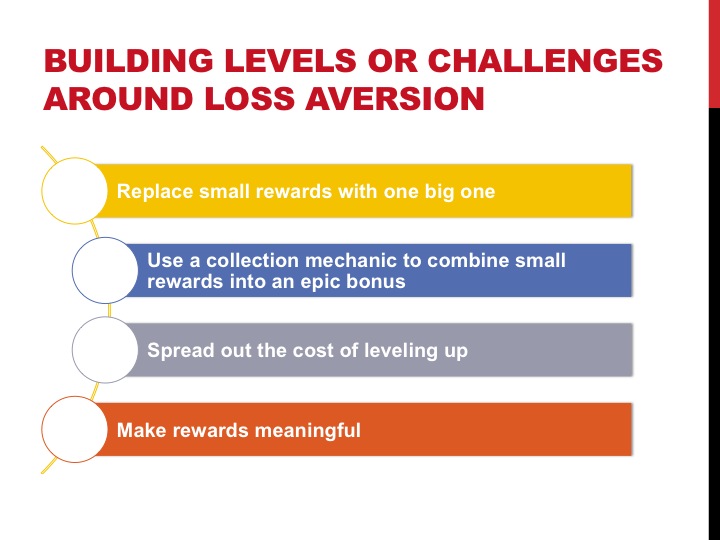
There are several key implications to optimizing your leveling system (or challenge system):

Slide1

  • Rather than give small rewards each time you level up (or complete a challenge), have them build up to one big reward. This could be by combining your leveling or challenge system with a collection mechanic, you get a piece each level and then every 10 levels can turn it in for a big reward.
  • Spread the costs of leveling up out. Rather than forcing players to win a big costly tournament or defeat an uber-boss, have the player go through multiple sinks to gain access to the big leveling reward.
  • Ensure your rewards for either leveling up or completing challenges are meaningful. Players need something big to overcome the perceived cost of the activity.

Key takeaways

  1. People, and gamers, place a higher negative value on a loss than they place a positive value on an equal gain.
  2. People prefer that their losses are spread out but their gains are large.
  3. You thus need to ensure big, meaningful rewards for leveling up or completing challenges to offset the costs (losses) of the activity. You can do this by creating a collection mechanic that leads to a large reward.

Share this:

  • Click to share on Facebook (Opens in new window) Facebook
  • Click to share on LinkedIn (Opens in new window) LinkedIn
Like Loading...
Unknown's avatarAuthor Lloyd MelnickPosted on March 27, 2018February 18, 2018Categories General Social Games BusinessTags challenges, game design, leveling, loss aversionLeave a comment on Using consumer behavior to design your leveling or challenge system

Algorithms are not humans

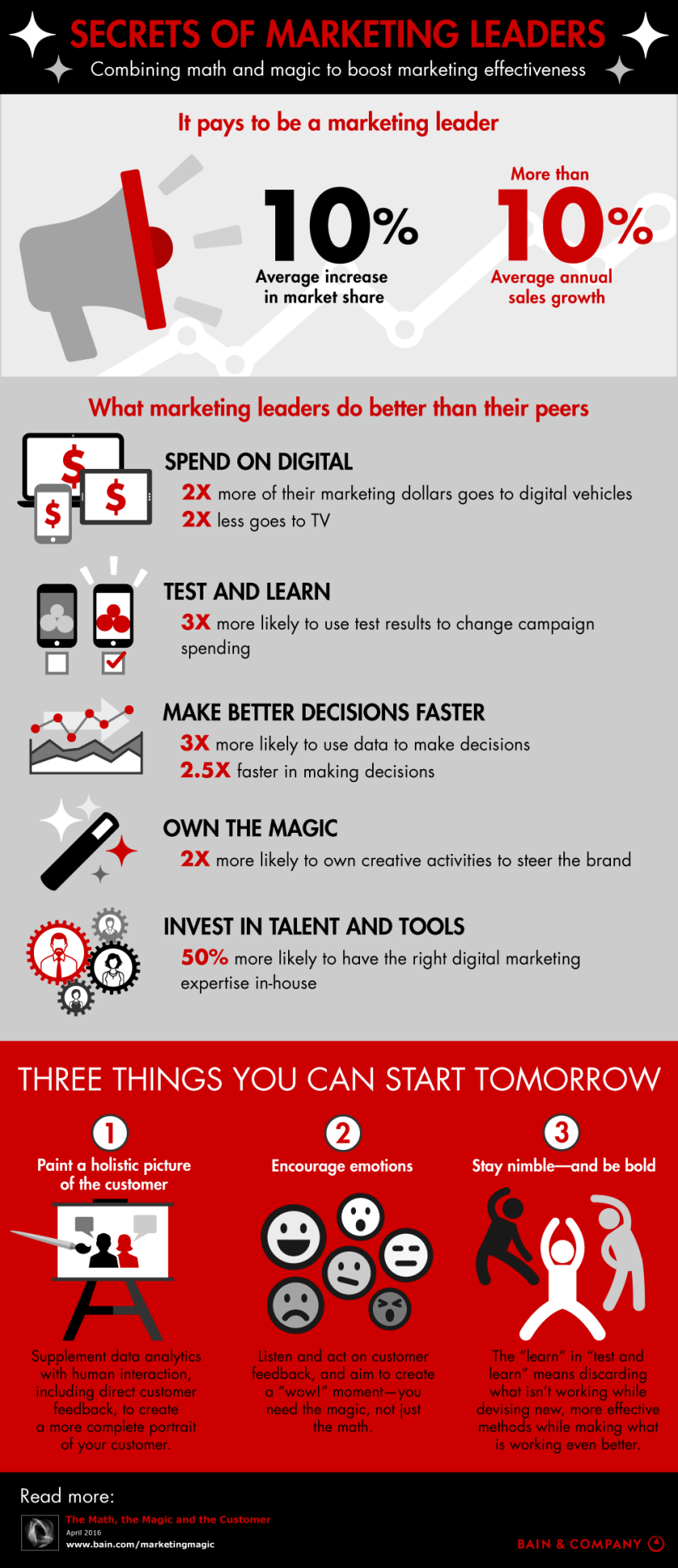
While I consider myself one of the most data-driven people in the gaming industry, I understand that quantitative data alone is not the optimal input for decision making. Combining analytics with qualitative data can often improve your decisions. You can think of it as a basic mathematic equation, if X is data and Y is qualitative information (ie. personal past experience), by definition X+Y will be equal or greater than X alone. An article by Bain & Co., one of the world’s leading consultancies, The Math, The Magic and the Customer shows how great marketers go beyond the data.

As the article points out, marketing departments now spend more on technology than IT departments. We have great tools not only to measure every marketing campaign, but each creative in the campaign, each channel we use and how each creative interacts with each customer in each channel. Often, however, we rely on this information without looking holistically at the customer or realizing that customers will not always behave consistently (or rationally). People make decisions emotionally as well as logically and as the article says, “great marketers have always known this, which is why they work hard to build an emotional bond with the customers they are targeting. They tell compelling stories about their brands through memorable messages and indelible images. At its best, this kind of marketing pops and dazzles, like magic. Marketing that ignores the magic and relies on math and science alone will be marketing that doesn’t work.”

Data and forging emotional connections are not mutually exclusive. Great marketers do not rely on just one. They use the myriad of data to create a holistic view of the customer and customer journey. The marketing is customer-centric rather than tool centric, all of the data and analysis comes down to what will be most effective in the future with the customer (not what the cohort did in the past). And as Bain writes, “contrary to the inclination of many marketers, moreover, they do not put measurement of ROI at the top of their agenda. When they can’t measure the ROI of an innovative effort, they are willing to let instinct guide their efforts—at least for a while.”

There are three keys to using data and the holistic view of the customer effectively. By combining a single view of the customer, understanding and tapping into their emotions and testing relentlessly you can replicate what is working for the most successful companies.

math and magic graphic

Paint a holistic picture of the customer

Most companies, not only online ones, have gigabytes of data about their customers. Data includes preferences, locations, device types, when and where they interact, purchase decision process, where they are browsing, what else they are doing online, etc. You can even see where your customers are and what they are doing at an exact time; you can interact on a real time basis. The information also comes from multiple sources and is stored in different locations.

The key to successful marketing is putting this data together for a single, real time, view of the customer. To achieve this goal companies must come together and the marketing team, IT team, analytics team — even finance — must all work together to share data and build systems to create a plan to build this complete view. Then the company needs to create a single customer record, where all of the information is held. While it sounds easy, this process can take years but in the interim data should be streaming into marketing so it can start looking at the customer holistically.

Encourage emotions

People are not algorithms or cells on a spreadsheet, not only is it immoral to treat them that way it is not good marketing. By understanding your customers’ journey, you can then tailor the experience to elicit the appropriate emotions at the right time. If it is a gambling game (either real money or virtual chips), provide excitement after a big win or help calm them down after a bad beat. By understanding your customers and potential customers emotions and encouraging the right one at the right time, you can make them more likely to choose and enjoy your product.

Stay nimble and be bold

You need to test many different approaches, as eliciting emotion is not easy. The important part of testing is learning from the results. Reinforce what is working and discard what is not, even if you were the advocate of the sub-optimal variant. Then think of new methods and promotions that will build on what you have learned and create even better results.

Moving forward you are not CFO

With the reliance on metrics and ROI in marketing, the marketing department is quietly becoming a mirror of finance. While metrics and ROI are critical to long-term success, so is generating emotions from your customers and potential customers. To become a truly great marketer, you need to understand how to connect to your customer as well as reading your daily dashboard.

Key takeaways

  • While data and ROI is critical to successful marketing, adding qualitative measures makes your marketing more effective as it is effectively additional data.
  • A key to successful marketing is generating the right emotion at the right time from your customer or potential customer, as emotions drive people, not data.
  • Continue testing different approaches and techniques, discarding what does not work and building off of what does work.

Share this:

  • Click to share on Facebook (Opens in new window) Facebook
  • Click to share on LinkedIn (Opens in new window) LinkedIn
Like Loading...
Unknown's avatarAuthor Lloyd MelnickPosted on March 20, 2018February 18, 2018Categories General Social Games Business, General Tech Business, Social Games MarketingTags marketing, roi, testingLeave a comment on Algorithms are not humans

Lifetime Value Part 25: Why retention is THE KPI

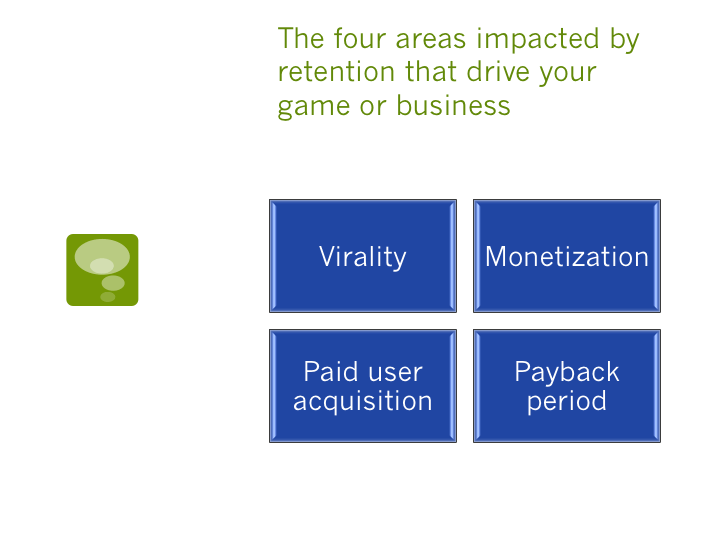
Whenever I write about lifetime value (LTV), I always try to stress that the key to growing a high LTV is retention. I recently came across an article, The One Growth Metric that Moves Acquisition, Monetization, and Virality by Brian Balfour, one of the top experts on growth, that does a wonderful job of showing just how powerful retention is to your LTV. Balfour identifies four areas that retention impacts.

Slide1

Acquisition

As you improve retention of existing users, you also acquire more new customers. A number of organic acquisition channels, such as virality and user-generated content (UGC), work when existing users take an action that introduces new users to your game or product (via inviting friends, sharing, word-of mouth, creating new content, etc.). A larger base of active users leads to better acquisition metrics. Players remaining in your game or product can invite new people to the product, so the more you retain, the more players who can send invites.

Monetization

Monetization is the second area impacted by retention. I get very frustrated when people, usually Product Managers, act as if there is a trade-off between retention and monetization. The reality is that retention drives monetization rather than damaging it. First, retention allows players to spend more frequently. If you retain a customer for three months rather than one month, they have 3X the opportunity to spend. Moreover, if your model is more robust than simply discreet purchases (either in-app purchases for a game or sales for a retailer), you also generate a longer stream of advertising or subscription revenue the longer the user is engaged with your product.

User acquisition becomes a competitive advantage

Paid user acquisition is one of the critical elements to growing a game or app, you need to have a positive return on ad spend to justify scaling your product. More importantly, since a bidding model drives user acquisition in the app space, with acquisition muscle you can push competitors out of acquisition channels, dominating a market and growing faster. As described earlier, your users are generating more revenue (they are in the product longer so spending more often and driving ad and subscription revenue), you can afford to outspend your competitors.

Payback period

Retention accelerates your payback period, allowing you to avoid raising additional funds or providing more free cash flow to funnel into acquisition. Payback period is the amount of time to pay for your full loaded user acquisition costs. As Balfour writes, “if you have a longer payback period, you either need to raise more money to fuel acquisition or wait longer to reinvest in acquisition. If you have a shorter payback period you will be able to reinvest the cash earned sooner in acquisition. Since improving retention drives monetization – meaning you make more money over a designated period of time – it also shortens your payback period.”

Build with retention top of mind

With retention driving so much value, you need both to create products that will retain customers or players and then the live services need to focus on improving retention. While it is sexy to try to boost ARPDAU, you will create the most value by strengthening your retention.

Key takeaways

  1. Retention is the most important area to focus on, as it drives four areas critical to growth: virality, monetization, paid acquisition and payback period.
  2. Retention generates more users because there is more virality, word of mouth, user generated content and an ability to spend more to acquire.
  3. Retention drives revenue because players have more opportunities to make purchases and generate additional advertising and subscription revenue.

Share this:

  • Click to share on Facebook (Opens in new window) Facebook
  • Click to share on LinkedIn (Opens in new window) LinkedIn
Like Loading...
Unknown's avatarAuthor Lloyd MelnickPosted on March 13, 2018February 4, 2018Categories General Social Games Business, General Tech Business, Growth, LTVTags Brian Balfour, customer lifetime value, lifetime value, monetization, retention, ViralityLeave a comment on Lifetime Value Part 25: Why retention is THE KPI

How to truly personalize and test

How to truly personalize and test

In 2018, if you are not delivering a personalized customer journey in your game or product you will fail. Personalization, for marketing, for customer experience, for CRM, for almost everything, is the current buzzword but it is still rare that companies have a comprehensive plan to create a personal experience. David Norton, former CMO at Harrah’s Casino group and architect of its Total Rewards program, discusses several ways companies can personalize effectively in his book The High Roller Experience.

Personalization is critical not only to a great customer experience but also to optimizing efficiency. As Norton writes, “personalizing the marketing communication approach will dramatically improve the efficiency of marketing spend both by eliminating activities that will not be fruitful and by improving response through more appropriate offers.” As your competitors are already optimizing, if you are not you will not be able to spend as many marketing dollars as they can, putting you at a fatal disadvantage.

How to create a personalized experience

Realistically, you are not going to have one-to-one personalization on day one, so you need practical planning to create a personal experience. A great way to start is replicate what Harrah’s did as a way to improve its marketing effectiveness, using a basic life cycle approach: new business, non-loyal, loyal, and defector. If you initially communicate differently with these segments, you will see an increase in overall ROI.

You also need to leverage the data you have on customers beyond the typical events. At Harrah’s, they looked at implied preferences based on all the information they had about their customers normal behavior, such as what customers did on their visits to our properties, including games played, offers redeemed, and nongaming activities, and then stored the preferences at a customer level for easy use in campaigns. They noted whether the customers preferred slot or table games, if they participated in gaming tournaments, if they most often came midweek or on the weekend, how often they redeemed offers when they came, what type of entertainment they preferred, which channel of communication they preferred, and a host of other factors. They used these implied preferences as inclusion and exclusion rules in campaigns. By excluding customers from programs that they had no chance to respond to based on their past behavior, they significantly improved response rates and cost savings. Most importantly, as Norton wrote, “we made our customers happier.”

Find the segments with high ROI

As alluded to above, you do not need to create hundreds of micro-segments initially but you do need to determine which segments you should invest in. Non-loyal customers represent a particularly attractive segment to target, as this is where you have the biggest opportunity to win market share. At Harrah’s, they targeted this segment by giving them increased value for more frequent visits, generating a significant increase in revenue from this group than they had predicted. In gaming, this creates opportunities, especially in the social and real money casino spaces, where players normally play three to five competitive apps.

Another segment rich with opportunity is defectors. Harrah’s found a way to identify those customers who had broken their typical visitation pattern as opposed to the standard inactive program practice of waiting 6 or 12 months to reach out to them, at which time they would have been long gone. This practice created lower churn and more value from this segment.

Treat VIPs extra special

I have written multiple times about VIP, and you need to ensure your personalization extends to giving VIPs a very special experience. This includes making sure you not only identify VIPs who make a large purchase in one product (or in Caesars case one property) but the ones who have the highest lifetime value. For an online company, the key is looking at number of transactions and adding across products to get the best picture of who your true VIPs are. You then need to treat VIPs in one product as VIPs in all your products. One of the biggest failures of personalization is when a VIP in one product or one retail location then goes to another and is treated as a standard customer.

Personalize all touch points

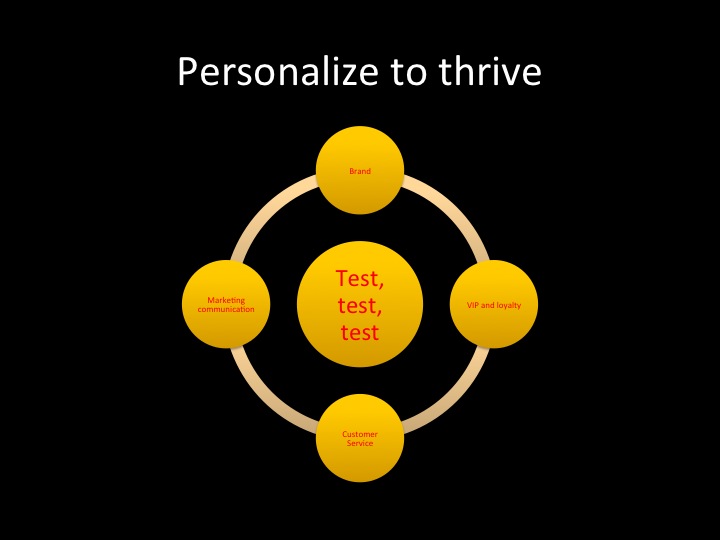
It is not just personalizing communications that is critical but you also need to personalize all the core functions. According to Norton, personalization needs to extend to brand, loyalty and customer service. As Norton writes, “if a company can execute against all three of these well, it is going to outperform its competitors….Customers increasingly want a seamless experience across touchpoints with a brand, and contact channels are often one of the greatest frustration points.”

Do not forget customer service (CS)

Given that you need to personalize all touch points, the one that companies most often miss is customer service. The service profit chain is not a theory but a powerful motivator and value creator.

It is absolutely essential, however, to think about the holistic customer service experience and understand the interplay among various channels. The call center and other contact channels are a valuable commodity. When personalized, CS can drive revenue and brand advocacy and provide valuable customer data. Norton writes, “I have always viewed customer care as a critical marketing channel that can build customer relationships, be a source of relevant information about the customer, and of course turn demand into revenue.“ Many of the product improvements that have led to the most revenue growth in my past two positions originated from feedback from our customer facing team members and VIP hosts.

CS is also an area for innovation, as you can improve your offering through technology. Customers may embrace technology before your company might, so CS can be a great vehicle to try new tools and channels.

To truly leverage customer service as a tool to improve personalization and the customer journey, you need to measure it at a granular level. This helps drive service improvement efficiently.

Testing is the key

You need to constantly test to ensure you are personalizing optimally. As Norton writes, “constantly testing and learning and holding out control groups is the best way to optimize marketing spend. This allows companies to find the most appropriate message and to spend .”

The first step is to automate the test process. If it takes months to evaluate what happened, the results become useless as the competitive landscape has changed.

It is also critical to have a control group for each campaign and program. While this policy seems automatic, there is often pressure to release what you believe is the optimal campaign or communications to everyone, as you do not want to leave money on the table. Holding out customers, however, from a specific marketing program is much more informative in determining which marketing activities drive the most incremental profitability, changing the customer’s behavior to spend more with you than with a competitor. This is also a better strategy than a universal control group, which does not show you the relative performance of different marketing programs.

As mentioned above, customer service is critical to personalization and measuring customer service with a significant level of granularity provides tremendous insight about the customer experience and helps identify areas for improvement. As Norton writes, “being able to correlate improved service to increased revenue, and developing a well-constructed incentive plan, leads to great outcomes for both a company and its customers— especially when there is innovation around challenged service touchpoints that drive overall customer satisfaction with the brand.”

Personalize, personalize, personalize

The key to success in the current business environment is personalization, your customers expect it, and if you do not deliver they will go to a competitor. And you need to deliver not only in communication but also in customer service and VIP. Then you need to optimize to ensure you are delivering a truly effective personal experience. This is not a secret to gaining competitive advantage, it is the cost of doing business.

Key takeaways

  • Personalization improves the efficiency of marketing spend by eliminating activities that will not be fruitful and by improving response through more appropriate offers
  • Think holistically about the customer journey. Ensure all parts of it are personalized, from the initial communication through the product to customer service and support.
  • Testing and control groups are the best ways to optimize your marketing and ensure your personalization efforts are creating value.
Slide1

Share this:

  • Click to share on Facebook (Opens in new window) Facebook
  • Click to share on LinkedIn (Opens in new window) LinkedIn
Like Loading...
Unknown's avatarAuthor Lloyd MelnickPosted on March 6, 2018March 6, 2018Categories General Social Games Business, Growth, Social Games MarketingTags CS, customer service, David Norton, loyalty, personalization, vipLeave a comment on How to truly personalize and test

Get my book on LTV

The definitive book on customer lifetime value, Understanding the Predictable, is now available in both print and Kindle formats on Amazon.

Understanding the Predictable delves into the world of Customer Lifetime Value (LTV), a metric that shows how much each customer is worth to your business. By understanding this metric, you can predict how changes to your product will impact the value of each customer. You will also learn how to apply this simple yet powerful method of predictive analytics to optimize your marketing and user acquisition.

For more information, click here

Follow The Business of Social Games and Casino on WordPress.com

Enter your email address to follow this blog and receive notifications of new posts by email.

Join 791 other subscribers

Most Recent Posts

  • Join me at PDMA Inspire for my talk on new product prioritization
  • Why keep studying?
  • The next three years of this blog
  • Interview with the CEO of Murka on the biggest growth opportunity in gaming, Barak David

Lloyd Melnick

This is Lloyd Melnick’s personal blog.  All views and opinions expressed on this website are mine alone and do not represent those of people, institutions or organizations that I may or may not be associated with in professional or personal capacity.

I am a serial builder of businesses (senior leadership on three exits worth over $700 million), successful in big (Disney, Stars Group/PokerStars, Zynga) and small companies (Merscom, Spooky Cool Labs) with over 20 years experience in the gaming and casino space.  Currently, I am the GM of VGW’s Chumba Casino and on the Board of Directors of Murka Games and Luckbox.

Topic Areas

  • Analytics (114)
  • Bayes' Theorem (8)
  • behavioral economics (8)
  • blue ocean strategy (14)
  • Crowdfunding (4)
  • DBA (2)
  • General Social Games Business (459)
  • General Tech Business (195)
  • Growth (88)
  • International Issues with Social Games (50)
  • Lloyd's favorite posts (101)
  • LTV (54)
  • Machine Learning (10)
  • Metaverse (1)
  • Mobile Platforms (37)
  • Prioritization (1)
  • Social Casino (52)
  • Social Games Marketing (105)
  • thinking fast and slow (5)
  • Uncategorized (33)

Social

  • View CasualGame’s profile on Facebook
  • View @lloydmelnick’s profile on Twitter
  • View lloydmelnick’s profile on LinkedIn

RSS

RSS Feed RSS - Posts

RSS Feed RSS - Comments

Categories

  • Analytics (114)
  • Bayes' Theorem (8)
  • behavioral economics (8)
  • blue ocean strategy (14)
  • Crowdfunding (4)
  • DBA (2)
  • General Social Games Business (459)
  • General Tech Business (195)
  • Growth (88)
  • International Issues with Social Games (50)
  • Lloyd's favorite posts (101)
  • LTV (54)
  • Machine Learning (10)
  • Metaverse (1)
  • Mobile Platforms (37)
  • Prioritization (1)
  • Social Casino (52)
  • Social Games Marketing (105)
  • thinking fast and slow (5)
  • Uncategorized (33)

Archives

  • September 2023
  • December 2021
  • July 2021
  • March 2021
  • February 2021
  • January 2021
  • December 2020
  • November 2020
  • October 2020
  • September 2020
  • August 2020
  • July 2020
  • June 2020
  • May 2020
  • April 2020
  • March 2020
  • February 2020
  • January 2020
  • November 2019
  • October 2019
  • September 2019
  • June 2019
  • May 2019
  • April 2019
  • March 2019
  • February 2019
  • January 2019
  • December 2018
  • June 2018
  • May 2018
  • April 2018
  • March 2018
  • February 2018
  • January 2018
  • December 2017
  • June 2017
  • May 2017
  • April 2017
  • March 2017
  • February 2017
  • January 2017
  • December 2016
  • November 2016
  • October 2016
  • September 2016
  • June 2016
  • May 2016
  • April 2016
  • March 2016
  • February 2016
  • January 2016
  • December 2015
  • November 2015
  • October 2015
  • September 2015
  • July 2015
  • June 2015
  • May 2015
  • April 2015
  • March 2015
  • February 2015
  • January 2015
  • December 2014
  • November 2014
  • October 2014
  • September 2014
  • August 2014
  • July 2014
  • June 2014
  • May 2014
  • April 2014
  • March 2014
  • February 2014
  • January 2014
  • December 2013
  • November 2013
  • October 2013
  • September 2013
  • August 2013
  • July 2013
  • June 2013
  • May 2013
  • April 2013
  • March 2013
  • February 2013
  • January 2013
  • December 2012
  • November 2012
  • October 2012
  • September 2012
  • August 2012
  • July 2012
  • June 2012
  • May 2012
  • April 2012
  • March 2012
  • February 2012
  • January 2012
  • December 2011
  • November 2011
  • October 2011
  • September 2011
  • August 2011
  • July 2011
  • June 2011
  • May 2011
  • December 2010
March 2018
S M T W T F S
 123
45678910
11121314151617
18192021222324
25262728293031
« Feb   Apr »

by Lloyd Melnick

All posts by Lloyd Melnick unless specified otherwise
Google+

Enter your email address to subscribe to this blog and receive notifications of new posts by email.

Join 791 other subscribers
Follow Lloyd Melnick on Quora

RSS HBR Blog

  • How One Manufacturer Achieved Net Zero at Zero Cost
  • What Can U.S. Employers Do About Rising Healthcare Costs?
  • When You Have to Execute a Strategy You Disagree With
  • 4 Ways to Build Durable Relationships with Your Most Important Customers
  • What Jargon Says About Your Company Culture
  • Research: When Used Correctly, LLMs Can Unlock More Creative Ideas
  • Your New Role Requires Strategic Thinking…But You’re Stuck in the Weeds
  • For Circular Economy Innovation, Look to the Global South
  • Why Great Leaders Focus on the Details
  • Corporate Disclosure in the Age of AI

RSS Techcrunch

  • An error has occurred; the feed is probably down. Try again later.

RSS MIT Sloan Management Review Blog

  • AI Coding Tools: The Productivity Trap Most Companies Miss
  • How Procter & Gamble Uses AI to Unlock New Insights From Data
  • Rewire Organizational Knowledge With GenAI
  • Hungry for Learning: Wendy’s Will Croushorn
  • Beat Burnout: 10 Essential MIT SMR Reads
  • How Leaders Stay True to Themselves and Their Stakeholders
  • Our Guide to the Winter 2026 Issue
  • Broadening Future Perspectives at the Bank of England
  • A Faster Way to Build Future Scenarios
  • Assess What Is Certain in a Sea of Unknowns
The Business of Social Games and Casino Website Powered by WordPress.com.
  • Subscribe Subscribed
    • The Business of Social Games and Casino
    • Join 726 other subscribers
    • Already have a WordPress.com account? Log in now.
    • The Business of Social Games and Casino
    • Subscribe Subscribed
    • Sign up
    • Log in
    • Report this content
    • View site in Reader
    • Manage subscriptions
    • Collapse this bar
 

Loading Comments...
 

    %d