Skip to content

The Business of Social Games and Casino

How to succeed in the mobile game space by Lloyd Melnick

Day: April 9, 2019

What Real Money Gaming companies should learn from the problems faced by EA and Activision Blizzard

What Real Money Gaming companies should learn from the problems faced by EA and Activision Blizzard

In January, I wrote a post on why Electronic Arts and Activision Blizzard’s stock had plummeted and what other game companies could learn from their challenges. While the lessons are relevant to social gaming companies, in many ways they are more germane to Real Money gaming companies, many of whom have also struggled to maintain their share prices.
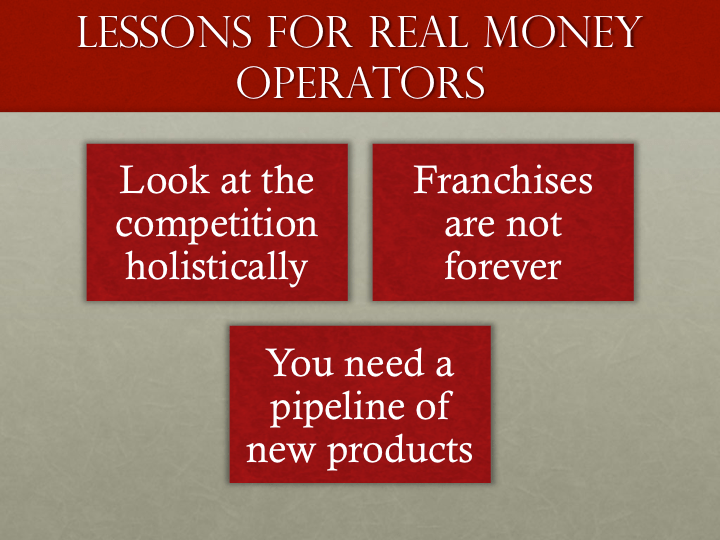
slide1

Look at the competition holistically

The first problem I identified with EA and Activision was that they focused solely on each other and other console game manufacturers when considering the competition and generating competitive responses. As Netflix stated in its shareholder letter in January, “we compete with (and lose to) Fortnite more than HBO,….When YouTube went down globally for a few minutes in October, our viewing and signups spiked for that time…There are thousands of competitors in this highly fragmented market vying to entertain consumers and low barriers to entry for those with great experiences.”

Real Money Gaming companies do not seem to have gotten the memo, they still focus primarily on each other. Most Real Money online casinos measure their competitiveness by how many games they have versus other online casinos. Sportsbets list their breadth of betting options and in-play bets versus other sports betting apps.

When the US market began to open last year, most Real Money operators looked at each other when developing their American strategy. They copied the partnerships other operators were entering into. They built similar go-to-market strategies. They took their European apps and “adapted” them for the US market.

The sole focus was outdoing their direct competitors. They did not look at how Americans consumed entertainment, how it was different than in their core markets and then build a strategy to compete with these other forms of entertainment.

The US is an example of how the Real Money operators fail to look holistically at the entertainment ecosystem and simply focus on each other. It is why margins continue to decrease and why fewer and fewer new customers enter the ecosystem. It also leaves them very vulnerable to other forms of entertainment appealing to their customers.

Franchises are not forever

The second lesson that Activision Blizzard and Electronic Arts learned the hard way is that franchises are not forever. Many of the biggest Real Money operators still rely on their existing franchise and have not built a sufficiently robust business to deal with downturns in the franchise. You can broadly define a franchise, as I would consider William Hill’s retail locations the same as Farmville, a formerly ubiquitous product that declines over time.

The Real Money space is dominated by one product companies, which leaves them particularly vulnerable to franchise erosion. Many of the operators (both large and small) rely on an individual product for success (often the product and company name are synonymous), and when that product decreases, they are in a very vulnerable position.

You need a pipeline of new products

Consistent with the above point, not only do many Real Money operators rely on one product, they do not have a green light process or plan to bring new apps to market. Often, their product development is focused on improving and optimizing their core offering. If the macro-market for that offering decreases, they do not have alternatives available to compensate.

As I wrote last month, companies need a robust green light process to identify market opportunities, particularly prospects to appeal to non-customers of the industry. Creating skins of existing products do not achieve this result; they simply provide a marketing tool and potentially nudge your product positioning. Yet very few Real Money operators launch entirely new products that have a different feature set and market appeal than their existing products.

These opportunities exist if Real Money operators will look outside of their current offering. There is no reason a Real Money sportsbook cannot offer a standalone eSports app or a Crypto sports betting solution or hypercasual sports betting games. A Real Money casino can look beyond its integrated casino to create a Live Dealer app or an app that has progression or social features. The key is for companies to assess the market opportunity, their strengths and weaknesses and create a product pipeline that will help them grow.

New products and new markets are the key to success

As the above analysis shows, Real Money gaming companies suffer the same issues as video gaming companies and firms in many industries. They lose the forest for the trees, focusing on their direct competitors and existing customers, rather than how the industry and world is evolving. These blinders leave them vulnerable as people’s preferences evolve and miss an opportunity to grow exponentially.

Key takeaways

  1. Real money operators need to avoid making the same mistakes that Electronic Arts and Activision Blizzard committed if they want their stock to be resilient.
  2. Real Money gaming companies should not simply focus on each other but realize they are competing with all entertainment companies and build products that expand their market.
  3. Real Money operators normally rely on one offering and do not have a robust product pipeline to deal with declines in their core product.

Share this:

  • Click to share on Facebook (Opens in new window) Facebook
  • Click to share on LinkedIn (Opens in new window) LinkedIn
Like Loading...
Unknown's avatarAuthor Lloyd MelnickPosted on April 9, 2019March 20, 2019Categories General Social Games BusinessTags Activision, competition, Electronic Arts, Green Light, green light process, real money online gamblingLeave a comment on What Real Money Gaming companies should learn from the problems faced by EA and Activision Blizzard

Get my book on LTV

The definitive book on customer lifetime value, Understanding the Predictable, is now available in both print and Kindle formats on Amazon.

Understanding the Predictable delves into the world of Customer Lifetime Value (LTV), a metric that shows how much each customer is worth to your business. By understanding this metric, you can predict how changes to your product will impact the value of each customer. You will also learn how to apply this simple yet powerful method of predictive analytics to optimize your marketing and user acquisition.

For more information, click here

Follow The Business of Social Games and Casino on WordPress.com

Enter your email address to follow this blog and receive notifications of new posts by email.

Join 791 other subscribers

Most Recent Posts

  • Join me at PDMA Inspire for my talk on new product prioritization
  • Why keep studying?
  • The next three years of this blog
  • Interview with the CEO of Murka on the biggest growth opportunity in gaming, Barak David

Lloyd Melnick

This is Lloyd Melnick’s personal blog.  All views and opinions expressed on this website are mine alone and do not represent those of people, institutions or organizations that I may or may not be associated with in professional or personal capacity.

I am a serial builder of businesses (senior leadership on three exits worth over $700 million), successful in big (Disney, Stars Group/PokerStars, Zynga) and small companies (Merscom, Spooky Cool Labs) with over 20 years experience in the gaming and casino space.  Currently, I am the GM of VGW’s Chumba Casino and on the Board of Directors of Murka Games and Luckbox.

Topic Areas

  • Analytics (114)
  • Bayes' Theorem (8)
  • behavioral economics (8)
  • blue ocean strategy (14)
  • Crowdfunding (4)
  • DBA (2)
  • General Social Games Business (459)
  • General Tech Business (195)
  • Growth (88)
  • International Issues with Social Games (50)
  • Lloyd's favorite posts (101)
  • LTV (54)
  • Machine Learning (10)
  • Metaverse (1)
  • Mobile Platforms (37)
  • Prioritization (1)
  • Social Casino (52)
  • Social Games Marketing (105)
  • thinking fast and slow (5)
  • Uncategorized (33)

Social

  • View CasualGame’s profile on Facebook
  • View @lloydmelnick’s profile on Twitter
  • View lloydmelnick’s profile on LinkedIn

RSS

RSS Feed RSS - Posts

RSS Feed RSS - Comments

Categories

  • Analytics (114)
  • Bayes' Theorem (8)
  • behavioral economics (8)
  • blue ocean strategy (14)
  • Crowdfunding (4)
  • DBA (2)
  • General Social Games Business (459)
  • General Tech Business (195)
  • Growth (88)
  • International Issues with Social Games (50)
  • Lloyd's favorite posts (101)
  • LTV (54)
  • Machine Learning (10)
  • Metaverse (1)
  • Mobile Platforms (37)
  • Prioritization (1)
  • Social Casino (52)
  • Social Games Marketing (105)
  • thinking fast and slow (5)
  • Uncategorized (33)

Archives

  • September 2023
  • December 2021
  • July 2021
  • March 2021
  • February 2021
  • January 2021
  • December 2020
  • November 2020
  • October 2020
  • September 2020
  • August 2020
  • July 2020
  • June 2020
  • May 2020
  • April 2020
  • March 2020
  • February 2020
  • January 2020
  • November 2019
  • October 2019
  • September 2019
  • June 2019
  • May 2019
  • April 2019
  • March 2019
  • February 2019
  • January 2019
  • December 2018
  • June 2018
  • May 2018
  • April 2018
  • March 2018
  • February 2018
  • January 2018
  • December 2017
  • June 2017
  • May 2017
  • April 2017
  • March 2017
  • February 2017
  • January 2017
  • December 2016
  • November 2016
  • October 2016
  • September 2016
  • June 2016
  • May 2016
  • April 2016
  • March 2016
  • February 2016
  • January 2016
  • December 2015
  • November 2015
  • October 2015
  • September 2015
  • July 2015
  • June 2015
  • May 2015
  • April 2015
  • March 2015
  • February 2015
  • January 2015
  • December 2014
  • November 2014
  • October 2014
  • September 2014
  • August 2014
  • July 2014
  • June 2014
  • May 2014
  • April 2014
  • March 2014
  • February 2014
  • January 2014
  • December 2013
  • November 2013
  • October 2013
  • September 2013
  • August 2013
  • July 2013
  • June 2013
  • May 2013
  • April 2013
  • March 2013
  • February 2013
  • January 2013
  • December 2012
  • November 2012
  • October 2012
  • September 2012
  • August 2012
  • July 2012
  • June 2012
  • May 2012
  • April 2012
  • March 2012
  • February 2012
  • January 2012
  • December 2011
  • November 2011
  • October 2011
  • September 2011
  • August 2011
  • July 2011
  • June 2011
  • May 2011
  • December 2010
April 2019
S M T W T F S
 123456
78910111213
14151617181920
21222324252627
282930  
« Mar   May »

by Lloyd Melnick

All posts by Lloyd Melnick unless specified otherwise
Google+

Enter your email address to subscribe to this blog and receive notifications of new posts by email.

Join 791 other subscribers
Follow Lloyd Melnick on Quora

RSS HBR Blog

  • How One Manufacturer Achieved Net Zero at Zero Cost
  • What Can U.S. Employers Do About Rising Healthcare Costs?
  • When You Have to Execute a Strategy You Disagree With
  • 4 Ways to Build Durable Relationships with Your Most Important Customers
  • What Jargon Says About Your Company Culture
  • Research: When Used Correctly, LLMs Can Unlock More Creative Ideas
  • Your New Role Requires Strategic Thinking…But You’re Stuck in the Weeds
  • For Circular Economy Innovation, Look to the Global South
  • Why Great Leaders Focus on the Details
  • Corporate Disclosure in the Age of AI

RSS Techcrunch

  • An error has occurred; the feed is probably down. Try again later.

RSS MIT Sloan Management Review Blog

  • AI Coding Tools: The Productivity Trap Most Companies Miss
  • How Procter & Gamble Uses AI to Unlock New Insights From Data
  • Rewire Organizational Knowledge With GenAI
  • Hungry for Learning: Wendy’s Will Croushorn
  • Beat Burnout: 10 Essential MIT SMR Reads
  • How Leaders Stay True to Themselves and Their Stakeholders
  • Our Guide to the Winter 2026 Issue
  • Broadening Future Perspectives at the Bank of England
  • A Faster Way to Build Future Scenarios
  • Assess What Is Certain in a Sea of Unknowns
The Business of Social Games and Casino Website Powered by WordPress.com.
  • Subscribe Subscribed
    • The Business of Social Games and Casino
    • Join 726 other subscribers
    • Already have a WordPress.com account? Log in now.
    • The Business of Social Games and Casino
    • Subscribe Subscribed
    • Sign up
    • Log in
    • Report this content
    • View site in Reader
    • Manage subscriptions
    • Collapse this bar
 

Loading Comments...
 

    %d