In January, I wrote a post on why Electronic Arts and Activision Blizzard’s stock had plummeted and what other game companies could learn from their challenges. While the lessons are relevant to social gaming companies, in many ways they are more germane to Real Money gaming companies, many of whom have also struggled to maintain their share prices.

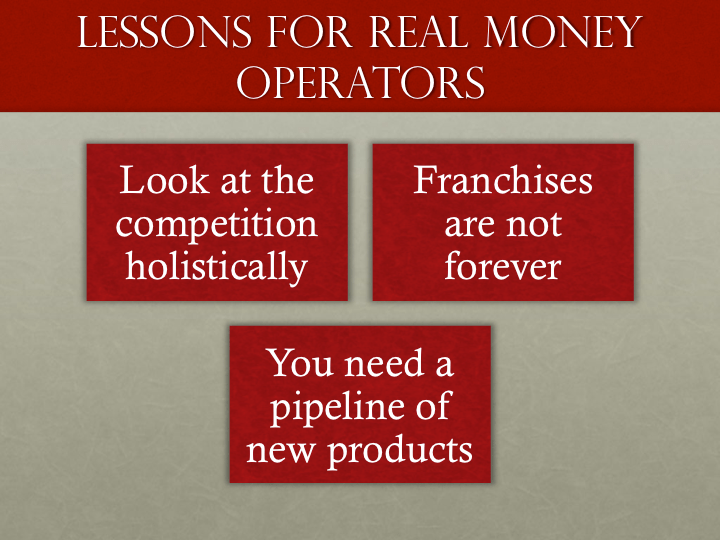
Look at the competition holistically
The first problem I identified with EA and Activision was that they focused solely on each other and other console game manufacturers when considering the competition and generating competitive responses. As Netflix stated in its shareholder letter in January, “we compete with (and lose to) Fortnite more than HBO,….When YouTube went down globally for a few minutes in October, our viewing and signups spiked for that time…There are thousands of competitors in this highly fragmented market vying to entertain consumers and low barriers to entry for those with great experiences.”
Real Money Gaming companies do not seem to have gotten the memo, they still focus primarily on each other. Most Real Money online casinos measure their competitiveness by how many games they have versus other online casinos. Sportsbets list their breadth of betting options and in-play bets versus other sports betting apps.
When the US market began to open last year, most Real Money operators looked at each other when developing their American strategy. They copied the partnerships other operators were entering into. They built similar go-to-market strategies. They took their European apps and “adapted” them for the US market.
The sole focus was outdoing their direct competitors. They did not look at how Americans consumed entertainment, how it was different than in their core markets and then build a strategy to compete with these other forms of entertainment.
The US is an example of how the Real Money operators fail to look holistically at the entertainment ecosystem and simply focus on each other. It is why margins continue to decrease and why fewer and fewer new customers enter the ecosystem. It also leaves them very vulnerable to other forms of entertainment appealing to their customers.
Franchises are not forever
The second lesson that Activision Blizzard and Electronic Arts learned the hard way is that franchises are not forever. Many of the biggest Real Money operators still rely on their existing franchise and have not built a sufficiently robust business to deal with downturns in the franchise. You can broadly define a franchise, as I would consider William Hill’s retail locations the same as Farmville, a formerly ubiquitous product that declines over time.
The Real Money space is dominated by one product companies, which leaves them particularly vulnerable to franchise erosion. Many of the operators (both large and small) rely on an individual product for success (often the product and company name are synonymous), and when that product decreases, they are in a very vulnerable position.
You need a pipeline of new products
Consistent with the above point, not only do many Real Money operators rely on one product, they do not have a green light process or plan to bring new apps to market. Often, their product development is focused on improving and optimizing their core offering. If the macro-market for that offering decreases, they do not have alternatives available to compensate.
As I wrote last month, companies need a robust green light process to identify market opportunities, particularly prospects to appeal to non-customers of the industry. Creating skins of existing products do not achieve this result; they simply provide a marketing tool and potentially nudge your product positioning. Yet very few Real Money operators launch entirely new products that have a different feature set and market appeal than their existing products.
These opportunities exist if Real Money operators will look outside of their current offering. There is no reason a Real Money sportsbook cannot offer a standalone eSports app or a Crypto sports betting solution or hypercasual sports betting games. A Real Money casino can look beyond its integrated casino to create a Live Dealer app or an app that has progression or social features. The key is for companies to assess the market opportunity, their strengths and weaknesses and create a product pipeline that will help them grow.
New products and new markets are the key to success
As the above analysis shows, Real Money gaming companies suffer the same issues as video gaming companies and firms in many industries. They lose the forest for the trees, focusing on their direct competitors and existing customers, rather than how the industry and world is evolving. These blinders leave them vulnerable as people’s preferences evolve and miss an opportunity to grow exponentially.
Key takeaways
- Real money operators need to avoid making the same mistakes that Electronic Arts and Activision Blizzard committed if they want their stock to be resilient.
- Real Money gaming companies should not simply focus on each other but realize they are competing with all entertainment companies and build products that expand their market.
- Real Money operators normally rely on one offering and do not have a robust product pipeline to deal with declines in their core product.


Leave a Reply