Lifetime Value Part 19: Applications of LTV in different business types

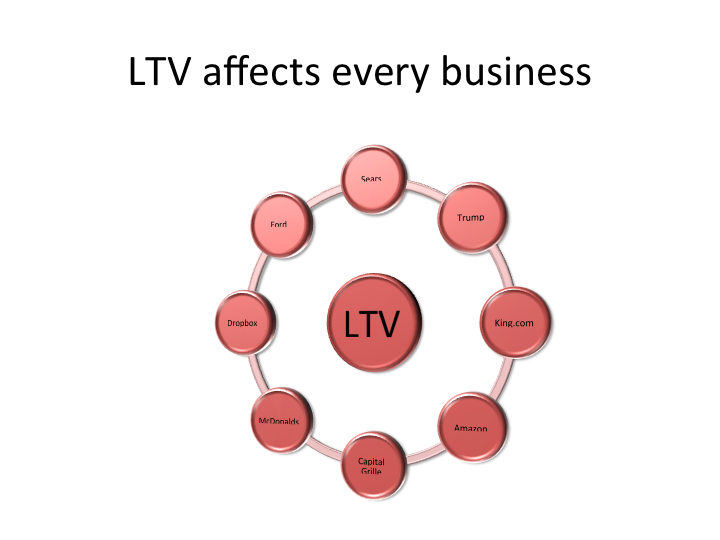
As this is my nineteenth post about customer lifetime value (LTV), I obviously think it is very important, but I wanted to take some time to provide examples of how it can impact almost any business. Even if the examples do not cover your initiative, they will hopefully help you see how understanding, marketing and designing for LTV is crucial to any company’s success. Examples range from tech companies to business types that have been around longer than the United States. The breadth of companies that LTV is critical for shows its central importance.

Slide1

Mail order catalogs

Catalog companies, from the days of Sears and Montgomery Ward, to the current heavyweights like Restoration Hardware and Crate & Barrel, have always needed a deep understanding of LTV to succeed.

With the cost of printing and mailing catalogs, these merchants need an LTV higher than the shipping/printing costs. Thus, they have to first understand different customer segments (e.g., location/postal code, sex, age) and only send catalogs to those people who will have a higher LTV. If they sent their catalog to everyone, the average LTV would decline and make their efforts unprofitable. In addition to understanding the LTVs of each segment they have to optimize along the three key LTV variables: Retention, monetization and virality. If a person reads through the catalog once, makes an order and never picks up the catalog again, it is hard for their value to be higher than the costs of shipping them the catalog. If they, however, keep the catalog and place ten orders in a six-month period, the LTV is likely to exceed to costs of sending them a catalog. Monetization is also critical. If they love the catalog, keep it on the coffee table, but never make a purchase, the merchant loses. Even if they make very small purchases the merchant proposal loses. Successful direct marketing companies succeed by getting larger shares of wallet from their customers. Finally, virality is important even for a non-digital good. If the person shows the catalog to ten family members or friends (who have an equal potential to buy), then the costs of sending a catalog are effectively one tenth as you are reaching 10X people. Continue reading “Lifetime Value Part 19: Applications of LTV in different business types”

Lifetime Value Part 15: Five ways to use data to improve customer lifetime value

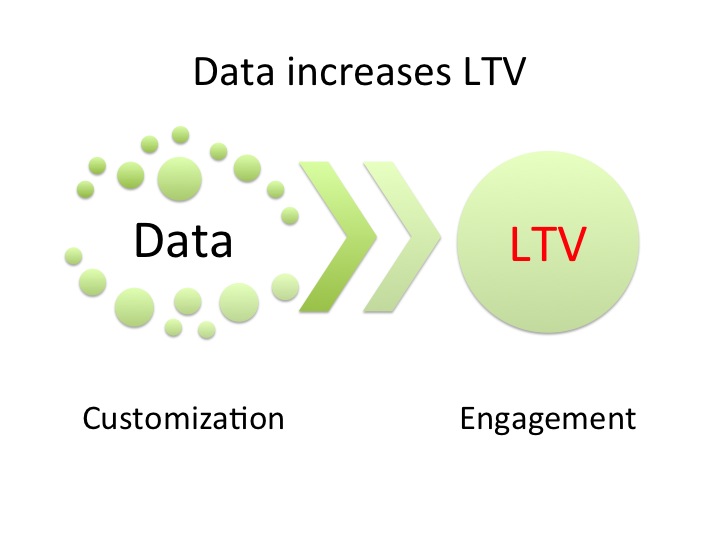
I recently came across a great post in Wired by Neil Capel about leveraging data to increase lifetime value. I have written many times about how lifetime value is the lifeblood of your business. A high lifetime value allows you to spend more on marketing and thus grow your business; low lifetime value makes it impossible to acquire new users. In Capel’s post, he outlines five ways you can leverage data to increase your lifetime value.

1: Use data to understand customer interests to create relevant content

Customers and players face an overwhelming amount of information and content. They are also not looking, and actively avoiding, advertising. What they want is information that is relevant to them. Customer’s interests and needs change constantly and you can tap into that inferred nature of the data to determine which elements of your content will be the most relatable and consumable to each user. Leveraging data you can determine which pieces of content an individual wants to interact with and then use that information to deliver automatically current and relevant content to that individual.
Slide1 Continue reading “Lifetime Value Part 15: Five ways to use data to improve customer lifetime value”

Lifetime Value Part 11: How to calculate LTV

Last year, I published a series of posts on the importance of knowing your users’ or players’ lifetime value, the key components and how to impact them and techniques to increase the accuracy of your customer lifetime value (LTV) predictions. I intentionally did not publish a formula for calculating LTV—while it is always a factor of retention, monetization and virality—as it is different by product and there are many alternative ways to get to an accurate customer lifetime value. Prompted by an infographic that I came across (see below) I did want to go into some details of the mechanics of calculating LTV.

The first step is to obtain your key variable metrics as averages across all users. The ones I prefer are ARPDAU (average revenue per daily active user), day 1 retention (how many people who use or install your website, app or game come back the next day), day 30 retention and k-score (how many free/organic users does a user bring in). Continue reading “Lifetime Value Part 11: How to calculate LTV”

How startups should use metrics

I recently came across a fantastic presentation on startup metrics by Andreas Klinger. It is embedded below but given its length I wanted to highlight the key takeaways:

  • The biggest risk for a startup is not failing to create a good product with a market; it is having a competitor come up with something a little better. Great example is Lyft, which I am sure is a little envious of Uber.
  • There are four stages for a startup to succeed. The first is discovery, generating the product idea. The second is validation, making sure the market wants the product. The third is efficiency, being able to supply the product cost effectively in quantity. Then there is scale, delivering the product to millions.
  • To look at it from the user perspective, there are two key elements: finding the product the market needs and then optimizing (the former encompassing discovery and validation, the latter representing efficiency and scale). To find a product the user needs, you need to understand these needs and create something that will be sticky (i.e., that they will return to) and viral (they will talk about). To optimize, you then need to build out the right revenue model and level, and then scale.
  • According to Klinger, 83 percent of startups are in the discovery phase (empathy, stickiness and virality) while most analytics are around revenue and scale.

    Andreas Klinger
  • A/B tests, funnels, referral optimization, etc., are about optimization, not innovation and cannot replace creating a great product that people want.
  • There is a way to get product insights from data to create that innovative product and you can do it with a much smaller number of users. They key is looking at whether people stay on your site or in your app, in other words, whether they are hooked.
  • Focusing on improving metrics creates a false positive, you can always improve ad conversions or funnels but what looks good for investors does not necessarily improve the product. You may be converting or funneling the wrong users.

Continue reading “How startups should use metrics”

Bayes Theorem Part 5: How it can help find the missing Malaysian Airlines jet

Over the last few weeks, I have been writing about and its applications. I just read a post on Nate Silver’s new blog, FiveThirtyEight. I recommend you read the post not only because it is interesting but to understand the breadth of applications of Bayes Rule.

Pushing the edge of machine learning

As part of a MOOC I just finished (Northwestern’s Content Strategy course, in which there was an interview with IBM’s SVP of the Watson Group, Mike Rhodin) that did a great job of showcasing the potential and future of machine learning. The Watson Group is probably most famous for developing the computer that won on Jeopardy! and it is now deploying that technology to push the boundaries of machine learning.

During the interview, Rhodin explained how Watson can read and understand text. As it can understand text, Watson can learn by reading or obtaining additional information that either will confirm or question a hypothesis. In the latter case, it can then seek out additional information to reach the most likely answer, including looking at historical research and results. It will then give a recommendation and confidence level based on all available information, with the supporting evidence and why the evidence is important. Watson will then analyze whether its recommendations were correct, learn from its mistakes, and effectively get smarter (e.g., why when it played Jeopardy! it got stronger as it completed a column).

Watson wins Jeopardy

Rhodin discussed how Watson is currently helping doctors make more accurate diagnoses. The doctor will tell Watson a patient’s symptoms (Watson can understand spoken English), then Watson will compare these symptoms with what it has read and what is in its knowledge base. It will then narrow down the possible causes and present that information to the doctor. Keep in mind that there is so much research being published daily (and even more historical research) that no doctor can stay on top of all of it. Once Watson has narrowed it down to a few possible causes, it will present these to the doctor with the evidence it generated. The doctor can either do their own research or it may trigger a memory of an article they read in the past. Watson has thus helped the doctor reach a diagnose faster, which often helps recovery rates and reduces treatment costs.

Continue reading “Pushing the edge of machine learning”