Skip to content

The Business of Social Games and Casino

How to succeed in the mobile game space by Lloyd Melnick

Category: Social Casino

The secrets to creating a top VIP (high roller) rewards initiative

The value of VIPs in social games and social casino is now a truism, everyone realizes that less than 0.5 percent of players drive more than 80 percent of revenue in most social casino games. Given this reality, an effective VIP scheme is a strong tool to convince customers to be more loyal and learn more about all of your customers’ preferences to personalize further your communication strategy.

This truth has driven many companies to create VIP programs and VIP concierge initiatives. I am proud to say I built one of the first at Zynga, but in the social space the are often haphazard and do not incorporate the learnings from other industries. Many companies create the programs with little insight into what makes a truly great VIP initiative.

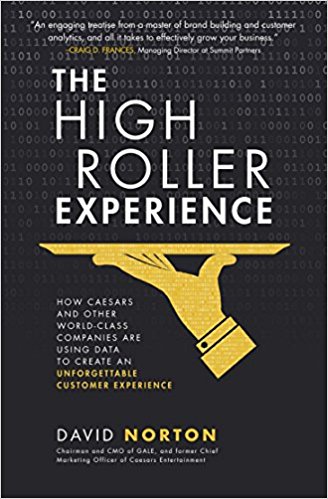
A new book from David Norton does a wonderful job of showing how to build a great rewards program (as well as other initiatives I will write about later), The High Roller Experience. Norton is the former CMO at Harrah’s (Caesars) and created its Total Rewards program, probably the most successful program in the casino space, so he knows what he is talking about.
High roller

While the value in building a rewards program is largely unquestioned, the challenge is underestimated. Norton points out that customers are on average in 18 loyalty programs, but only actively engage with about a third of them. This lack of use means that not only are companies wasting millions of dollars on programs by rewarding customers who do not value the rewards but actually incur a higher opportunity cost by not engaging many of their customers. These unengaged customers could potentially have a huge financial impact on the company. Norton points out several keys to building a successful loyalty program.

Make the currency bankable and under the customer’s control

A successful rewards program starts with bankable currency. The rewards system should create a currency that customers save up across multiple session, visits, applications, etc. and use however they want. For online and real money casinos, this currency represents a big shift, as compensation to high rollers is often subjective and disproportionally allocated to the most vocal customers. You should allocate a majority of your rewards/compensation budget to a points based program (Norton mentions Harrahs/Caesars put 80% of their $350 million budget to Total Rewards) that customers understand and control.

An effective program then allows customers to use the bankable currency the way they want to use it, so they get the most possible value (to them) out of the program. At Harrahs, the marketing around their Total Rewards program was “MORE”: more control for the customers, meaning they could use their comps for a broader variety of things than food— and could use them in more locations. To drive this point to customers, Harrahs supported the launch of the second iteration of Total Rewards with an advertising campaign that it called the 100 Million Reward Credit Giveaway with a broad set of prizes that were reflective of what was available in the program, including merchandise and experiences at its properties such as Jazz Fest in New Orleans or lift tickets at Heavenly in Lake Tahoe. This campaign showed all the different ways customers could potentially use their points.

Get customers engaged

If customers are not engaged with your loyalty program, nothing else matters. You can have the best loyalty program on paper, but you need to get your customers to engage. Given how many loyalty programs they are already members of; you must find ways to ensure they are interacting with yours. Harrah’s discovered that guest satisfaction with Total Rewards was much lower for those customers that had not yet redeemed any of their Reward Credits, the theory being that they had yet to have a positive experience with the program’s new currency.

To get customers more engaged and likely to redeem, you need to eliminate friction in the customer experience when customers interact with your loyalty program. Rather than having hurdles to redemption (which may save you funds in the short term), make the experience quick and easy. Also, promote as Harrah’s did the different rewards players can earn and notify those players who have outstanding points of the options they have. Get them to redeem and enjoy the benefits of your program.

Create multiple tiers

The next key to a successful loyalty program is multiple tiers. Tiers create aspiration and engender loyalty. Compelling tiers are a productive way to create aspiration from customers and have them give you more share of their spend.

With multiple tiers, you can maximize the return on rewards by providing the most to customers where you have the greatest opportunity to increase their lifetime value. Tiers must be meaningfully differentiated.; having meaningful differences in the benefits and services between tiers is critical.

The rewards spend also should be surgical, tied to incremental spend and behaviors, as opposed to programmatic, associated with purchases the customer would have given you anyway.

You also need to provide always aspirational tiers. People want to advance, make progress, so there must be a tier for them to strive for. Although you may not want to market the tier formally (you do not want to alienate other high tier players) but you do need to let your top customers know there is even a higher tier (possibly through your VIP hosts or targeted social media). I remember speaking to a VIP several years ago, one of our top spenders, and his biggest complaint was he was already on the highest tier so why keep playing (regardless of the fun in product and the benefits he was accruing).

Have aspirational levels

As just discussed, you should also ensure there are aspirational benefits in the highest tiers. These tiers provide benefits, experiences, and services that customers value, often more than points, and are a key part of successful loyalty programs. If developed properly, the cost to deliver differentiated benefits will not be directly correlated to the customer’s spend.

At Harrahs, one of the key changes they made to the Total Rewards program was adding the Seven Stars tier in mid-2004. According to Norton, “there were several reasons that led us to want to add a tier at the extreme high end of our customer distribution. First, we discovered that we were capturing only a 50 percent share from our Diamond customers, as many of them were trying to achieve the equivalent tier at a competitor much like a business traveler in some markets tries to achieve status in two airline programs to provide more choices to be upgraded when flying. We wanted to make the decision more difficult to try to attain a high status at a competitor. Second, we found that for our top 5,000 out of 10 million customers, there was significant revenue churn year to year at an individual level. That is one year a customer would spend $85,000 and the next $70,000. Given that this group was spending or losing $80,000 a year with us, a 20 + percent revenue drop from a quarter of them was significant. We realized that some of this drop was a matter of having less time or disposable income to gamble in a given year, but we also felt that a big reason for the variation year to year was that there was no transparent goal to attain.“ These reasons drove development of an ultra-exclusive tier for Harrah’s most valuable customers.

Differentiate service to loyal customers

The next key to a successful loyalty program is differentiating the services customers experience. If built properly, the perceived value of premium service is much higher than the actual cost of delivering the service. The additional revenue the special services creates will not be linear to the additional revenue it generates.

By providing unique and better services as customers move up tiers, your loyalty program will have a stronger impact. Norton points out “airline programs do this very well with their tier benefits such as early boarding, the chance to be upgraded, and shorter security lines that enhance the travel experience. A mix of service items and access to unique “priceless” experiences should be developed as part of a three- to four-tier program depending on the size and distribution of the database. “

There are several ways this can be achieved in games. You can provide players with early access or unique content, allow them to attend VIP experiences (visits to your office or special events) or even provide special badges.

Transparency is important

For the loyalty program to have its strongest impact, particularly driving customers to try to move up tiers, you need to be transparent. Let your customers check their status where and how they want to: online, on a mobile site or in an app. Wherever they see their status, also remind them of what they need to do to attain or retain a status, especially as the earning time frame approaches its end.

So is profitability

While it is important to be transparent, the key is to build a program that increases profitability. Norton points out that “While there is a need to have an earning process that is easily understood to members, points earning should be tied to profitability and, ideally, to incremental behavior even though it adds a level of complexity.” In the case of Harrah’s, customers earned points tied to how much profit (not simply revenue) they generated. If they played slot machines that had a lower return to player than other slots, they would earn more rewards for playing those slots.

This approach also allows you to drive behavior that in the long-term is strategically beneficial. If you are launching a new business or game, you can provide extra points for consuming the new product. This provides a more cost effective way of launching a new business or testing a new game.

While it is hard to convey to players how exactly they are earning points, Total Rewards overcame this problem by clearly showing players the rewards they had and what they just earned. The additional benefit from this approach is that players who are rewards driven learn what activity generates the most points and then focus on that activity. If the activity also generates the most profits, then that is exactly the outcome you want.

Downgrade status

Another hotly debated topic is whether you should downgrade status or if customers who earn a high status keep it for a lifetime. I have been in many “debates” about this point, with the argument for status being permanent being that you do not want to insult a top customer or give them a reason to move to a competitor (because their status has been downgraded). Norton, however, makes a compelling case that status should be earned on an annual basis.

First, the desire to maintain or increase status is compelling, and often drives the behavior you want at the end of the status period. Second, it separates customers who will spend at a low level regardless of whether there is a loyalty program, so you do not waste resources on rewarding players who do not value the rewards.

Start with less

When you are building and rolling out your rewards program, it is best to start with the minimum viable product. You can (and should) always add features and benefits but it is very challenging to take away something once you give it to a customer. Launch with a small number of meaningful components that you can execute and that customers can understand, but realize it is always better to add elements than it is to have to take them away.

Monitor and model rigorously

Loyalty programs can have a great impact on customer behavior but also a great cost. Successful programs require rigorous financial analysis that includes models of customer behavior. The key is to understand the incremental behavior the program generates against the costs of the program for each customer segment. The more granularity you build into the segmentation, the easier to optimize as you can discontinue rewards to segments where there is not a positive ROI, change the mix to segments where there is a low ROI and accelerate efforts where you see a strong ROI.

Innovate and iterate

You can always improve your reward program. Even if you do everything right at launch, your customers are unique and different elements of the program will resonate more with customers. You need to identify those elements and build off of that, as competitors will always be launching new loyalty initiatives to win over your customers. Even with Harrah’s Total Rewards, Norton writes, “despite our many accolades, we at Caesars never stopped evolving, testing, and tinkering with Total Rewards, making it great for customers, but also for us.“

Integrate rewards and CRM

The final, but possibly most important, key to a successful rewards program is integrating it with your CRM. Loyalty schemes and CRM should work together to drive optimal customer behavior. Tiers in loyalty programs provide the clear goals that encourage loyalty, and CRM activities give incentive in between the tier hurdles. Additionally, the loyalty program provides great insights into customer behavior. It shows you where they spend their time and what their aspirations are. You can then feed this information back into all of your CRM campaigns to ensure they have the greatest impact.

Do it, but do it right

To succeed today, you have to have a loyalty program and that needs to be your first priority. Just having one, however, does not ensure success. Most people are in many loyalty programs but only a few influence their behavior. For you to have a truly effective one and get a strong return from it, you need to follow the steps above.

Key takeaways

  1. Service benefits are an economical way to add real value. Creating compelling differentiated benefits and experiences is a very economical way to add value to a loyalty program and deepen relationships with customers.
  2. Successful loyalty programs require rigorous financial analysis that includes models of customer behavior so you can understand the incremental performance for each customer segment.
  3. Great loyalty programs are integrated with your CRM. Loyalty schemes and CRM should work together to drive optimal customer behavior.
Share this:

  • Click to share on Facebook (Opens in new window) Facebook
  • Click to share on LinkedIn (Opens in new window) LinkedIn
Like Loading...
Unknown's avatarAuthor Lloyd MelnickPosted on January 30, 2018January 14, 2018Categories General Social Games Business, General Tech Business, Lloyd's favorite posts, Social CasinoTags brand loyalty, David Norton, High Roller Experience, loyalty, vip, VIPs2 Comments on The secrets to creating a top VIP (high roller) rewards initiative

Why people gamble, and pay real money to play social casino games

When I accepted my first job in the social casino (free to play slot machines) space, I did not understand fully (or believe) why anyone would pay to play a casino game (slots, poker, bingo, etc.) if they could not win money. After all, people gambled to win money, or so I thought. It was, however, difficult to argue with the data that showed social casino consistently the most profitable genre in social and mobile gaming. Moreover, I also did not fully understand why people would spend real money for a virtual good (i.e. a virtual tractor) and assumed the two must be related.

Those questions prompted me to do research before starting my position in the social casino, which led to my blog post Why would anyone buy a virtual good? . The post also included information that people gamble for three reasons – economic, symbolic and pleasure-seeking – and only one of them was tied to making money.

Recently, I came across an article, Segmenting slot machine players: a factor-cluster analysis by Sandy Chen, Stowe Shoemaker and Dina Marie Zemke, that provides even more insight into why people would spend money on a social casino game. While the research was about real money slots players, it shows their motivations are often non-financial; that is they are not playing to make money.

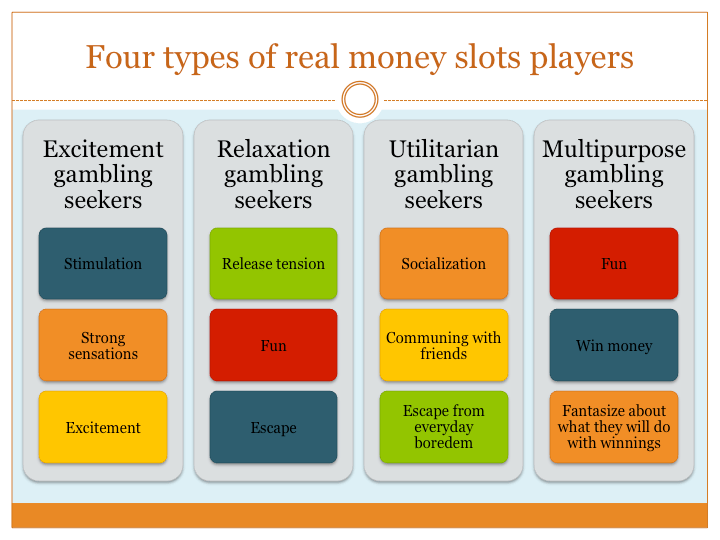
Chen, Shoemaker and Zemke segmented slots players into four clusters based on five sets of factors, and by looking at each cluster it provides a good understanding of the people who play and monetize on social slots products. The five factors are ego-driven, learning, relaxation, excitement and financial rewards. Based on how players ranked the various factors, the authors were able to create four distinct clusters that show different types of players. Below, I recap the four clusters, which you can then use to make your products and marketing better fit for your target customers.

Slide1

The “excitement gambling seekers” cluster

Players who are excitement gambling seekers are playing for the stimulation. Their primary motivation is the strong sensations they experience while playing, the positive memories from winning moments and the thrill of winning or losing. Excitement seekers were the largest cluster of slots players (27.5%) in the research.

The key takeaway about this cluster is they are not playing to win or make money, they are playing for the same reason someone rides a roller coaster, excitement.

The “relaxation gambling seekers” cluster

These customers are playing slots to escape. Their key motivation is to release tension and because the game is fun. They will often credit slots as the best way to relax completely. This cluster is more interested in the experience of playing rather than focusing on winning. This is has more men than women (51.5% to 49.5% respectively). 25.5 percent of slots players make up this cluster.

The key takeaway with this cluster is that they are playing largely for the same reason someone goes to the cinema or reads a book, to relax and escape. As with the excitement cluster, they are not looking for financial rewards.

The “utilitarian gambling seekers” cluster

These are players who play as a means of socialization, communing with friends or as an escape from everyday boredom. It is referred to as utilitarian because the purpose is functional (utilitarian) and players gamble to satisfy experiential motives. About 20 percent of the players sampled fell into this cluster (which was also the oldest group).

These players place little value in some of the features many social casinos focus on. They do not care about themes or progressive jackpots. One of their most important considerations is the minimum bet of the slot machines.

Earlier this month, I wrote about Robert Thaler’s work on behavioural economics, including his theory regarding mental accounting. Mental accounting is a psychological theory of how limited cognition affects spending, saving, and other household behavior. In particular, people group their expenditures into different categories (housing, food, clothes, etc.), with each category corresponding to a separate mental account. Each account has its own budget and its own separate reference point, which results in restricted movement between the accounts. When integrated with the research of Chen, Shoemaker and Zemke, mental accounting explains how people have a set sum to spend on slots and will chose the purchase that allows them to optimize use of those funds.

The “multipurpose gambling seekers” cluster

The multi-purpose cluster, as its name suggests, play for several reasons. Players in this cluster play because slots are fun but also because there is a good chance to win and it is in their budget. These are players who think (fantasize) about what they will do with their winnings and want to make a lot of money. These players normally do not care about themes around games. About 27 percent of slots players are in the multipurpose cluster.

The takeaway with this cluster is that it combines a desire to win money with the entertainment value of playing. These are the players who might seek a real money alternative when it is available but play free to play (social) slots if they are in a location where they do not have access to real money.

How men and women differ

One other interesting insight in this research is the difference between male and female slots players. Many female players were excitement gambling seekers or utilitarian gambling seekers, while male players were relaxation or multipurpose gambling seekers. Thus, if you target different genders, your messaging and promotions should apply to what they are more likely to find important.

Remember these are real money players

The most important takeaway from the above cluster analysis is that it was done with real money land based slots players, not social players. This is critical because even people gambling in the traditional sense are largely not gambling to make money but for excitement, relaxation, etc. Once their motivations are understood, it is obvious why people would spend to play slot machines where the real money opportunity does not exist. As the authors write, “American slot players were mainly motivated by hedonic and experiential motives…gambling is a type of recreation or entertainment in America.” Hence, why social casino is such a strong and growing genre.

Key takeaways

  1. Research shows that there are four types of slots players, with each group having different motivations.
  2. Three of the four groups are driven by non-economic reasons (excitement, relaxation, fun, etc.) to play slots, thus they get the same satisfaction from social casino products that they get from playing real money slots.
  3. Gambling is primarily recreation and entertainment in the US.

Share this:

  • Click to share on Facebook (Opens in new window) Facebook
  • Click to share on LinkedIn (Opens in new window) LinkedIn
Like Loading...
Unknown's avatarAuthor Lloyd MelnickPosted on January 23, 2018January 14, 2018Categories General Social Games Business, Growth, Lloyd's favorite posts, Social CasinoTags excitement, gambling, online gambling, real money online gambling, relaxation, slots, social casino6 Comments on Why people gamble, and pay real money to play social casino games

The good and the bad from Aristocrat’s 2017 acquisitions

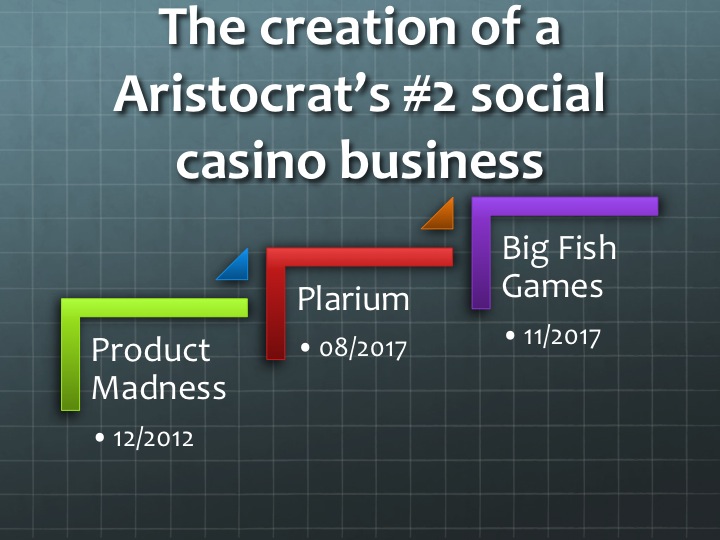
Last year, one company, Aristocrat, made two of the largest moves in the social casino space. In August, Aristocrat announced it was acquiring Plarium for $500 million. It followed up that transaction by acquiring Big Fish Games from Churchill Downs in November for almost $1 billion. While there were other deals in the space last year, these two showed Aristocrat’s intention to try to dominate the space. While one of these transactions was very savvy, the other is one they are likely to regret.

Slide1

I have been through many mergers and acquisitions, including several at the company that is probably the best at integrating new businesses, Disney, and there are two hallmarks to successful M&A (mergers and acquisition).

  1. The first key is that at least one of the parties adds value to the other party. The company that is being acquired could have a technology or expertise that makes the acquiring company more valuable. An example would be Google’s acquisition of DeepMind. Post acquisition, DeepMind was able to accelerate Google’s own AI efforts as well as potentially improve its search technology. The other type of benefit is where the acquiring company adds value to the company it acquires, either through tech, expertise or channels. An example here would be Disney’s acquisition of Marvel, where it used its superior film making skills to help Marvel separate its movie business from competitor DC Comics, owned by Warner Brothers.
  2. The second key to a successful acquisition is that the rationale is the combined business is more than the sum of its parts. An acquisition is not likely to generate long-term value if it is only meant to make a company bigger. If the number two company in a space buys the number three company it may become number one but that is not a real financial benefit (unless it paid below market price), the return on capital is likely to remain unchanged. Only if the combination makes the new entity more efficient does it generate a market return above a traditional investment.

As with all rules, there are exceptions. Private equity (PE) companies consistently have a strong return on investment by acquiring companies whose value can be increased by making them more efficient either organically or via combining them with other businesses. Even in these situations, however, the PE companies are actually adding value because they have an expertise in efficiency or an ability to acquire financing at a lower cost.

Looking through the lens of increasing value for one or both parties in an acquisition, it becomes much clearer where Aristocrat got it right and where it is likely to fail.

Big Fish Games

The Big Fish acquisition was a master stroke by Aristocrat. Big Fish, whose crown jewel is the Big Fish social casino app, has been one of the leaders in the social casino space for more than five years. In 2014, Churchill Downs acquired Big Fish for $885 million, hoping to grow the business even further. This was a case of not adding any value, however, as Big Fish did not boost Churchill’s core business and they were not able to help Big Fish grow.

Big Fish traditionally succeeded in the social casino space by layering true social features on a average to below average slots and casino product. The social features both kept core players engaged and drove high revenue from players, especially VIPs. Big Fish Casino was consistently in the top 5 percent of monetization, generating over $0.80 in ARPDAU, more than twice many of its competitors. Big Fish, however, has largely stagnated the last couple of years under Churchill’s ownership as other companies, such as Huuuge Games, have replicated the social features leaving Big Fish’s lower quality casino offering a liability.

Aristocrat, meanwhile, has grown from a major land-based slots developer to one of the top-five social casino companies. Combining its Product Madness social slots business (acquired in 2012) with their land based real money content, they have gone from an afterthought to a top social slots company. It’s Heart of Vegas title is consistently among the top-5 grossing title, often number one, and they dominate the world’s second largest social casino market, Australia.

By acquiring Big Fish, Aristocrat is likely to improve both the Big Fish business and its internal social casino efforts. Big Fish will benefit from access to Aristocrat’s land based slots content, eliminating its greatest weakness (mediocre slots). Big Fish should also gain market share in Australia, given Aristocrat’s dominant position there.

Conversely, Aristocrat will grow its core social business (Product Madness) by understanding how to bring the most valuable social features to social casino. These features have driven revenue for Big Fish (and competitors like Huuuge) but they are a challenge to implement. Big Fish’s expertise with social features is likely to improve the core Aristocrat social casino products.

Plarium

The Plarium story is not likely to have as happy an ending. While Plarium is a very competent mid-core game company (with great games like Vikings) and Aristocrat is a great social casino company, there are few areas they can help each other. Plarium’s games appeal to a younger, male demographic while Aristocrat’s social casino (and land based) products appeal to older (55+) women. This is an awful starting point for cooperation. Few of Plarium’s players are likely to be interested in social casino games, and those who do are even less likely to be VIPs. Conversely, a social slots player is not likely to be interested in a mid-core combat game. Additionally, the product features that work in a combat game like Vikings will not be transferable to the social casino business while Plarium will learn very little from Aristocrat’s product management.

The best case for Aristocrat is that Plarium continues to grow its revenue and contribution and proves to be a sound financial decision. I say best case as the acquisition needs to be compared to any other investment since it will not improve the core business. The reality is most acquisitions fail and as Aristocrat is not adding any value to Plarium; for it to have a positive ROI simply in financial terms they need to have seen a better value opportunity than anyone else. Given the cost of the acquisition, I would not bet on it.

The Future

2018 will bring more deals in the social casino space, it’s not a prediction but an extrapolation of the past eight years. The deals that will be successful long-term are the ones that are symbiotic, where one of both companies brings additional value to the combined entity.

Key takeaways


  • Successful mergers or acquisitions are ones where at least one of the companies also improves the other company, not simply adding together financial results.
  • Aristocrat’s acquisition of Big Fish is likely to be a successful acquisition, as Aristocrat can share its great real money slots content with Big Fish and Big Fish can provide its expertise in creating social features.
  • Aristocrat’s acquisition of Plarium is less likely to end up a success, as they have completely different player bases and there is little opportunity for cross over.


Share this:

  • Click to share on Facebook (Opens in new window) Facebook
  • Click to share on LinkedIn (Opens in new window) LinkedIn
Like Loading...
Unknown's avatarAuthor Lloyd MelnickPosted on January 16, 2018December 31, 2017Categories General Social Games Business, Social CasinoTags Aristocrat, Big Fish Games, Churchill Downs, Mergers and Acquisition, PlariumLeave a comment on The good and the bad from Aristocrat’s 2017 acquisitions

NOT predictions for 2018

This time of year always makes me chuckle at the arrogance of some but more the desire of others to accept proclamations of what the new year will bring. I am not a big fan of predictions. First, regardless of experts’ success or intelligence, there are too many variables to predict accurately what will happen in 2018. As much as I respect Bill Gates, Warren Buffett, Mary Meeker, etc., they cannot predict the future. If they could, they would even be wealthier (who has not played the mental game of what you would invest in if you could go back in time five years). It’s the same underlying reason why the best and brightest mutual fund managers cannot regularly beat the market indexes they are targeting.

Second, and a little more sinister, most people who claim to predict what will happen in 2018 are little more than fortune tellers you would meet at a State Fair (or social gaming conference). The predictions are generally broad enough that regardless of what happens next year they will be able to pull some “victories” from their predictions. It may be things as simple as bitcoin will have a volatile 2018 to there will be at least one major acquisition in the video gaming space; these are either broad enough that you can always claim victory or predictable by anyone who looks at the past trends. The point is, they are not providing any information that is actionable unless they get lucky. Again, if they were so visionary, they would act on it rather than talk about it.

So with that said, it is time for my predictions. Seriously, rather than predictions, I do feel it is helpful to look at trends that have gained momentum in 2017 and are likely to have a disproportionate impact in 2018.

The convergence of micro-segmentation, AI and machine learning to create extreme personalization

The most important trend that is gaining momentum is personalization. Various related technologies are allowing game and technology companies to optimize experiences for every individual. From Amazon showing you products you are most interested in to Supercell pairing you with a player whose gameplay style best complements yours, everyone will have an experience personal to them in ecommerce, gaming and pretty much anywhere in 2018.

Microsegmentation

Three related technologies are driving this personalization: micro-segmentation, artificial intelligence and machine learning. Micro-segmentation allows companies to create hundreds or thousands of different clusters of customers and then provides the best experience for each of these segments. One segment may be players who have monetized 3-6 months ago and continue to play but not spend and are more open to free offers than sales; micro-segmentation will help create offers to optimize their experience and make them more likely to spend. Another segment might also have spent at some time 3-6 months ago and remain active but these players are more likely to spend if encouraged to play at higher stakes. Micro-segmentation allows companies to create the best path for each player.

Machine learning allows for more and better micro-segmentation, as it automatically creates hundreds, thousands or millions of segments. And artificial intelligence then determines what to offer each micro-segment.

The key takeaway is that customers will get very personal experiences on the successful sites, apps and games in 2018. They will then come to expect experiences and offers tailored to their needs, directing their money to those that deliver.

Voice recognition

I wrote in 2016 about the increasing importance of voice recognitionand this is likely to accelerate in 2018. Providing directions verbally is much more natural and simpler than having to type them. While the technology is still largely a novelty, everyone uses Alexa or Siri but primarily to listen to music or set a timer, in 2018 voice recognition will become more integrated on how you use/consume technology. In particular, I see it becoming a central part of the social/mobile game user interface, it will be much easier to play a game by speaking to it rather than typing or navigating with a mouse.

Big change in social casino

I have been in the social casino space (online free to play slot, poker, etc) for almost five years and have seen it mature and continue to grow revenue but it is still largely the same as it was in 2012. The interface, gameplay mechanics even art have changed very little. Companies have gotten better at monetizing their players but the games have not evolved. Even land-based casinos look more different now than they did five years ago than social casinos do.

While I do not expect an entirely new gaming mechanic to surface, one or two companies will innovate and create a very different product that not only steals existing market share but also brings new customers into the market. There is enough money in social casino that new entrants will try to innovate to build a competitive position and the company(ies) that is able to create a new market space will be the next Playtika.

Devices and platforms will become less important

When I first entered the game space, one of the biggest determinants of success was anticipating what platforms (Playstation, X-box, DS, etc.) would become big, getting on them early and not getting tied to a dying platform. Platforms (iOS, Android, Kindle, etc.), however, are becoming increasingly less important. Tools and underlying technology are allowing the best content to be used regardless of device. This trend should accelerate and companies that spend the bulk of their time trying to optimize for the next big thing will lose out to companies looking to create the next great content.

Privacy

I am one of those people who never really cares about privacy settings, have not read a Terms & Conditions in my life before clicking continue, and never worry about sharing my personal information. I am, however, in the minority. More and more people are concerned about privacy and products that either ignore this fact or try to trick customers and players into sharing information they do not want to share will fail in 2018. Successful products will empower customers to share the information they want to share, which will be different by individual (see first point on personalization). This is also the area where Blockchain can have the greatest impact, even more so than the crypto-currency space.

Dual devices

Not a 2018 trend (or even a 2015 trend) but more of a 2018 fact of life. People virtually never use only one screen. It is not only using your phone or tablet while watching television. It is using your phone while on your tablet. Using your tablet while on your work computer. Watching television while on your phone. Giving Alexa directions while watching television. You get the idea.

Your games and applications need to be sensitive both to people not focusing 100 percent and also provide a good experience as the second device your customer is focused on using. You also need to understand the different use cases and allow people to consume your product in different cases, whether they are also watching TV or working on their computer.

Big players will enter free to play, and fail

Remember how I said the hallmark of a good fortune teller is to include in their predictions something that definitely will happen (ie. there will be a lot of vitriol on Facebook about politics), here is my prediction that will come true in 2018. At least one major multi-billion company not currently in free to play will enter the space either through a new venture or acquisition because it just seems so easy to make money selling virtual goods; and they will fail miserably. It’s happened every year since social gaming took off and will probably happen for the next ten years.

Other trends

I would love to know what trends you are seeing and how they will help shape 2018. Let me know your thoughts on what we will be writing about this time next year.

Key Takeaways

  1. Personalization will dominate 2018. Successful games, sites and retailers will provide a hyper-personal experience to all customers with a combination of machine learning, artificial intelligence and micro-segmentation.
  2. Voice recognition will go from the domain of Alexa and Siri to become a primary and powerful user interface for people playing games, shopping or doing virtually anything.
  3. The social casino space will experience a disruptive product that not only takes significant existing market share but brings new customers to the market.

Share this:

  • Click to share on Facebook (Opens in new window) Facebook
  • Click to share on LinkedIn (Opens in new window) LinkedIn
Like Loading...
Unknown's avatarAuthor Lloyd MelnickPosted on January 2, 2018December 30, 2017Categories General Social Games Business, General Tech Business, Machine Learning, Social CasinoTags alexa, artificial intelligence, Blockchain, Machine learning, micro-segmentation, privacy, social casino, Voice recognitionLeave a comment on NOT predictions for 2018

Neuromarketing and gaming

I recently finished a class on Coursera, An Introduction to Consumer Neuroscience & Neuromarketing, that gave some great insights applicable to gaming and the greater tech sector.

Neuromarketing is a very exciting new field that is driving business growth, think Big Data ten years ago. The course, taught by Neuromarketing pioneer Thomas Zoëga Ramsøy of the Copenhagen Business School, delves into neuroscience and how both small and large companies can use it. It leverages increasing understanding in how the brain works with the emergence of behavioral economics and data-driven marketing.

While marketing in the past largely relied on intuition, surveys and focus groups, neuromarketing starts by understanding how the brain functions and what parts of the brain drive different behavior. By understanding what parts of the brain drive emotion, motivation, etc., you can then create products and marketing campaign most likely to get customers to purchase.

While I am not the person to summarize how the brain works, below are some of the key learnings from Professor Ramsøy’s course and implications for the game industry.

Cognitive Load

The concept of cognitive load is critical to the success of many products, from games like slots to apps like Uber. Given the the human brain consumers 20 percent of the body’s energy but only is 2 percent of the body’s mass, it is important to understand that people will subconsciously work to reduce the amount of energy the brain is using.

Cognitive load is how much info people are processing at any one time. Cognitive load is tied to working memory, the more information in that short-term memory the higher the cognitive load. As cognitive load increases, consumers are less likely to make a purchasing decision.

The concept of cognitive load also confirms why UIUX is often better when simpler. A simple user experience minimizes cognitive load, thus not creating too much strain.

Implications

It is important to manage proactively consumers’ cognitive load. Giving consumers many choices increases their cognitive load, thus making them less likely to purchase. Thus, it is critical that rather than giving your customer 25 different packages they can buy, keep the purchasing decision simple.

While simpler is better is often considered the goal of UIUX, it often is abandoned so new features can be added. The reality is that simpler is more important than features and you need to build your products not as a tradeoff between the two but as something that focuses on minimizing customers cognitive load.

Uber is a great example of the success of this strategy. From a very simple interface to only a few options to not even letting customers think about tipping to not even having to worry about paying, using Uber requires very little thought. Yet this incredibly simple app has made Uber worth over $60 billion.

Not only is cognitive load important when creating the overall product but also the underlying mechanic in the product. People often question the enduring popularity of slot machines. There are, however, virtually no game mechanics that have lower cognitive load than slots. The slot mechanic provides entertainment without using too much energy. When creating other mechanics, it is critical to understand how much mental energy they will consume.

Search and attention

One of the most powerful applications of neuromarketing is related to search and what consumers select following the search process. Critically, there are two types of search, and each is driven by different parts of the brain.

First there is bottom-up search, which is largely unconscious. This is where a person comes across something and it grabs your attention. Certain receptors in eyes more receptive to things like contrast and density. The best example is when you are in a grocery store and you notice something you were not planning on buying. This type of search is generally driven by colors, shape and density. Consumers are likely to buy some that grabs their attention. As much of consumer behavior is unconscious,

The other type of search is top-down, which is primarily conscious. This is when somebody is searching for something in particular. You may again be in a grocery store and looking for eggs. You will focus your mental energy on thinking hard and finding what you need.

Implications

You need to design your UIUX based on what type of search your customers will be conducting. If they are conducting a top-down search, then you do not have to prioritize making it that visible. They will find it regardless. Conversely, if you want to engage your easier (get them to try a new feature or new content or have them think about monetizing), then you want to stand out during a bottom-up search.

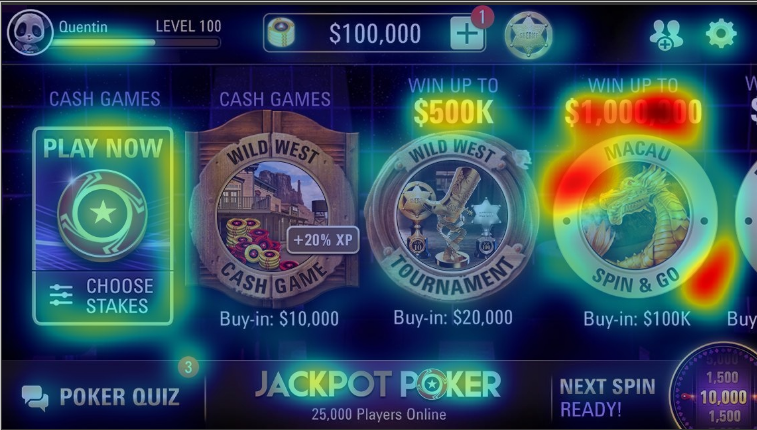
In this case, there are some great new tools for UIUX to optimize visual search results. Professor Ramsøy, who taught the course, has a commercial product called Neurovision. Neurovision allows you to put in an image of your game (in our case) and see what players will notice without the need of a fancy heat test, thus what will jump out in a bottom-up search (see example below):

Screen Shot 2017-03-19 at 4.39.45 PM

It is also often used by retailers (including Walmart and Home Depot) to understand what consumers will see while walking through their store, it can even analyze what people will notice during videos. Neurovision is one of a host of new products based on Neuroscience that help you scientifically improve your products rather than relying on anecdotal experience with a limited number of users.

Branding

The value of brands is often debated but neuromarketing shows the value of a brand. Brands impact how we perceive and enjoy a product and stimulate additional parts of the brain that the product would not normally impact.

As discussed with cognitive load, the brain uses a lot of energy and consumers are constantly looking at ways to minimize this energy usage. Brands help consumers save energy because when they see a brand they are familiar with, the branding fills in a lot of information that they do not have to then ascertain (quality, style, etc.). Thus, when deciding between a branded product and a brand they are not familiar with (or no brand) the branded product has an advantage as choosing it requires less energy.

While this analysis may not seem like neuromarketing, neuromarketing confirms it. When people who have been exposed to branding for a certain paint are then in the paint section of a hardware store, eye-tracking confirms that they spend more attention on products from brands they are aware of. This phenomenon then leads to a higher likelihood of purchase.

Branding also helps with search, particularly bottom up search. While a consumer focused on finding a specific product or specific feature set may not respond to branding, as they are doing a top-down search, someone who is browsing for a new product (say a new casino app), a familiar brand would make it more likely to gain a customer’s attention.

Finally, branding stimulates parts of the brain that then impact how consumers feel about a product. A strong brand will create positive emotions around a product even before the consumer evaluates the product.

Implications

Branding is not dead or useless in a performance marketing world. Strong brand can translate into a higher impact from your performance marketing, customers are more likely to click on your ads. They are also more likely to pick your product when searching organically for one.

Using Neuroscience

Neuroscience is a strong tool to help improve your product and marketing. By understanding how the brain processes information, you can tailor your product and marketing to optimize your chances for success.

Key takeaways

  1. Neuromarketing, based on neuroscience, uses understanding of the brain to drive product and marketing decisions, just as big data creates much higher returns.
  2. You can increase sales and satisfaction by minimizing cognitive load, how much your customer’s brain has to process navigating your app or store
  3. Your UIUX should account for whether your customer is conducint a top-down search (looking for something in particular) or bottom-up search where you want them to find something.

Share this:

  • Click to share on Facebook (Opens in new window) Facebook
  • Click to share on LinkedIn (Opens in new window) LinkedIn
Like Loading...
Unknown's avatarAuthor Lloyd MelnickPosted on March 22, 2017March 19, 2017Categories General Social Games Business, General Tech Business, Growth, Lloyd's favorite posts, Social Casino, Social Games MarketingTags cognitive load, neuromarketing, Product design, search, Thomas Zoëga Ramsøy, uiux1 Comment on Neuromarketing and gaming

How to create a valuable product or game

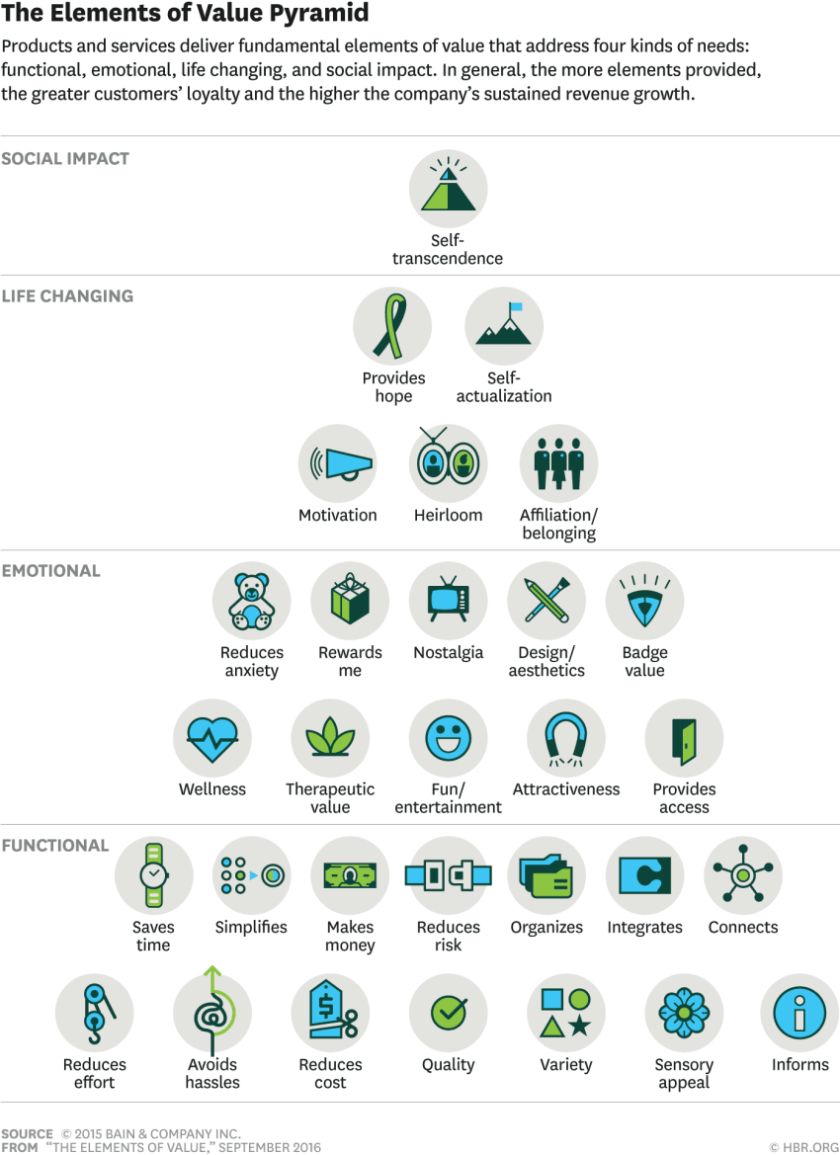
A colleague of mine recently used in a presentation a chart from a Harvard Business Review article and it was so helpful in defining a new product I wanted to share the concepts with everyone. In The Elements of Value by Eric Almquist, John Senior and Nicolas Block of Bain’s Strategy Practice, the authors discuss that while consumers evaluate a product by its perceived value versus cost, most marketers and executives focus on the price side of the equation. They attribute this focus largely to it being easier to manage price, as there are limited variables involved and it is easy to test.

It is more challenging to measure and optimize what customers truly value, whether functional (giving someone more capabilities) or emotional, because it is often a combination of multiple components. While value is always intrinsic to the customer (different people have a different value for the same attributes), the authors have identified universal building blocks of value to improve performance in current markets or enter new markets. Their analysis shows that the right combinations of these attributes leads to higher customer loyalty, greater willingness to try a brand and sustained revenue growth.

In the article, they have identified 30 elements of value (see below), fundamental attributes in their most essential and discrete forms. You can categorize these components in four buckets:

  • Functional
  • Emotional
  • Life-changing
  • Social impact
value-pyramid
From Harvard Business Review, Sept 2016

Some are inwardly focused, like motivation, while others help people deal with other or operate in the world, Not surprisingly, the Value Pyramid is related to Maslow’s Hierarchy of Needs. For those not familiar with Maslow’s work, Maslow’s hierarchy of needs is often portrayed in the shape of a pyramid with the largest, most fundamental levels of needs at the bottom and the need for self-actualization and self-transcendence at the top. The most fundamental and basic four layers of the pyramid contain what Maslow called “deficiency needs” or “d-needs”: esteem, friendship and love, security, and physical needs. If these “deficiency needs” are not met – with the exception of the most fundamental (physiological) need – there may not be a physical indication, but the individual will feel anxious and tense. Maslow’s theory suggests that the most basic level of needs must be met before the individual will strongly desire (or focus motivation upon) the secondary or higher level needs.

According the Almquist, Senior and Bloch, “the elements of value approach extends his insights by focusing on people as consumers—describing their behavior as it relates to products and services….The elements of value pyramid is a heuristic model—practical rather than theoretically perfect—in which the most powerful forms of value live at the top. To be able to deliver on those higher-order elements, a company must provide at least some of the functional elements required by a particular product category.”

Depending on your industry and product, the elements of value will vary. Some industries or geographies will focus more on basic elements, those near the bottom of the pyramid, while others will be focused higher.

Product lifecycle is critical

One area the authors did not explore that I think is critical is product lifecycle. Also, although not a feature of the article, an industry’s stage of development strongly impacts which elements will drive value for a consumer. In an emerging industry, consumers will be much more driven by the functional features. As an industry matures, you no longer will be able to compete on the functional elements but instead will need to move higher up the pyramid. Everyone in the industry will be providing the functional features, so you will have to deliver emotional value. Even there, your competitors will catch up and you will then have to deliver life changing or social impact attributes.

The social slots business is a great example of how the value pyramid has driven success. Five + years ago, companies experienced great success just by providing an online version of slot machines that people formerly only played in casinos. As long as you had a game that worked, priced it correctly (free to play) and made it simple to use, you had a ticket to print money. As the market became more mature, emotional attributes became the factor that generated success. Companies late to the market leap-frogged the Functional leaders by making the products nostalgic (classic slots by DGN or Rocket Games) or better design and more attractive (Hit It Rich by Zynga). As the market gets even more mature and competitive the companies that are experiencing success are those that are introducing life changing elements, primarily affiliation and belonging (such as Huuuge Games).

Using the elements to grow

An area where the elements can help you succeed is by improving on the elements that form your core value, so you can differentiate from the competition and better meet your customers’ needs. The elements can also help you grow your product’s value without overhauling your game or product.

Some companies use the elements to identify where customers see strengths and weaknesses. First, they look at which elements are important in their industry and how they compare with competitors. Then if there are any significant gaps, the priority is eliminating those gaps. Once the gaps are closed, you can then see what elements could create a new gap above your competitors.

Implementation

To leverage the elements model effectively, you should integrate it into several key areas of your business:

  1. New product development. The elements framework should provide ideas for new products and enhancements to existing products.
  2. Pricing. If you are looking to increase your prices, you can soften the blow of the increase by concurrently increasing the value your customer receives from your product. Amazon Prime is a great example, as the service started at $79.99 (I think) with frequent discounts and is now significantly higher but the free shipping is only a side thought, as you get everything from streaming services to special credit cards.
  3. Customer segmentation. Rather than only segmenting customers by demographic or behavioral group, you can use the elements to segment them by where they are deriving value. You can then focus on delivering more of the elements that these segments want or highlighting the elements that may exist but they are not aware of.

While adding value to increase competitive is not the most unique or newest idea, Almquist et. al., have created a framework to focus on creating the most value for your customers and knowing where to focus to increase that value. If you continue to deliver more value than your competitors, you will succeed.

Key takeaways

  • There are 30 core elements that drive the value a consumer derives from a product and the more they are willing to spend on the product
  • The values are hierarchical, similar to Maslow’s hierarchy of needs, and once a consumer gets the base value they will be more engaged by life changing or social impact elements.
  • The value you need to deliver is based on the life stage of the industry. Young industries are focused on functional value while you need to deliver higher level value to compete in a mature industry.

Share this:

  • Click to share on Facebook (Opens in new window) Facebook
  • Click to share on LinkedIn (Opens in new window) LinkedIn
Like Loading...
Unknown's avatarAuthor Lloyd MelnickPosted on March 8, 2017March 4, 2017Categories General Social Games Business, General Tech Business, Growth, Lloyd's favorite posts, Social Casino, Social Games MarketingTags Bain, elements of value, social casino, value1 Comment on How to create a valuable product or game

How motivation can improve the performance of social games

One of the best books I read last year was Payoff: The Hidden Logic that Shapes our Motivation by Dan Ariely and I wrote about how to apply some of Ariely’s idea to improving your team’s motivation. In addition to showing how to improve employee’s motivation, Ariely’s book also has lessons that can be applied to increasing the motivation of players to engage more with your game.

slide1

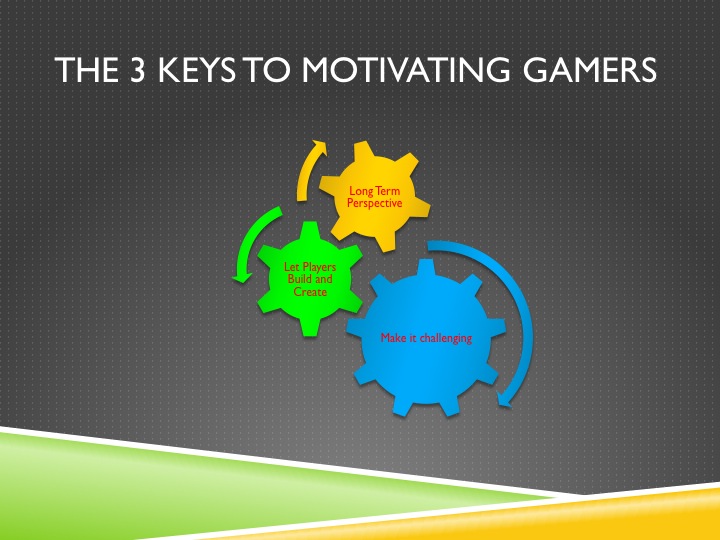
Make it challenging

The first insight is that people are often motivated to achieve things that are “difficult, challenging, and even painful.” Moreover, it they work harder and put in more effort, they enjoy a greater sense of ownership what they create and enjoy it more than if it is given to them.

Give people ownership

The second key to motivating players is to help them feel like owners of the content. In Ariely’s research, he had one group of people create origami creatures. He then offered to sell the origamis both to a group that was not involved in building them and to their creators. It turned out that the builders were willing to pay five times more for their handmade creations than the buyers were. As Ariely wrote, “our participants’ behavior clearly revealed that we are strongly motivated by identity, the need for recognition, a sense of accomplishment, and feeling of creation. “

The early invest express (invest your time and express yourself) games, such as Farmville and Hay Day, leveraged this motivation by allowing people to build their own farms. Since it was theirs, people would spend significant sums to keep and improve it. Even today, Clash of Clans and other games allow players to build their own forts or cities and this drives more engagement and monetization.

Create a long-term perspective

The final lesson from Ariely’s book is to create a long-term perspective. Rather than give people a one-time or short-term experience, players are most motivated if they have a long-term vision. Players would not bother putting a lot of energy into a short-term relationship, as Ariely writes, “whether with a romantic partner, employer, colleague, or apartment. But if you think of that relationship as a long-term investment, then you will be motivated to deposit more of your love, trust, energy, and time. This sense of investment is the basis of the marriage vow, and it is the basis of true dedication and loyalty….”

If you look at what turned social casino from a small niche part of the social game space to one of the largest is when they evolved from discrete slots experiences to a long-term meta-game where the goal was to continue unlocking content and progressing. This progression created a long-term perspective that motivates players to engage (and spend) more.

Another example would be the match-3 space. Bejeweled Blitz is a brilliant match-3 game. It is expertly designed for many exciting moments and perfect game balancing. Yet it never monetized as its creators had hoped (other than helping get the company sold to EA for about $1 billion). King entered the space with yet another match-3 game, Candy Crush Saga, but one that had a long-term goal, as you continuously wanted to progress. Candy Crush was able to transform an industry where customers were not motivated to spend to one of the most profitable in the mobile game space.

Motivation is critical

The better motivated your players, the more they will enjoy your game. The more they enjoy it, the more engaged they will be. And with engagement comes a successful product.

Key takeaways

  1. The first key to motivation is make it challenging.
  2. The second key to motivating players is to give them a sense of ownership.
  3. The final key to motivating players is give them a long-term perspective, not a one-off game play experience.

Share this:

  • Click to share on Facebook (Opens in new window) Facebook
  • Click to share on LinkedIn (Opens in new window) LinkedIn
Like Loading...
Unknown's avatarAuthor Lloyd MelnickPosted on January 11, 2017January 9, 2017Categories General Social Games Business, Social CasinoTags dan ariely, game design, motivationLeave a comment on How motivation can improve the performance of social games

Marketing social casino to millennials

Key takeaways

  • The key to marketing to millennials is that marketing alone won’t succeed. Millennials will not be influenced by great 1-to-many brand marketing.
  • Instead, you need to create more value, more entertainment for the money, than their alternatives (which are not only casino products, but any form of entertainment).
  • You also need to provide a simple, compelling experience across platforms, allowing your users to have a unifed experience wherever and whenever they want.

Marketing social casino to millennials

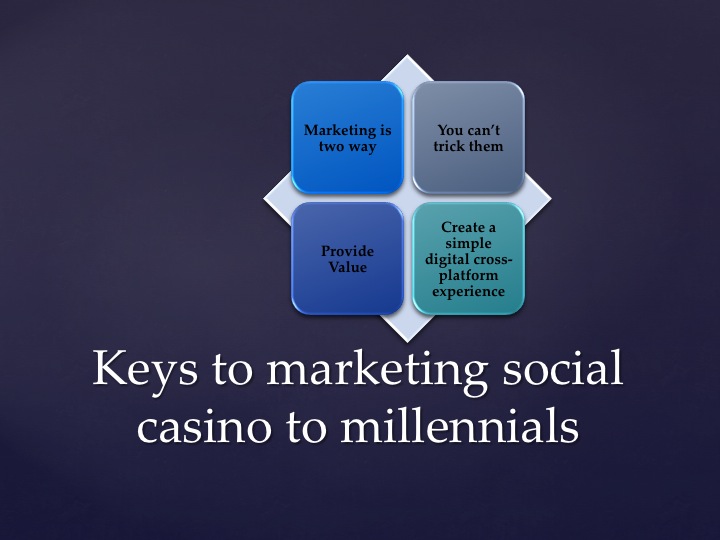
I am speaking next week at EiG on marketing to millennials and wanted to share the key lessons you can apply to create a social casino offering more competitive for millennials. This is an issue that has caused consternation in the land based and online casino space for the past several years, as younger people are less likely to participate in traditional casino gaming. Rather than wringing your hands about the situation, there are several keys to staying relevant with the millennial demographic:

  1. Marketing is two way. Rather than focus on delivering a message to potential millennial consumers, you need to build a conversation. One to many advertising is largely ignored by millennials, if they are even watching your ads on television or have not deployed ad-blocking software online, they are probably tuning out the advertising. Thus, to introduce potential customers to your product or game, you need to engage them in conversations. You can start the conversation on a blog or social media (Twitter, Facebook, Medium, etc.) but the key is to have conversations with as many potential customers as you can, not try to deliver a message to them. Engage with them, even when they do not agree or like what you are saying, continue the conversation while listening to your potential customers. You can only build relationships with millennials if you talk with them, not talk at them.
  2. You can’t trick them. Much marketing, especially promotions, has been centered around convincing people to do what they do not want to do or should not do. This strategy, a mistake with millennials, takes two directions. First is the traditional grocery store trick, 5 for the price of 4, to get consumers who only want to buy one or two of an item to buy more than they need. The second is promotions with such convoluted T&Cs that the user never sees the benefit of the promotion. While these tactics have traditionally worked, it fails dramatically with millennials. They are more sophisticated in understanding why a company is proposing a certain promotion and are cynical enough to dissect the promotion to understand its actual benefits. Moreover, they have information readily available (it’s called Google) to find the offers that will benefit them and not fall for the ones that only benefit the company making the offer.
  3. Provide value. Since promotion won’t drive usage, you need to provide more value to users than alternatives (which may be other casino games, but also eSports, television, etc). Thus, if they are going to spend $5 or $500 in your product, they need to get more entertainment value from that expenditure than they would from an alternative (and there are many alternatives). Thus, your pricing needs to be about delivering value, not by getting as much from the player as quickly as you can.
  4. Create a simple digital cross-platform experience. Marketing and product are not two separate silos with millennials. You need to build a product that will appeal to them as marketing expertise will not make up for a sub-optimal product. For millennials, the key is creating a product that works across platform, or is platform agnostic, so they can use it on their laptop, their smartphone, their tablet, whenever and however they want. The experience needs to be consistent across all of these platforms (don’t ask them to set up separate accounts). It also needs to be simple, they are not going to spend an hour learning how to play, or even 5 minutes, they need to be able to start using the product immediately and enjoy it immediately.

slide1

Only great experiences will succeed

The key to succeeding with millennials is providing them with a great experience, not a great marketing campaign. They will not respond to marketing that does not deliver value, but if you give them a better experience than their alternatives they will respond accordingly.

Share this:

  • Click to share on Facebook (Opens in new window) Facebook
  • Click to share on LinkedIn (Opens in new window) LinkedIn
Like Loading...
Unknown's avatarAuthor Lloyd MelnickPosted on October 12, 2016October 9, 2016Categories General Social Games Business, Growth, Social Casino, Social Games MarketingTags EiG, marketing, marketing strategy, MillenialsLeave a comment on Marketing social casino to millennials

Four trends in social casino

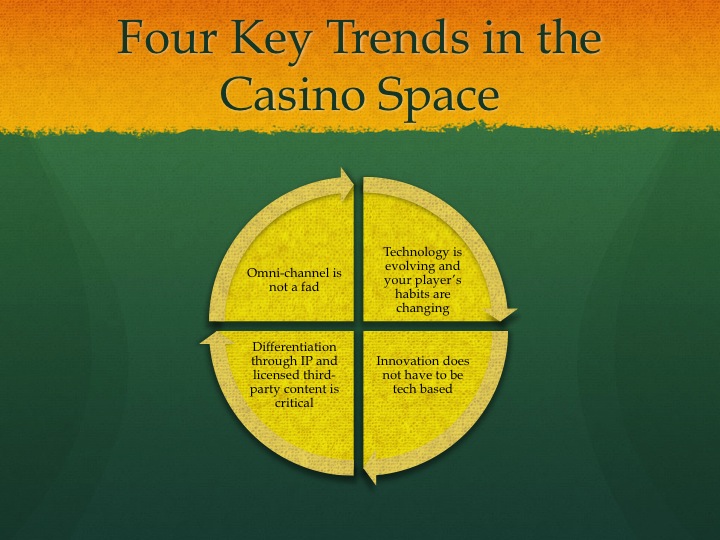
I recently came across a great article, The Top Ice Takeaways, by a former colleague of mine, Barry Cottle, that highlighted four key trends in the casino space. Barry has a unique perspective, involved in online real money, land based casino as well as the social space. He’s identified several trends that will impact all three businesses. The four trends, in what I consider the most important order for social casino businesses, are:

Slide1

  1. Technology is evolving and your player’s habits are changing.We live in an age where technology changes constantly. Several years ago, Blackberries and PDAs were at the edge of technology. Then users migrated to iPhones. Then the iPad and tablets became the primary way that people consumed mobile content. Now players are leaving tablets for phablets and larger devices. It is critical to stay at the front of these trends. You need to make sure your content is available not only on the new devices people are using but also optimize the experience for these devices.

    Barry uses the example of building casino apps now for portrait mode. He cites studies that show users are quickly moving to a portrait-only mentality that is driven by the speed of play ease of holding your phone in one hand while doing something else. The key is to understand how your players are consuming content and build your experience for that, rather than focusing on an old technology or any particular device.

  2. Innovation does not have to be tech based. I frequently discuss Clay Christensen’s theory on innovation and the key is to disrupt markets by addressing users who are not served by the existing companies. A key to this strategy is not simply creating a new product but building a new business model that better serves these customers. About ten years ago, the free-to-play model disrupted the video game industry rather than a cool new technology. The innovation can be in the promotions that you offer players, the partnerships you strike with IP holders or companies in adjacent casino spaces or even your on-boarding experience.
  3. Differentiation through IP and licensed third-party content is critical. IP allows companies to take a commoditized space and create a unique position. When Zynga launched HitItRich! slots in 2013, there were already many successful social casino titles. One problem in the space, however, was that players could play one title, use up their free chips, then play a competing product. HitItRich! pursued a strategy of integrating exclusive IP into its casino. It was the only place where you could play a Sex in the City or Wizard of Oz slot machines. This unique content allowed it to differentiate from other social casinos and be Zynga’s most successful new product in years. There is no reason that IP cannot have a similar impact on other parts of the casino space.
  4. Omni-channels is not a fad. As Barry points out, “in the mobile age of gaming, players expect a seamless crossover in both content and experience from land-based to online.” I would add that consumers also want a seamless experience from desktop to mobile and from real money online to social. They also want the same experience if they are in Des Moines or Tel Aviv. It is thus critical that you look at your offerings holistically and build the best experience for your customers.

Key takeaways

  • There are four key trends impacting the casino business, from social to real money online to land based.
  • One of the most important trends is that technology is continually evolving and it is critical to ensure your offering creates a great experience for how your customers are consuming content today, not last year.
  • Other trends include the importance of innovating your business practices as well as your products, differentiating your content through IP and providing a holistic experience between land-based, social and real money on-line.

Share this:

  • Click to share on Facebook (Opens in new window) Facebook
  • Click to share on LinkedIn (Opens in new window) LinkedIn
Like Loading...
Unknown's avatarAuthor Lloyd MelnickPosted on February 17, 2016February 13, 2016Categories General Social Games Business, Social Casino, Social Games MarketingTags Barry Cottle, innovation, licensing, omni-channel, Portrait modeLeave a comment on Four trends in social casino

You need a good game, not a feature

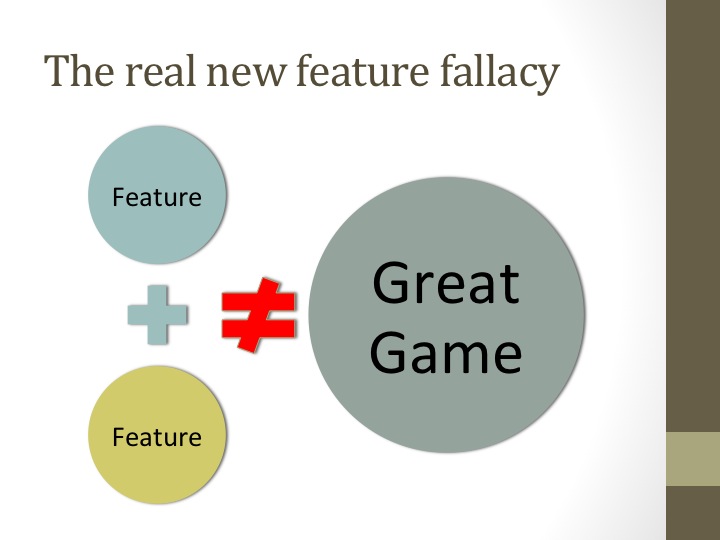
Last week, I summarized Andrew Chen’s “New Feature Fallacy,” which your new features need to touch players at the top of the funnel to improve your game. Several colleagues offered suggestion why the fallacy is a fallacy. In thinking further, the true fallacy is that any feature can fix a broken product.

Games are not a collection of features, there needs to be a core game loop that is fun. Then you can improve your LTV by building on that game loop, but if the loop does not exist there are no features that can help.

Slide1

You often see this problem in the free-to-play game space, where product management teams believe that successful products are a collection of features. Their roadmaps list each feature with the improvement in metrics it will generate. They then add up all of these improvements and come up with estimates that show how the game will generate millions of dollars. The company then invests because it wants to make millions of dollars (or investors buy shares in the company) and a year or so later they wonder why the game does not work.

Related, they look at each feature in a vacuum and AB test it. All of the features show positive improvement in metrics. The game, however, fails. A senior product who is probably the best PM I ever met once said to me it was curious how every AB test an unnamed game company we worked out had fantastic results, so good the PMs would create presentations so others in the company could copy them, yet the company’s revenue and user base continued to decline rather dramatically. Unfortunately, he was one of the few who found it “curious.” Continue reading “You need a good game, not a feature”

Like Loading...
Unknown's avatarAuthor Lloyd MelnickPosted on June 16, 2015April 5, 2021Categories General Social Games Business, Lloyd's favorite posts, Social CasinoTags core loop, feature, game design3 Comments on You need a good game, not a feature

Posts pagination

Previous page Page 1 … Page 4 Page 5 Page 6 Next page

Get my book on LTV

The definitive book on customer lifetime value, Understanding the Predictable, is now available in both print and Kindle formats on Amazon.

Understanding the Predictable delves into the world of Customer Lifetime Value (LTV), a metric that shows how much each customer is worth to your business. By understanding this metric, you can predict how changes to your product will impact the value of each customer. You will also learn how to apply this simple yet powerful method of predictive analytics to optimize your marketing and user acquisition.

For more information, click here

Follow The Business of Social Games and Casino on WordPress.com

Enter your email address to follow this blog and receive notifications of new posts by email.

Join 791 other subscribers

Most Recent Posts

  • Join me at PDMA Inspire for my talk on new product prioritization
  • Why keep studying?
  • The next three years of this blog
  • Interview with the CEO of Murka on the biggest growth opportunity in gaming, Barak David

Lloyd Melnick

This is Lloyd Melnick’s personal blog.  All views and opinions expressed on this website are mine alone and do not represent those of people, institutions or organizations that I may or may not be associated with in professional or personal capacity.

I am a serial builder of businesses (senior leadership on three exits worth over $700 million), successful in big (Disney, Stars Group/PokerStars, Zynga) and small companies (Merscom, Spooky Cool Labs) with over 20 years experience in the gaming and casino space.  Currently, I am the GM of VGW’s Chumba Casino and on the Board of Directors of Murka Games and Luckbox.

Topic Areas

  • Analytics (114)
  • Bayes' Theorem (8)
  • behavioral economics (8)
  • blue ocean strategy (14)
  • Crowdfunding (4)
  • DBA (2)
  • General Social Games Business (459)
  • General Tech Business (195)
  • Growth (88)
  • International Issues with Social Games (50)
  • Lloyd's favorite posts (101)
  • LTV (54)
  • Machine Learning (10)
  • Metaverse (1)
  • Mobile Platforms (37)
  • Prioritization (1)
  • Social Casino (52)
  • Social Games Marketing (105)
  • thinking fast and slow (5)
  • Uncategorized (33)

Social

  • View CasualGame’s profile on Facebook
  • View @lloydmelnick’s profile on Twitter
  • View lloydmelnick’s profile on LinkedIn

RSS

RSS Feed RSS - Posts

RSS Feed RSS - Comments

Categories

  • Analytics (114)
  • Bayes' Theorem (8)
  • behavioral economics (8)
  • blue ocean strategy (14)
  • Crowdfunding (4)
  • DBA (2)
  • General Social Games Business (459)
  • General Tech Business (195)
  • Growth (88)
  • International Issues with Social Games (50)
  • Lloyd's favorite posts (101)
  • LTV (54)
  • Machine Learning (10)
  • Metaverse (1)
  • Mobile Platforms (37)
  • Prioritization (1)
  • Social Casino (52)
  • Social Games Marketing (105)
  • thinking fast and slow (5)
  • Uncategorized (33)

Archives

  • September 2023
  • December 2021
  • July 2021
  • March 2021
  • February 2021
  • January 2021
  • December 2020
  • November 2020
  • October 2020
  • September 2020
  • August 2020
  • July 2020
  • June 2020
  • May 2020
  • April 2020
  • March 2020
  • February 2020
  • January 2020
  • November 2019
  • October 2019
  • September 2019
  • June 2019
  • May 2019
  • April 2019
  • March 2019
  • February 2019
  • January 2019
  • December 2018
  • June 2018
  • May 2018
  • April 2018
  • March 2018
  • February 2018
  • January 2018
  • December 2017
  • June 2017
  • May 2017
  • April 2017
  • March 2017
  • February 2017
  • January 2017
  • December 2016
  • November 2016
  • October 2016
  • September 2016
  • June 2016
  • May 2016
  • April 2016
  • March 2016
  • February 2016
  • January 2016
  • December 2015
  • November 2015
  • October 2015
  • September 2015
  • July 2015
  • June 2015
  • May 2015
  • April 2015
  • March 2015
  • February 2015
  • January 2015
  • December 2014
  • November 2014
  • October 2014
  • September 2014
  • August 2014
  • July 2014
  • June 2014
  • May 2014
  • April 2014
  • March 2014
  • February 2014
  • January 2014
  • December 2013
  • November 2013
  • October 2013
  • September 2013
  • August 2013
  • July 2013
  • June 2013
  • May 2013
  • April 2013
  • March 2013
  • February 2013
  • January 2013
  • December 2012
  • November 2012
  • October 2012
  • September 2012
  • August 2012
  • July 2012
  • June 2012
  • May 2012
  • April 2012
  • March 2012
  • February 2012
  • January 2012
  • December 2011
  • November 2011
  • October 2011
  • September 2011
  • August 2011
  • July 2011
  • June 2011
  • May 2011
  • December 2010
December 2025
S M T W T F S
 123456
78910111213
14151617181920
21222324252627
28293031  
« Sep    

by Lloyd Melnick

All posts by Lloyd Melnick unless specified otherwise
Google+

Enter your email address to subscribe to this blog and receive notifications of new posts by email.

Join 791 other subscribers
Follow Lloyd Melnick on Quora

RSS HBR Blog

  • How One Manufacturer Achieved Net Zero at Zero Cost
  • What Can U.S. Employers Do About Rising Healthcare Costs?
  • When You Have to Execute a Strategy You Disagree With
  • 4 Ways to Build Durable Relationships with Your Most Important Customers
  • What Jargon Says About Your Company Culture
  • Research: When Used Correctly, LLMs Can Unlock More Creative Ideas
  • Your New Role Requires Strategic Thinking…But You’re Stuck in the Weeds
  • For Circular Economy Innovation, Look to the Global South
  • Why Great Leaders Focus on the Details
  • Corporate Disclosure in the Age of AI

RSS Techcrunch

  • An error has occurred; the feed is probably down. Try again later.

RSS MIT Sloan Management Review Blog

  • AI Coding Tools: The Productivity Trap Most Companies Miss
  • How Procter & Gamble Uses AI to Unlock New Insights From Data
  • Rewire Organizational Knowledge With GenAI
  • Hungry for Learning: Wendy’s Will Croushorn
  • Beat Burnout: 10 Essential MIT SMR Reads
  • How Leaders Stay True to Themselves and Their Stakeholders
  • Our Guide to the Winter 2026 Issue
  • Broadening Future Perspectives at the Bank of England
  • A Faster Way to Build Future Scenarios
  • Assess What Is Certain in a Sea of Unknowns
The Business of Social Games and Casino Website Powered by WordPress.com.
  • Subscribe Subscribed
    • The Business of Social Games and Casino
    • Join 726 other subscribers
    • Already have a WordPress.com account? Log in now.
    • The Business of Social Games and Casino
    • Subscribe Subscribed
    • Sign up
    • Log in
    • Report this content
    • View site in Reader
    • Manage subscriptions
    • Collapse this bar
 

Loading Comments...
 

    %d